


sharpener
-
Posts
1492 -
Joined
-
Last visited
-
Days Won
1
Everything posted by sharpener
-
For clarification is this a bungalow? If not how is the upstairs heated? R290 (propane) is the latest refrigerant gas which some HPs use, it is more efficient but inflammable so there are restrictions on putting them near doors and windows. 55m^2 is quite small hence you will not need a twin-fan unit. So it will probably be lower than the window sill, which is OK (since propane is heavier than air) unless it is actually a doorway or there are open drains nearby. Plenty of good HPs about that are still using R32 which is non-flammable so does not have this issue.
-
1. Presumably a short return fence on the end of the house will screen the HP from the neighbour's window. 2. If it uses R290 check it is not too near the kitchen window 3. Could you run the primary pipework through the kitchen so the heat loss from it is inside the thermal envelope? N.b. I put up an expensive fence from Jacksons thinking it would see me out. But the posts rotted through in less than 10 years. I had a lot of trouble getting them replaced under warranty, it was a lot of extra work to put them in and the fence doesn't look the same. So don't pin a lot of hope on the 25yr warranty on their acoustic panels.
-
@JamesPa is your man for this. What have yr planners actually put in writing about what they require?
-
ASHP/UFH install issues and questions
sharpener replied to markharro's topic in Air Source Heat Pumps (ASHP)
Well for a start there are splits and gaps in several places, if water can penetrate it the insulation properties will be compromised. And although my install hasn't yet been done so I have nothing to compare with first hand it looks like ordinary indoor insulation to me, should be done with something like Primary Pro, maybe someone else will comment on that aspect. Even the old rubber Armaflex was better bc of its smooth outer surface. (My installer is proposing insulated pipe inside black PVC trunking.) What was the resolution to the warm water coming out of the cold tap? -
Might be a good idea to check the voltage drop. IIRC when I had 3.2 kW added to my second roof only 20m distant I got them to wire as two separate 4mm^2 strings to get voltage drop below the recommended 3%. Victron calculator here suggests 6mm^2, however it now seems to lack the volt drop calculation I remember using but other apps are available.
-
Surplus solar diverter + battery storage issue?
sharpener replied to lakelandfolk's topic in Photovoltaics (PV)
It's generally best to have a short mains cable and long CT cable as the latter is low voltage and will neither radiate nor pick up interference. I looked at their website and it seems a reasonable product (I built my own diverter and am familiar with some others). If it is working OK (and it sounds from your first post it is), nothing is overheating or causing radio interference then you could just leave it as it is. I would perhaps check if the transmitter will cope with the extra range, if not I would leave it be rather than bother extending its cable. Your choice. Bonne chance. -
Surplus solar diverter + battery storage issue?
sharpener replied to lakelandfolk's topic in Photovoltaics (PV)
The diverter probably supplies a chopped waveform very far from being a simple sine wave. So a multimeter will not average it correctly using the root-mean-square method unless it is an expensive "true rms" type. This also may explain why they specify a short cable run, to reduce the risk of radio interference from the chopped waveform. Also it can cause problems with screw connections, I have had to replace even a high grade (MK) fused spur box because of this, make sure they are all very tight. -
Contacting MCS will be as good as asking a chocolate teapot. Surprised your architect or PM can't suggest anyone or a way forward. Try and locate a Heat Geek near you https://www.heatgeek.com/find-a-heat-geek/. If you pay for their advice to fix the probs their report may also help a later case with MCS and/or RECC. Or start the Small Claims Court process against the original installer, it will show him you are serious and maybe sharpen his mind.
-
Thanks. Surprised Villavent don't offer as standard then. Will think about it again when we are about to run out of stock material. Availability has been a problem in the past but we have quite a lot atm. Have had a duff experience buying replacement filters online for the central unit, they came without the foam sealing tape round the periphery so then had to source that separately. And they are relatively expensive so prolonging the life with filters at the inlets is worth doing. Have no idea how restrictive the BAF wadding is, but it seems very easy to breathe through with no noticeable restriction, that's partly why we use two thicknesses in the bathrooms. But only one in the kitchen as the airborne grease spatter seems to coat the filter material which makes it better at capturing other particles. Overall am pleased with the results. Is less of a hassle than many other routine maintenance tasks e.g. replacing batteries in alarms and wireless TRVs which I always seem to be doing, they fail according to usage so a campaign once a year might still not be often enough for some.
-
DIY The kitchen has a 6 in self-closing fire register, this has a big lyre-shaped loop of temperature-sensitive Shape Memory Alloy above it so we tailor a disposable "hat" of bonded actate fibre to go over it, John Lewis sell a self-extinguishing grade in their uphostery materials dept. OH usually makes several at a time from a cardboard template. The bathroom registers are plain 4 in circular with an adjustable centre damper. We cut 4 in circles of BAF and use two thicknesses, discarding the dirty (lower) one and fitting the new one over the central adjusment screw on the clean (upper) side every 6 months. I usually remember to (a) turn off the system while I do this so stray stuff is not sucked upwards and (b) put a flexible duster (hamster-on-a-stick type) up the duct and back with a twisting motion but it's usually pretty clean anyway. Villavent instructions are to clean all the ductwork with a wet pull-through every ?5 years, didn't fancy having to do that, much of it is as you would expect rather inaccessible as the solar inverters and narrow roof trusses make the loft impassable in places.
-
ASHP/UFH install issues and questions
sharpener replied to markharro's topic in Air Source Heat Pumps (ASHP)
Not seen anything quite like this, but it doesn't look too unreasonable and have seen pix of a lot worse, it is perhaps his usual way so I would let it pass. Am I right in assuming they are flexi connections under the different shiny insulation? This at least puts them behind the HP itself which looks neater. The fittings also need to be insulated as well unless they are the antifreeze valves, and all the joints taped to prevent water ingress. I would get him to fault find fundamental probs like the hw to the cold tap, and simply try and make a snagging list of this minor kind of thing rather than keep pointing things out as he goes along. To add to previous list I would include Sort out BUS paperwork if applicable Register the warranty with the HP mfr inside their time limit for this -
ASHP/UFH install issues and questions
sharpener replied to markharro's topic in Air Source Heat Pumps (ASHP)
He should (under MCS guidelines) Set it up with Weather Compensation working Show you how to increase/decrease the heating curve in light of experience Agree a suitable setback temp and timing for your lifestyle Set DHW heating to a sensible schedule (at night if you are on a ToU tariff) not 24/7 Explain the user interface to you including all controls and indicators Give you a handover pack -
If the MVHR has an extract point in the kitchen put a filter pad in it. We change ours at least every six months and it is amazing what grease and crud it catches that would otherwise be deposited on the inside of the ducting and the HR heat exchanger. Ditto bathrooms to catch towel fluff. HX in central plant then stays squeaky clean, as it is in ceiling void over stairwell this reduces need for servicing off an extending ladder.
-
What company will tell you what size pipes, ASHP?
sharpener replied to CalvinHobbes's topic in Air Source Heat Pumps (ASHP)
10kW is massive for a modern house, maybe up to 400 sq m. This unit will actually produce 11.6 kW at -1C OAT and 45C flow so where did they get the 10.8 from? see the chart below. The 7kW unit will produce 9.25 kW under the same conditions so is spot on for your heat loss. This will make a big difference as the 10kW is really a dumbed down 12kW and is likewise a twin-fan unit so too big (in England) for deemed planning permission and needing a planning application. Do you really want the bedrooms to be at 18C, many ppl would find that uncomfortably hot. They have shown rad flow 45C return 35C. But the Vaillant HP will always produce 5C delta T so something is wrong here too. The schematic shows a buffer (why?) but only a single, UFH, heating circuit however there is a schedule for radiators as well. The parts list does show a VR71 wiring centre which you will defo need to control rads + UFH + DHW. It should appear on the schematic as item 12e but it is not there, confirming they have proposed the wrong schematic.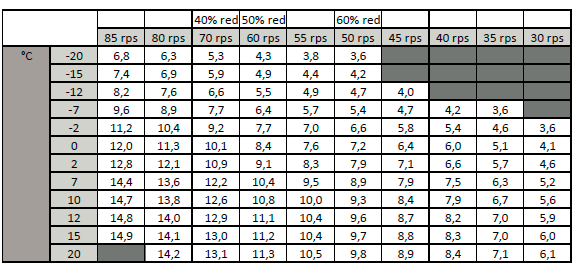
-
What company will tell you what size pipes, ASHP?
sharpener replied to CalvinHobbes's topic in Air Source Heat Pumps (ASHP)
Start with a proper heat loss calculation. Have you looked to see if there are any Heat Geeks in NI? If it is a new build does your architect or mech services designer not know someone who can do this? If you know the fabric/construction details you can download Heatpunk s/w free from Midsummer website and do it yourself. Pipe sizes should roughly be one size up on normal rad system design bc the low delta-T (typ 5 deg) means higher flow rates than in a boiler system, and certainly not microbore. I would not expect a plumbers merchant to have the faintest idea about correct HP sizing unless he happened to have a personal interest for some reason. -
What do you think of the passive smart thermostat?
sharpener replied to CalvinHobbes's topic in Air Source Heat Pumps (ASHP)
Sounds similar to Heatly. If it can set your HP's flow temp according to its algorithms well and good, but I doubt it is fully integrateable with the many different kinds that are out there, some with proprietary interfaces. If it can only serve as an on-off control or vary the start time then it is the very opposite of the ideal HP control strategy which is to run for the longest possible time at the lowest possible temp according to a WC curve. -
No, we need the existing standards properly enforced (as with cyclists). The unwritten deal in allowing the existence of monopolies has been (ever since the Guilds in the middle ages and the granting of Letters Patent by the crown) that the grantees enforce satisfactory standards amongst themselves. Unfortunately it seems to be difficult for affected customers to get redress from MCS or get sanctions applied to unsatisfactory installers. That is the process step that needs to be fixed, or the monopoly broken in which case market forces may take care of it.
-
Not bad for a daily newspaper. And the graph of cost vs SCOP on various tariffs is useful. Heat Engineer seems to use a default setting of 18 for bedrooms which is I think in MCS or CIBSE guidance (but 21 for bathrooms seems unnecessarily high). Even using 18 means we need 6 replacement radiators as per other thread. But contrary to what is implied the cost of rad replacement (~£2k) is not a big part of total bill. My running cost is predicted to breakeven with current oil boiler at an electricity price of 34p 24/7. But ToU tariffs such as E7 will reduce that somewhat and Cosy by more. So even with 50C flow temp and hence a (reduced) SCOP of 3.92 I am still expecting lower running cost, ?thanks in part to R290 refrigerant. However this alone would not give a sensible payback on the capital expenditure. Replacing the 25 y/o oil boiler is the justification here, it would be expensive as flue would allegedly need to be replaced also. Economics for a gas boiler just do not make sense without a significant increase in BUS grant, even supposing it would not be creamed off by MCS installers. So increasing the supply (and use) of other HP-trained ppl is perhaps the only way forward.
-
By chance a quick search for "second hand solar panels" turned up a load of my original Upsolar 230W ones that Bimble are offering. The later Longi all black ones are quite different, but inconspicuous on the slate roof. I might have preferred matching silver frames but had no choice other than to take what the installer had from stock. These people have a lot of s/h inverters of all kinds, including once again an exact match for my Steca inverters. Can't make up my mind whether to buy them as spares. Both of which suggest that it might not be too hard to find what you want.
-
Tell us the exact model of HP you have, someone else may have the same. Have you got the manual or looked on line for it? May be necessary but not sufficient! On Vaillants you also need to insert a special programming plug. Or perhaps the scheme under which you got it for free doesn't allow cooling for some bureaucratic reason so it has been disabled.
-
Maybe the key is to make it less hassle/a more attractive project for them. I can see that repanelling a roof is sthg they would not want to do, either they have to re-use the old rails that someone else put up years ago (?liability) or take them off and make good where the fixings were. This is where a jobbing roofer might be better. I think many will have experience of PV now and not be worried by the cabling. Also you are likely to get a better job of the weatherproofing. It seems a lot of work and expense to achieve a net increase of 2450W pk (and 750W of spare panels). And to benefit properly from the extra generation, as well as adding inverter capacity somehow I think you would also need storage. One alternative approach would be to leave the existing MCS-certified setup exactly as it is and just add the new 750W array (can you get any 400W size panels in the space you have?), combined with a small hybrid inverter and some of the money saved on panels spent on battery storage. This might make it a more attractive mini-project for an installer. The battery should pay for itself in <10 yrs through time-shifting. Then you would get a new MCS cert so can export on OO, and also be free of the apportionment hassle as you are not adding capacity to the existing FIT system.
-
If the capacity is already limited by the inverter rating what do you gain by adding more panels? Yes there is some advantage by over-panelling a bit wrt the inverter (20% is often suggested as optimal and my second set is a bit under 10%) bc you get more at the shoulder periods of the day and in winter. However I thought you were talking in terms of a lot more and if you are already over-panelled as you imply I don't quite see the benefit, can you share the numbers?
-
The new generation will be excluded by the "apportionment" process so you will not get FIT payments on it anyway. So if the original (MCS) installation is unchanged it is not clear why you would need MCS on the new one as it is not eligible for FITs. Perhaps you mean about registering with Octopus for their Outgoing tariff? I don't know if they would accept the certificate you already have, it would be some time before they worked out you are exporting more than its rated capacity if indeed you ever do. [For comparison my original installation could theoretically export about 4MWhr/yr but my actual export from both is in fact only 2.8 because of the self-consumption (which they cannot check) so the additional capacity would be undetectable.] The longstop position is their self-certification scheme which will cost you £250 plus the cost of a structural engineer's report on the roof. Edit: the above is a good reason to have different cos for your FIT payments and the export tariff. There is a central database though so get the export tariff set up before you add the capacity. BTW have you got your mind round my schematic yet <g>?
-
Thanks. I think the confusion is cleared up by these paras 4.5. Alternatively, FIT installation owners can decide to opt out of receiving FIT export payments and may seek to sell their exported electricity through a power purchase agreement (PPA) or similar commercial arrangements. 4.19. Where storage is co-located and it is not possible to identify whether the export meter measures export from the accredited FIT installation or another ineligible source, such as stored electricity imported from the grid or another generation source, the generator will not be entitled to export payments. However, generators of such installations may secure other revenue streams, such as a power purchase agreement (PPA) or similar commercial arrangements to continue receiving revenue from the electricity they are able to export. 4.20. Please note that most smart meters are not “bi-directional meters” under the definition we use here. This is because even though they are capable of measuring both import and export, they do not generate a net value. So if you opt out of deemed exports in favour of a PPA then technically they are no longer FIT export payments at all which is why they earn at the same rate as your non-FIT generation. And under a PPA e.g. Octopus Outgoing you are also allowed to arbitrage by selling them back power you have bought at a cheaper rate.
-
They are both eligible for export payments and at the same (generic) rate, that is why they can go through the same (smart) meter. Non-FIT PV is not eligible for FIT generation payments which is why it can't go through the TGM.

