sharpener
-
Posts
1492 -
Joined
-
Last visited
-
Days Won
1
Everything posted by sharpener
-
Samsung ASHP Compressor turning itself off
sharpener replied to Julian S's topic in Air Source Heat Pumps (ASHP)
Sounds plausible, IIRC Daikin HPs have a similar restriction, there is a minimum temp at which they will start, below that they do not in order to protect the compressor(!). -
Sorry to burst your bubble but the motor can only turn clockwise or anticlockwise, there is no Third Way! 3 of the wiring options give one and the other 3 the other as upthread. There is no more to be had, focus now on seeing if the Victron inverter behaviour has got any better.
-
It's been an enjoyable ride and am so pleased for you. Just glad we could all help, that's the power of BuildHub. If it now draws only 600W (don't quite understand why that might be but an added bonus) then maybe it will run without crashing your battery so much, keep us posted about that too.
-
No it does not matter. As others will be able to confirm all three windings on the motor will be identical. And all three outputs of the VFD are electrically equivalent to each other, except for a 120 degrees phase difference in the waveform (see Wikipedia article). So it makes no difference which is connected to what, there are six possible ways. However for 3 of the six the motor will run in one direction and for the other 3 in the other direction. Swapping any two wires - as @dpmiller also recommends - will change the direction. I was only joking, there is no danger to you, the VFD or the motor in trying it out.
-
If only it were that easy. Terminals are U, V, W. Wires are brown, grey, black (though not in that order). Go figure! I guess we will find out shortly, if @Hastings is still with us.
-
Yes swap the wires going to terminals marked V and W. Good luck!
-
See https://en.wikipedia.org/wiki/Three-phase_electric_power#Three-wire_and_four-wire_circuits for an explanation. In Italy and much of continental Europe they have 3 wires plus earth. Houses often have a 3 phase supply, which is 230V from one phase to another. There is no neutral, all three wires are live. Everyone else calls this delta after the shape of the Greek letter but the Italians seem to call this triangle. In the UK we have four wire plus earth three phase connections. Single phase to the typical house is 240V between one phase and the neutral. We call this star, the US calls it Y or wye. The phase to phase voltage is 415V (which will burn out your motor). Do not worry about any of this, I am convinced the motor is right for the VFD but may be running backwards. Do the test! Edit: Well Tom P as their UK agent knows this is what you are doing but it doesn't sound as though he has been able to come up with a solution.
-
And what if you want to add say a DIN rail meter to an existing board? AFAIK Eastron don't sell breakers or enclosures and Crabtree et al do not sell meters. Not readily available at trade counters anyway. BEAMA are not a regulatory body, they are the trade association with the specific task of protecting their own members' interests (I had a lot of dealings with them when I was at the DTI). So no-one is going to state that another's components are compatible even if that is manifestly the case. Crabtree probably wouldn't even tell you you can use their Loadstar accessories in a Starbreaker enclosure (but not the other way round). It's typical protectionist behaviour, though nowhere near as bad as battery drill manufacturers all having different incompatible batteries. /rant
-
Can't see any colour code for the connections mentioned in the VFD instructions, sounds as though it may be arbitrary. Is there a direction arrow on the body of the motor or pump? (I appreciate it is a packaged unit so may not be possible to see which way it is rotating.) Try swapping e.g. the brown and black at the terminal strip and see if it is any better. It is not likely to cause any harm for a short test run. I see you can also do this in the VFD software settings but personally I would swap the wires to be more confident that the test has actually been performed.

-
I think that is the power consumption of the pump on its own, not the pump/VFD combo. To first order, the flow rate will go down as the delivery head increases, as @SteamyTea implies the power into the water is the product of the two so might well remain relatively constant. Hydraulic output is delivery head in m * 9.81 * flow rate in l/s. Maximum output power will be at about half max flow rate, e.g. for the DAB 102 pictured above 3.5 * 9.81 * 0.6 so about 200W, these small jet pumps are not very efficient (you would not use them on an industrial scale or at Dinowig) and most of the rest is motor and impeller parasitic (drag) losses which are constant and independent of flow rate. Doubtful, you do not say the colours but I would certainly expect the earth to be green/yellow. Phase wires might be all brown (possibly numbered 1,2,3) or brown, grey, black, or something else. Have you disconnected the motor from the VFD and reconnected it? It is possible you have got two wires swapped and the motor is running backwards, it might still pump after a fashion even so. IIRC there is something about this in the VFD instructions, failing which swap any two of the phase wires with each other leaving the third as it is, see if it goes any better. Did they just test the pump or the pump/VFD combo? If you have exhausted all the above it is infuriating but in the interests of having a reliable water supply in a remote off-grid location may be better to cut your losses and install a small single phase pump either from the same or a different mfr depending on how you feel about them. Tom P might even be willing to give you a discount for persistence!
-
Yes, subject to them providing the functionality I need (and have discussed with his boss), which is to run the HP from the battery system not the incoming supply. So my favoured approach to the current issue is to put a 32A Type C mcb in the existing board, and then take a 4 sq mm cable to a sub-board with their Type B RCD, the meter and a 6A mcb for the control circuitry inside it. Avoids the need for any heavy gauge meter tails too. Will phone them tomorrow with this proposition. Yes, hence I have standardised on Starbreaker fittings, there are 3 sub-boards doing various things and it has allowed me to swap accessories as the system has evolved. I already have their 4 module mini CUs housing an MK two-module SPD, a two-module Eastron meter and a different single module meter, the busbar doesn't get in the way. Just checked, it will also take the entire innards from a Proteus garage unit dating from 1995, so I have high hopes it would accomodate this Proteus Type B RCD though £200 is a hell of a price. Personally I don't see the problem in assessing mechanical and electrical fit for myself, but the mfrs of course say they won't warrant this use, largely out of self-interest. Electricians are after all happy to use unbranded generic DIN enclosures, what is the difference?
-
Much confusion has been caused by the authorities allowing the use of the word "type" for two entirely different concepts For mcbs (miniature circuit breakers) and rcbos (residual current breakers with overload protection) the Type is the overload tripping characteristic, with the most widely stocked being Type B: immediate tripping on 3 to 5 times rated current (most domestic situations) and Type 😄 5 to 10 times (small motors and HPs). OTOH for rcds (residual current devices) the Type is the level of protection against DC fault currents with AC being the least and then A, F and B as per the diagram here. As noted above type F appear to be adequate for single phase VFDs, but don't seem to be specified by HP mfrs, even for models which do not come in a three-phase version.
-
On a early site visit the head of the firm agreed they would fit extra mcbs to my CU and this was echoed on drawings I sent them 6 weeks ago. He didn't mention anything about a Type B RCD then or at any other time. Better I suppose it comes to light now than when their electrician turns up the week after next with the wrong bits. It is not straight forward because (as previously explained to them) the HP has to be fed from the 50A battery inverter output. It can't just be teed off the meter tails with Henley blocks which seems the usual approach. I have also got a DIN rail mounted meter which needs to go in the circuit somewhere. I went through all this with the previous people (who failed to install before Easter as they had promised) and they didn't mention anything about a Type B RCD either. Perhaps some regulatory body has recently issued new guidance/reminder. The new meter goes on the rails and fits correctly through the aperture on the Crabtree Starbreaker CU, which was there in 2007 when we bought the house, maybe I have been lucky. Unfortunately they don't do a Type B which is odd because of their increasing use on EV charging point circuits. Agreed. If to Euro standards it should work off anything 230V +/- 10%. UK supplies are for historical reasons 230 +10% -6% so at the upper end. And I see 250V at some point most days so very close to the highest permissible voltage. Fortunately it is a stiff supply so my PV doesn't push it up noticeably.
-
Thanks, found it. It's a bit tautologous as it says "if these are stipulated for the installation site". Who does the stipulating? IMO this was drafted for the German market where the 3-phase model is more or less universal. In the UK on single phase I think a Type F would be adequate as per the link above. They are only 2/3 the price, though still over £100 e.g. this one (which is a standard 2 module DIN rail fixing so looks as though it could go in my existing CU, subject to my comparing the detailed dimensions).
-
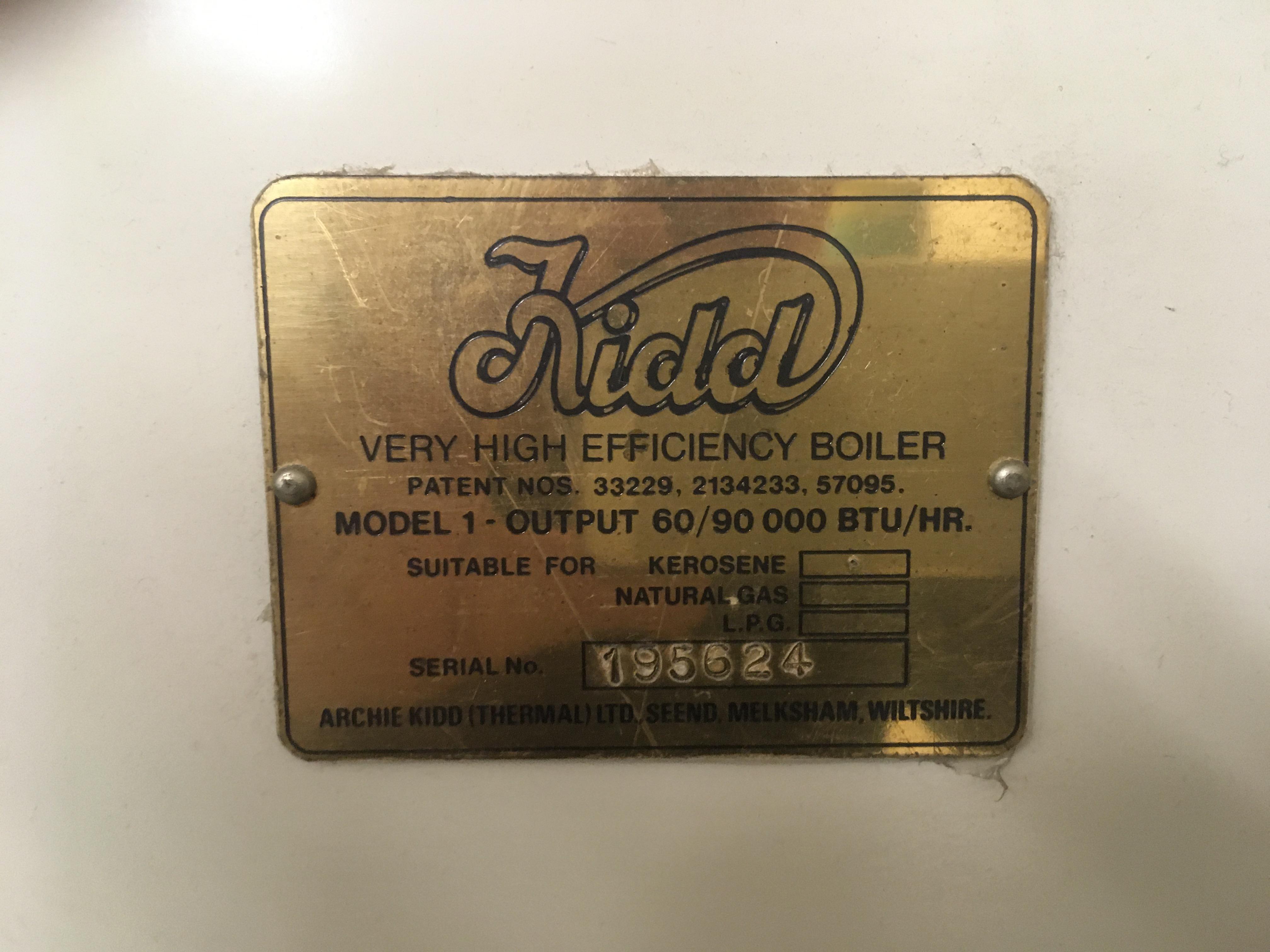
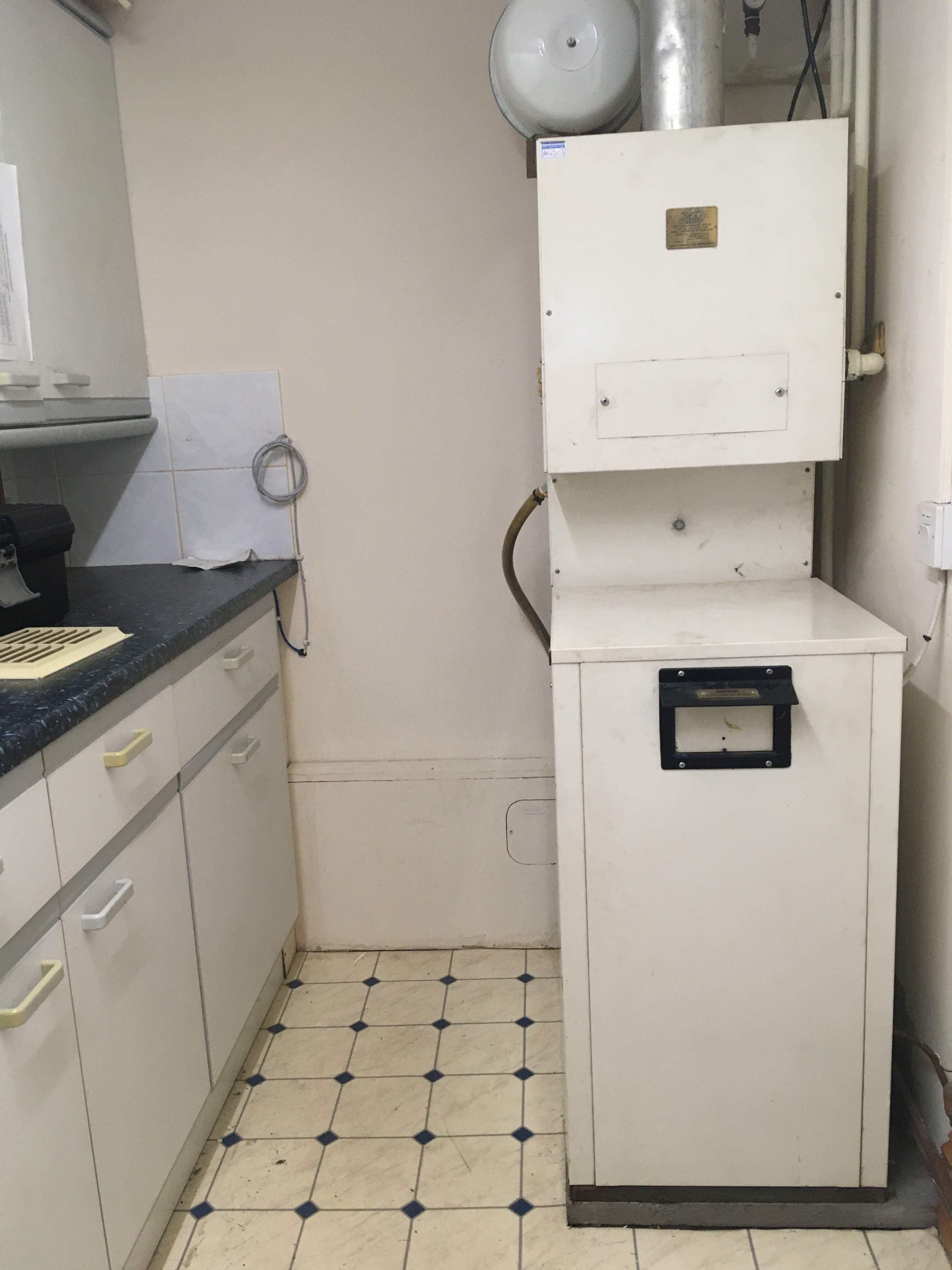
Anyone want spares for a Kidd boiler?
sharpener replied to sharpener's topic in Boilers & Hot Water Tanks
Ours is a Model 1 commissioned on 26/6/95, although many parts have been replaced over the years so are not that old. We are in the S Hams so within a reasonable distance from you. If you can let me know what parts you are interested in we can probably work out if they are compatible.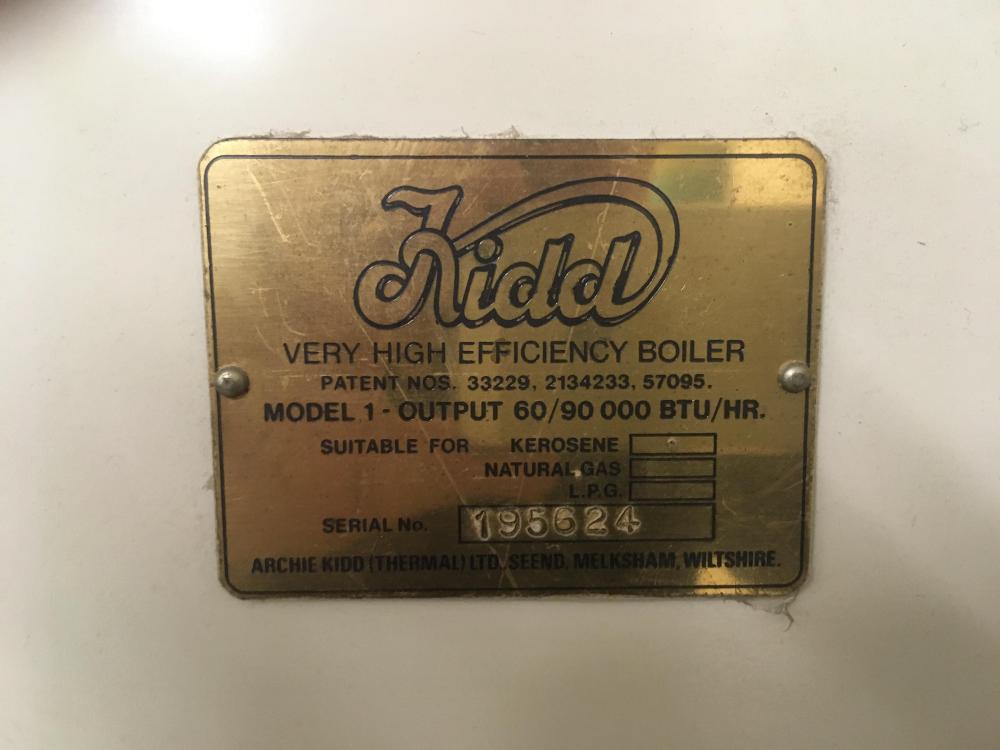
-
Have just been informed I need to have an additional CU with a Type B RCD for my upcoming Vaillant HP (Arotherm + 12kW). Previously I had been led to believe they would just fit 2 extra mcbs in my existing CU for which there are sufficient spare ways, but they now want to fit a subsidiary board instead. Has anyone else encountered this requirement? How important is it? Is Type B even the correct spec for a single-phase inverter-driven HP, this site suggests that a Type F is adequate and Type B is only requried for 3-phase drives.
-
Hi again @Hastings. The X-JE120BT does have a three-phase motor according to the FAQs here and this catalogue page, I think the T is the Italian for Trifasi. The fact that the space on the rating plate for capacitor size is blank is consistent with that bc it will not have a capacitor (but not conclusive, the Amps space is blank too). I am not sure what the Vc is, perhaps the voltage rating of the capacitor when one is fitted (single phase models only). What colour wires does it have? I would expect a 3-phase motor to have 4 cores, viz 3 phases and one earth. If you have a multimeter and it is not damaged you should get the same resistance reading between any two of its phase wires (three identical readings in all). I think the "230" on the rating plate confirms it is the T230 model which has the correct windings for a continental delta-connected 3-phase supply suitable for the VFD (see my queston upthread). So do not connect it to a UK star-connected 415V 3-phase supply or you will burn it out. I assume from yr use of the term static pressure you have tested it against a closed tap/no flow condition (although @JohnMo seems to think not). In which case (i) the pressure seems much lower than it should be (ii) I am surprised the pressure vessel makes much difference. If the combo does not perform properly on a decent mains supply then I think this at least partly exonerates your battery inverter system and calls into question the bench tests that your supplier has carried out. Did you get it from a distributor? Maybe it is time to contact Steelpumps direct. I had a brief email exchange with their technical director about filters and he was quick to respond (though it was not ultimately the right answer): Tom Parry Technical Director for and on behalf of 3P Technik UK Ltd - Water Management STORMWATER TREATMENT | RAINWATER HARVESTING | PUMPS & CONTROLLERS | GARDEN TANKS E: tomparry@3ptechnik.co.uk T: +44 (0)1239 623506 www.3ptechnik.co.uk ¦ www.steelpumps.co.uk ¦ www.mac3uk.com
-
Total cobblers as @JohnMo has said. What is he proposing to connect the second coil to, the Eddi or directly to the PV panels<g>? If a well-insulated house you will only need a (proportionately) small HP so why not do it right away? If not then I agree, small system boiler plus heat-pump ready unvented cylinder. Not too big, guidance is 45 litres x (number of bedrooms +1). Explanation of different heating control wiring options at https://flameport.com/electric/central_heating/heating_wiring_S_plan.cs4.
-
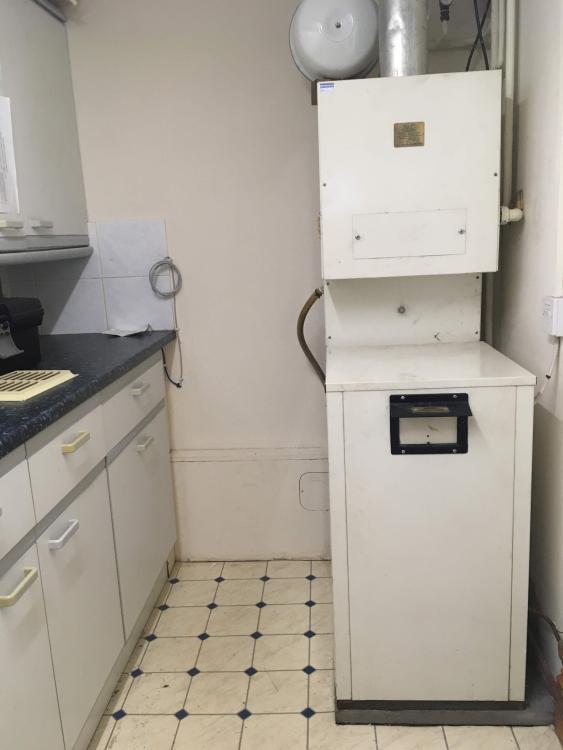
Anyone want spares for a Kidd boiler like this? Ours is going to be replaced shortly with a heat pump. It has a standard EDGB Inter 2011 burner so if anyone would like any parts for spares, the motor, control box, oil pump, photocell etc are all in good working order having been serviced regularly. Probably usable on many other boilers with the same or similar burner. Have already put on local FB and Freecycle but so far no takers. It seems a pity to scrap off a load of good working bits.
-
Could someone identify this controller please
sharpener replied to kandgmitchell's topic in Air Source Heat Pumps (ASHP)
Yes, VWZ AI. Is connected to the HP via the two-wire bus. Does the HP-specific stuff, the SensoComfort controller is generic for all Vaillant htg systems inc boilers and hybrid/mixed. The manuals are not very helpful for understanding but this FB forum is your friend. Just keep an eye on it, most common topics get a fresh airing once a week or so. Also lots of resources in the Files tab, manuals, performance graphs etc. Unless your installer is really expert you will after a short while be able to tweak the settings to suit your circumstances and get better perfomance/lower electricity bills. Record what it is currently set to first! There is also a SensoComfort simulator here which will allow you to play without changing your real settings. -
I wondered if there was any remaining value in the original paperwork, but between my installing the battery system and applying for a heat pump WPD had been taken over by NG and the process seems to have changed quite a bit. A phone call might swiftly elicit whether it can be re-submitted or you are better off starting again. Or you might be put on hold for 40 mins...
-
How would this help?
-
You can certainly do it yourself (I had no choice as the battery system was a self-install) but it is by no means straightforward so if the installers are willing I would leave it all to them, hopefully they deal with yr DNO all the time and know the wrinkles of the process. There are (or were) several different kinds of application possible, some fast-track and some not and the forms vary from one DNO to another so getting the correct advice is not easy. If nevertheless you are in a big hurry I would start with a call to yr DNO helpline and ask what they want rather than try and work it out from the web site.
-
Incorporating solar into modernist shallow pitch roof?
sharpener replied to flanagaj's topic in Photovoltaics (PV)
In that case give them a choice, either they give you permission for angled frames - which will cost extra and look dreadful - or allow you to have a normal pitched roof. PVGIS is your friend here as you can demonstrate to them how much generation you will sacrifice. -
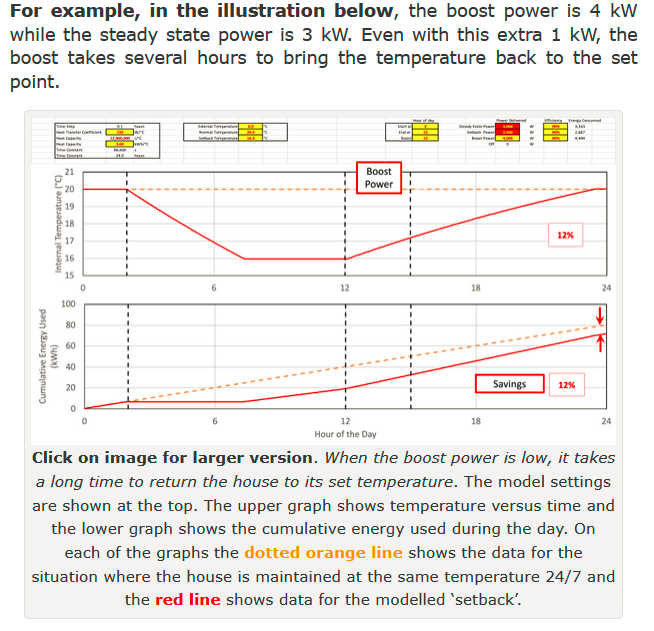
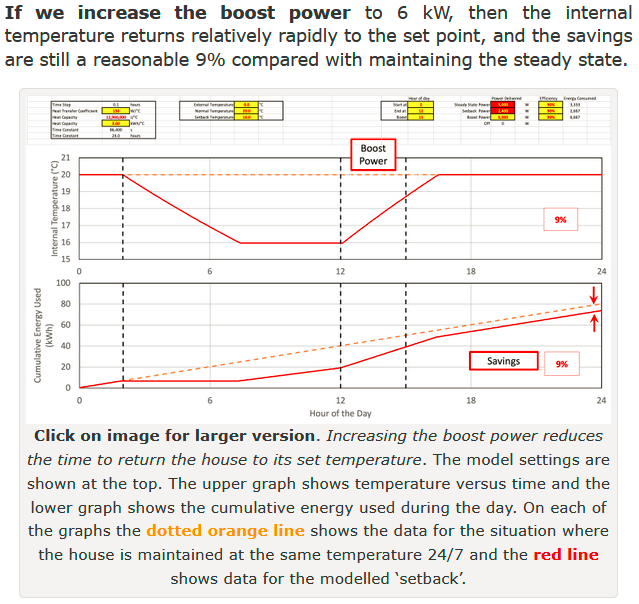
In the article linked to above Michael Podesta shows that without a boost phase you might save 12% but the recovery time is impossibly long. He suggests that you need 6kW boost power (where the steady-state is 3kW) to get a recovery time of 3 hrs and this reduces the savings to 9%. Also if the CoP falls from 3.0 to 2.5 then the savings are more than wiped out. Clearly if the OAT is such that you do not have 100% overcapacity to play with you cannot do this, and in the limit you dare not have any setback at all or you can never recover. Otherwise you will have to choose which rooms you can heat at any one time.