Crofter
-
Posts
3451 -
Joined
-
Last visited
-
Days Won
10
Everything posted by Crofter
-
It's absolutely fine. The engineered timber I-joists sit on hangers within the ring beam, and the bottom of them is flush with the bottom of the ring beam. But the osb is in the form of strips between each joist, and sits on the lower flange of the joists. So they are a couple of inches up from the lowest point of the building, and all they see is the very dry and well ventilated underfloor space.
-
Caravans Act nineteen-sixty-something. Less than 6m wide, 18m long, internal ceiling height of 3.048m or less, and demountable into up to two sections. It *can* be constructed on site, if it can be shown that it would be feasible to later move it. And the nature of being moveable lies within the building itself, so if it ends up boxed in by obstructions that prevent any real chance of ever removing it in one piece, that doesn't count against it. Edit to add- a flat pack approach doesn't qualify, unless the roof is a sort of 'module' that could be craned on and off in a single unit. The two-section limit means you can't make it up from a set of prefab panels.
-
My wee house is also built on a timber ring beam. I've put 9mm osb under the insulation, so that's what you see underneath the house. And being three feet off the ground ensures access by cat/terrier/alsatian/rentakill etc.
-

A few questions including the obligatory plastic vs copper
Crofter replied to Crofter's topic in General Plumbing
OK getting my head round this... Kitchen run I think is easy- a 15mm cold and a 15mm hot, the cold will have a tee off for the washing machine and dishwasher, then both end up at the sink. Bathroom is trickier. Looks like a dedicated hot and cold for the shower, the cold coming off the PRV on the tank. Then a separate pair of 10mm hot and cold, not balanced, feeding the basin and WC? -
A few questions including the obligatory plastic vs copper
Crofter replied to Crofter's topic in General Plumbing
I had wondered about noise, but was sure that fast flow in a small pipe would actually be worse? But I suppose it's the fill rate of the cistern that's the cuplrit really, not the noise in the pipe. -
A few questions including the obligatory plastic vs copper
Crofter replied to Crofter's topic in General Plumbing
Must be an easier way to fix it than knocking the whole house down! What's the advantage of 10mm by the way? Other than getting hot water to the basin slightly quicker. -
Ah Taytos... best washed down with a Smithwicks, personally. Well done!
-
A few questions including the obligatory plastic vs copper
Crofter replied to Crofter's topic in General Plumbing
So this whole balanced feed thing... Does the mixer shower need a dedicated cold supply? I hadn't realised or planned for that- it will be much easier to have the single cold feed as planned, so the WC and basin would tee off it. Will this cause problems? -
It's very little work/cost really to add a counterbatten. I think TRADA specify a minimum of 12.5mm, although I used 25mm. I had to do this because I had sarking so you really can't skip the counterbatten if you are going that route. Also in the back of my mind was my parents' house- sarking, tiles, no counterbatten = rotten battens where water cannot run off. For the sake of a few pounds worth of wood it is going to create an awful lot of work when they finally have to rip all the tiles off and replace the rotting battens.
-
A few questions including the obligatory plastic vs copper
Crofter replied to Crofter's topic in General Plumbing
Ah now that is useful info! I had been planning a simple system of a hot and cold run, everything just teeing off the cold- including the shower, which is the only mixer. I could run a second dedicated pipe run for the shower, tapped off the PRV- perhaps this is a good idea anyway? Any thoughts on leaving space for the shower unit, by the way? -
A few questions including the obligatory plastic vs copper
Crofter replied to Crofter's topic in General Plumbing
Ah but the cold system would not have a PRV... would it...? Mind you a quick peek at Google suggests I'm about 30m lower than the tank, so that makes three bar, I think. So sounds like a reasonable margin for safety. -
A few questions including the obligatory plastic vs copper
Crofter replied to Crofter's topic in General Plumbing
It appears that Hep2O is the gold standard when it comes to plastic stuff. I've got quite high water pressure and will be using a UVC so don't want to cut any corners. But presumably the other makes, like JG or Floplast, are all approved and should be perfectly up to the job? It would be interesting to hear if there any genuine reports of failure with the up to date versions of the cheaper systems. -
A few questions including the obligatory plastic vs copper
Crofter replied to Crofter's topic in General Plumbing
I did use push fit copper once, something about it seemed a bit too much like magic and somehow I trust a compression fitting more. Weird I know! So I'm not looking at plastic primarily from the persepctive of ease of use of the fittings, it is more to do with being able to 'cable' the pipe around awkward spaces. -
I'm reaching the stage where my vague ideas of where to put pipes ('over there somewhere') has to translate into actual plans and decisions. In my infinite* wisdom, I have already laid the floor and had just assumed that all the 15mm water pipes could run in the 25mm service cavity. Now that the wiring is going in, the remaining space is looking tight at certain points. I'm tempted to use plastic, at least in part, because I can reduce the number of fittings. And I've happily used it in the past. But the push-fit fittings are too bulky to hide within the service cavity, so can I just switch to copper for these? Or alternatively, seeing as all the fittings will be in cupboards, behind kitchen units etc, then just bring the plumbing out from behind the plasterboard. It seems if you google long enough, you can find every opinion available on the pros and cons of plastic and copper, and whether to stick to one system throughout or mix and match (plastic with copper fittings). And then of course there are the different brands of plastic system. In the past I have merrily used whatever was available and never had a problem, but that was always small changes and this is a whole house (albeit a very small one). A final question: the (TM) shower will be going on an external wall. Other than aesthetics, anything to consider? A concealed one would obviously look neater but require a bit of rework to make the space for it in the wall. Or I could bring the wall forward a bit with a plywood panel. *this may include infinitely small
-
Thanks all going to be bamboo flooring, just the 10mm stuff. Jury still out on whether to go with electric UFH which affects the FFL (side note- the UFH would be lovely but the depth of bedding compound needed means the whole thing is starting to look just too expensive). I have built whole partitions including doors etc before, in my previous house, so I know that I can do it, but I remember it being a bit fiddly and it's the kind of work that is very much 'on show'. With speed becoming more and more of the essence, I was thinking of contracting this bit out to someone who would probably do all three (!) doorways in a morning, compared to me taking a few days.
-
I'm building my internal stud partitions but will probably get a joiner to do the fiddly final fitting of doors, frames, architrave etc. So I just need to leave a space that will allow him (or her!) to do their thing. I guess this comes down to the sizes of timber that are generally used around the door frame- and obviously what size doors are used.
-
The future - from the land of Chernobyl
Crofter replied to MikeSharp01's topic in General Construction Issues
It does read like buzzword bingo. PH cert at 36m2, and with that much glass, is a really, really tough challenge. -
I'll have to spend a bit longer doing a more accurate calculation, but I reckon I've only got about 125m2 to do. This is assuming no skim required on thr bathroom walls or inside the cupboard. It really is quite a small house So if I can get a similar rate to Jeremy, the right side of £500. Probably worth it, but not in the budget. Will check behind the sofa.
-
I'm going to look into the cost of getting a skim coat done, although I might be urinating contrary to the air movement on that one- I don't think it's common practise up here. Just so I can budget for it, it wouod be interesting to hear what people have paid for this- PM if you prefer. Is a m2 price the standard,p? I'd imagine smaller rooms and vaulted ceilings (both of which I have!) would bump the cost up. If it turns out not to be too expensive, that probably means I can get slightly sloppier with my plasterboarding
-
I just used ordinary nail gun nails on my counterbattens, but I used long screws on the battens. This was because I wanted to fix right through to the stud, and you can feel whether a screw has bitten or not, plus a 90mm nail wouldn't have been long enough.
-
It never really occured to me to do it landscape. Don't you end up needing a lot more supports on the board joins?
-
Thanks Nick, makes perfect sense now. So a shorter joint with some added support, rather than a long joint that lines us with the battens. It will be easier to handle two square bits as well, rather than two long skinny ones. (Confession time- I already broke one board yesterday when I thought I could balance it on my head and carry it up a stepladder. Note to self, no you cannot).
-
Erm, not sure I'm following you on this one. How many bits am I cutting the board in to?? If I cut lengthways, then there is no 'top' and 'bottom' bit, just a left and right.
-
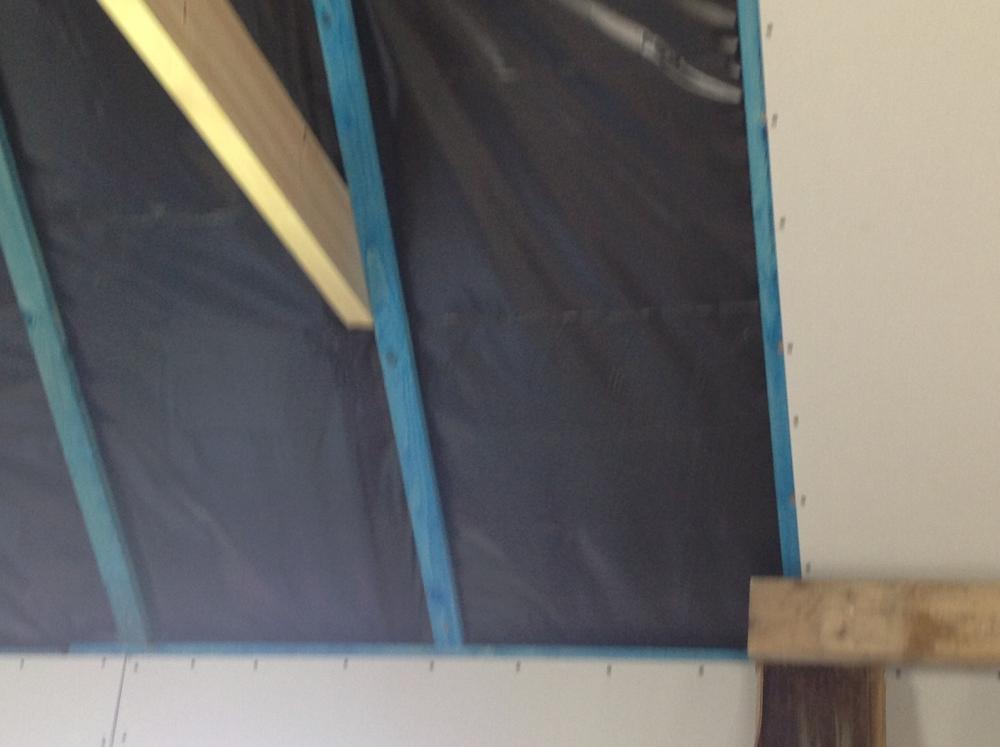
Here we go... the next bit of pb on the left has to be cut to fit round the beam... so vertically or horizontally? I have already planned the boarding of the ceiling so as to maximise the number of full boards, but there are three each side that clash with the beams.
-
Another wee question: On the vaulted ceiling, there are exposed beams that the boards will have to be cut around. In some places the beam is at the edge of the board and I will cut a small chunk out, all good, but other beams land smack bang in the middle of a board. So I presume my options are: - split a board longways up the middle, and fit it around the beam. Pros: no additional battens needed. Cons: full length cut edge joint. - split the board across its width and put one part above and one below the beam. Pros: shorter total joint length. Cons: Will need extra battens to support it What would you chaps do? And don't say "make sure the beams are all on 1200 centres", it's a bit late for that!