


MikeSharp01
-
Posts
5693 -
Joined
-
Last visited
-
Days Won
16
Everything posted by MikeSharp01
-
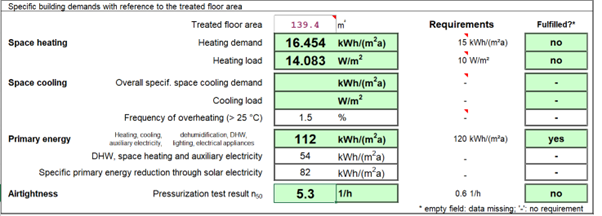
I think is a simple enough, as, if you could reduce the uncontrolled airtightness to 0 (zero) then any ventilation would all need to be controlled windows open or not. MVHR is a way of controlling the ventilation (MV) while recovering 90% (ish) of the heat in the air being expelled from the house to allow the house to breath. Airtightness as you say @SBMS is important. here are the figures from the PHPP for our build. First with the achieved air tightness of 0.2 (n50) And then as the Passive house worst case allowable of 0.6 (n50) And just for fun I set the figure the PH equivalent of the Building Regs figure. (0.2 n50 = 0.3 [From our certificate] of 8 m3/hr/m2 from Building Regs. So 8 /0.3 = 26.6666 => 26.6666 * .2 = 5.3333 which is what I entered – clearly at that point we would not have a passive house but see what it does to the Heating Load – almost doubles it. Heating load goes from 8.268 * 139 = 1149.25W to 1957.54W still only need small ASHP but hey I am saving all that energy and cost. I am not sure if I can wind the efficiency of the MVHR down to 0 and see what fully uncontrolled ventilation would cost - lets see, well the PHPP spreadsheet will work it out, but a little message says - 'please get a new designer', and the figure is 20.384W/m2 pops out. So 139 x 20.384 = 2833.38W
-
Yes BUT it depends somewhat on how you look at it. Assuming you need .5 ACH from all sources (Natural leakage + Controlled Ventilation) the smaller you make the Natural leakage with great air tightness and more of that controlled ventilation ACH you can get the MVHR to package the more you are saving. Looking at it this way it does not add to the losses, 0.5 ACH would be a total loss if all of it was natural, but does what it says on the tin and recovers a significant proportion of the heat embodied in that air thereby saving you money and the planet some energy. So, in that sense, it does not add to the losses you needed 0.5 ACH anyway it just recovers a chunk of the energy from it such that it will always be a saving just in the slightly different dimensions of money & energy.
-
The interval then - all hands on deck in the bar!
-
No neither was I which is why I deleted my post - you must be having a very fun packed evening if you sample BH so often you picked it up in the 2 minutes it was on the site. Just enjoy your evening and we will just imagine the fun you are having.
-
Yes but you live in the frozen North! The whole issue here is that the numbers don't add up / work out makes you wonder how good the spreadsheet they are using is.
-
-5.8 feels like a low number, where are you installing?
-
Possibly, I will get it dug out but probably not this side of XMAS, sorry @pudding - where are you we used the UKPN online assessment system and uploaded all the images and documents.
-

Finaly have our Completion certificate
MikeSharp01 replied to Buzz's topic in General Self Build & DIY Discussion
Brilliant - well done, no comes the VAT reclaim, the rerating by the Local Authority and lifetime of increasingly minor snagging! -
Welcome to THE forum for people like us - although, to be fair, I don't live on a boat! The thing about underfloor heating is that it is one of the oldest heating technologies, other than an open fire, being developed by the Romans - now if I know my Romans you can bet that some mad Caesar asked for a heated floor in their 'barge'!
-
We did not upgrade this was new build so a single application for everything, just need time to pull it all together and redact the private parts (See if Pocster reads this) so I can publish it.
-
OK so we got permission today to export a max of 6kW on a single phase, all we asked for - so good news. When I get time I will post everything I sent them, suitably redacted, to help others contemplating this route. Although ours is somewhat specific to UK power networks.
-
If you can work out the switch connections in the ceiling rose you can disconnect there and insert a test switch but only play if you have an earth leakage breaker in the consumer unit - if not leave it alone. (Just getting ready for the online harms bill don,'t you know!)
-
We can't rest on our laurels though we need an industrial strategy that aligns with exactly the products and systems you describe.
-
Welcome to THE forum for people like us - we are building in Kent!
-
Anybody and experience of FATMAX battery power tools
MikeSharp01 posted a topic in Tools & Equipment
Has anybody got any experience with FAXMAX battery power tools, Drill, Impact driver and angle grinder. My nephew is thinking of investing and he quite likes the look of them? -
Yes - we did a hydro test to 1200psi, the steam generator is not my build I am just doing the controls which is proving to be a big pain.
-
Yeh - me too, and I build steam locomotives - don't know why, although I am currently working on a flash steam plant for a car - right pain, so I guess I will have to get back into thermo to get it working reliably - how much energy have I got in 3 litres of steam at 600PSI contained in 20m of steel tube at an average of 400degC I wonder.
-
Yes - were within 5% of the official test a few days later.
-
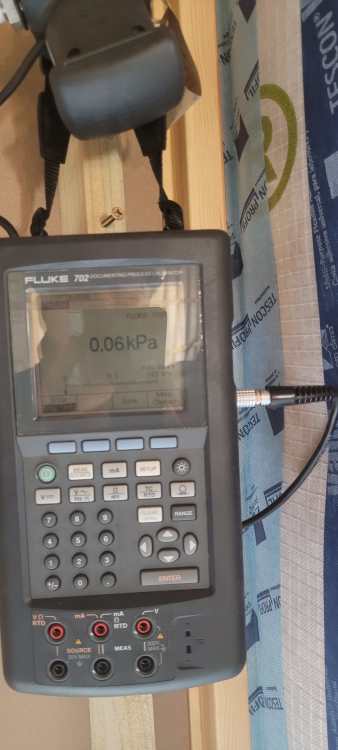
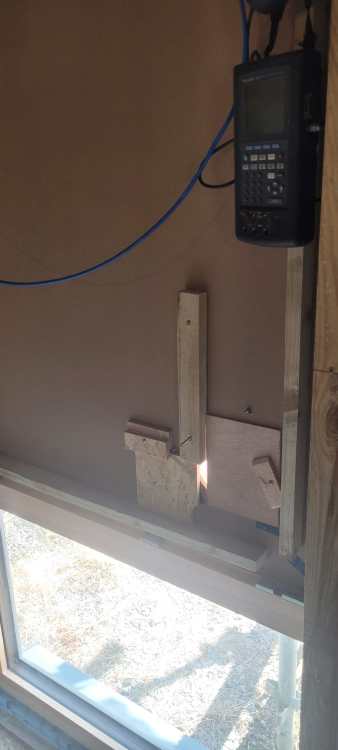
We did the same but I used a variable speed dust extraction unit and even on the slowest speed I had to restrict the hole so much to get it to hold the pressure.
-
That's is an awful lot of pressure. 1.5psi = 6000 Pa = 120 x the passive house test pressure = massive load on a door (3000lb @ 72inch x 33inch x 1.5lb)
-
Because you have to fill all the voids. If you have flat timber frames it is easy but then you have massive cold bridges on the outside. We have I joists so the void is odd shaped - don't know what you are considering. Filling cavities is easy, just drop the batts in as you go.
-
The fitting won't be easy, we had it as an option but chose the blown cellulose in the end. Although there are some places we used it because the space was too small for blowing.
-
I think there are quite a few in that range. Mineral wool: 0.030–0.040 W/m²K Expanded polystyrene: 0.030–0.038 W/m²K Extruded polystyrene: 0.028–0.038 W/m²K Polyisocyanurate (PIR) and polyurethane (PUR) foam: 0.022–0.028 W/m²K Cellulose fiber: 0.04–0.05 W/m²K
-
Door cill detail for MBC passiv raft foundation
MikeSharp01 replied to RedRhino's topic in Timber Frame
We just used it where we needed the load bearing capacity, everywhere else we used PU or EPS100 if we could not get the right PU section. Cutting compacfoam is hard. They say you cannot cut it with a circular saw - I say you can't! I did find my hot wire did it on full power going slowley. -
Door cill detail for MBC passiv raft foundation
MikeSharp01 replied to RedRhino's topic in Timber Frame
We used a structural polystyrene from Green Building Store. Compacfoam




