

Iceverge
-
Posts
4485 -
Joined
-
Last visited
-
Days Won
32
Everything posted by Iceverge
-
@SteamyTea has been sniffing foam for many years. Perhaps he can chip in.
-
Walltite and Technitherm are brands that have/had a BBA cert from memory. Not cheap but a vastly superior idea to dismantling your house.
-
Has my suggestion of closed cell foam to expand and put the boards tight to the inner leaf been lost in the ether?
-
Nonsense. Confusing vapour driven moisture with moisture carried by crap airtightness as usual. Drafts carry often thousands of more undesirable moisture into the wall than vapour diffusion. If you put a cracker Airtightness layer somewhere/anywhere then you'll be fine. Which diagram are you thinking about? No issue with moving the airtighess layer in board. Will it not be very tricky to detail around the roof structure though?
-

MVHR ? Who needs it? I don't.
Iceverge replied to ToughButterCup's topic in Mechanical Ventilation with Heat Recovery (MVHR)
It's entirely possible that MVHR isn't the optimum solution for you. I'm going to make some wild (and inflammatory😈) assumptions here. You are a couple of 900 year old geriatrics rattling around in a huge house. 100m2 plus each to allow your dusty farts to dilute hugely and waft harmlessly into the curtains. You prefer to take a long sedentary steam free bath for your "bones" rather than a rapid steamy shower like those of us who have actual work to do. As you were born in the 1800's you still follow the daily routine of opening every window in the house just like your childhood chambermaid used to do to dispel the "pot gasses". You enjoy burning lumps of timber almost as much as you treasure the opinion pages of the Daily mail and mid afternoon TV with reruns of 1960's dramas. You suspiciously view an MVHR unit as "too good to be true" and treat it accordingly and think a much more decent, and honourable thing to do, is pay old fashioned British Gas an honest wage and not to cheat the system. You have lots of lots of Sterling silver and Kruger Rand still buried under the bed from when you were forced to sell the last of your slavery bonds by the "WOKE" government. Spending another token or two on the boiler churning through some of Putins gas isn't going to make a dent in the intergenerational wealth. You asked........I poked.............. ( actually that reminds me of my first GF.....)
- 50 replies
-
- 18
-

-

-

-
Firstly poorly aligned and plumbed walls are not acceptable. Thats just sloppy but it's easy to see what went wrong ang how it can be cured. Otherwise lets look at the reasons for the condensation. Pictures please. Before after and during install. 1. Details of this sealing around the board edges that is supposed to have happened ( I'm certain it didn't). 2. Detailing around the ceilings and socket outlets too please. I'm going to make a diagnosis in the meantime about the mould. Terrible airtightness is the culprit here, not anything to do with vapour diffusion or vapour control layers etc. It's a red herring. Yes vapour does diffuse through materials in an effort to for differing gasses to get to a state of equal vapour pressure ( same as absolute humidity) but the quantity is so miniscule it's not an issue in reality for plasterboard. Drafts caused by lack of proper airtightness carry hundreds and often thousands of times more water into the structure which result in condensation. It's here you need to focus, no matter what kind of structure you have, even an uninsulated wall will suffer from damp internal air making its way inside. This installed system has no proper tactic to deal with airtightness other than a mastic seal at the perimeter of the boards. This needs to be absolutely immaculately done and will be completely pointless unless you hermetically seal all ceilings, floors, windows, doors, and socket penetrations, it's impractical in reality as it requires adequate knowledge of why it's being done and will cost extra for each follow on trade to take the lever of required care. For internal insulation you need to move your airtight layer outboard of any penetrations and ensure it's completely continuous throughout the house. This includes taking down ceiling perimeters to ensure there's a continuous airtight layer between both floors and adding a continuous airtight layer to the floors and below the attic. You can use airtight membranes of variable or high vapour permeability, airtight paints or a parge coat. Adequate mechanical ventilation is very important too to control excess humidity inside the building. Infact this alone can cover up an awful lot of bad workmanship if done well. I've made a very boring video explaining this in relation to older stone houses in Ireland (where driving rain is also a big issue) but the principles are the same.
-
I wouldn't bother. Well taped normal OSB is fine.
-
Don't put PIR between the rafters unless you're a sadist. Osb is the airtight layer.
-
A hybrid warm roof is an option not loved by many on here. However if installed by someone who really has an excellent grasp of airtighess then it's totally fine. In the lower drawing you could omit the top layer of OSB and I would be happy to push it to a 1:1 ratio mineral wool to PIR. Lots of this is dictated by what depth of structural timer you require but it can be a good choice for complex roofs as it moves the airtighess layer above the rafters.
-
Pics please.
-
Yeah, that's tops. That'll be excellent.
-
I'm not a huge fan of Tyvek. I think the quality of glidevale vp400 is better than tyvek supro for less money. Are you planning to penetrate the membrane with the ridge vents? A sketch would help.
-
Could you fit them externally, then mesh and render over them.
-
On the Roof ventilation side I think you are planning insulation at ceiling level and a pitched roof? If so I would opt for a sealed roof and zero ventilation in the attic to prevent wind washing of the insulation. Have a look at Tyveks detail for a non ventilated cold roof.
-
From looking at it the insulation is fitted between the rafters, AKA a hybrid roof. These are fine if done by someone who knows their business but really require an immaculate airtight layer somewhere to prevent any any condensation in the roof. It really needs to be a perfect airtight layer to be sure it's effective. From looking at the rest of the job this is unlikely to be the case and I'm very sorry that a "builder" took your hard earned cash and did a substandard job. If it was my roof I'd do the following . 1 .Strip the existing roof back to the bricks, take down the parapet on the gable end. 2.Install timber wall plates on top of a DPC on the brick walls. Strap them to the walls with galvanised tie downs to resist wind uplift. If possible include a strip of insulation outboards of the plates to keep them warm and not attract condensation. Add a plate on top of the "L" lintel above the door and screw it to the metal with self drilling screws. Add a layer of PIR outboard and a 10MM PVC fascia over the top to finish. 3. Install insulated metal cladding straight onto the wall plates. The narrow span makes it an ideal solution and does away with the need for extra internal timbers and ceiling finishing. Appropriately foamed ( I recommend illbruck FM330) it will be completely airtight and condensation safe. 4. Add either a propierty gutter for insulated metal roofs or a standard UPVC one screwed to the fascia. It will cost some cash but should be cheaper than the original job. Make sure that the flashing tieing the roof onto the main house is cut into the bricks and sealed appropriately too.
-
I've been taking deep breaths and thinking hard about how not to say you'll need to start from scratch if you want a satisfactory job. I think whoever installed is very inexperienced at best but more likely has no knowledge or interest in making you a safe and long lasting roof. By all means pursue them for compensation but I wouldn't be letting them work on my house again. Ultimately I fear you'll need to take down everything that's there and rebuild it properly at your own cost. You could bodge it to stop rain coming in but it'll be only a temporary solution. The main issues I can spot are. 1. Insufficient support for the roof timbers at the high side of the roof. 2. The absence of a satisfactory airtight layer to contain internal humidity. 3. Insufficient overhangs to allow correct water shedding. 4. Insufficient tie downs to keep the roof in place in a storm. 5. Insufficient fixings to the lintel at the low side of the roof. 6. An incorrectly installed and located gutter. 7. An insulated metal lintel that will attract condensation. You have water ingress, almost certainly condensation issues, and I reckon a dangerous roof in the event of strong winds or heavy snow loading. Personally I would cut your losses and start fresh. Sorry to be the bearer of bad news.
-
More pics please. Before during and after. Do you have any list of works the builders undertook? Like @Redbeard says it could be a recipe for condensation and rot if not done correctly.
-
Installing suspended timber floor with PIR
Iceverge replied to tommyleestaples's topic in Heat Insulation
You've had a new extension done with 100 mm joists? This is unusual. They must be very closely spaced and regularly supported by sleeper walls ? In any case 130mm of PIR between the timbers alone wont meet a U value of 0.18. It would be closer to 0.3 by the time you take the bridging effect of the joists into account. Do you have space above the floor to put more insulation there below your finished floor height? Pics of the build as it stands would be useful. -
Installing suspended timber floor with PIR
Iceverge replied to tommyleestaples's topic in Heat Insulation
Or you could save some money and just insulate the floor with gold leaf. What U value do you need? PIR between timbers isn't a good idea in my book this detail from ecological building systems is much more robust.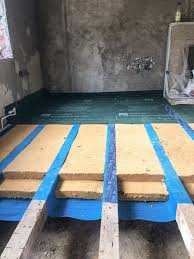
-
It will turn a normal dense concrete block into a lightweight too. You'd save a fortune and your back.
-
Send them back up to fix it. https://youtu.be/b_ZeJqNt4Hk?si=CsfA58HZh5gIzlYe
-
Find the most idiotic person you know. Bring them to your house, get them good and drunk and let them loose. If they fail to operate any part of the house then it's too complex.
-
Ground works. Dig hole, pour in concrete. Done, dusted , finito. Now let's talk about this digger.......
-
You're right. I saw a number (5MW) and gone with that . That is rather larger than the average on futher digging. 1000 is a better number than the one I picked.
-
What do the economics look like? Farming is absolutely marginal even without the inefficiencies of a operating around a field of solar panels. Subsidies form a large part of farm incomes. Would these remain if there was solar panels ? Also farmers hate them, partially because we're ( I'm a part timer) stupid and hate change, partially because they make us redundant and partially because we don't like our neighbour we see in the he field next door and at the market being replaced by panels. I'm guessing solar on a large scale is a subsidy game too, (ignoring the long term climate thing) . Oil is only $70/barrel at the moment.