

Iceverge
-
Posts
4487 -
Joined
-
Last visited
-
Days Won
32
Everything posted by Iceverge
-

Time of year for EWI and K Rend
Iceverge replied to canalsiderenovation's topic in Plastering & Rendering
You can insulate over the frames for improved performance. Use sill extenders for greater depth and take the insulation right down to the foundations if you can. EPS gives the best bang for your buck with external insulation. -
Welcome welcome. Don't worry about not being a tradesman or having an experienced builder to hand. A diligent DIYer can do a good job of most things with time and research. Do you have any photos to share with us or a plan of how you hope to use your house in the future? Jonathan
-
A mask or preferably a respirator for cutting masonry is a good idea I'd say.
-
Good stuff. To quote the Americans: "If it can't dry its gonna die!" Do you have a ventilation strategy for dealing with moisture/ CO2 and VOC's generated inside the house?
-
Hello. Just starting ideas... so many questions!
Iceverge replied to MLR1907's topic in Introduce Yourself
This changes the balance significantly! Best of luck. As for green building. Minimise your energy demand. Build your house out of things that were recently plants. Heat it with renewable electricity. Use an insulated raft foundation like isoquick or kore. Minimum use of concrete and thermally excellent. -
Hello. Just starting ideas... so many questions!
Iceverge replied to MLR1907's topic in Introduce Yourself
Until last week we were living in less than 60m2. It was tight but perfectly adequate when we were 2 not 3. For all that junk a shed or storage unit will do. My neighbour was hauling stuff into his attic last week at his partners behest. We mused that what he really needed to do was to install a hatch in the gable end of the attic through which he could dump said items directly into a skip. People have too much stuff I reckon. “The more things you own, the more they own you.” ― Chuck Palahniuk, Fight Club -
Hello. Just starting ideas... so many questions!
Iceverge replied to MLR1907's topic in Introduce Yourself
Welcome. I keep directing people to this but have a look at the Green building store denby dale passivhaus you tube video's. In my opinion 30-40m2 per person is generous living space. With cleverly placed windows it will feel much larger. @TerryE has a good setup for what you're after. A traditional looking house build to modern standards. Timber frame is only one way to skin the cat though. Be careful of all the greenwash out there. An very large poorly built house with a high heating demand and a few bolt on "eco" bits and pieces will do more harm to the environment than a conservatively proportioned smaller dwelling built properly to the building regulations. -
Hardly a problem. More lightly the solution I'd say.
-
Welcome. A picture would help. Whats your construction method?
-
I did hours and hours of sums and spreadsheets on this one. The best year round solution I could come up with was build a passive house. (square and simple with no conventional heating system worked out cheaper than a building regs house). Note mains gas isn’t an option for us. Provide space heating using an air to air heat pump. Heat DHW via night rate electricity. Install 4kw pv to help DHW in summer. It was a pretty close run thing with omitting the PV and using an ASHP for space heating and DHW but the initial capital cost was conservatively €4000 higher. The break even point was 20 years when the ASHP became cheaper (using an optimistic COP of 3 for DHW and heating). Even after 25 years the ASHP was only in the lead by €800. That was assuming it ran flawlessly for all that time and I ignored the extra cost of interest on the €4k. Note the sums would sway drastically towards the ASHP if we had a conventional heat demand. We went with the former as a plan. At the moment we have a 2kw resistive heater in the hall(€35) providing space heating (€2.56/day for 20deg everywhere) and a 300l direct UVC providing hot water ( Using about €1 per day for 2 showers and a bath). We haven’t installed the a2a unit yet or the PV. I’m going to monitor the first year and see how we get on in actual usage before redoing my sums. I have a sneaking suspicion that we’ll never install anymore heating but we probably will put in PV.
-
This Video below gives a reasonable impression of the biomass industry I think. Simply put the idea of chopping down trees and burning them to improve the environment doesn't make sense. The cheapest route I reckon. 1: Reduce your need for heat through improving your building fabric and ventilation. 2: Gas 3: ASHP The greenest 1. Reduce your heat demand 2. ASHP with green electricity
-
@shuff27 nothing really to add apart from the south facing windows in the kitchen. i’d make them as large as you can get away with. they’ll really enhance the room.
-
Unvented Cylinder Installation. Spot the Problem!
Iceverge replied to Iceverge's topic in Boilers & Hot Water Tanks
Thanks for the inputs. No time to do anything at the moment so I'll mull it over. I'll let you know when I go further. -
Unvented Cylinder Installation. Spot the Problem!
Iceverge replied to Iceverge's topic in Boilers & Hot Water Tanks
I was reckoning about 400ml so you're pretty much spot on! ( about 4 seconds at the kitchen tap, 6 seconds at the basin) The very best case I can get water to the kitchen tap in a 16mm pipe is 16 seconds. I'm tempted by having hot water at the kitchen tap in less than 1 second with the undersink heater and 4 seconds at the basin tap. Top plan. Me neither, I have heard about one other instance of a thermal store causing overheating. The trouble is that given most houses have such high losses and high heating demands that 100w here or there isn't even noticeable so nobody really bothers designing it in. https://passivehouseplus.ie/magazine/new-build/ecological-lake-district-passive-house-generates-its-own-electricity It will remove a reasonable chunk of my dead leg problem for sure but the issue of the remaining 7.2m of 26mm pipe now hidden in the ceiling and behind the cupboards would remain. I suspect I would still be left with a 30 second time to hot at the kitchen tap for all the extra effort. If we were back at square 1 I would plumb the whole thing myself. I would trial 10mm to the kitchen tap during construction to see if the flow was sufficient. If not I would upgrade to 15mm and see if the time to hot was quick enough. If neither was enough I would consider an instant water heater to boost the kitchen tap or else maybe a circulation loop. Sadly that ship has sailed. To go down this route now would require core drilling through a 225mm concete first floor, taking down the ceiling of our utility. Cutting out the back of one of the cupboards in the utility, painstakingly threading the required pipe under the units in the utility, the W/C and the kitchen. and replacing/repairing everything once we're done. On top I would have to attack the UVC installation and replace multilayer pipes with something I could DIY. All for a potential reduction from 45seconds to a best case of 16. (assuming 10mm pipe won't provide 6l/m) The rest of the house is ok as all other outlets are fed from 16mm feeds via very short runs. The shortness of the runs hides the large volume pipes upstream of the manifold. I will probably take on the work myself at this stage as my faith in plumbers is low. In fairness the builder agreed to pick up the costs so I'm not massively hung up on the materials bill. -
Unvented Cylinder Installation. Spot the Problem!
Iceverge replied to Iceverge's topic in Boilers & Hot Water Tanks
There is already a fused spur under the sink for the dishwasher. Would a 2kw undersink water heater should run from this ok? ( I don't know if it's allowed but this was the setup in our rental house and it was both fast and economical to operate) https://www.plumbnation.co.uk/site/zip-aquapoint-iii-under-sink-unvented-15l-water-heater/ At the moment our daily cost of water heating is €1.70/ day. (€620/year) I reckon this could expand by many multiplies if we were to install a hot loop as the hot circuit would be continually cooling the tank and we would have to pay double to run the immersion during the day. -
Unvented Cylinder Installation. Spot the Problem!
Iceverge replied to Iceverge's topic in Boilers & Hot Water Tanks
@Nickfromwales I’m reluctant to fit a circulation pump due to the high energy losses. Also as we’ve built a passive house I'm worried about overheating issues in the summer. Our only tariff option here in Ireland is 23:00-8:00 night rate (8c/kWh) or 24hr flat rate (13c/kWh). We have no PV fitted but plan to do so on the garage whenever that’s finished. I was the designer (a basic UVC and manifold layout with tips from this forum) but the plumber unfortunately ignored my drawings and instructions entirely and the manufacturers diagrams too. I wouldn’t have held much hope for them understanding or installing a return loop properly. I’d prefer to reconfigure the entire UVC layout to minimise the dead legs by putting the TMV and Hot manifold as close as possible to the UVC outlet. Generally tidy up the layout and balance the cold manifold correctly. I think a 15l under sink water heater for the kitchen tap and downstairs basin would be the best solution to avoid removing fitted cupboards and taking down ceilings. Any reasons not to go down this route? Jonathan -
Watch the videos about the denby dale passive house from green building store. Here's the first one in the series. It's an hour spent that will make your house comfortable fro generations. Also whoever is doing your insulation calculations is telling you porkies. At a quick take your floor comes closer to 0.14 W/m2K nad your wall 0.2W/m2K. Ditch the dot and dab. It's terrible for airtightness.
-
Unvented Cylinder Installation. Spot the Problem!
Iceverge replied to Iceverge's topic in Boilers & Hot Water Tanks
So we're in! The kitchen tap is taking 45 sec on average to get hot water. The downstairs basin 1 minute. In practice we're not waiting for water to heat up in the basin and in the kitchen we're dumping 20-30 litres a day waiting for the hot tap. With this drawing the equivalent amount of cold into the UVC. As I've set it up to heat all the water with a cheap night rate tariff this meant my 9pm shower went cold half way through. With more accurate measuring I reckon its a total 16.2m of a hot water run to the kitchen tap. Compromised of 9m of 16mm(12mm internally) and 7.2m of 26mm. (20mm internally) Doing the sums this gives 2.26l from the 26mm pipe and 1.02l from the 16mm pipe. Where is the remaining 1.22 litres of water coming from. Is it a delay through the TMV? The reason that this makes a difference is that if i was to change the setup to 16mm pipe all the way through it would speed up time to tap to 18 seconds about 2 litres best case or 30 second worst case , still too slow. Alternatively I go 10mm Hep20 and potentially have hot water in 5 seconds, with perhaps a lower flow rate than 6l/m we have currently. I'm tempted to just install an undersink water heater and cap the hot line off. We'd have very little hot water delay. No pipe losses and wouldn't have to go tearing down the ceiling of our lovely new house. The only negatives I can see would be less chance to avail of night rate electricity. The losses from storing water in a smaller volume would probably be offset by the lack of pipe losses. Your thoughts please. Jonathan -
SIP floor ventilated or not
Iceverge replied to paul1974's topic in Structural Insulated Panels (SIPs)
Topsoil removed around the perimeter to create a trench. Pour filled with ready-mix concrete. Blocks built to elevate the sips to leave ventilation underneath. It's the cheapest way if you have time to kill and don't mind a bit of suffering. To create a rodent proof base. I would just leave it high enough that a cat could get in there! -
SIP floor ventilated or not
Iceverge replied to paul1974's topic in Structural Insulated Panels (SIPs)
I'd do away with the concrete slab and use a pier and beam foundation or a strip foundation with block rising walls. I wouldn't rest timber based products on the ground DPM or not. If not ventilated and in contact with the ground it will rot. -
No-concrete foundations for a timber framed building
Iceverge replied to Carol L's topic in Foundations
You’ll struggle to get cheaper than concrete unfortunately although there are low carbon concrete options. concrete pads with metal posts are probably the most economical. -
Read this thread. It's much the same situation yours.
-
Recently built 3-storey home and looking into MVHR systems
Iceverge replied to Jde00's topic in Other Heating Systems
I think your airtightness levels are too low and with your house already being built built it's a non starter. Read up on decentralised MVHR but decentralised DCV (demand controlled ventilation ) is probably the best you can do in terms of performance and price. -
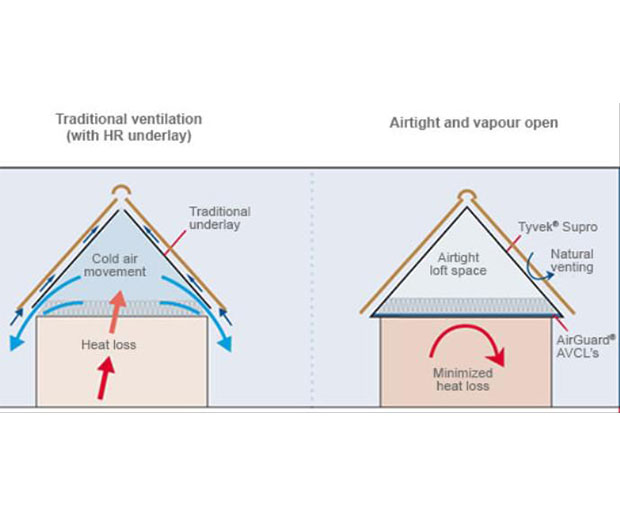
Have you considered the sealed attic method with battens and counterbattens to create a 50mm space above the rafters breathable membrane. It'll keep all nasties out of your attic and help your insulation perform better.
-
Glad to help. The software is SketchUp. It used to be free but I think it's a paid version now. If I wasn't so lazy I'd learn something that I could do scaled drawings on. We're in the process of moving from a 60m2 house to approx 180m2. I'll miss how proximate everything .If we were to do it again I think 150m2 or less would be fine. The piano is certainly a consideration. Planners seem to occupy a different universe at times. From my experience though they take a one look at a plan and decide. Then spend hours looking for reasons to justify their first impression.


