Jeremy Harris
-
Posts
26430 -
Joined
-
Last visited
-
Days Won
360
Everything posted by Jeremy Harris
-

MVHR newbie.. help needed
Jeremy Harris replied to Savage87's topic in Mechanical Ventilation with Heat Recovery (MVHR)
The simple answer is that I didn't! I made that unit up when I was trying to improve the airtightness of our old house, so I used it to de-pressurise the house and then went around looking for air leaks (there were dozens, all over the place). It worked pretty well, as the bigger air leaks could be found by just holding your hand around likely places and many of the medium sized leaks made a great deal of noise. Some of the more serious medium sized leaks were around every ceiling to wall junction (it was a bungalow). There were no obvious cracks, but the plasterboard ceiling leaked air where it met the wet plastered walls everywhere. I spent ages going around with acrylic filler trying to seal all these joints up. -
Anyone used online 3D printing services
Jeremy Harris replied to Gone West's topic in Tools & Equipment
TBH, I'm still in a sort of mix'n'match mode with CAD. I'm still drawing things up in AutoCAD, then importing the files into FreeCAD, and using that complete the 3D design and export .stl files. FreeCAD hasn't got the best user interface in the world, but it does feel easier to use if you're very used to working with something like AutoCAD. My main problem with any of the other 3D CAD packages I've tried is that entering coordinates so that you have precisely dimensioned parts isn't always that intuitive. It's almost as if the focus is on creating shapes without dimensional references, then adjusting them afterwards, which doesn't seem natural to me. -
Heating System Basics...
Jeremy Harris replied to Mulberry View's topic in New House & Self Build Design
When the WBS is going I'd guess the extract temps will be pretty high. Might be good in terms of MVHR efficiency, as this usually tends to improve a bit as the temperature differential between extract and supply increases. Just looked at ours, and the room temp is 22.1°C, extract is at 22.8°C and the fresh air room supply is 19.8°C. The unit is on it's normal background ventilation rate, which gives about 1 air change every 2 1/2 hours. The heat capacity of the air in the house is about 0.114 kWh/K[1]. The ∆T between extract and supply is 22.8 - 19.8 = 3 K, so the ventilation heat loss with MVHR is ~ 137 W. The outside air temperature at the moment is 10.9°C, so the same ventilation rate without MVHR would mean a ventilation heat loss of ~ 565 W, so the MVHR is reducing the house ventilation heat loss rate by ~ 428 W. If the temps were the same through the whole 24h day, then the saving in heating energy from the MVHR would be ~ 10.27 kWh, so worth recovering. Put another way, if we didn't have MVHR, then on a day like today we'd be paying around 312% more for heat input to account for the ventilation heat loss. [1] Should be joules, but I would guess most people can relate kWh to cost better, just because we buy energy in kWh, not joules -
Heating System Basics...
Jeremy Harris replied to Mulberry View's topic in New House & Self Build Design
MVHR always cools fresh air fed rooms, unless it is one of the expensive systems that includes additional heating/cooling. MVHR is also pretty poor at moving heat, as the ventilation rate will typically be very low, maybe one air change every 2 1/2 hours or so, and the heat capacity of air is very low. Our MVHR has a heat pump built in, so it can heat or cool the fresh air supply to rooms, but the maximum output is about 1.5 kW, so about 250 W maximum per room, but it has to be on full boost to achieve that heat output. Enough for a passive house, but probably not for one built to just meet current regs, I suspect. -
Anyone used online 3D printing services
Jeremy Harris replied to Gone West's topic in Tools & Equipment
Making a hybrid from two different designs could be fairly easy, if the original CAD files are available, or not so easy if only the .stl files are available. I'm not a great fan of the .stl format, as it only represents the surfaces, so can be a PITA to edit accurately. Be nice if everyone sharing 3D printed designs would include the full CAD files as well, although some do. -
Anyone used online 3D printing services
Jeremy Harris replied to Gone West's topic in Tools & Equipment
I did look at the link you posted to those, to see if they would fit my printer, but it would have been fiddly to slice the parts into sections to get it to fit, so I didn't offer to print it for you, I'm afraid. This gives an idea of what you can do with glueing separate parts together, my (still unfinished) walk-the-plank mousetrap mechanism: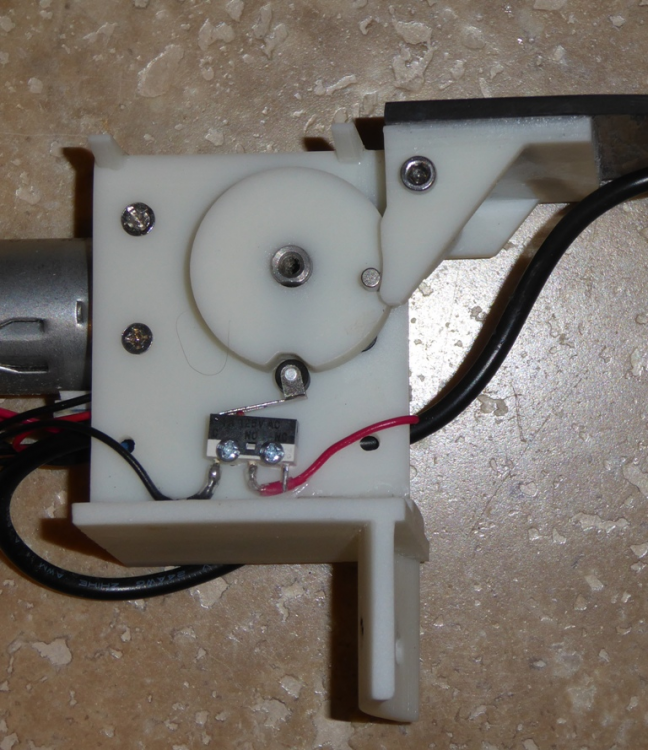
-
Controlling Air blower for waste water treatment system
Jeremy Harris replied to mfmcdonagh's topic in Waste & Sewerage
That's useful, as it does seem as if there are two air feeds to the tank and the valve just activates one of them once an hour, with the other one being fed continuously via the lower hose in that photo. The Secoh pump you have is one of the quietest ones, if ours is anything to go by. -
Low Carbon Checklist - Boilerplate Text
Jeremy Harris replied to AliMcLeod's topic in Planning Permission
I was asked to send a brochure showing our PV system as it would look when installed, but couldn't, as there were two separate parts, the in-roof mounting system (which didn't show black panels) and the panels themselves (which didn't show the mounting system). The panel brochure I sent wasn't from the same supplier that we eventually used, either, although there's no easy way to see that from looking at the panels on the roof. The catch-all for us was that all external materials used had to be approved by the planners, as a condition on the PP, so I had to send details of the system we eventually chose for approval before we fitted them. -
Anyone used online 3D printing services
Jeremy Harris replied to Gone West's topic in Tools & Equipment
Mainly for the print quality, but also because of the low price. However, the small build volume is an issue, especially the maximum width (fore and aft, looking at the printer). The resin smell and messiness are also a nuisance; I run mine in the garage because of this. I can get around some of the build volume limitations by printing things in sections, then glueing them together later (superglue seems to work very well for this). This can also speed up prints, as print time is determined only by the height of the object above the bed, not any other dimension. It very much depends on what you want to print as to what type of printer you get. If you want to print fairly large things, and surface finish isn't that important, then an FDM printer might be the one to go for. If print size isn't that important, but surface finish is, then a DLP resin printer might be the best bet. If the printer is to be used indoors, though, then a resin printer really needs a workspace where parts can be washed free from resin residue with IPA, and that has good ventilation, because of the smell. -
It was an odd build, with an oak frame internally (not sure it was even structural) with a SIP structure outside that, with the SIPs clad with wood fibre bats and then lime rendered. The oak frame was superfluous structurally, I think, as IIRC all the structural support was provided by the SIPs around the outside. This presumably allowed the oak to move around, as it will, without causing airtightness problems. I remember it because the finished house didn't look as if it had been built using modern methods of construction, and also because it had a very large brick external chimney (slightly too large for the house, to my eye). I've just been looking around, and I think it may have been series 3, episode 8, "The Traditional Cottage" in Herefordshire. It was a young couple, and IIRC the girls father had an oak frame company.
-
Small roofing project - log store
Jeremy Harris replied to DaveH's topic in Roofing, Tiling & Slating
Just had a look at the one we have. It's branded "Armagh Glass". No idea why, as I think it was used to deliver a flat packed shed. -
The relatively low decrement delay from using insulation with a relatively low heat capacity was one thing that made me shift away from SIPs to an alternative closed panel frame system. We ended up with slightly thicker walls, with 300mm of blown cellulose between the skins (400mm in the roof), but the much longer decrement delay has resulted in a house with a thermal time constant that is a fair bit longer than the diurnal period, which keeps the internal temperature nice and stable. We have a concrete slab above 300mm of insulation, but that isn't as big a factor in having a long thermal time constant as the walls and roof, or even the internal plasterboard and plaster. The latter has a surprisingly high heat capacity, higher than that of concrete, so contributes significantly to maintaining an even temperature.
-
Small roofing project - log store
Jeremy Harris replied to DaveH's topic in Roofing, Tiling & Slating
Quite a few of the pallets we had left over (still have one) were painted, too. Anyone want a nice blue one? -
Controlling Air blower for waste water treatment system
Jeremy Harris replied to mfmcdonagh's topic in Waste & Sewerage
Another reason for noise could be that a diaphragm is on the way out. perhaps? -
Controlling Air blower for waste water treatment system
Jeremy Harris replied to mfmcdonagh's topic in Waste & Sewerage
Just had another thought. I wonder if the solenoid valve is there to prevent sludge flowing back down into the air diffuser and pipework during the off period? There has to be a very good reason for Klargester to have made the design more complicated than might seem necessary, as doing this makes the thing more costly to manufacture. If the valve closes off the air supply, then my guess is that the diffuser and supply pipework will remain at the static pressure that prevails at the base of the tank, which may be enough to keep sludge out. There are certainly known problems when sludge builds up and increases the pressure at the pump with some diaphragm pumps; it tends to cause the rubber diaphragm(s) to fail prematurely. -
Planning breech to be made arrestable
Jeremy Harris replied to Temp's topic in Party Wall & Property Legal Issues
Depends on the wording of the law, but I suspect it may well be targeted at travellers, rather than be included in more general planning law. There's probably also some subtlety around the "arrestable offence" bit, I think, as well as demonstrating "intent to set up home". The problem the police have with unlawful traveller encampments is that they cannot arrest someone for trespass at the moment, unless some other offence is committed. If trespass, under certain circumstances, is made an arrestable offence, then the police could act more quickly, which may result in encampments being moved on before they can become established. Ultimately I'd guess this might just put more pressure on LAs to provide traveller sites. Whether this can apply more generally, for example to land that might have fallen within adverse possession depends very much on both the wording and the way the police choose to use the law. Given that to be able to claim adverse possession has been made significantly harder since 2002, together with a lot of land now being registered, I'm not sure it's that likely to affect many people other than squatters and travellers. -
Controlling Air blower for waste water treatment system
Jeremy Harris replied to mfmcdonagh's topic in Waste & Sewerage
Welcome. There are certainly some treatment plants around that switch the air pump on and off, mainly to save energy. There are other considerations, though, and the design of any timer control system needs to match the type of pump used. Some low pressure pumps may not switch on against a higher than expected pressure head, even though they will deliver that pressure once running. Some types of pump may also fail prematurely if they are run with a closed off outlet. From your description, I'm not sure whether the air pump outlet is actually blocked for 59 minutes, or if it discharges to the air during this off time. I'm not familiar with the way the particular model you have works, but it may be possible to change the air pump system for one that's more energy efficient, less noisy and which still allows the unit to meet the statutory requirements (the latter are becoming more critical, as all treatment plants are subject to periodic physical inspection to ensure compliance with the regulations from next January, I believe). -
Heating System Basics...
Jeremy Harris replied to Mulberry View's topic in New House & Self Build Design
It's the one thing I wish I'd done, fit electric UFH in the bathrooms. It's not a major issue, but it is something I miss, as I fitted electric UFH under the tiles in the bathroom at our old house. It wasn't until we moved in that I realised the difference having the floor just a couple of degrees warmer made to bare foot comfort. TBH, it's not a major issue, it just means keeping slippers on until stepping into the shower, and having a reasonable bath mat to step out on to, but it niggles me that I didn't think to do it. -
Heating System Basics...
Jeremy Harris replied to Mulberry View's topic in New House & Self Build Design
This quote is out of date (2011) but seems to have the same number of bulk LPG installations, but also gives an estimate for bottled LPG heating: Using the upper estimate that would mean around 0.73% of UK homes used LPG for heating, so still a pretty small market. Whether that has an impact on price I don't know, but I suspect it may do, as the process of changing from one LPG supplier to another, at least for bulk LPG, seems a bit more onerous than changing oil suppliers. It seems you can only change bulk LPG supplier once per year, as the new supplier has to agree to purchase the tank from the old supplier. -
Low Carbon Checklist - Boilerplate Text
Jeremy Harris replied to AliMcLeod's topic in Planning Permission
I had this discussion with a Conservation Officer, who wanted to mandate the use of stone from a specific (closed) local quarry. It seemed that this sort of stipulation on the source of materials can apply in some specific circumstances. I'm pretty sure that National Parks can dictate where some external materials are sourced, and think that someone here had that discussion with one (not sure who, may have been @Barney12 regarding roofing slates?). I doubt that a specific manufacturer of solar panels could be specified, though, only the appearance. I agreed that I'd use black panels, with black frames, inset into a dark grey slate roof, and provided some examples from a couple of suppliers. We certainly used the fixing system I'd agreed with the planners, and the same colour of panels, but that was as far as it went. I'd imagine that, given the fairly volatile solar panel market, it may well be that a particular make and model of solar panel may not exist by the time the house came to be built. -
Heating System Basics...
Jeremy Harris replied to Mulberry View's topic in New House & Self Build Design
That's bulk tank LPG installations. No idea how many use bottled gas for heating, but I'd guess it's probably not a very large number, given the very high cost of bottled gas. -
Heating System Basics...
Jeremy Harris replied to Mulberry View's topic in New House & Self Build Design
100W/m² seems way OTT for a new build, or even a house built any time in the past couple of decades. Admittedly our heating requirement is lower than average, at around 5 W/m² on average for just the ground floor in the winter (about 21 W/m² worst case, when it's -10°C outside, and we don't have upstairs), but I'd be surprised if any new build needed more than about 30 to 40 W/m². -
Heating System Basics...
Jeremy Harris replied to Mulberry View's topic in New House & Self Build Design
There's an oil club that operates in our village. Run by a group of volunteers, they collect details of oil requirements from anyone that wants to join, then put out a request for tenders to a few suppliers, based on the total volume. They seem to get a pretty good price, from what I can gather. -
Heating System Basics...
Jeremy Harris replied to Mulberry View's topic in New House & Self Build Design
Looking around, the size of the LPG heating market doesn't seem huge, an estimated 150,000 UK LPG heating installations, out of a housing stock of around 27,227,700 so only about 0.55% of the whole UK household heating market. That may have a bearing on pricing, especially as it seems that all the suppliers put their prices up around the same time (from what I've just seen both Calor and Flogas have done this). -
That's a pretty good idea, as it reminds me of something I saw a while ago, where someone had made a base for a record deck using an offcut of granite worktop. IIRC they picked this up very cheaply from going to a stone supplier and asking if they had any offcuts.