
Jeremy Harris
-
Posts
26430 -
Joined
-
Last visited
-
Days Won
360
Everything posted by Jeremy Harris
-
As a general rule of thumb, a soil max allowable bearing load of about 100 kN/m² is what's been accepted as being OK for standard trench fill foundations for a brick or block house. A passive slab has the massive advantage that it can support a massive load with underlying ground that's around that bearing load figure. IIRC, I worked out that our house was imposing a load on the ground beneath of around 5 kN/m².
-

Any refrigeration experts here (ASHP)?
Jeremy Harris replied to ProDave's topic in Other Heating Systems
I would respond by telling them that they can collect it, as you are unable to ensure that it is suitably packaged for delivery, to their quality standards, and that you would not wish for anything that you may do in packing the unit for shipment to possibly cause damage in transit. -
If it goes click, I'll buy it......
Jeremy Harris replied to ToughButterCup's topic in General Construction Issues
Placebo effect always amazes me, not so much for the way it makes interpreting data challenging, but because it's hard evidence that belief has a very noticeable impact on outcome. Looking through study data where, in addition to a double blind trial they have run a zero treatment study, the placebo effect is often pretty dramatically demonstrated. In a couple of studies I looked at involving anti-hypertension medication, the placebo effect was more pronounced than the additional effect of the medication. The challenge is trying to harness this ability for the mind to impact the body in a consistent way, across all personality types. As a related example of the power of the subconscious, I found out a while that I, like around 20 to 30% of the population, suffer from "white coat hypertension" (I think I related the tale here). What I find fascinating about that is that it is a response that's so deeply buried in my subconscious, that I cannot do a thing to change it. Like the placebo effect it's another demonstration of how little we really understand about the way our bodies really work, in the holistic sense. -
If it goes click, I'll buy it......
Jeremy Harris replied to ToughButterCup's topic in General Construction Issues
Cochrane is pretty much the only independent, volunteer run, review body that I know of. It was a bit of an eye-opener seeing just how poor, in terms of demonstrating a useful outcome, most drug trials are. Cochrane reports are free, but the process of creating them is very slow, because of the very large amount of data that has to be manually reviewed; there's no real alternative to having several reviewers working independently, and in parallel, assessing data by eye to spot the omissions and examine the reasons for leaving out some results. There is a general trend that a lot of commonly prescribed drugs for everyday ailments are little or no better than placebo. Even drugs accepted as being "effective" are often far less effective in reality than many assume. Take hypertension medication, as an example. Typically treatment is prescribed for those with a BP that's regularly over around 140/90. The most commonly prescribed drugs, like angiotensin-2 receptor blockers, or angiotensin-converting-enzyme inhibitors, can lower BP by about 10mmHg, no more. Given that often medication may not be prescribed until BP gets well over the lower threshold, perhaps not until it reaches around 160/100, and that ideally it needs to be close to 120/80 in order to reduce the risk of stroke, cardiovascular disease etc, then it's pretty clear that these drugs aren't going to do a great deal in practice. Add in that the latest evidence from long term studies shows that the reduction in mortality or morbidity from prescribing anti-hypertensive medication to those over 55 is small (in fact not statistically relevant) and you have to ask quite how we've managed to be hoodwinked into spending hundreds of millions of pounds on treating people that almost certainly won't receive any significant benefit. -
Treatment plant and rainwater
Jeremy Harris replied to Russell griffiths's topic in Waste & Sewerage
I've built a programmable timer that fits inside a standard outdoor single socket (the ones that remains weatherproof with the plug in) and turns the power to that socket on and off with a solid state relay. I've configured this as an extension lead, so although it's wall mounted inside the stone pump enclosure, it's plugged in to one side of a two gang weatherproof socket. I've not yet tested it, but the idea is that the timer can be programmed to turn the pump on and off, with programmable on and off times, both because there are only two of us most of the time (the treatment plant is a Biopure 1) and to reduce the power used by the pump. The selection of the on and off timing is interesting, because @PeterStarck mentioned some time ago that the air ports on his unit (which looked very similar in design to the Biopure, with a conical lower tank section) got blocked with sludge and this may have contributed to his subsequent pump failure. I've been wondering what the best compromise is between on and off times. The 2:1 off to on ratio seems to be one used by other switched systems, and my guess is that the off time needs to be short enough so as to not pose too much risk of sludge settling down too firmly, as it's the air that keeps much of the sludge suspended within the unit, to allow more complete digestion. I did look around to see if there was an affordable and reliable way to sense BOD, as that seemed to be a clever way to select the pump operating duty cycle. If the BOD drops below a certain point than the pump timer could go into the lowest power mode, with the duty cycle changing as the BOD increased in the main tank. Sadly I couldn't find a suitable BOD sensor, nor could I find any information as to whether an analogue measurement (such as measuring gas concentrations in the air above the tank) would reflect the BOD of the tank contents. I do have a PCB master for the timer, it uses an 8 pin microcontroller, simply because as well as switching the SSR on and off, it also sends a signal to the alarm unit, so that the low pressure alarm doesn't operate when the pump turns off during the time cycle. I have to plug a laptop in to change the on and off times, though, as I couldn't be bothered to add external controls for this. The PCB also includes a power supply that runs the alarm unit, and a doppler radar intruder sensor, that triggers our CCTV system to record. The latter is only included because the pump housing is right next to the lower end of the drive, so is ideally positioned to trigger the cameras at the front. -
If it goes click, I'll buy it......
Jeremy Harris replied to ToughButterCup's topic in General Construction Issues
Yes, this is exactly what they do. Getting hold of raw data to review is damned hard, but the legislation in some countries does require pharmaceutical companies to provide it, although they are exceptionally good at giving what seem to be valid reasons for disregarding data points that don't fit with what they are trying to promote. The major problem is that the focus of trials is often on adverse effects, rather than efficacy, as it's adverse effects that impact directly on approval. It isn't at all uncommon to find approved medications that have little or no benefit, the best that can be said for them is that they haven't yet been shown to be harmful. -
I'm having the same problem with getting a quote to resurface the drive at our old house. I've managed to get two people out to look at it, helped them out by giving them a CAD drawing showing the area, gradients etc, yet neither has come back with a quote, despite promising to. I've lost count of the number of people I've phoned or emailed and left messages, who've not got back to us. All told it's bloody frustrating, and I could do without the extra hassle right now.
-
To grey water or not to grey water.
Jeremy Harris replied to MikeSharp01's topic in Environmental Products
You can install a rainwater storage system reasonably cheaply if you shop around. IBCs hold 1000 litres each and can be picked from places like Smiths (http://www.smithsofthedean.co.uk/ ) reasonably cheaply, together with all the fittings needed. @Bitpipe has a storage system that uses IBCs: -
I'd be inclined to fit the smaller one. It seems unlikely that you would overload it, and even if you did it would probably only be for a very short period of time, which wouldn't be that likely to cause a significant problem. Better to have too much nutrient available than too little, IMHO.
-
Treatment plant and rainwater
Jeremy Harris replied to Russell griffiths's topic in Waste & Sewerage
There should never be a need to pump fresh water from a pond to a treatment plant, as the treatment plant will sit full of water/effluent/bacteria even with no input for a few weeks. If left unused for months then the bacterial population will die down, leaving the tank full of treated effluent with a low BOD, and there will be a delay when effluent reaches the treatment plant again before the bacterial population has had a time to multiply up, but as the resting BOD of the tank contents will be much lower than the limit, it can take usually tolerate this time delay without significantly exceeding the discharge BOD limit. -
Treatment plant and rainwater
Jeremy Harris replied to Russell griffiths's topic in Waste & Sewerage
Really just that the general rule is to try to maintain a high nutrient level in a treatment plant with a throughput of effluent that is matched as closely as possible to the size of the tank. Over sizing the unit is not good, for the same reason as putting too much water through a unit, it dilutes the nutrient content. I think it's best to try and deal with rainwater run off with either a soakaway, or some form of surge storage system. We had to use the latter, because of the proximity of the stream (it's about 6 or 7m from our front door), and as we didn't have room for a surge storage pond we ended up burying twenty 196 litre Aquacell crates under the drive, to give us nearly 4000 litres of surge storage capacity. This drains to the stream slowly, via a permeable soil layer, so complies with the SuDS rules. -
To grey water or not to grey water.
Jeremy Harris replied to MikeSharp01's topic in Environmental Products
I looked at whether filtering and re-using grey water was feasible, but read so many horror stories about problems with grey water storage, filtration and treatment that I decided against it. If we had not had a borehole, I'd have fitted an underground rainwater storage tank, and used that for watering the garden and probably toilet flushing. Rainwater is a LOT easier to use than grey water, from all I've read. Bear in mind that grey water will always contain faecal coliforms, as well as other potential pathogens, in addition to a high phosphate concentration, from the surfactants used in body, clothes and dish washing products. -
Treatment plant and rainwater
Jeremy Harris replied to Russell griffiths's topic in Waste & Sewerage
It's not at all good to run excess water through a treatment plant, as it will dilute the nutrient concentration which will then dilute the aerobic bacteria population, meaning that when a flush of nutrient enters the tank there may be insufficient bacteria to quickly consume it. If fresh water then flushes through the tank it could very easily end up washing partially-digested material through the outlet. If that outlet is running to a watercourse, then there is a significant risk that discharging high biological oxygen demand waste could have an adverse impact on the watercourse. -
What goes more than 100mm deep into the slab.
Jeremy Harris replied to MikeSharp01's topic in General Structural Issues
I chose to place the sensor where I thought it would be most likely to accurately sense the slab core temperature, at the same depth as the UFH pipes. Putting it under the stud wall was an attempt to not have local slab surface heat loss effect the measurement too much. Whether this was right or wrong I don't know, but I do know that the slab surface temperature tends to be higher than the temperature at the slab sensor for an hour or two, until the heat travels sideways to the sensor (the sensor is well away from the edge of the slab). The slab surface temperature tends to be very even, except in the doorway between the utility room and the kitchen, where there are 6 UFH pipe runs out to the rest of the slab, so the spacing is a lot closer there than elsewhere. The slab rate of change of temperature seems a lot faster than the house, but very small changes in slab temperature have a large impact on the house temperature. The latter effect is down to the heat power output from the slab relative to the temperature differential between it and the room. Given that the house rarely needs more than about 1 kW of heat, and most of the time in the heating season it barely needs more than a couple of hundred Watts, it's easy to see how this sensitivity to slab temperature arises. Here are the heat output numbers for our 75m² heated floor area for a small range of room and slab surface temperatures: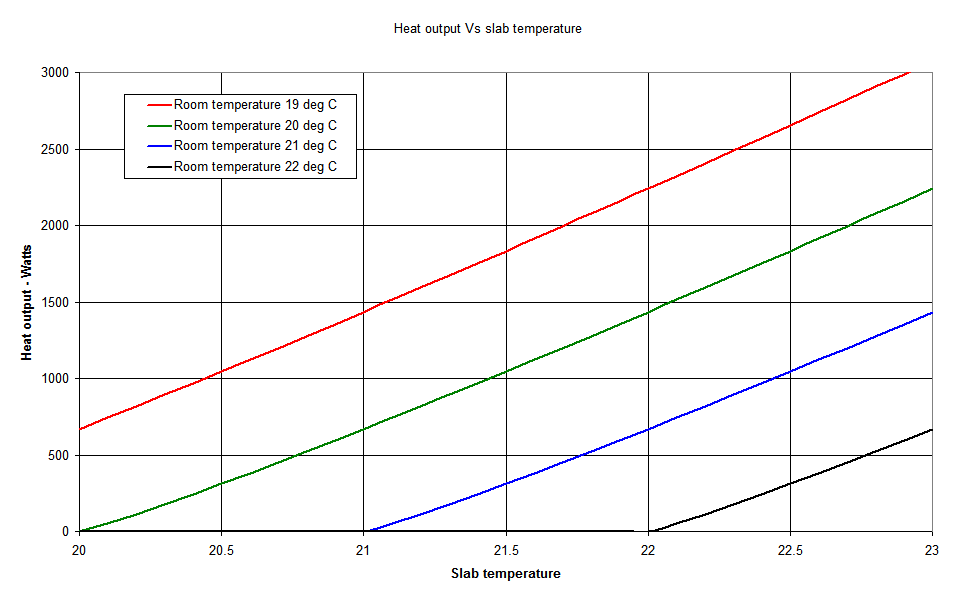
-
What goes more than 100mm deep into the slab.
Jeremy Harris replied to MikeSharp01's topic in General Structural Issues
I have taken several thermal images of the floor, both in the areas where the flooring is travertine and the areas where it's bamboo (both bonded directly to the slab). None seem to show any indication as to where the pipes are, and our pipes are on 200mm centres. The other thing that's noticeable is the time lag between the in-floor temperature sensor, which is located under a stud wall, about 200mm horizontally from the nearest UFH pipe, and the heating or cooling coming on. This lag is around 2 to 3 hours, with the measured temperature only getting within about 0.1 deg C of the surface temperature after around 6 to 8 hours. Given that the heat loss from the surface of the slab above the sensor will be a fair bit lower (because it's under a stud wall that's filled with rockwool), I was surprised at just how slowly this sensor responded to change when the heating/cooling turned on. This delay was one of the reasons I really struggled to get the floor temperature control system to work, and why I ended up reverting to a simple room thermostat. -
What goes more than 100mm deep into the slab.
Jeremy Harris replied to MikeSharp01's topic in General Structural Issues
My experience (hard won, and at odds with my natural instincts) is that it is very easy to over-think stuff that has next to sod all real-world impact. The sad thing is that I'm very definitely an applied, rather than pure, scientist, so you'd think I'd be more inclined to just accept an empirically derived solution! The bottom line is that there are loads of hard to quantify variables that could be included in a model, but that have a negligible effect in practice. In practice I've found that our UFH is pretty slow to respond, with the upper surface of the pipes around 30 to 40mm below the top of the 100mm thick slab. I think that placing the pipes lower would have two negative effects; it would make the lower surface of the slab warmer then the upper surface, so increasing downward losses through the insulation (by increasing the Δt) and it would slow the rate of change of temperature of the upper floor surface, so slowing the time taken for either heating or cooling to transfer heat in or out of the room. -
What goes more than 100mm deep into the slab.
Jeremy Harris replied to MikeSharp01's topic in General Structural Issues
The position of all our internal walls, kitchen units, kitchen island, ground floor WC, utility room units etc were all accurately spray paint marked on the insulation under our slab before the UFH pipe was laid, so we could be certain that we had no pipes underneath anywhere where we might later need to drill any holes. Our pipes are also towards the top of the slab; the reinforcing fabric is in the centre of the 100mm thick slab and the 16mm pipes are cable tied to the top of this, to get them closer to the upper surface. Concrete has a reasonably good thermal conductivity, but even so I'd want the pipes nearer the top surface than the bottom. There will always be a thermal gradient inside the slab, and even though there is insulation underneath it I'd still prefer the thermal path to the upper surface to be as short as possible. -
Bath Surround / Boxing In, and concealed pipework
Jeremy Harris replied to Onoff's topic in Bathrooms, Ensuites & Wetrooms
That PU filler/adhesive is chemically very, very similar to the thick Sikaflex PU filler/adhesive, which in turn is near-identical to Tigerseal and similar car body sealants. -
Any refrigeration experts here (ASHP)?
Jeremy Harris replied to ProDave's topic in Other Heating Systems
Looks to be a Mitsubishi compressor, from the part number, which is good news, as these are pretty common and used in a fairly wide range of heat pumps and air con units. My guess is that EBAC are assembling these from well-known parts, as they make them here in the UK, and that's also good news, as the chances are that there will be several sources for spares. -
I'd be interested to know the real world range of these switches, as I'm less than impressed by the Byron/HomeEasy remote switches we have. I have two two way switches that both operate two receivers in the ceiling of our kitchen/dining room, and had to locate the receivers as close to the wall switches as possible to get them to work, and even then they aren't very reliable, and it often takes two or three presses of the switch to activate the lights. At a guess the range can't be more than about 3m and the receivers only have the thickness of the skimmed plasterboard ceiling (which isn't foil backed), between them and the wall mounted switches.
-
Any refrigeration experts here (ASHP)?
Jeremy Harris replied to ProDave's topic in Other Heating Systems
You just need to hope that it hasn't got moisture in, as that can seriously bugger up things like valves and the compressor. With luck it will have been run enough with gas in for some oil to have been circulated around the refrigerant circuit and provide enough corrosion protection. If the unit has just been left degassed, with just some slight residual pressure, then that should mean it's OK internally. Fingers crossed that the company can sort it properly. -
Any refrigeration experts here (ASHP)?
Jeremy Harris replied to ProDave's topic in Other Heating Systems
Well worth pushing to get it fixed under warranty, especially as it sounds as if it had lost refrigerant before you received it. I suspect it has a leak, which means it will need to be vacuumed, held under vacuum to get any moisture out, then refilled and leak tested. Any refrigeration/air con engineer that holds an F gas ticket can do the job in an hour or so. The main concern that I'd have is whether a warranty repair might end up being just a re-gas, without a proper leak test. If there is a leak, then just re-gassing the unit may get it working for a while, until the refrigerant leaks out again after the warranty has expired. -
BT/Openreach - a private monopoly in action
Jeremy Harris replied to a topic in Networks, AV, Security & Automation
That's exactly my thoughts, and I'm wondering if they've re-routed the trunk cable. This wouldn't have been that hard to do, as at the point where the return leg of the long loop comes back into the village it was only one pole away from the outbound leg. I did see OpenReach vans in the village a week or two ago, and I know that I wasn't the only one complaining about the low speed, so perhaps we're now on a much shorter copper loop than before. We're about 400m from the fibre cabinet, so potentially I think the copper length may have been reduced to a bit over 400m if they have re-routed the cable. There's still an ongoing enquiry as to whether we can have FTTP, and what the cost would be. Right now there are five households on the same copper run that are interested in FTTP, and I noticed a week or so ago that they've added another add-on cabinet the the fibre cabinet in the village. Our hope is that FTTP will be both available and affordable, we just have to wait and see. One thing in our favour is that there is a small industrial estate about a mile of so outside the village, on the line of the cable from the cabinet that now seems to run past us. That may well help our case for getting a fibre strung along with the existing overhead copper, and hopefully reduce the cost for anyone who wants FTTP. -
Any refrigeration experts here (ASHP)?
Jeremy Harris replied to ProDave's topic in Other Heating Systems
Regards the labour, if the bloke is going to do it properly, then he needs to do the following: Fit a vacuum pump and pump the refrigerant side down to ensure there is no moisture in there. Do a vacuum test to check for gross leaks. Weigh in the exact amount of refrigerant (he'll put the bottle on a scale and measure the weight of refrigerant added to get it right). Add fluorescent dye when filling with refrigerant (which may well come with dye already in). Let the temperature and pressure stabilise for 15 to 20 minutes. Check for leaks with a UV lamp. Test the unit and check that the low and high pressure sides are at the right working temperature and pressure. Just filling the unit up with more refrigerant, without doing the checks, could well be a waste of money, as there has to be a good reason for the unit having lost gas. Generally they are like refrigerators, and rarely just lose gas without there being a leak somewhere, and as they are sealed systems the leak can be very small and hard to locate without the dye and UV light. -
That's exactly how ours came. They were packed on pallets (I bought 5 pallet loads for £15 per pallet, "left over from a job"....) and when the wrap was peeled off you could see that adjacent "bricks" were just split, as the uneven faces were a perfect match to each other. I bought four different sizes, so we could make some of the larger walls in the garden look semi-random, with square jumpers in the courses and as capping "stones" (there's a block wall behind that front wall, just to add a bit of extra strength):