
Jeremy Harris
-
Posts
26430 -
Joined
-
Last visited
-
Days Won
360
Everything posted by Jeremy Harris
-

Water connection
Jeremy Harris replied to recoveringbuilder's topic in General Self Build & DIY Discussion
Just to make you feel better (!) Wessex Water quoted us around £23,000 for a mains water connection, plus another £14,000 for a pumped sewage connection (not including the ~£3k for the pump chamber and installation). Electricity connection and cable moves in total came to just under £4,000. The cheap one was the 'phone, as all we paid was the standard connection charge, around £100, IIRC. The moral of this tale is to ALWAYS check, and double check, the costs and viability of getting services to your plot BEFORE you exchange contracts. Had we not done this we would have had some very nasty surprises (and we could have paid a great deal more for our plot than we did). -
I'm pretty sure it's only the heat pump that's RHI compliant and only it's contribution that is counted towards the payments.
-
We fitted these to the Lynx for operation in Iraq - without them the bleed air fed cooling holes in the Gem engine turbine blades would block with glass from the melted sand that was ingested. They are big, though, and do hit engine performance a fair bit, which made an already marginal hot and high performance A/C even more marginal, reducing useful payload. They work by spinning out the dust, so do have the effect of blowing all the exhausted and spun out dust from the rear of the filter box at high velocity. Overall they aren't a great system, but they are all we have. FWIW, the same sort of fine sand filters are fitted to our tanks too, as they were never designed to operate in the desert, either. All our design requirements assumed that any land conflict would be on the plains of Europe - i.e. probably the big flat bit of Germany. Those plans all went for a ball of chalk when the Soviet Union collapsed, but it takes around 30 years for the defence equipment programme to respond to such a dramatic change, because of the long lead time on kit and the long in-service life of most of it.
-
Is acidic water an issue with all plastic/stainless?
Jeremy Harris replied to sam's topic in General Plumbing
A pH of 6 is actually within limits, but probably makes the water taste slightly acidic, but TBH I doubt it'd be enough to notice. I suspect that the pH correction system was put in to fix something else, like a high dissolved metals problem, rather than just to provide a very modest correction to the pH. In general, most metals are more soluble in acidic water, and some metals are not great for health. The worry isn't with your plumbing, as very little copper is going to dissolve into water at a pH of 6, it's with whatever metals are in the ground that the aquifer feeding the spring runs through. Here are the UK acceptable limits for minerals and metals in drinking water (there is zero tolerance for coliforms, cysts etc, which are pretty much bound to be present in water from a surface spring, but the UV will kill them off as long as it has a 5µ pre-filter): There are lots of labs that will do a water test, but often it's cheaper to get your local environmental health people in the council to come out and take a sample and get it tested. They have a capped price (around £125 here) to do this and that is cheaper than the majority of labs would charge - I found that labs charged over £150 just to test a sample that I'd taken myself. There's no mandatory requirement for testing a private water supply, as long as no one other than the householders use it. The moment you allow the water to be used by others (for example paying guests at a B&B) then there is a mandatory requirement for annual testing. In terms of servicing, the UV tube needs replacing every 12 months, although they seem to last around 18 months in practice. Some UV systems have an alarm that goes off to remind you to replace the lamp, or if the lamp fails. UV lamps are bloody expensive, and I found that it's a lot cheaper to buy them in bulk direct from China (where most of them are made anyway). At the same time as the lamp is changed the 5µ pre-filter needs to be changed or cleaned. I used a washable pleated pre-filter and have two, so I can swap them over and then wash the spare ready to be swapped back the next year. Channelling is only an issue with filter media, not with limestone chippings for pH correction, so that makes me think that you've either been given duff info or the thing is doing more than just a little bit of pH correction.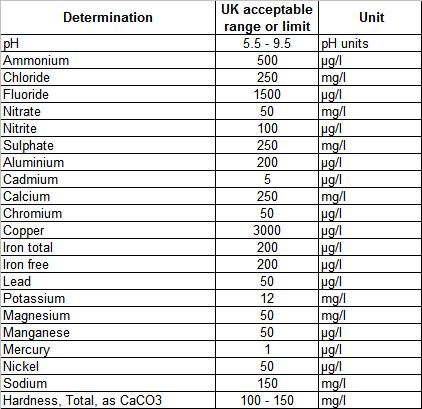
-
The tale of the sale of our old house
Jeremy Harris replied to Jeremy Harris's topic in General Self Build & DIY Discussion
If I search for the wrong post code, SP3 5JS, it's listed, along with the house up another lane that our plot is adjacent too. If I search under the correct post code, SP3 5JP, it;s not listed, all that shows in the next cottage around 100m up Mill Lane, that's just gone on the market. -
The tale of the sale of our old house
Jeremy Harris replied to Jeremy Harris's topic in General Self Build & DIY Discussion
Just done a post code search using my post code and got an EPC for an old cottage up the lane that's just gone on the market. It seems our EPC is listed under the post code for the house up the other lane behind us, not the one we're on. -
The tale of the sale of our old house
Jeremy Harris replied to Jeremy Harris's topic in General Self Build & DIY Discussion
Mine gives the same result if I search for my postcode, it's got the wrong postcode listed for some reason, not sure why. It turns up OK when I use the RRN number though. -
The tale of the sale of our old house
Jeremy Harris replied to Jeremy Harris's topic in General Self Build & DIY Discussion
Good spot, I hadn't realised there was a post code search (although it has the wrong post code for our house). -
The tale of the sale of our old house
Jeremy Harris replied to Jeremy Harris's topic in General Self Build & DIY Discussion
If there was an as-built SAP then there will be a lodged EPC. If you can find out the 24 character RRN from building control, you can get a copy of the lodged EPC from here: https://www.epcregister.com/searchReport.html For example, my RRN is 8497-7437-1430-2812-4906 You can look it up and download it as a PDF if you want a good laugh about the recommendations it makes, and work out the return on investment from them! -
The tale of the sale of our old house
Jeremy Harris replied to Jeremy Harris's topic in General Self Build & DIY Discussion
Based on my experience today I think you could tell someone like the bloke who did ours anything and he'd give you the EPC you wanted. Nothing to stop you then getting another one later. The only snag is that an EPC is valid and held on the register for ten years, I believe, so if your as-built EPC from when the house was constructed is on the register already, that's what will be used. I was told that they check the register to see if there's still a valid EPC lodged before doing another assessment. -
The tale of the sale of our old house
Jeremy Harris replied to Jeremy Harris's topic in General Self Build & DIY Discussion
Well, the Energy Assessor came around this afternoon to do the RdSAP assessment. Frankly it was a complete joke. Knowing both RdSAP and the order in which data is supposed to be entered, I'd printed out a crib sheet, with all the info in order, so all the chap needed to do was verify the accuracy of each statement and then enter it into the app on his iPad. Did he check the validity of any data? Did he heck as like. I got pretty annoyed within the first minute and ended up telling him that I wanted him to record all the required evidence, as he was supposed to. I made him look at, and take verification photos of the TRVs, programmable thermostat, boiler type and installation date, cavity wall insulation type, glazing type, including the full frame and glazing unit specification and go up in the loft to verify that we really did have 250mm of fibreglass up there, and photograph it. If I hadn't been so insistent he would have just made up numbers and walked off. As it was he was in the house for at the most ten minutes, with most of that time filling in stuff on the app on his iPad. I've no doubt he'd have lodged the EPC by the time he got back in his car. Not a bad way to make £84 for at most 20 minutes work. I've always been a bit cynical about the way some energy assessors "work", and this incident has just made me even more convinced that EPCs are a load of meaningless crap whose only purpose is to keep people who can make easy money by doing next to sod all in employment. Be interesting to see what his assessment comes up with, as I've already done a full SAP assessment on the house, using accurate data, and got an EPC of Band C 71. -
Is acidic water an issue with all plastic/stainless?
Jeremy Harris replied to sam's topic in General Plumbing
Backwashing will undoubtedly deplete the limestone more quickly unless it's necessary to clean the chippings or other neutralising media of something like ferric iron deposits. A simple pH correction system only really needs the vessel with the limestone plus the bypass, unless you've also got something like dissolved iron in the water that accumulates as iron salts in the media and so has to be periodically washed out. Do you have an analysis for the water before treatment? If so that should indicate what else is in the water. It's not uncommon to have excessive amounts of ferrous iron in solution in acidic water, and some of this will drop out of solution as insoluble ferric iron as the pH increases, and so build up in the vessel, needing the backwash. The safe drinking water upper limit for dissolved iron is 200 µg/litre, so may be your water would have more iron in that this if it wasn't pH corrected. -
I was lucky, in that I was allowed to keep a copy when I retired, but it's a bit old now. Does everything I want though, and was still more than good enough to design our house with.
-
Is acidic water an issue with all plastic/stainless?
Jeremy Harris replied to sam's topic in General Plumbing
I'd very definitely keep the pH neutralisation system in place. What sort of system are you using, just a pressure vessel filled with limestone chippings, or something that needs regular maintenance? A simple pressure vessel filled with limestone chippings, with a bypass and valve to adjust the pH to 7, should last a long time before the chippings need to be replaced. If you fit two vessels, so you can change them over and refill one whilst the other is in service, it's easier to look after. The key to getting a long interval between services is to size the system correctly and set up the bypass accurately, so that the pH is spot on 7, and no higher. -
That's probably because AutoCad has an arcane user interface that was invented when it first came out and ran on DOS. The first release I used ran on DOS, with a dongle plugged into the parallel port to verify that you were the licence holder. IIRC, the machine was a state of the art (for the time) 386, with a maths co-processor (essential to get AutoCad to run) clocked at a blistering 20 MHz. You could actually see vectors redrawing on the screen if you refreshed the viewport. The interface hasn't changed much since, and I find I still tend to type in commands as often as I use the mouse, simply because the command line was the better way of drawing quickly back then. Autocad was always intended as a replacement for a drawing board, and so the whole philosophy of the user interface assumed that users were already competent draftspeople. If you weren't competent to use a drawing board and didn't understand normal drawing conventions, then AutoCad must have been a PITA to learn. Now I find I really like AutoCad, just because I've got around 30 years experience of using it. I've tried far more modern packages, like Solidworks, Rhinoceros and even had to get to grips with CATIA when I was running the Future Lynx programme, at least as far as being able to manipulate some of the models to see what the designers were up to with the novel, machined from solid, airframe.
- 34 replies
-
- 2
-

-
- first post
- summer house
- (and 1 more)
-
Good tip. I also wrote in big letters across the bottom of all my initial drawings "CAD GENERATED DRAWING - DO NOT SCALE". The fact that the drawing prints I sent them were all pretty much spot on to a set scale was neither here nor there, my intention was to make it clear that they shouldn't just put a scale rule on the drawing and assume any unmarked dimension taken that way was valid.
-
Who has used, is using, PHPP?
Jeremy Harris replied to Dreadnaught's topic in New House & Self Build Design
I think the bottom line here is that of all the systems used to build passive houses in the UK, the MBC twin frame is most probably the most common one in recent years. Some of those are certified by the PHI, most probably aren't, but it does show that it's easy enough to meet PHI requirements using that system. FWIW, I looked at using I beam frames, but the thermal bridging through the OSB webs was higher than through the noggin spacers and nailplates of the twin stud. Not by much, but enough to make me consider having large holes drilled in the OSB webs to reduce the thermal bridging. You might also want to note that the geometric thermal bridges in the corners has a great impact than the nailplates. I mitigated this on our build by adding rigid foam insulation into the eaves and fascia ladder frames. The overhanging additional insulation removes most of the geometric thermal bridge in those areas and is relatively easy to do after the frame is up. -
House Cooling ideas
Jeremy Harris replied to mike2016's topic in Energy Efficient & Sustainable Design Concepts
We have one of those Victorian looking hoist up rails in the utility room and I arranged it so that the utility extract vent is directly above it. Things dry very quickly indoors I've found. On the subject of humidity, I have a display in the hall that gives lots of useful information about the house, and right now it's telling me that the RH is 46%, the temperature is 22.2 deg C, the outside air temperature is 24.6 deg C and the CO2 concentration is 456ppm. I find that the RH tends to stay between 40% and 50% most of the time. It might drop right down to about 35% in prolonged very cold (sub-zero) weather and occasionally rises up to around 60% in prolonged warm wet weather. I find that I tend to suffer from rhinitis when the humidity gets too low, and haven't yet suffered from it at all here, whereas it used to be a frequent occurrence when I was working, as the RH in my office would often get down to below 30%. -
House Cooling ideas
Jeremy Harris replied to mike2016's topic in Energy Efficient & Sustainable Design Concepts
Very true - a look at the volume of condensate coming down the drain pipe shows just how much water is being condensed out, which in turn is a good indication of the amount of heat being recovered from phase change. -
House Cooling ideas
Jeremy Harris replied to mike2016's topic in Energy Efficient & Sustainable Design Concepts
Or unless the unit has active cooling, when it goes to 100% bypass and turns on the air-to-air heat pump... -
House Cooling ideas
Jeremy Harris replied to mike2016's topic in Energy Efficient & Sustainable Design Concepts
Yes, initially, but the house will start to warm up and so there will come a point where this effect isn't worth having. In general, our MVHR is on 100% bypass by mid-morning at the moment, which is the point where it senses no benefit from having the heat exchanger in circuit. Yes. Spot on - better to shut the MVHR off once it goes to 100% bypass during the day, unless you have an active MVHR which cools the fresh air. Yes, the MVHR may well do as you say. There's some merit in never letting the house get warm inside, so that you can use the limited airflow from cooled air provided to (or from) a duct cooler in the MVHR to maintain a comfortable temperature (I'm ironing out the details of doing just this for our system right now). Not as such, but turning the MVHR off has much the same effect in practice, and is what we do if someone lights a bonfire. You can live in the house quite comfortably with the MVHR off and the doors and windows closed for a few hours - I watch the CO2 and it rarely gets above about 800 ppm and that's considered an OK figure. -
Who has used, is using, PHPP?
Jeremy Harris replied to Dreadnaught's topic in New House & Self Build Design
I agree wholeheartedly! I went berserk with modelling every thermal bridge, geometric bridge etc initially. I ended up with U values that were modelled to five decimal places for every element. Pointless really, as when I later came to the trade-off stage, and started changing values of components to see what the impact was on the overall heat loss, I found that seemingly large changes in the values of some components made very little overall difference. I've a personality type that can get very easily interested in digging down to the finest detail, though, whereas I know that most of the time these small details just don't have a massive impact and are swamped by factors that are outside any modelled parameters, anyway. -
House Cooling ideas
Jeremy Harris replied to mike2016's topic in Energy Efficient & Sustainable Design Concepts
I wouldn't dismiss a properly engineered tensioned fabric sail without checking. We had them at a place I worked, made from something like the stuff curtainsider lorries use, in white, with, I think, a fibreglass core sandwiched between the white plastic external material. These sails were tensioned with stainless steel wire and yacht rigging turnbuckles and there was a heck of a lot of tension in the fabric, so much so that it barely moved in the wind. There was a similar system used to shade the upper seats of the London 2012 stadium; somewhere I have some photos I took when I was there during its construction, that might show how they were fitted and tensioned, I'll have a look later. -
Who has used, is using, PHPP?
Jeremy Harris replied to Dreadnaught's topic in New House & Self Build Design
If you can hang on until later this evening, I can try and find the archived detail from when I did the analysis on this. I concluded that the impact of the nailplates wasn't massive and seemed to have been included in the original analysis for the wall U value I'd been given, as my result was damned close to that. -
House Cooling ideas
Jeremy Harris replied to mike2016's topic in Energy Efficient & Sustainable Design Concepts
What did the architect have to say about the need for shading? My experience was that most of the architects I spoke to weren't that clued up about it - one even suggested that having a lot of South facing glazing would make for a wonderful sunny aspect. One thing that is relatively cheap and works well is solar sails, set up to provide shaded areas and an architectural feature. Not great if you're in a very windy area, but otherwise they seem to work well. I like the idea of using tensioned fabric structures like this, and you can get some extremely tough materials that mean you could have them as a permanent feature (subject to checking things like the snow loading). Edited to say that I cross posted with @RandAbuild, saying much the same!