


Jeremy Harris
-
Posts
26430 -
Joined
-
Last visited
-
Days Won
360
Everything posted by Jeremy Harris
-

Internal windows in a design?
Jeremy Harris replied to Dreadnaught's topic in New House & Self Build Design
Out of necessity, the bathrooms have no windows (planners wouldn't allow roof windows on that elevation, and the first floor is room in roof). Bathrooms with no windows are fine, but I felt it would be useful to steal some light from the very bright hall, which has a 5m high fully glazed gable that's South facing and dead opposite where I've fitted that bathroom internal window. I used glazed bricks because they are much cheaper than very thick acoustic glazing (we would have needed something like recording studio glazing to keep "bathroom noises" from echoing around the large hall area) and also because glazed bricks added a bit of interest and looked a bit nicer than an obscured glass window. The other advantage they have is that they are hermetically sealed hollow glass, so there's never going to be a risk of a seal breaking down and condensation forming inside the bricks. The annoying thing is that glazed bricks used to be made in their thousands here in the UK, but now it seem you have to import them from France for some reason. -
Yes, it's a Carrier 30AWH. the 6/7kW model, badged as if it were made by Glowworm.
-
Why is my hot water tank making a noise?
Jeremy Harris replied to ProDave's topic in Boilers & Hot Water Tanks
Could there be air in the primary circuit that's causing the noise in the coil? -
The cheapest supply and install price I was quoted for a very small and simple monoblock ASHP was around £5k to £6k, IIRC. I bought a unit for £1700 and installed it myself in around half a day. The installation parts probably added another £100, and I'd already concreted in some concrete blocks on their side to form the two raised mounting piers the unit needed. The hardest part was carrying the ASHP around to the back of the house and lifting it up onto the concrete blocks. I did spend a fair bit of time reverse engineering the controls, working out how to get it to run in cooling mode and tweaking the settings to improve the performance, but none of that would have been done by a normal installer, I'm sure.
-
There wuz I Digging this 'ole .....
Jeremy Harris replied to ToughButterCup's topic in Waste & Sewerage
I'd say that if you dig a hole 3 metres deep and you get water flowing into it from the ground at this time of the year, then you need to consider that you may get enough water around the installed tank to float it out of the ground when it's just been emptied and there's been a period of heavy rain for a few weeks. In our case our hole filled to about 1/4 of it's depth overnight, in very hot, dry, weather, which was enough to cause me concern and choose to fill it with concrete. -
Why is my hot water tank making a noise?
Jeremy Harris replied to ProDave's topic in Boilers & Hot Water Tanks
How far away is the heat pump from the tank and how well decoupled are the pipes at the heat pump end? I found that copper pipes were really good at transmitting vibration, even when going through walls and wrapped in insulation, and ended up fitting long anti-vibration loops of flexible pipe to decouple the heat pump from the copper pipes going into the house. -
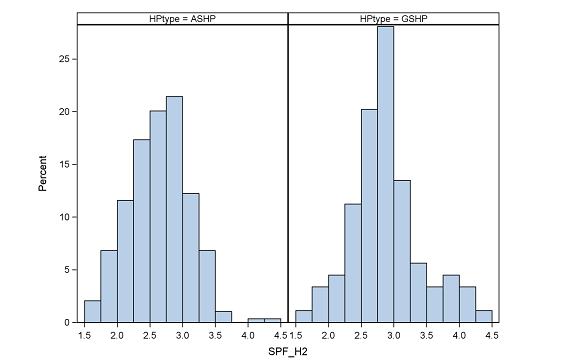
@pdf27. Depends who's figures you choose to believe for COP, and with the greatest respect to Nick Grant, he has always looked on the optimistic side with regard to alternatives to burning stuff (particularly wood and biomass, hence that bloody great rift in the AECB a few years ago), and is a strong supporter of heat pumps (as am I, come to that) I'm inclined to the view that it's "possible" to get a COP that averages above about 3 for a carefully tuned and set up ASHP that is never called upon to deliver DHW. In fact I'd go further, and say that based on our personal experience with a carefully tweaked ASHP we can average an SPFH2 of over 3.5 all year around. However, there is a fair bit of contradictory evidence from the EST and anecdotal evidence from members here, that getting an average COP of even as high as 3 throughout the year is not common (I don't think there are many here that are measuring true SPF in any meaningful way). There's no doubt that the competence of ASHP installers seems to be improving, and I believe, based on my own experience, that it is that which is having far and away the most significant performance improvement. I also think we need to stop looking at heat pumps in terms of COP, as that's a deeply flawed measurement that takes no account of defrost cycling, resistance boost heating within the heat pump itself etc, and I think we should really be talking in terms of SPFH2, rather than COP, as a more balanced and accurate measure of energy in versus energy out over the whole year. The latest government data set is, by it's own admission, flawed, with lots of variability as a consequence of inconsistent measurement methods, but it does seem to indicate that a minority of ASHP installation reach or exceed an SPFH2 of 3, Only around 21% or so of ASHP installations exceeded an SPFH2 of 3.0, and there are a still large percentage of installations that are below an SPFH2 of 3, which does still just make gas a better bet at the moment (part of this may be that the government target SPFH" is only 2.5 - so few installers try to get better performance than this, perhaps. The worst case is the one Nick Grant and Alan Clark have highlighted, where there is a relatively high DHW demand, a condition where all heat pumps start to suffer from performance degradation due to the relatively high Δt. ASHPs using CO2 as the refrigerant may improve things, and reduce the scope for installer set-up induced variations, but right now we at a point where if someone just gets an ASHP installed by a random installer the chances are that their SPFH2 will be lower than 3, making gas both cheaper and lower in terms of CO2 emissions. There's every indication that heat pumps. or more accurately their installation and setup, will improve in the next few years and the plots below are likely to shift to the right, but I think we are a way off that point yet, as change only seems to happen very slowly, unfortunately.
-
Internal windows in a design?
Jeremy Harris replied to Dreadnaught's topic in New House & Self Build Design
We have an internal window from our very high (~6m) hall to one of our bathrooms. I made the window from glass bricks, as these let light in yet provide good soundproofing. It works very well, and lets in a surprising amount of light. -
Yes, definitely. It only makes sense for us to use an ASHP because we stuck with only having electricity, plus we have a fair bit of PV, so summer cooling using the ASHP is almost always "free", You just need to weigh up the capital cost of the brine loop cooling versus it's effectiveness, which is unlikely to be very good. You may want to consider a cheap air-to-air heat pump to address cooling, as opening windows won't help at all when the outside air temperature is warmer than your desired room temperature. Air-to-air heat pumps are pretty cheap and if designed needn't cost a lot to install.
-
Yes, it is an earth pipe problem Brine systems can be made to work OK, but need a lot of ground works. We've found that just using a relatively cheap ASHP and using it for the UFH in winter and then switching it to cooling mode to cool the floor in hot weather works very well (our build isn't PHI certified, but exceeds the PH standard).
-
From wonky shelf to self build in deepest Cambridgeshire
Jeremy Harris replied to Lots2learn's topic in Introduce Yourself
Shame you couldn't get the spreadsheet to run on a Mac, as it should work OK on even a really old Mac. It just needs a spreadsheet programme to be installed on the Mac, and Libreoffice runs OK (and is free) on MacOS. -
Essentially it's a very, very dodgy area in the UK climate. The reasons are to do with keeping the ground heat exchange ducts free from mould and fungal growth for decades. At least one house in Belgium has been made uninhabitable by a poor choice of duct for their MVHR (worth a read): https://www.greenbuildingadvisor.com/article/belgian-passivhaus-is-rendered-uninhabitable-by-bad-indoor-air There are a couple of companies that offer silver-coated ground ducts, to try and prevent mould growth, but they are expensive and (as a scientist) I'm no convinced of their long term reliability. I personally like "permanent" house systems to have a life of several decades, as the last thing I want to do is have to dig up an established garden a few years later.
-
From wonky shelf to self build in deepest Cambridgeshire
Jeremy Harris replied to Lots2learn's topic in Introduce Yourself
Welcome, and sorry for missing your first post. I'll pop over to it and try to help. -
We had one house with hardwood worktops. They look nice, but they are a fair bit of work it you want to keep them looking good. It was my job to regularly give them a rub down with a Scotchbrite pad and then re-oil them, which seemed to be needed at least two or three times a year to keep them looking good. I wanted laminate work surfaces at the new house, but was over-ruled. All I can say in favour of the Silestone we've got is that it looks nice when it's clean. However, being dark grey it does tend to show the slightest mark.
-
One thing to watch would be how to ventilate under the GRP in order to maintain vapour permeability. The GSE/EasyRoof mounts have large ventilation holes in them, with raised edges, behind the panels, so that ventilation is maintained. Not hard to make up a second skin fitted to counter battens, with a ventilated space underneath, and then cover that with GRP. I think I'd prefer GRP to EPDM, as I suspect it may well last longer. Come to that, why not make up a mould to make your own GRP panel mounts. Probably only a day's work to make a mould up, and less than an hour to lay up each panel mount. Or, easier still, make a simple wooden mould and vacuum form the panel mounts from a suitable sheet plastic. There's lots of instructions on the web for DIY vacuum forming - it's not hard to do.
-
Good news, and it's useful experience gained, too, which isn't to be frowned upon.
-
Magistrates do not deal with civil claims. The Small Claims Track is the least cost method for dealing with a limited cost civil matter in a County Court, and will normally be dealt with by a Recorder in an informal hearing, almost always not in an actual court room. It will have nothing at all to do with a Bench of Magistrates at all, as Magistrates generally only deal with the Criminal law.
-
Mocking up a Kitchen island
Jeremy Harris replied to ToughButterCup's topic in Kitchen Units & Worktops
To save drilling into the finished floor, I anchored all our wall facing units to the walls only and I anchored the island by sticking some lengths of planed 2 x 1 down to the floor, 2" side down, inside the outline of the island carcass. I used the small angle brackets that seem to come in abundance with a new kitchen to secure the island down to these bits of 2 x 1. It seems very solid, yet if we needed to replace it I'm reasonably sure I could use a sharp knife and cut the silicone bond holding down the bits of 2 x 1 and so reposition things on the floor to suit a different shape. Other big advantages of flooring the whole kitchen before fitting any units is that you get a dead level floor to work from, plus you can seal around all the edges. I used some PVC angle that was around 25mm to 30mm and bonded it to the floor and wall all around the bottom where the units went, so that any accidental water spillage could not get to the walls or underneath the flooring. -
Mocking up a Kitchen island
Jeremy Harris replied to ToughButterCup's topic in Kitchen Units & Worktops
I put our Island, and all the kitchen units, on to the finished floor. The reason is that the flooring is travertine tiles and is likely to outlast the kitchen, so if we fit a new kitchen then there will be flooring everywhere and that will allow for the new kitchen to be a slightly different shape of size. -
Fabric and ventilation heat loss calculator
Jeremy Harris replied to Jeremy Harris's topic in Heat Insulation
Just had a quick look and it seems there are several spreadsheet apps for the iPad. No idea whether they would work OK or not, but the quick ones I've found are Numbers, Free Spreadsheet and Excel. I'd imagine that using them on a tablet may well be an exercise in frustration though, as one key thing with any spreadsheet is the need to see the screen whilst entering data into cells, so without an external keyboard I'd guess they are likely to be a bit awkward and very slow to use. Any of them should be able to accept an .xls file though, as it's a very old standard. If you need it in another format I can upload in a pretty wide range of them, I'd just need to know what file extension any programme expects to see.- 204 replies
-
- 1
-

-
- heat loss
- ventilation
- (and 4 more)
-
Fabric and ventilation heat loss calculator
Jeremy Harris replied to Jeremy Harris's topic in Heat Insulation
Does the iPad have a spreadsheet app as standard? Not sure it does. The calculator is a spreadsheet, and will run in pretty much any spreadsheet programme, as it doesn't use any functions that are specific to a particular company's product. It runs fine in Microsoft Excel (all versions since 2003), all versions of LibreOffice Calc, Open Office etc. Pretty sure it should run on the version of Excel in Office 365, too. I'm afraid I know little about Apple stuff, but do know that there's a version of Excel that runs fine on Apple Mac machines under MacOS, so it should run on that. I've no idea if there's a spreadsheet app available for a iPad, I'm afraid, as I daren't go near my wife's iPad to find out! I would guess that it won't be that easy to use a spreadsheet on a tablet device, as the chances are the keyboard will end up covering the parts of the screen you want to see a lot of the time, and you'll need the keyboard on screen a lot to change data in the various user-input cells. -
Fabric and ventilation heat loss calculator
Jeremy Harris replied to Jeremy Harris's topic in Heat Insulation
It isn't more complex, it's the same spreadsheet, just with an error corrected in one of the cells. I just renamed the file to give it a shorter file name when I uploaded it here, rather than hosting it on my own website (finger trouble I'm afraid - I need to sit down and sort out why Wordpress has corrupted the file database on my site and try and fix it). -
Fabric and ventilation heat loss calculator
Jeremy Harris replied to Jeremy Harris's topic in Heat Insulation
I've just tried it, downloaded it from the link, edited the suffix and it works fine, both on a Linux machine (opens in LibreOffice without a problem) and on Windows machine, where it just opens in Excel. Here's the link again, just in case it's a link problem: Heat loss calculator - Master.txt -
Planning permission refused - options
Jeremy Harris replied to oldkettle's topic in Planning Permission
In my experience, absolutely anything goes when it comes to planning committee meetings. I've seen some outrageous behaviour, one case where I accidentally overheard a developer stating quite clearly that he'd "paid a bung" to one or more of the committee members (in the presence of a local journalist, who was as gobsmacked as me), I've seen applicants rig up an array of supporters speaking from pre-prepared scripts, people openly lie in front of the committee in order to try and make their point, you name it, it goes on. I'd have no reservations at all in getting someone to stand and speak. If any member of the public registers an interest in expressing their view at a planning committee meeting then I believe that automatically gives the applicant a right to reply. -
Planning permission refused - options
Jeremy Harris replied to oldkettle's topic in Planning Permission
Easy fix there, just get a friend to apply as an objector, and then stand up and basically support your application. That way you get your 3 minutes to make your points...

