Jeremy Harris
-
Posts
26430 -
Joined
-
Last visited
-
Days Won
360
Everything posted by Jeremy Harris
-
We had to jump through a few hoops to prove income, as I'd taken early retirement and so had to prove that my pension was not going to just disappear. Proof of income was the greatest amount of work in getting the mortgage sorted, IIRC, as despite the fact that my pension was more than enough to cover the amount we borrowed, they still needed full details of my wife's income as well, and proof of her pension when she reached retirement age. Getting that information was a PITA, as she was about 5 years off retirement and her employer wasn't set up to provide that information. It all seemed a bit pointless for a mortgage that was never going to exist for more than 5 years, too, but we had to comply in order to get the money.
-

Double or triple glazing on south facing walls?
Jeremy Harris replied to eandg's topic in Windows & Glazing
That Solargard Sentinel Plus is the same film as we have on our front glazing, which is also St Gobain 3G, although fitted to Munster windows/doors rather than Internorm. -
is it difficult to borrow if you have a deposit
Jeremy Harris replied to Amateur bob's topic in Self Build Mortgages
We hit a lending policy change right when we came to draw down our already agreed (and fees paid for) mortgage. We arranged an interest only mortgage on our existing house (which we didn't have a mortgage on) to cover the part of the build for which we hadn't got enough savings for. This was arranged directly with our bank, Santander, who gave us a mortgage offer, did the valuation survey etc, took the arrangement fees from us etc, and then left the agreed mortgage on hold for a couple of months until we needed to draw down from it. We'd planned ahead in arranging the mortgage, but didn't want to draw it down too early as that would have incurred additional interest. We only needed to draw down on it in order to pay the first big payment to our frame supplier (who we'd already contracted with). When I went in to our local Santander branch to arrange the draw down, they told me that their lending policy had changed, and that as I was over 60 they would no longer lend us the money. They also refused to refund our arrangement and valuation fees. This left us in a blind panic, as we needed to pay the frame supplier, but thankfully the Ecology Building Society were both prepared to lend to us and were able to arrange a mortgage in a couple of weeks (they get full marks from me, although they are not the cheapest lender). I then did battle with Santander for nearly a year to get our fees back. -
Double or triple glazing on south facing walls?
Jeremy Harris replied to eandg's topic in Windows & Glazing
I didn't see this available here when I was looking around. It looks as if it might be a good option, although the 3M film we have on the East windows is pretty clear, yet still blocks about 80% or more of the solar gain. The film we have on the outside of the front gable could do with being less dark, though, and this film would have been a good option if I'd seen it at the time. There's a definite grey tint to the light coming in through our front glazing, that makes it seem as if it's a cloudy even on a bright day, and this photochromic film may well reduce that effect a bit. The key thing will be making sure that it's compatible with high performance 3G glazing, as we initially struggled a bit to get our window supplier to agree that it was OK to fit external film (internal film is a definite no-no). -
Interestingly that's slightly cheaper than I was quoted back in 2012 for roughly the same size slab. IIRC, the SE costs plus insulation came to about half the £10,500 total. The rest was the steel reinforcement, concrete and labour.
-
Double or triple glazing on south facing walls?
Jeremy Harris replied to eandg's topic in Windows & Glazing
With the benefit of hindsight, pretty much the only changes I'd make to our house would be related to over-heating. I dearly wish that I'd not been so focussed on heating during the design stage, as heating is a complete non-issue. A single fan heater would keep the whole house warm in mid-winter. I should have spent far more effort in designing out solar gain, without any doubt whatsoever. Getting heat out of a house that's already overheated is much harder than stopping that heat from getting in in the first place. -
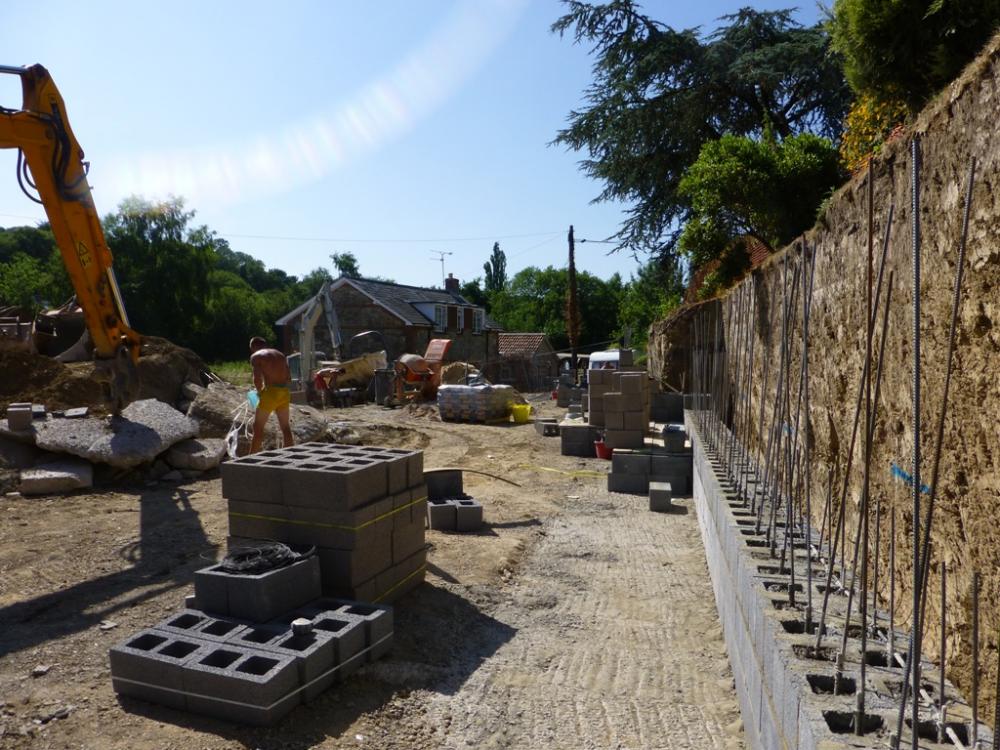
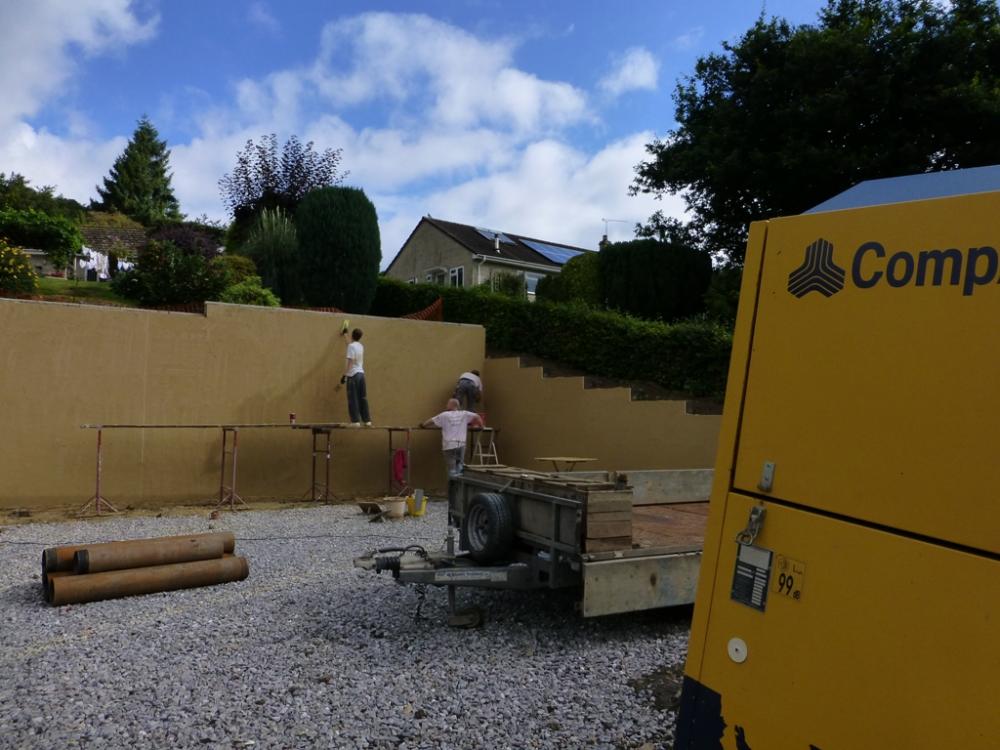
It's two walls that form all of the North boundary and part of the East boundary of the plot. The North wall is about 35m long, and varies from about 3m high in the corner to about 1.5m high at the end, the East wall starts at about 2.5m high and drops down to about 1m high after about 8m. The wall sits on a ~2000mm wide, 400mm deep reinforced concrete foundation, with a 600mm x 600mm concrete key beneath, to resist sliding. The wall itself is built from 215mm wide hollow blocks, doubled up in thickness, with rebar up through the cores, with those cores then backfilled with concrete. There are also rebars laid horizontally along the courses. The upper section of the wall reduces to a single 215mm block thickness above about 1.5m up from the foundation.
-
Designing Mvhr in/pricing
Jeremy Harris replied to eandg's topic in Mechanical Ventilation with Heat Recovery (MVHR)
Not heating, but cooling. It was very much a last minute change of plan, resulting from the weather when we were doing the ground works. After we'd excavated out the hollow that our house sits in, we realised that it was likely to get a bit warm, as we had temperatures in the high 30's when the guys were building the big retaining wall. I'd originally planned to fit a standard MVHR, but spotted the Genvex, with it's cooling capability, and decided to splash out on it. I'm glad we did, as it helps keep the house cool, although with hindsight it would have been cheaper and more effective if I'd opted to just fit a standard MVHR and add a split air con unit, with the indoor unit high in our central entrance hall. -
We didn't have room to batter the retaining wall back, so had to have a vertical solution, with a hefty foundation and lots of steel reinforcement. The best I could find, after a lot of shopping around, was £300 for the SE design and £35k for the excavation and wall construction (which included rendering and a low stone wall on top, facing our neighbour). IIRC, the stone wall cost around £4k out of the £35k, and that was just to keep our neighbour onside.
-
Double or triple glazing on south facing walls?
Jeremy Harris replied to eandg's topic in Windows & Glazing
Our 3G front glazing is about 2m wide by 5.5m high. Wasn't a problem to install, and was done without using any lifting gear, just three fitters who manhandled it all into place. -
Designing Mvhr in/pricing
Jeremy Harris replied to eandg's topic in Mechanical Ventilation with Heat Recovery (MVHR)
Why would anyone have a maintenance contract for an MVHR? Maintenance is designed to be by the consumer, just a matter of cleaning/replacing the filters every 4 to 6 months, which is less challenging than emptying a vacuum cleaner and replacing/cleaning the filters in that. -
Double or triple glazing on south facing walls?
Jeremy Harris replied to eandg's topic in Windows & Glazing
TBH, in purely financial terms it would never pay for itself, as most of our cooling energy comes from the PV system. The problem we have now is that, having paid for the 3G, and then paid another big wedge for the reflective film, we've already splashed a lot of cash on the glazing. That would be wasted if we decided to retrofit Sageglass. However, it's not all about whether something pays for itself, there's a certain value in having glazing that provides greater comfort. -
Designing Mvhr in/pricing
Jeremy Harris replied to eandg's topic in Mechanical Ventilation with Heat Recovery (MVHR)
All MVHR systems, without exception, need two external ducts, one for fresh air intake, one for exhaust. I installed a very expensive active MVHR system (it includes an air-to-air heat pump, so can cool and heat the house) and the total installed cost was about £5k. A more basic MVHR could have been installed for about half that. This was for a 130m2 house. -
Double or triple glazing on south facing walls?
Jeremy Harris replied to eandg's topic in Windows & Glazing
Our experience has been that a large roof overhang is OK in summer, but summer isn't the problem. The really BIG problem we have is in Spring and Autumn, when the weather is relatively mild and the sun is low in the sky, so penetrates deeply into the house. We are in a sheltered spot, and the lack of wind where we are definitely contributes to our overheating problems, but I'm still kicking myself, 6 years on, for having been obsessed with heating, when the reality has been that heating is a complete irrelevance, the main problem we have is cooling. We start actively cooling the house in March, and will carry on using active cooling through to at least October, so cooling is far and away our biggest energy consumer, accepting that most of that energy comes from our PV system. FWIW, SAP showed that we had about a 5% overheating risk, which is massively in error. We don't like the bedroom to be warmer than about 21 deg C, or the living rooms to be above about 22 deg C, yet even today, when it's been cloudy here, we're sitting with the air cooling running flat out since about 7am, (it's still running) and the bedroom's at 21.5 deg C and the living room is about 22.5 deg C. We've had the cooling systems running every day for the past month or so. -
Double or triple glazing on south facing walls?
Jeremy Harris replied to eandg's topic in Windows & Glazing
Do you need the solar gain, or will it be likely to contribute to over-heating? With a good level of insulation and airtightness most of the heat loss in a house is from the glazing, and solar gain is a very mixed blessing. I cursed the amount of heat that came in through our glazing, and dearly wish that I'd specified glass that kept much more of it out, as that would have saved on having to have reflective film installed on the outside of the glass to try to cut down the spring and autumn over-heating. The amount of solar gain we had during the heating season in winter, before we installed the reflective film, was negligible in practice, and we don't notice any difference at all, even though we've now blocked something like 80% of it. -
As another example, I used a local SE to design and spec our retaining wall, which is a pretty massive structure (much bigger than our foundation slab). I had one quote from another local SE for £8,500, plus site visit charges as required. The SE we used charged £300 +VAT. The retaining wall cost around £35k in total.
-
Then I'd shop around. I have the breakdown of costs from Kore and that's the SE cost element from 2013 (total was £10,800 for a ~7m x 12m slab).
-
SE costs for a passive slab were around £500 or so when I enquired back in 2013, so nowhere near half the cost, more like 5% of the cost.
-
Please recommend shower wall panels
Jeremy Harris replied to joe90's topic in Bathrooms, Ensuites & Wetrooms
Multipanel is the one that has the rubbish bottom seal. However, it's easy to get around this by not using the gutter-like sealing kit they supply, and just using a decent sealant at the base. The problem with their kit is that it has a shallow channel that the panel sits in, and no matter how well you try and seal it, water ends up sitting at the bottom edge of the panel and swells up the ply. -
savings to be had
Jeremy Harris replied to selfbuildaberdeen's topic in General Self Build & DIY Discussion
Our foundations, frame (with closed panel insulation), 3G doors and windows and roofing came to about 47% of the total build cost, excluding the plot cost. First fix costs after that were relatively low, as I did all the plumbing, heating and ventilation system work, and some of the labouring for the wiring. Second fix costs were higher, as they included paying guys to do the plaster boarding and plastering, lay our stone flooring and getting a joiner in to hang the internal doors and help install the stairs. I made a fair saving by doing all the kitchen and bathrooms fitting out, by laying the bamboo flooring and by fitting all the skirtings and architrave myself. -
I went around several local architectural practices with our site plan and our list of requirements for the house and had estimates that varied between 10% and 15% of the finished cost of the build. That would have equated to around £20k to £30k. That was for an architect design and managed build. I also saw a local architectural technician and his fees would have been lower. A design, PP and BC drawings only package would have cost about £2.5k. He didn't offer a managed build option, so we'd have had to use a project manager. As it turned out, the only chap I felt comfortable with was the architectural technician, but because we had a long delay in completing the purchase of the plot he'd retired when we came to start. As a consequence, I opted to do the design, drawings, PP and BC submissions myself. I also opted to project manage the build. A steep learning curve but it did save quite a lot of money. My advice would be to look a using an architectural technician as well as architects if you know what you want. In general, architectural technicians do a lot of smaller, domestic scale, work, and can often have as much, if not more, practical knowledge.
-
Minimum kitchen sink window height from floor
Jeremy Harris replied to Wagas's topic in Building Regulations
Our plinths are 150mm high, but the Silestone work tops are only 20mm thick. I think that the units are pretty standard in terms of height. -
Minimum kitchen sink window height from floor
Jeremy Harris replied to Wagas's topic in Building Regulations
I agree that between 1050mm and 1100mm works well. Our worktops are 900mm above the floor and the window cills are 170mm above them, so about 1070mm above FFL. -
Air Source Heat Pump vs Oil Boiler
Jeremy Harris replied to paulc313's topic in Air Source Heat Pumps (ASHP)
That's because they are trying to sell you something that isn't needed. The instructions for our ASHP are clear. It needs a visual inspection externally once a year and, if needed, any dust or cobwebs need to be cleaned out of the heat exchanger. It takes all of five minutes with a soft brush to do this. There are no parts within the ASHP to maintain. The only other check is related to the heating installation, rather than the ASHP, and that's to check that the pressure and pre-charge are OK. This takes seconds to glance at the pressure gauge, and is something I tend to do every few weeks as a matter of course. Putting a tyre pressure gauge on the pressure vessel and checking it similarly takes seconds to do. The settings for the heat pump vary from make to make. We never bother running ours in eco/quiet mode, as all it does is make it run for longer to deliver the same heat output. It's very quiet in normal mode, and despite us living in a very quiet area we can't ever hear the thing running (unless stood outside right next to it). If your house is only going to be built to just meet building regs then the heating requirement will be quite high (relatively speaking) and so you would burn more oil and if using an ASHP you'd get a higher RHI payment for the first 7 years. You may find that the RHI payment makes the ASHP a fair bit cheaper option because of that. If you improve the energy efficiency of the house, to the sort of level ours is, then the RHI becomes a bit pointless. There is a premium for an ASHP installed by an MCS approved installer that's typically around £1,500 to £2,000, because they know that you need an MCS approved installation in order to claim the RHI grant. Taking our case as an example, the RHI payments for us would have been about £84 a year for 7 years, so about £588 in total. We were quoted about £4,000 for an MCS approved ASHP installation. I bought an ASHP for £1,700 and fitted it myself in less than a day (dead easy job). The total installation cost was around £2,000. So I saved about £2,000, but lost out on the RHI grant of about £588, so we still came out way ahead. The same may not be the case if you have an inefficient house that needs a lot more heat, as in that case the RHI payments will be a lot higher, and may well cover the higher costs associated with an MCS installation. As an aside, I have little experience of installing heating systems but found that installing an ASHP was extremely easy. Just two pipes, a power cable and a control cable. Any competent heating installer could fit one in less time that it takes to install a boiler, as there's no messing about fitting a flue etc. -
Air Source Heat Pump vs Oil Boiler
Jeremy Harris replied to paulc313's topic in Air Source Heat Pumps (ASHP)
Best to look at this as a sum of two parts, the capital cost associated with purchase and installation and the whole life running cost. An oil fired boiler will be perhaps half the capital cost initially, and likely have a real-world efficiency of around 85%. For any given heat output the running cost can be estimated, and this will vary with the price of oil. If you had a house that needed around 5,000 kWh of heating and hot water a year at today's oil price of around 50p/litre, and assuming that 1 litre of oil gives about 10.5 kWh at 100% efficiency, then at 85% boiler efficiency 1 litre of oil would deliver just under 9 kWh. To meet the notional 5,000 kWh annual demand the boiler would burn about 555 litres of oil, at a cost of about £277 a year. An ASHP would cost more initially, and would have a real-world efficiency of around 300%. For the same 5,000 kWh annual demand, the ASHP would consume about 1,667 kWh of electricity, and if run on a standard tariff of about 15p/kWh would cost around £250 a year. However, we run our ASHP almost exclusively on the Economy 7 off-peak tariff, which only costs 8.148p/kWh, so using that tariff rate 5,000 kWh of heat (1,667 kWh of electricity used) would cost about £136 a year. In addition to the above, servicing costs need to be taken into account. An oil fired boiler is likely to always need an annual service, at around £100, whereas an ASHP is pretty much maintenance-free, all it needs is an occasional external clean. The question then becomes one of whether the potential saving over the life of the unit will justify the difference in the installation cost. If the house is pretty poor thermally (say, built to only just meet building regs) then the chances are that the RHI payments that the ASHP installation would attract might well cover the installation cost difference.