


Jeremy Harris
-
Posts
26430 -
Joined
-
Last visited
-
Days Won
360
Everything posted by Jeremy Harris
-
Welcome. Breaking that estimate down by item: Honeywell 2 port valves cost about £80 each and will take maybe an hour to change, at around £20 to £30 per hour, so about £180 to £190. A power flush takes a couple of hours or so and typically costs around £200 to £300, so that's another fair chunk. Refilling and testing the system shouldn't take more than an hour, so maybe £20 to £30 for labour. Inhibitor will be around £30 for 4 litres. A Salus magnetic filter is about £50 A boiler service is typically around £100 to £120 or so Adding that lot up comes to a bit over £600, so the price you've been quoted seems about right.
-
Not at all. I've already mentioned that I believe that the word efficiency may be being misused, but, unlike some other terms, efficiency doesn't have several different meanings. Most commonly the word has two common meanings: the good use of time and energy in a way that does not waste any: "What is so impressive about their society is the efficiency of the public services." energy efficiency: the difference between the amount of energy that is put into a machine in the form of fuel, effort, etc. and the amount that comes out of it in the form of movement Neither of these has any reference or connection to comfort, and if the Nexgen advertising material had referred to “around 55% more comfort than a Water based system”, rather than “around 55% less energy than a Water based system”, then I'd not have picked up on this point at all.
-
 The reason I got rid of my BOC Portapak was the eye-watering bottle rental, although I made up hoses so I could surreptitiously refill my bottles from full size ones at work (BOC definitely would not have approved!).
 -
The intention was not to insult you, or your company at all, just to point out the fact (and it is a fact, not an opinion) that 1 kW of heat emitted from a 1950's single bar electric heater is absolutely identical to 1 kW of heat emitted from any other near-zero loss heating system. All this talk about wavelength etc is irrelevant, as space heating a house is a pretty much steady state requirement, where all surfaces will reach an equilibrium temperature and the heat input power needed to maintain a given room temperature will have to match the heat loss power from the fabric of the building (and that heat loss power includes all forms of heat loss, so conduction through the floor, walls and roof, as well as ventilation heat loss). All that matters, as far as efficiency is concerned, is the ratio of the input power to the heat output power.
-
I think the key issue here is understanding just how heat is transmitted from any body that is at a warmer temperature than closed surroundings. The latter is very important, as the unmodified Stefan Boltzmann equation relates only to radiated heat from a body that is at a temperature above absolute zero. For all practical space heating situations, the radiated heat from any emitter will be very significantly impacted by the temperature of the surrounding surfaces. Things are further complicated in that any heated surface will also conduct heat into the air surrounding it, and heat will also be convected through the air surrounding the heated surface, depending to some degree on the orientation of it. Because the Stefan Boltzmann equation applies only to a heated body in a vacuum, where conduction and convection cannot occur, it will tend to give a result is pretty inaccurate when trying to determine the radiated heat output from a real-world surface within an air filled closed space, like a room. To add to the complexity of the way heat is transported around a closed space, surfaces within the room will be heated by radiation from the heated surface, and by conduction from the warmed air in the room. Those heated surfaces will then radiate, conduct and convect heat, so setting up some pretty complicated heat transfer paths. In the case of any heated panel fitted within a finished wall, ceiling or floor, the amount of heat that is radiated from it (in Watts) will depend only on the temperature differential between it and the surrounding surfaces and the emissivity of the finished wall, floor or ceiling. Generally, painted or papered finishes on walls and ceilings are likely to have an emissivity of around 0.9, so using that should give a reasonably accurate estimate of heat output for any given temperature differential. Some account also needs to be made for heat that will be conducted and convected from the heated surface, too. This will only be a relatively small proportion of the total heat output, in the case of a low temperature heated surface, but nevertheless needs to be included in any calculation. It's worth noting that most of the heat emitted by wet underfloor heating is radiated, too.
-
Air changes per hour has no relevance at all, as ventilation heat loss is simply one element of the total heat loss for any heated enclosed space, and has no more, or less, significance that the thermal conductivity of the structure. The hot water system is always isolated from the UFH, without exception. It has to be, as I mentioned in the earlier post. The use of a buffer tank makes no difference to the efficiency, either, as any buffer would always be within the heated envelope. We preheat hot water to ~35°C to 40°C using a plate heat exchanger, then increase the temperature up to about 55°C using a thermal store. This means that incoming cold water is flash heated to hot water, just like it would be in a combi boiler. with no body of stored hot water. There is no requirement (or practical means to provide) legionella treatment, as there is no stored body of hot water to heat up.
-
For your specific case the conditions are very different from inside a closed space. Outside, where the differential temperature, as far as radiated heat is concerned, is very high (because the sky temperature is extremely low, not far off absolute zero) then the heat radiated by the aluminium plate will be close to that given by the normal (unmodified) Stefan Boltzmann equation. The temperature that the aluminium plate is heated to by solar radiation depends on the insolation and the sun-facing emissivity of the plate, as Kirchoff's law of thermal radiation applies. If the plate was matt black then it would reach a high temperature, if it were polished to a mirror finish then it would reach a much lower temperature. Someone underneath the plate would feel the heat re-radiated from the plate, and again this would depend on the temperature of the plate and the emissivity of the underside face. The re-radiated heat from the underside of a matt black plate would be very much greater than that from a polished plate. The bottom line is that, for this case, the amount of heat radiated from the underside of the aluminium plate would be extremely dependent on the emissivity of both sides of the plate. Emissivity would dominate the level of radiated heat, much as it will from any heated surface.
-
I would agree that the use of radiant heat for medical treatment purposes seems to be pretty well proven. I seem to remember my mother using one of the pig heat lamps we used on the farm to ease pain as she got older. With regard to wet underfloor heating, then those temperatures look very high indeed, and far from typical. Our UFH runs at a flow temperature into the floor of about 26°C. Any higher and the room temperature tends to overshoot the set point, even with a 0.1°C hysteresis thermostat. The flow temperature only really governs the response time, though and has little or no effect on the heat delivered to the room. That is determined by the floor surface temperature and the emissivity of the floor covering, as the majority of the heat delivered by wet UFH is also radiant, with only a small percentage being transmitted to the room by convection. In our case the floor surface temperature never exceeds about 22.5°C, although in theory it might need to get as high as 23.2°C in order to maintain a 21°C room temperature when it's -10°C outside, and there is no incidental heat gain contributing to the total heat input. Legionella is not applicable to wet heating, as the system is sealed. We have no legionella treatment at all, as there is no connection between the sealed low temperature UFH loop and the domestic hot water system. This is the normal arrangement, as the UFH loop will always contain potentially toxic inhibitor and antifreeze, so must remain isolated from any domestic hot water supply.
-
I didn't mention, or refer to, conduction, only emissivity. As I'm sure you know, the transfer of radiant heat from a warm body, in the specific case of space heating in a house, depends on it's temperature relative to its surroundings and the emissivity of it's surface. The equation is simple, it's a modified version of the Stefan Boltzmann equation. A matt black aluminium sphere is pretty damned close to s perfect black body, with an emissivity of very close to unity, whereas the same aluminium sphere, with a mirror polished finish, would have an emissivity of about 0.05. The consequence of these two very different emissivities is that the heat radiated from the polished sphere, for a given temperature differential, would be a small fraction of the heat radiated from a matt black aluminium sphere, with the same temperature differential.
-
Which unit
Jeremy Harris replied to Pocster's topic in Mechanical Ventilation with Heat Recovery (MVHR)
I'd only consider that in a really extreme set of circumstances, as there will inevitably be some degree of mixing between the intake and exhaust, plus it may well invalidate some performance elements of the MVHR unit warranty, or be considered non-compliant by building control if they chose to be pedantic. It's a compromise solution, for circumstances where it would be impossible to fit two well-separated external terminals, rather than something to be used routinely. There is guidance in Part F and in the associated Domestic Ventilation Compliance Guide on the placement of fresh air intakes and exhaust terminals and it states that the exhaust terminal should be positioned down wind (relative to the prevailing wind conditions) from the intake, and sufficiently far away from it to ensure that exhaust air is not drawn in to the intake. Additionally, MVHR manufacturers often stipulate in their MIs the spacing, and MIs always overrule building regs when it comes to compliance demonstration. For example, the MIs for our MVHR stipulate the following separation criteria between intake and exhaust: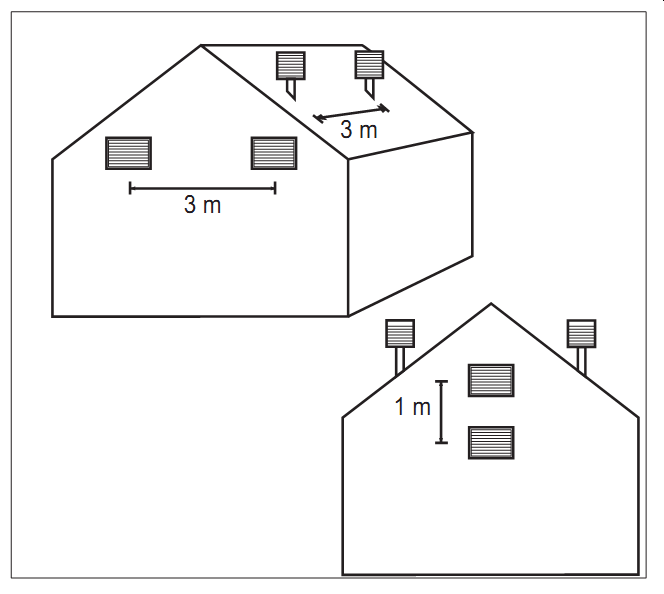
-
What does this have to do with efficiency? I have a feeling that the word "efficiency" may not always be used correctly here. For any heating system, of any type, efficiency is always, without any exception, the ratio of total power in to useful power output, and will always be less than unity in practice, due to losses that reduce the useful power delivered. For example, heat pumps may look like over-unity devices, but in reality we usually only measure a small part of the input power, the electrical power in to the device. Most of the power they deliver comes from heat extracted from the heat exchange medium (usually either air or brine heated up from the ground or a water source).
-
The material makes absolutely no difference to the emissivity at all. For example, we used to used matt black painted aluminium temperature controlled spheres as black body reference sources for calibrating bolometer thermal imaging sensors. They had an emissivity of very close to unity. Polishing one of those aluminium spheres to a mirror finish would reduce the emissivity to about 0.05.
-
My hope is that the test results will demonstrate the total efficiency, and validate the advertising claim that this is significantly higher than water based heating, such as conventional underfloor heating systems. The easiest way to demonstrate this would be to provide data that shows the electrical input power needed in order to deliver a defined heat output power. The time taken to reach this steady state isn't important, as it has no bearing on efficiency, as long as there is a linear relationship between input electrical power and heat output power (which there will be for any form of electrical resistance heating).
-
Thanks, I look forward to reading it in due course. Sorry, but I didn't "start" anything. I only made the point that 1 kW of heat = 1 kW of heat, and the means by which that heat is delivered to a space with a defined heating requirement doesn't matter, as far as the steady state is concerned. I understand the perceived comfort effect well too, and have commented here several times on how 3G glazing, with 2 low e coated panes, feels subjectively warmer for a given room temperature than 2G glazing with only 1 low e coated pane. The reason for that is primarily to do with the surface of the body sensing the reduced radiative heat loss through the glazing. Using a black body reference source (emissivity = 1.0) would be normal practice for calibrating instrumentation, but the key factor will be the actual surface emissivity of the decorated wall, ceiling or floor into which the heated film is set. A painted surface will have an emissivity of about 0.9 usually, as I'm sure you're aware.
-
Those numbers don't seem to match what would be expected, are you sure that the data is accurate? Even small errors in surface and room temperature measurements can result in fairly large variations in heat output, due to the non-linear relationship between ΔT and heat output for a radiating surface. Using your data, and assuming a surface emissivity of 0.9 for the wall/panels (which will be within a couple of % for a typical painted wall), then for a heat output of 870 W (not "watts per hour") then the ΔT between the heated surface temperature and the room temperature would be 7.93°C. So, for a heated surface temperature of 32°C the room temperature for this heat output would be 32°C - 7.93°C = 24.07°C and for a heated surface temperature of 34°C then the room temperature for this heat output would be 26.07°C. These room temperatures seem very high to me. Are you 100% sure that the surface temperature of the heat emitting surface is really as high as 32°C to 34°C? Using a more typical case, with a room temperature of 21°C, a heated surface area of 10m² and a surface emissivity of 0.9 (so ΔT for 870 W heat output is 7.93°C), gives a heated surface temperature of 28.93°C. This seems to be much closer to what I'd expect, having measured the surface temperature of other radiant heating systems in the past.
-
I appreciate what you're saying, but there is a very clear, fundamental, principle here. To heat a given space, that has a known, fixed, heating requirement, to a defined temperature, requires a defined heat input. This cannot be changed, it is a fixed function, determined by the heat loss rate from the space. Ventilation rate is just one element of the total heat loss, so is included in the basic heating requirement; it has as much significance as the other forms of heat loss from the heated space. The form of heat input is irrelevant The time taken to heat the space is irrelevant, as we are dealing with a steady-state condition, not a dynamic one. It matters not whether the heat be entirely radiant, convective or conducted. The area of the heated surface is also irrelevant as far as efficiency is concerned. All that matters is the amount of electrical power required in order to provide the required heating power into the space, to balance the heat loss rate. As we live in a self-build passive house, that I designed and thermally modelled, I understand the challenges of managing heat loss, heat recovery ventilation, ensuring that the decrement delay for the external structure is adequately long to ensure good thermal stability, and the heating and cooling challenges of such a build. I look forward to seeing your energy efficiency data in due course.
-
Which unit
Jeremy Harris replied to Pocster's topic in Mechanical Ventilation with Heat Recovery (MVHR)
I retro fitted the one pictured, I just put the remote sensor that comes with that unit inside the extract plenum chamber, which is fairly close to the MVHR unit. The MVHR just needs a dry contact switch to make it boost, and this humidity controller has dry contact relay contacts available. It should work with any MVHR that has a switch input for boost. -
@Clive Osborne, can you please just answer the question asked about efficiency. The laws of physics are pretty well proven. If you take a house with a known heat loss, under defined conditions, then it will require a defined amount of heating power in order to maintain a given temperature differential. If your heating system requires less electrical input power in order to provide that heating power, then please give the EXACT mechanism by which that can happen, with supporting evidence. You seem to be exceptionally adept at obfuscation, referring to irrelevant control and maintenance cost aspects in order to avoid answering the fundamental question about efficiency. Some may view that as being suspicious, but I'd like to give you the benefit of the doubt. Your advertising is clear, it states unequivocally that your heating system uses, quote, “around 55% less energy than a Water based system”. I have shown very clearly that this doesn't seem to be the case. The onus is on you to prove that my analysis is flawed. Why not just post the energy efficiency rating for your system? A simple photo of the energy efficiency label would be a start. By way of background, before I retired I was a senior principal scientist, my first degree was in physical chemistry, my second was physics with electrical engineering, my post-grad training was in aerodynamics and aircraft instrumentation. I am, therefore, reasonably well-qualified to try to understand the way in which an electrical heating system may perform.
-
Many of the online prices are for an RdSAP, the Reduced Data version that's used for things like RHI and other grants, and used to be needed for PV systems when FiT was around. The work needed for a full as-built SAP assessment for a new build and lodging the EPC etc is significantly greater. It doesn't involve any inspection or a site visit normally, but there is a fair bit of data that has to be put into the worksheet. Collating and checking this data, then putting it into the worksheet, could take some time. Not sure how much, but I spent a fair few hours collating and checking all the data that went in to ours.
-
I did our design SAP/EPC, as that doesn't need a registered assessor to do (I didn't find it hard to learn about SAP, either). For the as-built one I found an assessor that would accept my file, so I entered all the data, emailed him the file and he checked it and lodged the report (which ticked the box for building control). The cost was £120, but that's three years ago, and he didn't have to do much work.
-
True story. When we got married we sent around a wedding present list. Wife-to-be's uncle wasn't short of a few bob (hereditary peer, family lived in the same castle since 1086, etc). He rang me up asking about the wedding present list. Said he'd like to get us something decent and wondered what a washing machine was. I told him, and his astonished reply was "Don't you have a woman to do that?"... To think he used to sit in the House of Lords helping to approve our laws.
-
You can just about braze with ordinary butane/propane mix, as used in cheap plumbing-type blow torches, but it's right up at the upper end of what one of those will do, especially on anything other than small parts. Silver solder is a great deal easier, as long as the parts are clean, and doesn't need as much heat as brazing. The downside of silver solder is the cost of the stuff, but for small jobs it's not too bad. A MAPP gas torch will braze pretty easily, but you're then swapping the high cost of silver solder for the high cost of gas.
-
If you learn the hardest and most technical technique (almost certainly TIG) then you will have no trouble at all with MIG or stick welding. Stick welding is of fairly limited use, especially for car work, MIG is probably the closest there is to an all round welding technique, and has the advantage of requiring the lowest skill level in order to make serviceable, if a bit ugly, welds. TIG is the most expensive set up, then MIG, then stick welding, so that has some bearing on your choice, perhaps. Welding underhand with TIG is trickier than welding underhand with MIG, and MIG is probably the most common welding method used in car repairs (might have a fair bit to do with the lower overall skill level needed plus the lower cost of kit, though). TIG works with pretty near any metal, as long as you have a TIG set that offers AC and DC, together with HF start. With TIG and the skill to use it there isn't much you can't weld.
-
Or try one of the under-carpet supplementary heating systems, like this one: https://www.bewarmer.co.uk/rugbuddy-under-rug-heating/
-
There are systems available with a slim build up, this one is 25mm: https://www.ufh.co.uk/products/underfloor-heating-panels and this one can be as low as 15mm: https://www.warm-board.com/warm-board/


