Jeremy Harris
-
Posts
26430 -
Joined
-
Last visited
-
Days Won
360
Everything posted by Jeremy Harris
-
The idea wasn't mine, it came from a chap doing some landscaping work for us, who had a digger on site. We were thinking of what to do with one area and he suggested it as a secret cave. It was one step on from that to make it a location for a secure and weatherproof outdoor safe. Not hard to do, as the safe is secured inside a totally weatherproof, airtight enclosure, so the safe is nothing special, didn't cost me anything, either, as I scrounged it when it was being thrown out at work, years ago. The safe was security rated as being OK for secret and top secret documents back when it was made, so should be secure enough! Moving it and securing it needed two of us and a digger, though.
-
@lizzie's slab is like ours, only 100mm thick, so not deep enough for a decent sized document safe. I have our safe outside the house, hidden so it's not obvious where it is. Seems to be a good location for it, as it's dry, secure and well aware from anything like fire. As a bonus, I have a spare set of keys in it, so it doubles up as a way to get into the house if we lost our keys (the safe doesn't have a key).
-
 Looks very like the sort of bedroom furniture found in some hotels, so a look around hotel outfitters might prove fruitful. Alternatively, it's probably something that a reasonable joiner could make fairly easily, perhaps. My concern would be the effect of contact with the corners of the bed frame on my shins in the middle of the night. We have an oak chest at the end of the bed and that's caught me a few times now, but it's at knee height. I think if it were at shin height it would have had to go...
 -
It looks like yew may be of some value to woodturners: https://www.ebay.co.uk/itm/One-English-Yew-wood-turning-log-blank-200-or-300mm-8-or-12-long-/252635866439 200mm long, 120mm diameter lumps going for £18 each.
-
Smaller bore pipes seem fine for sinks, basins, washing machines, dishwashers etc, and for a mains pressure hot and cold system (which is pretty universal now, both pipes can be the same bore. They've been using smaller bore pipes in countries like France for decades now, and they seem to be OK. In general, a tap on a sink or basin doesn't need to flow at more than about 4 to 6 litres per minute, and the lower flow rate seems to reduce splashing a lot and make taps more controllable. The only caution I'd have is if you had a particularly low pressure mains water supply, as then the flow rates might be a bit low with smaller bore pipes. Also, it's best to run showers and baths from larger pipes in order to get them to flow at a reasonable rate.
-
The way the Chinese water heaters work (there are loads of them, and Jiangsu Gomon is one manufacture of them: https://www.chinagomon.com/model-a.html ) is that they use warm air from the house as the intake for the heat pump, so they can deliver a high temperature to the water as the ΔT is still reasonable. They can be integrated (sort of) into MVHR, but they do unbalance the MVHR a fair bit whilst heating the water and so cause a small heat recovery deficit for that period of time. I'm not sure if any of the manufacturers in China have taken heed of the way that companies like Genvex, Paul and Nibe have managed to get around this potential problem with exhaust air heat pumps or not. Last time I looked all the Chinese systems were still using fixed rate heat pumps for these integrated tank heaters.
-
My guess is similar, that they are looking to leverage the extensive Chinese knowledge and experience with direct heat exchanger heat pump water tanks (the Ecocent is an example of the very common Chinese direct heat exchanger heat pump water heaters). There are literally dozens of manufacturers of this sort of integrated heat pump/hot water tank combination on sale in China, so my guess is that the idea here may be to do something similar and integrate a direct heat exchange heat pump into a Sunamp PCM store. Seems like a good idea in principle, and the chances are that using a direct heat exchanger might just be enough to get up to the ~60° to 65°C needed.
-
Different duct sizes
Jeremy Harris replied to bissoejosh's topic in Mechanical Ventilation with Heat Recovery (MVHR)
I can't help thinking that mixing systems is likely to result in a system that's really difficult to balance, bearing in mind the need to ensure the need to ensure that the flow rates remain balanced with changes in ventilation rate (from background through to full boost). One thing that needs care is making sure that there is no tendency for a branched-off larger duct to create an imbalance as the flow velocity increases, due to possible dynamic changes in flow induced by a local velocity change past a junction. If the index branch changes due to a change in velocity past one of the junctions in the ducting, then it may well be near-impossible to balance the system properly. -
When flying and working on aircraft, the golden rule was to always tell everyone about any error or mistake. The only really stupid thing is to make a mistake and then keep quiet about it.
-
Ecology were pretty quick, around four weeks from start to finish, IIRC. The longest part of the process was getting the plot valuation, which took around a week to sort out. The fees were £300 for the valuation plus £995 for the set up fee, but this was in 2014, so they may well have changed since then.
-
Different duct sizes
Jeremy Harris replied to bissoejosh's topic in Mechanical Ventilation with Heat Recovery (MVHR)
In that case I think I'd be inclined to switch from a radial configuration to a conventional rigid duct configuration for the whole house. I strongly suspect that trying to balance a mixed configuration will be a nightmare, especially with conventional larger bore ducting on the extract side and small bore radial ducting on the fresh air supply side. Whilst a conventional duct configuration needs a bit more up-front design work to get the flow rates in the right ball park, I think it may well be your best option.- 7 replies
-
- 1
-

-
- mvhr duct
- galvanised
- (and 2 more)
-
I've only got experience from the Ecology, and they were very easy to deal with. We didn't have a staged release, as Ecology just let us have all the money upfront, but it wasn't for the whole build cost, only a relatively small part of it.
-
An alternative is to just use small bore pipe for the feeds to basins and sinks. 10mm pipe is usually fine for these, if you have a decent mains pressure, and the hot water will run a lot quicker due to the smaller volume in the pipe. It's also easy to increase the size of the insulation on 10mm pipes without things getting too bulky in confined spaces, and the heat loss will generally be lower overall, due to the lower volume of hot water in the pipes and the smaller pipe surface area.
-
Welcome. There is a bit of a problem with a shortage of brokers who operate in the self-build mortgage sector, and the fact that the biggest player in that market, Buildstore, tends to be pretty expensive. Our experience was that Buildstore was also expensive and very slow. They do offer a range of additional services, though, like site insurance (which you can get direct without paying the Buildstore markup) and a warranty. The Ecology Building Society are very good, and offer self-build mortgages, but only if the build meets their environmental standards. I'm also not sure if they offer mortgages North of the border. Our experience with the Ecology was very good indeed, and I'd not hesitate to recommend them. I'd suggest shopping around yet again, rather than accept any offer where the fee was a percentage of the amount borrowed. As @Christine Walker has mentioned, the idea of paying such a fee seems unreasonable.
-
Different duct sizes
Jeremy Harris replied to bissoejosh's topic in Mechanical Ventilation with Heat Recovery (MVHR)
The standard way to do this with a 75/68mm radial duct system is to double up the ducts. The terminals will usually accept either one or two ducts, so for any high flow rate extract rooms you just run two ducts in parallel from the plenum. If you need more than that then you will need to add extra terminals to the room anyway, as the maximum flow rate through a ceiling terminal becomes the limiting factor, not the duct size. In general, standard size ceiling terminals can only handle the flow from up to about 100mm diameter duct, or two parallel 75/68mm ducts. The flow velocity has to be kept below 2.5m/s everywhere if you want to avoid flow noise. Anything over 2.5m/s, even locally around a terminal, will start to make a noticeable noise. This probably isn't an issue for high rate extraction (for example to meet building regs for a kitchen), as that's only a boost extract rate, so will only be on for relatively short periods when needed. -
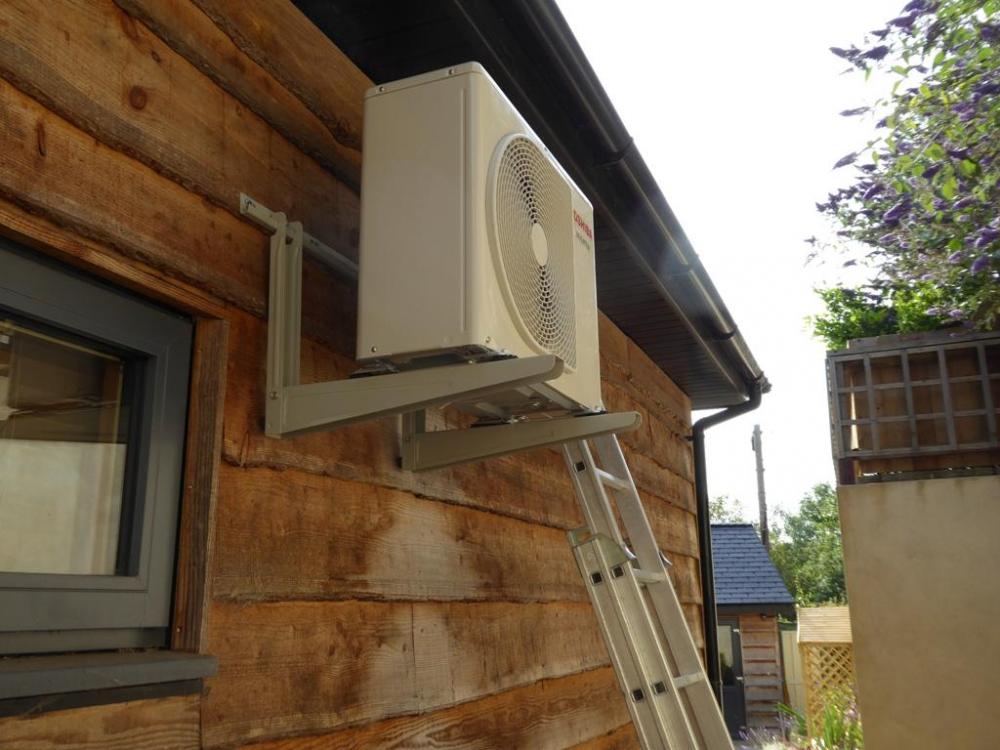
Sadly not, and if I had it'd have been a long one, given that it took me several goes to get the thing up there. It's fixed now, just needs plumbing, wiring and testing.
-
FENSA only applies to installers, not manufacturers, so it's the installation that is getting building regs approval as being compliant via the FENSA contractor. The main issue will be compliance with Part B (fire escape provision through windows), Part M (width of openings, thresholds etc) and Part N (glazing safety).
-
There's a brilliant Catch 22 in this one. As a sop to the complaints raised by some home built boat hobbyists during the consultation phase, they added a clause that allowed a home built boat to be sold without a CE mark after five years from "having been first brought in to service". When tested, being "first brought in to service" was considered to be when the boat might be inspected by someone authorised to declare that the boat was compliant with the RCD. In other words, there is no way for a hobby builder to be able to prove the date when it was "first brought into service" without paying a fee to have the boat inspected (typically around £500) and CE marked. If they do sell it without doing this, then they become personally liable should there be a later accident involving the boat. The consequences of that are unthinkable in terms of cost, and it's an uninsurable risk. People do break this regulation all the time, but I suspect they may not be aware of the consequences of doing so. I decided to officially scrap both boats and give them away as scrap on Freecycle.
-
The Recreational Craft Directive has a commercially-driven clause in it that makes it unlawful to sell a second-hand home built boat, as it doesn't have a CE mark and may not comply with the requirements of the Directive. It's lawful to build one for your own use, but not to sell it.
-
I agree wholeheartedly. The kWh is a bastardised unit that shouldn't exist, in my view, as it constantly seems to cause confusion. Far better to just stick to SI units, not that I suspect we'll ever get the energy companies to agree.
-
Ours runs at 1080P and is plenty good enough, in my view. I also think that CCTV is far more useful than an alarm system, simply because most people just seem to ignore alarms when they go off now. They only thing I'd think about is adding some additional IR illuminators, that auto switch on at night. The IR LEDs in the cameras aren't great, and adding additional IR illumination makes a big difference to the night time image quality.
-
I'm a great fan of Freecycle, but have found recently that there are "professional" takers now, who swoop like hawks on anything they think they can sell on. I gave away two boats on Freecycle before we moved (it was unlawful to sell them due EU to regulations), and both ended up on eBay within a week. The buyer of one of them managed to track me down via a boat forum, where there were pictures of the build of the boat, and asked me for advice. I had to tell him that, sadly, he was on his own, as I Freecycled it precisely because it was unlawful to sell it, so in my view it had been scrapped.
-
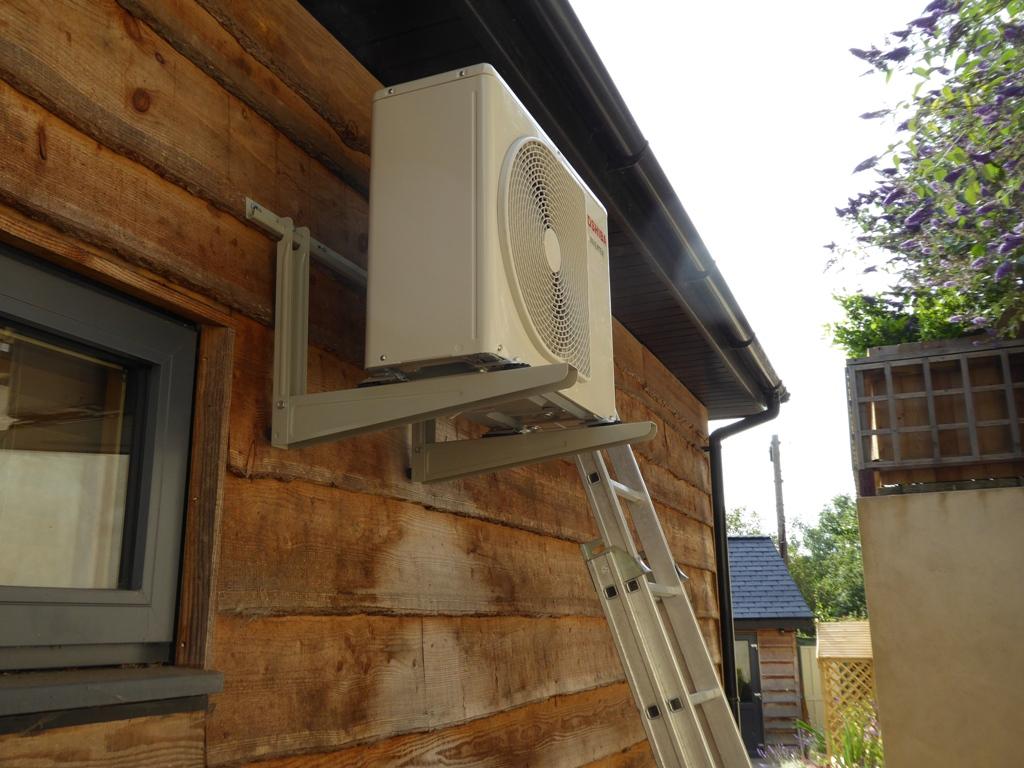
The H&S fanatics would have had kittens a short time ago, watching me up a ladder, manhandling a 23kg air con outdoor unit on to a set of brackets under the eaves... The bastard is up there now, though, and I'm never getting it down.
-
That is absolutely ludicrous!!! At the very most, installation might cost around £400 to £500, but frankly I'd have thought closer to around £250 to £300 would normally be the case (half a day's work plus some pipe, fittings and a run of cable). The "25% off" is just classic double-glazing sales technique, and isn't real at all, given the greater than 100% markup on the discounted price anyway. I'm all for people being in business to make a fair profit, but this seems to be just a massive rip-off. Sure the Sunamp UniQ is a good product, and now that the glitches in the controller and sensors seem to have ironed out it does work very well indeed. Whether it works well enough to be priced way, way above an unvented cylinder is very questionable, though. I'd say that, for the majority of people this sort of price makes it very poor value, as the small energy saving made from the lower standing loss is likely to never be recovered through life from the higher price. At a guess, our's saves us maybe 1 kWh/day in reduced loss, and that saving is only real outside the heating season, when the heat loss isn't beneficial to heating the house. For most of the time the Sunamp is heated by excess PV generation outside the heating season, so is "free", but if I assume that we didn't have PV, then that 1 kWh/day for around 240 days is worth between £20/year (assuming E7 tariff) and £36/year (assuming peak rate tariff). If we assume a life for the unit of 20 years then the saving will be between £400 and £720 at today's prices. That doesn't begin to cover the higher capital cost over installing a UVC.
-
Interesting spin on the cause of the demands by insurers. My take on this is that the insurers have become aware that building inspection has been a sham for years now, with poor/inadequate inspections that have allowed vast numbers of defects to go unchecked (not just Grenfell, there are stacks of examples of construction defects in housing that should have been picked up had there been a competent inspection regime in place). The private inspection companies only have themselves to blame for this situation, IMHO. Had they not been so eager and willing to sell new build sign offs with minimal inspection, in order to compete with each other for big developer business, then they would not be facing this problem. Trying to blame excessively stringent public liability insurance premiums seems to be just a deflection technique, aimed at masking the underlying problem that exists with the inspection system.