


deuce22
-
Posts
282 -
Joined
-
Last visited
Everything posted by deuce22
-
Thanks Russell. I did mention to Jackon about drilling and chemically fixing steel rods and they said I can if I want, but there's no need to. The concrete will bond to the block in the same way cement does, I will fix rods though, just to be safe. I did manage to speak with the architect and he also said continue with a block flat.
-
I have strip foundations and I need to block it up, so I can then fill in the oversite.
-
I am having the drawings done for building control. I haven't got drawings yet as I was planning to build with concrete blocks. It is not for the main house, just the garage. I assumed the bricklayer would know, but he hasn't had experience with ICF, so he is just doing it the way he would, if he was building it in block work.
-
Hi. I have had the bricklayer bring the blocks out of ground and we are now a couple of courses below DPC. He is going to revert from laying flat to a cavity like you normally would with block work, leaving the cavity open 225mm. If I now start using ICF on top of this, then the cavity will just fill, when I start filling the ICF with concrete. What is the correct way to construct the block work at DPC if I will be using ICF. Thanks.
-
I've just been quoted a price from Nudura and Jackon. Nudura - £45+Vat Jackon - £37+Vat
-
Thanks Jeremy for the explanation.
-
That was very interesting Jeremy. I have watched a video of the Isoquick system, but I am trying to find something for traditional rafts. Is the Kore system similar to Isoquick? Why did you choose Kore? Why did you have a 200ft bore hole? What was the reason to choose this over a traditional raft, it does seem a lot quicker and more efficient.
-
Ok. So as I said, I haven't constructed a raft before (only strip foundations). Can somebody give me an idea of how it is laid? I was told it was shuttered and poured once, then shuttered on top to create the step cavity tray and then poured again. Insulation is the laid and then a screed finish. Is this correct? Thanks.
-
Hi. I've never constructed a raft before and will get the exact specs from the SE at some point. I'm just trying to plan out which method I'm going to use. I've been told how the raft gets constructed, so I'm working off that. I'm estimating that the depth will be around 500mm poured in 2 separate amounts. The insulation is then laid and screed finish on top. The other method is to used the insulated forms (such as isoquick. From what I have watched the forms are laid and then concrete poured once for a finished floor. I have been quoted £7700 for the forms from Isoquick and the concrete depth is then 250mm. I've done a quick calculation and it has worked out around £1500 cheaper to use the forms. I'm wondering if I've missed something out as I would have thought this would have been more expensive. Thanks.
-
I've spoken with the bricklayer and BCO and they have both agreed to construct it from the example you gave above. Thanks very much.
-
Thanks. I've got a few things to think about.
-
I'm not sure if the garage door will be insulated, but I will definitely have it draught proof.
-
I'm just going off past experience. I've been in a detached single block garage and an integrated insulated cavity block garage in the winter (neither with heating) and there was not much difference between the two. Are there other benefits other than heat loss? Are there details to suggest there's a benefit even without heating? Thanks.
-
I wasn't planning on putting insulation under the slab and didn't think it would make much difference as there won't be any heating. It's a double block cavity wall (with no insulation) up to first floor height. I will then use insulation in the wall and floor for the living space above. Is there any reason why I should insulate the slab and walls of the garage? I have a lifting platform for where I will train, so there's no worries about damaging the floor, the rest of the area will be to store things. I just want it to look decent and not like a standard garage where you can see the ripples from it being tamped.
-
The total floor area will be around 42m2. The bricky has recently built a garage near near and said that the floor was perfect, it was nowhere near what I would expect. That is the reason why I don't want to do it. If it's gone off to much, I'll never get it to a decent finish. I've lived in a few properties where the garage floor has just been tamped and then painted and the paint just flakes up on every bit that is protruding slightly. I'm not going to be using it for putting cars in, it'll be more for my gym and I just want a decent surface.
-
Hi. I'll be ready to pour the oversite for the garage in a couple of weeks and I'm looking for recommendations on the best way to get a smooth finish. The bricklayer is only prepared to tamp it and then use a large float to finish it (he doesn't like power floating). I know it can be power floated, but I've just read vrfdave's post and the last thing I want is to go over somebody's work after I've paid them to do the job. I did use a liquid concrete self levelling product years ago on an extension and that was a pretty good finish. Any advice would be helpful. Thanks.
-
Thanks Peter.
-
Great. I know the noise of macerators are horrible. I'm living in a caravan on site and have 2 for the toilets, the one seems to come on for a short time every now and then for no reason. Good to know that the other is almost silent. Thanks for your recommendation.
-
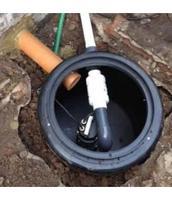
Ok, thanks. I do want something reliable and it doesn't seem to cost a fortune. So do these just sit in an inspection chamber like the image.
-
Is this what your talking about. https://www.tanks-direct.co.uk/sewage-and-waste/sewage-pumping-stations/single-sewage-pumping-stations/sewage-pump-station-190-litre-tank.html There will be living space above the garage with a shower, toilet and 2 sinks. I was told to just put a macerator under the stairs and have all the pipework going into that. I'm wondering if this will be sufficient and how long it will last.
-
Hi. I'm starting the build for my garage, but I will be around metre lower than where the main drain will be. Is there some type of pump that can be used for 110mm underground pipe? Thanks.
-
Thanks Temp. I'll speak with the bricky and make sure he knows how to do this.
-
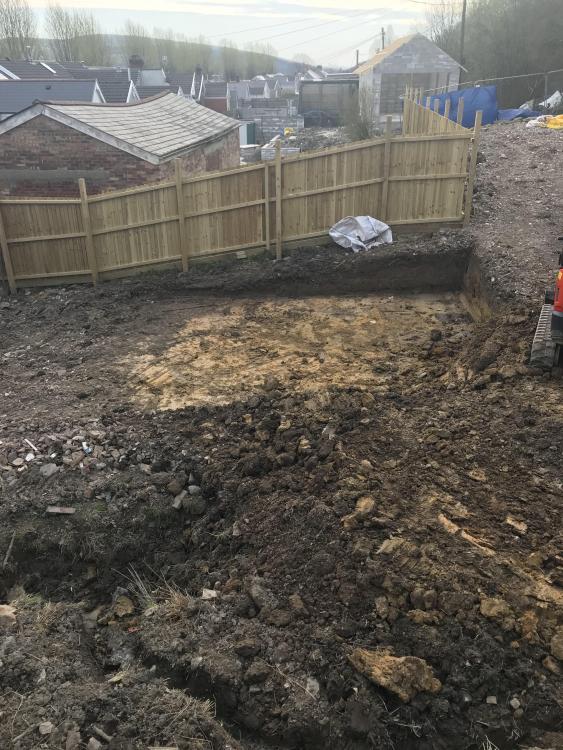
Hi. I am looking for some ideas on what to do regarding the ground around my garage. I have just started digging out for the garage, but I'm unsure of any other way to fix the sloping ground issue. The frontage of the garage is 10m by 6m in the width. The ground slopes from left to right, but it will only be above the DPC for about 4.5m, tapering down from 800mm to about 200mm at the back. The ground on the 6m side will be 800mm above DPC for the whole 6m. I know the standard thing would be to remove more of the earth away from the building and put a retaining wall in. However, I will be encroaching onto the fence at the back if I do this, which may weaken the posts. On the 6m side, it will narrow the drive that I will be putting in at a later date. Is there a way, to not have to dig away this ground and put a retaining wall there? Thanks.
-
The last garage did the same (but only after about 5years) as yours with days of persistent rain. I had a fine render finish, but hairline cracks appeared from movement. Water would eventually penetrate through the actual block, but it would also come in at the bottom (DPC) and the render did go lower by about 4". I think it will be better to just do a cavity wall to make sure this doesn't happen. Thanks.
-
Hi. I understand how a cavity wall construction is built at floor level, but I'm unfamiliar with a single skin construction. My last garage (that was built by a bricklayer) was single skin and after a few years (after cracks appearing in the render) I started getting water come in where the DPC met the concrete floor. Is there a way to stop this on a single skin wall? Thanks.

