


deuce22
-
Posts
282 -
Joined
-
Last visited
Everything posted by deuce22
-
Yes, the ground will be dug down about a metre at the back and will be built up at the front. The plan was to use gabion baskets along the back. Would what you suggest still work with them? The engineer was from planning and he was the one that objected it.
-
Yes. They have agreed to let me divert it with a sweep from the ground behind, but I'm not sure if the owner will allow me to do it.
-
When you say no problem, Is there a rule of what can actually be done or is it different between different planners? When I met the drainage engineer on site, he just looked at the drawing and said "my boss won't allow it to go under the house" and didn't say anything else. I mentioned about diverting it and they agreed, but they want it to be open as much as possible. I can culvert it where the price will go. Is it worth getting the exact difference in height?
-
They won't let me. The want it to be accessible if it collapses.
-
There is around a 2.5m difference between the back and front of house and the ground continues to drop all the way to the chamber. I would guess that it's about 4m difference.
-
The flow differs depending on the time of year, so I'm not sure of maximum flow. It goes into a chamber at the bottom and then into a 10" (roughly) concrete pipe. I asked about doing what you stated and keeping the direction of it, but they don't want it going under the property. The guy behind is bizarre. He asked about having some land to the right, so he could create a drive and get access to his existing house further up. It would also open up an opportunity to develop the land he has behind me. I said he could have 20m x 3m as long as I could have some ground directly behind my house (roughly 15m x 2m) and he hasn't got back to me. It is way more valuable to him.
-
Hi. I have a planning application submitted and one of the objections is about a watercourse that is coming from a spring on the adjoining land behind my plot. They have agreed to let me divert it away from the house, by accessing the ground behind me, but i have to get permission from the land owner first. I have spoken with him in the past and he is a bit strange, so i am pre-empting that he doesn’t allow me to do what I need. I have been told that I can’t allow it through the headwall and then connect a 90 degree bend to take it away from the property, it has to have a sweep, which means I can only do it this way by having access to his ground. I’m trying to think of other ways to get around not having to move the position of the property if the owner doesn't allow me access. Would it be possible to run an industrial type of Aco drain or some type of open culvert pipe across the back of the boundary on my side and then have the outlet however far away I need it? I have attached some drawings. Thanks. Existing_Watercourse.pdf Accepted_Watercourse.pdf Proposed_New_Watercourse.pdf
-
Mr Punter. The frame is being built on site (stick build) by a Carpenter and myself. The plan was to frame it, get it wind and water tight, do 1st fix and then insulate it. A_L I only estimated 200mm of PIR, but I don’t think it’ll be far off that considering that it’s just going to be cladded. What about spray foam insulation, has it got similar properties to PIR or does nothing else come close to it? PeterStarck The slabs could be an option, but when I used the PIR slabs before there was quite a bit of waste and it was very time consuming. I’d prefer to use some type of blown or sprayed insulation, but want to do the work myself. I’ll have to do some more research. Thanks.
-
Hi. I have recently applied for planning and I’m researching about insulation. I haven’t gone through anything yet, with the architect or building control, so I’m not 100% sure on the thickness. I’m building a timber frame structure and then cladding the outside and guessing it would need to be around 200mm. I have fitted PIR insulation in the past and it was a horrible, time consuming job, so I am looking for alternatives. I have spoken with a company about blown cellulose and I’m waiting for an estimate. I asked if the equipment could be hired and they said nobody in the UK hires the machine to do it. I’m planning to do as much of the work myself, so I don’t really want to pay labour for this. What other alternatives are there and which ones can be done yourself. Thanks.
-
Your right. That's exactly what I will do.
-
That was just to supply. I mentioned that, but he didn't care. He said the membrane gets pierced with the fixing which allows damp through. He said he realised nothing would probably happen for years, but he was talking of later in the future.
-
Thanks. I just had a look at Larsen truss walls and it looks like there's a few ways to construct them. These could quite easily be made on site if I was allowed to use the thing pieces of OSB to join them together. I'll do some more research on the insulated raft ystem. Thanks.
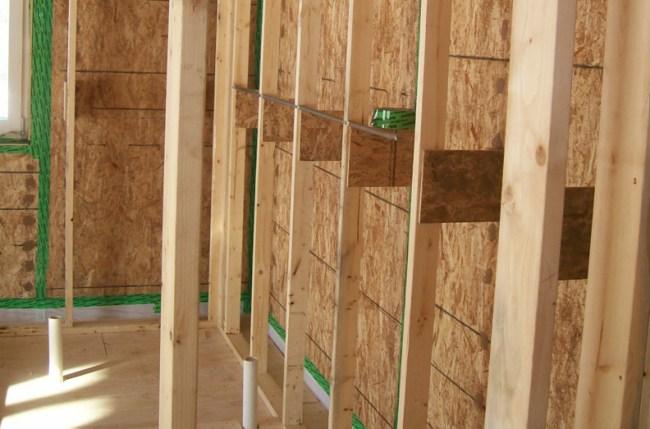
-
Thanks. No Thermal bridging or reduced? They must be connected together in some way, so there should be some. I'd have to calculate the costs as I'm planning to construct the timber frame myself and i'm guessing these are manufactured. I'll also be adding 100mm fibreboard which should reduce the TB. Has anybody used this insulated raft system by DIY? I've just spoken with Isoquick and they quoted me £75 m2 roughly. Seems really expensive.
-
A friend of mine (from England) did something similar about 18 months ago and Planning/BC were fine with it. However, when I spoke with a BCO about 12 months ago about doing the same thing, he said it wouldn't be allowed. If the cladding broke down in some way and damp got into the battens it could easily travel through into the main structure. I'm from Wales, so maybe building regs are different. Ill ask again again because it may have changed now. I'm guessing you had the same construction as JSHarris and used the twin stud method. What is the benefit of that over a single 6x2 stud? Thanks.
-
The cladding or render board has to be fitted to something though, so surely there's not just a complete gap between the cladding and the outer stud? How does the cladding get fitted, so it is not bridging to the outer stud?
-
I have always used a double block construction when building extensions and the 2 new builds I've done, so I don't have experience in other types of construction. A friend built his with a 6x2 frame, covered with 100mm fibre board and then cladding. I am really interested in this because it takes away a large amount of work for bricklayers (which is something I don't do). I'd be able to do all of that myself with a labourer. I just don't know if it would be approved by planning because the SE said the planners still prefer traditional builds. Jack. I'm assuming that your construction is similar to a traditional build with a cavity between walls, but timber used instead of brick/block. How does it work at the bottom where you'd normally have a cavity tray for moisture, either building up inside the cavity or coming through the outer leaf? Thanks.
-
I'm in south Wales. I'll speak with the SE later. I would be doing it DIY style.
-
Hi JSHarris. I just had a quick look through the images, looks pretty straight forward. Where does the outer leaf sit? It's normally lower with a cavity tray between the two. How much did it cost per m2?
-
Thanks ProDave. I've just had a look at Kore systems. It looks a lot easier than the standard way of constructing rafts.
-
Hi. I've just had a Mining risk assessment report completed and I'm almost positive that I'm going to have to use a raft foundation. I'll confirm this with the SE and he will then tell me exactly how he wants it constructed. In the meantime, I would like to get some information on rafts, so that I have an idea of the costs involved and exactly what needs to be done. I've always used strip foundations, so don't know how much more rafts cost or exactly how they are constructed and formed. Could someone please give me some advice on this, so I at least know what the SE is talking about. Thanks.
-
Thanks joe90 for letting me know this. It's crazy how it differs from one project to another. I realise that quality comes into play, but going from £500 to £1900 perm2. Thanks again.
-
That's exactly right. My uncle who has completed about 10 self builds still misses out important things and over spends. There's no point asking him as he doesn't do much of the work and because he's got a bit of money his budget is very flexible.
-
Thanks Crofter. That's exactly what I'm going to do. I think the majority of people doing this for the first time will have everything that's needed accounted for and like you say, certain things will cost more and (hopefully) other thing less.
-
PeterW. I did forget the block work. Probably around another £1000 - £1500 (inc labour). Just checked and you're right, it's 140mm insulation for 0.11 U value. That's another £1100, so that's around 10k for the slab. £760 is a big drop from some of the others, but then they may be adding in everything. I'm glad I asked as I realise now that I need to get a budget that's more accurate, before I get this designed. Thanks.
-
I've just calculated what the slab and foundations will cost roughly. This is just materials only. The footings have a linear meterage of 56m and the slab has a floor area of 130m2. I've calculated the footings as a 750mm trench fill. I've included 150mm scalpings, 50mm sand, 100mm Insulation, DPM and 150mm concrete. This has come to around 8k. Does that sound about right.
