


deuce22
-
Posts
282 -
Joined
-
Last visited
Everything posted by deuce22
-
Hi. I'm looking for some advice on the best way to backfill behind a separate retaining wall and 2 retaining walls which will be a part of the house. The separate wall is 1.7m away from the property and starts at 1m high, up to 3m high, over a 10m span. It is constructed from ICF and has an 200mm fill. I have wrapped 100mm perforated pipe in a geotextile sock, covered it with around 300mm of 40mm clean stone and then backfilled it with the earth I removed. I'm not concerned about water penetration on this wall, just hydrostatic pressure. I'm not 100% sure if this is adequate, however a local groundworker said this is sufficient to drain the excess water. On the 2 retaining house walls, I will use waterproof readymix concrete and a peel and stick waterproof DPM. The span of the one wall is 13m, so the last thing I want is pressure to build up behind and cause problems. Due to the ground behind being around 4.5m high, it had to be chamfered back and is around 500mm back at the bottom and 4m at the top. This would cost to much to completely fill with clean stone, so I've had to think of another way. My plan is to sandwich lengths of 10x2 timbers between 2 OSB sheets and stick this to the back of the wall. I can then fill this void with clean stone and fill behind it with the earth that I removed. I will drill a series of holes to the outside sheet and then cover with geotextile fabric. Would this be a better option than to just fill the bottom 1m with clean stone and then put the earth on top. Thanks.
-
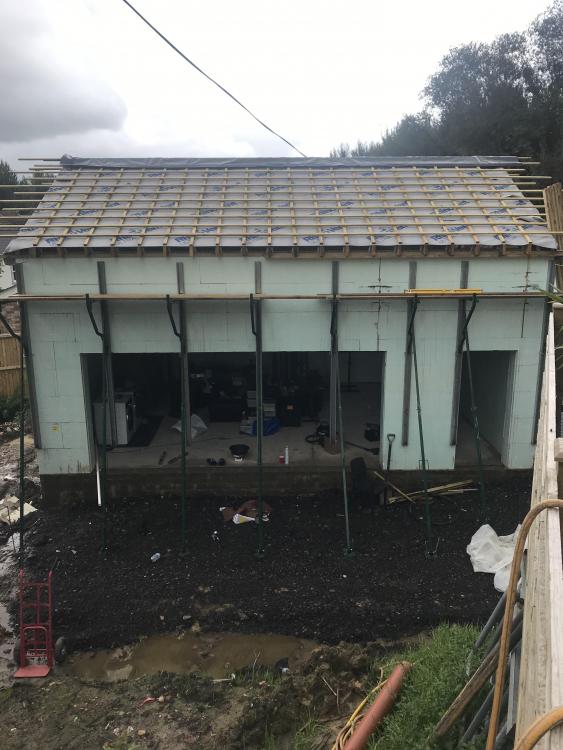
I've decided to use Nudura. The blocks are 2.4m long and 450mm high. There is no cost difference between a 150mm fill block and a 300mm fill block. The insulation thickness is around 65mm and I've been told that anything over this has minimal benefits. I'm not sure what the U value is, but I'll check with the distributor. He seemed more interested in the thermal mass and air tightness, when I discussed it with him last. I've recently finished building my garage with it and also finished a 200mm fill retaining wall. I am going to start building the house in a few weeks when the blocks arrive. The back and one side of the house will be a retaining wall, so I will use a 200mm fill block. I will then transition off the corners to a 150mm block and use 150mm blocks for the rest of the house.
-
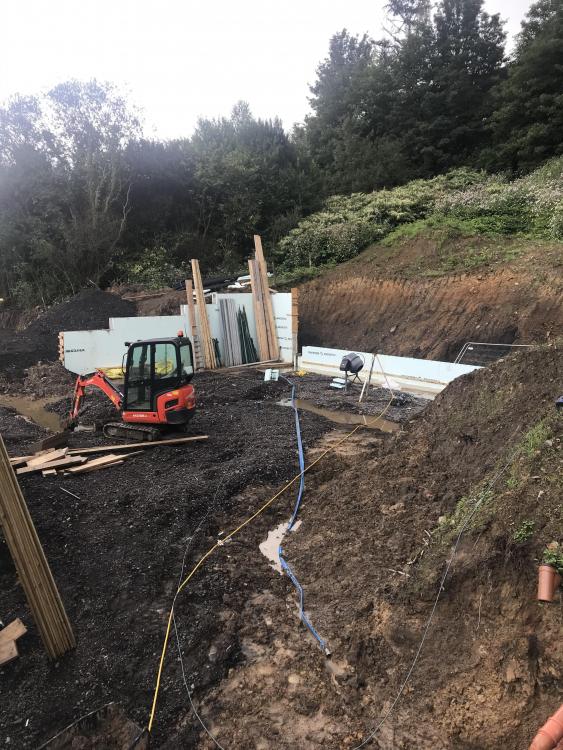
I did see the same effect on the side walls of the watercourse when I first bought the plot, so I'm sure it was going into the culvert at some point. I'm not trying to channel it, the back of the house is a retaining wall and that's where the bulk of it is showing. I have to put a land drain at the back of this wall to stop the added pressure. The BCO just seemed concerned about it contaminating the water going into the culvert. I'm wondering what difference it is compared to before.
-
The BCO didn't mention anything about issues with the waterproofing. He was concerned about where it is draining to. Mine will be going into land drains and then connecting to a culvert along with the rest of the surface water. Where have you got yours draining? Thanks.
-
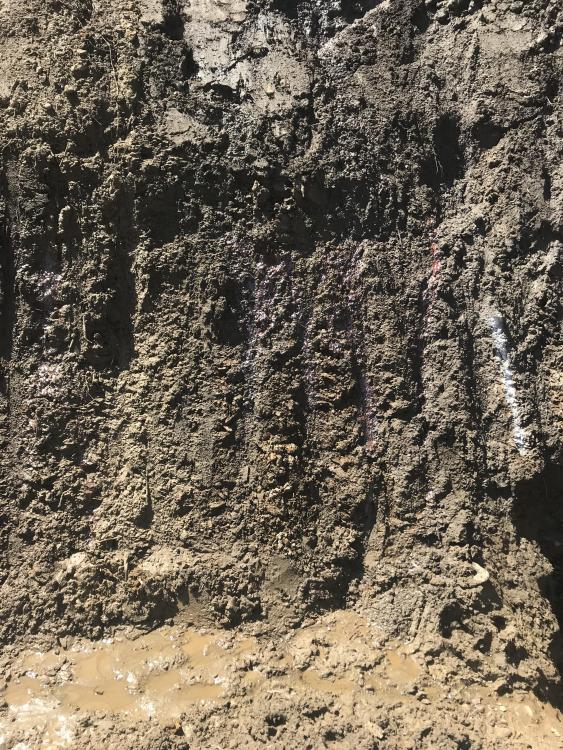
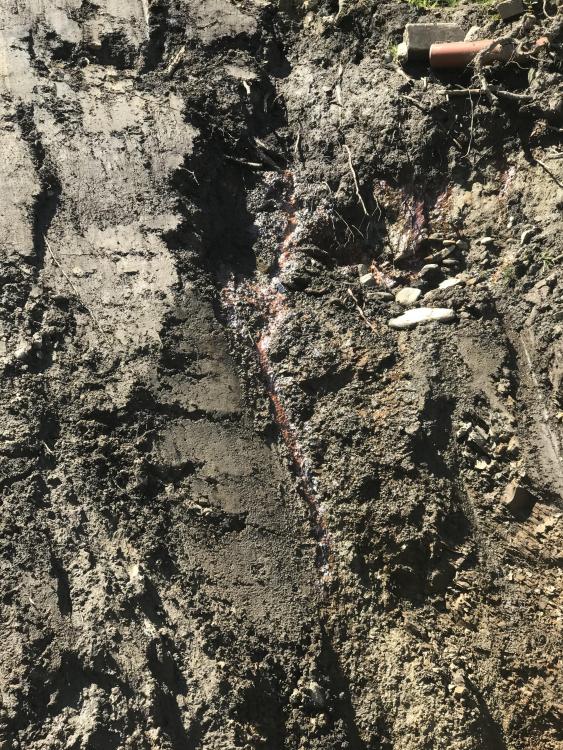
Hi. I have recently dug out for the foundations on a sloping site and the bank at the back of the house has an orange - petrol coloured liquid coming out in a couple of places. A local ground worker that's helping me with the dig, has said that it's all over the area and it's Iron ore residue from the closing of the mines. The building inspector has also seen it and wants me to get it checked out. I've mentioned it to my architect and he is in the process of finding out what needs to be done. Has anybody come across this before and what is the solution to it? Thanks.
-
Hi Russell. Yes what you suggested does make sense, but there's a lot more work involved, plus there will be thermal bridging through the trimmer. The roof will have vaulted ceilings. I've decided to create a slight upstaged at the bottom of the gable wall. This will allow me to fit the last rafter on the internal side of the wall and be fully insulated. I will then do what Willbish did and chemically fit the ladder rafters to the outside of the wall. Thanks both for your help.
-
Hi. Can somebody that has built with ICF let me know if the gable walls were cut from wall plate height or if the thickness of the rafter was added as well. I've never constructed with it before, but I'm about to start adding the gables. If I cut from the height of the wall plate then add the 7x2 rafters, there will not be any wall in between the ladder rafters, like there is with blockwork. If I add it on then I will need to leave a void to allow me to cut through the polystyrene to attach the ladies for the last rafter. If this is the case then it would be easier to just attach some PIR insulation after. Thanks.
-
The back and right hand side will be retaining walls built into the house. I will have 100mm perforated pipe running around the house and it will connect into the culvert. It needs to stay on the right side as I have been granted permission to move it over 3m.
-
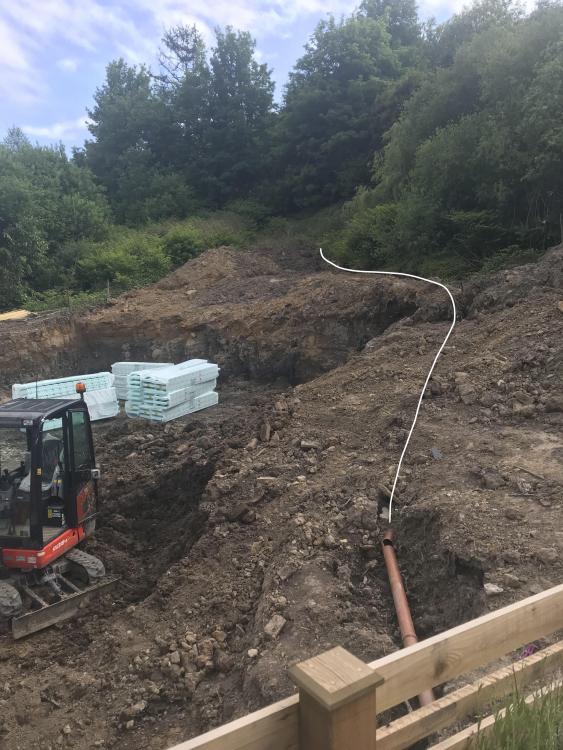
Mine is nothing like yours. There are a few springs in the ground behind me and the water is coming from there. It was called a ditch, not watercourse from NRW and they said it was my responsibility. The engineer in planning said differently. The house will be positioned where the ICF is. The water runs through a ditch behind and I have temporary culverted it, whilst I was moving earth. The whole length of the white line needs to stay open and then it will drop down into a culvert.
-
I've spoken with Welsh water, NRW and the drainage engineer in planning is the one that I am dealing with. The other 2 didn't want to know.
-
Planning have agreed for me to culvert part of it. The watercourse I have is starting behind my plot which is elevated and runs through at a higher height than my house and garage. I've had to cut out a big amount of earth to build the house and water is seeping through the ground. Thanks.
-
Hi. I have around 50m of watercourse running through my plot. 30m will be culverted and the other 20m needs to stay open. I'm looking for ideas on the best material to line it with, rather than just a half concrete culvert. There is not a huge amount of water, so it doesn't have to be very deep or wide, but it will be on show, so I want it to be a bit of a feature. Any body come across this? Thanks.
-
How did you find using the self levelling concrete? Do you just pour it in and leave it?
-
Thanks guy's for that info. I've got a better understanding now and thinking that an insulated raft may not work. The house has 3 floors, with wall plate height of 6.6m and ridge height of 10m. I will also have a retaining wall built in to the rear and side wall, so I would imagine that this is going to be a lot of weight. Thanks.
-
Which company did you use for the raft? I was told that, the benefit of using something like Isoquick was that it only needs one pour, whereas a traditional raft is two pours. However the guy from Nudura has stated that it can be poured in one amount as there's no need for a cavity tray around the perimeter. It's been pretty difficult as I've only built 1 property about 15 years ago and that was on a strip foundation. The architect is also the engineer and not that helpful, he is a friend of the family and I feel like I'm the one doing all the research and coming up with different ideas.
-
I wasn't that concerned about how high you can pour the ICF fill. As I understand you can go to floor level each time, which is what I will be doing. It is more about the raft detail. As I've never done one, I'm unsure of how it is constructed. The engineer also stated that it is poured in two stages and hasn't had much experience with ICF. I've received a detail from Nudura and my engineer will obviously have to speak with them. I will receive a design detail off of him, but just wanted to know what others using ICF have done.
-
Hi. As I have never laid a raft foundation before (only strip foundations), I didn't know the exact way of doing it. I was told by a few people that the concrete is poured in 2 stages, so that you can shutter the 2nd pour, and can create a step (cavity tray). For this reason I was planning to use either Jacksons Atlas system or Isoquick. I have now been told by Nudura that you do not need a cavity when using ICF, so 1 pour of concrete is the correct way. Is this correct? I also wanted to know if there is a way of adding insulation into the concrete and then finish it or do you have to insulate on top and then screed? Thanks.
-
Thanks Archer. I've messaged the ICF companies to see what they advise. I'll have a look into what you had done, £60m2 in London is probably double of what it would cost in South Wales.
-
I've had a quote from Durisol, but it was double what I've had from Jackon. I've noticed that, Some tradesmen act like I've won money with the prices they quote.
-
What brand do you use? This plaster uses Parex, which is around £10 per bag, but said the bags for ICF is over 3x as much per bag.
-
Hi. I have been told that you need to use a silicone render on ICF and had somebody give me a quote today. He’s told me that He needs to scratch the surface of the polystyrene, use a bonding base coat called maite and push mesh into it, before giving it a second coat. Then he can give it one coat of parex. After that he sprays something else on top of it to stop mould and waterproof it. He uses a pump to get the render on and the bags are different to normal, just over £30 compared with around £10. He's quoted me around £70 a metre. At that price, it would cost way to much. What have others used when using ICF? Thanks.
-
I agree that this is slightly awkward and it's due to me changing my mind on the construction method. I will make sure that I have decided on what I will be doing for the house and have all drawings done way before. Regarding the retaining wall, I will discuss this with the SE beforehand, but have spoken with Jackon and they have suggested to use a waterproof concrete for the height that I need and then just fix DPM to the outside as well. I don't really understand what this means "if your icf is below ground level on the outside but above ffl on the inside". Can you explain it? Thanks.
-
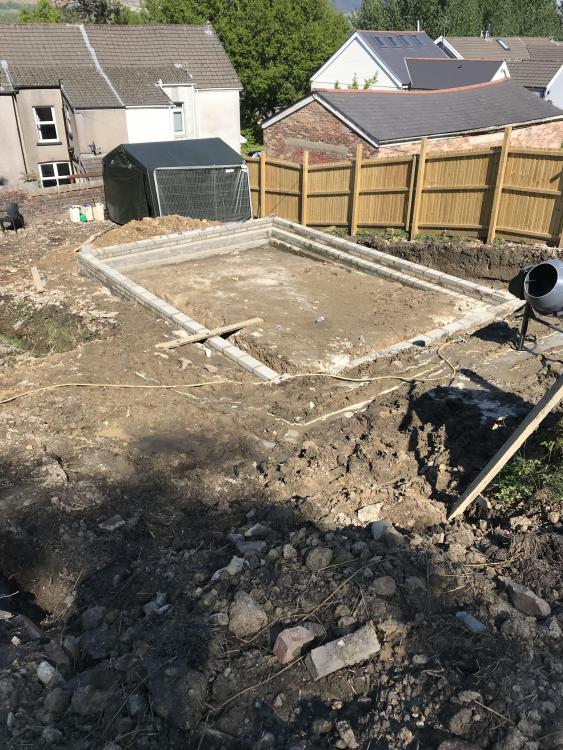
I wish I knew this a couple of weeks ago. The bricky has been a pain, not very helpful and really bad mouthing ICF. I can see this being more straight forward if using a raft, but more complicated with strip foundations. I have come up to floor level with a block flat. I've been told to just lay the DPM up the inside wall and render as far down as I can, below floor level. There will be thermal bridging at that point, but it is a garage and the BCO isn't that concerned. My only concern is getting any damp. Do you think this will be good enough? Thanks.
-
They haven't included that. Do you need to get that from them?
-
Including delivery. I am waiting on becowallform and will then speak with thermohouse.





