LA3222
-
Posts
1185 -
Joined
-
Last visited
-
Days Won
11
Everything posted by LA3222
-
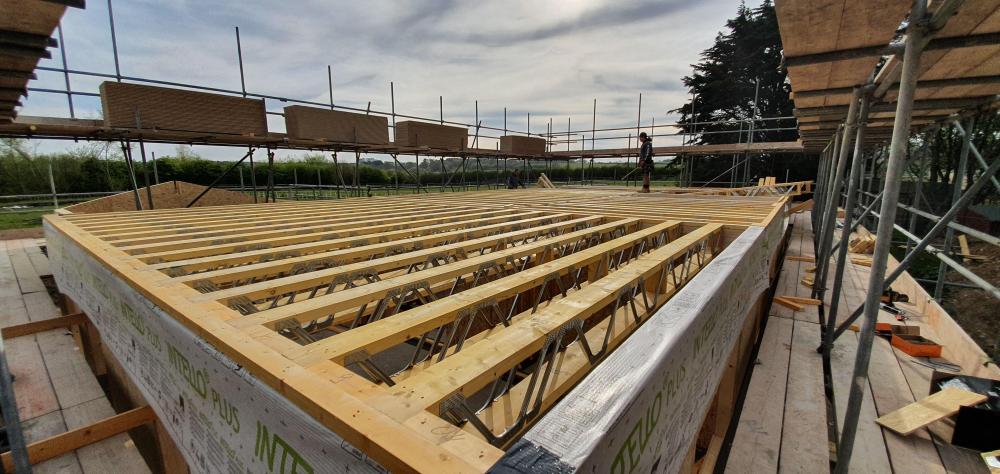
The timber being in compression and not tension is also what makes me thinking cutting a hole in it is not an issue. I suspect this is a lot of the answer as to why the glulams were used. They were used in this role everywhere in my build. In one room I mentioned that it blocked the passage of services and was told I could hack it to my hearts content as it pretty much only supported the floor deck above. Its the fact there is a load bearing wall above this one which makes me hesitant to rush into cutting holes! This is a good shout and something I'm happy to do as belts and braces regardless. I had another look earlier and to the right, (about 1m away from where i want to core) there are 5 studs together in a direct path from the point load of the purlin above so I don't see the hole I want to make affecting that. And this is probably the final piece of the puzzle as to why it is done this way. I have a SIP build, superdry timber is used throughout so that the shrinkage is minimal. I suspect the use of glulams here helps a lot with keeping shrinkage down. Out of interest, I've attached a picture of how the joists sit on the glulams:
-
The timber in question is fully supported by doubled up 89mm C16 timbers underneath it, so is it deemed to be unsupported? The glulam is supported across its whole length by two horizontal timbers stacked on top of the 89mm vertical wall studs (can be seen in the first picture). To my mind it is not a 'beam', it is a packing piece/space filler - am I wrong in this thinking.
-
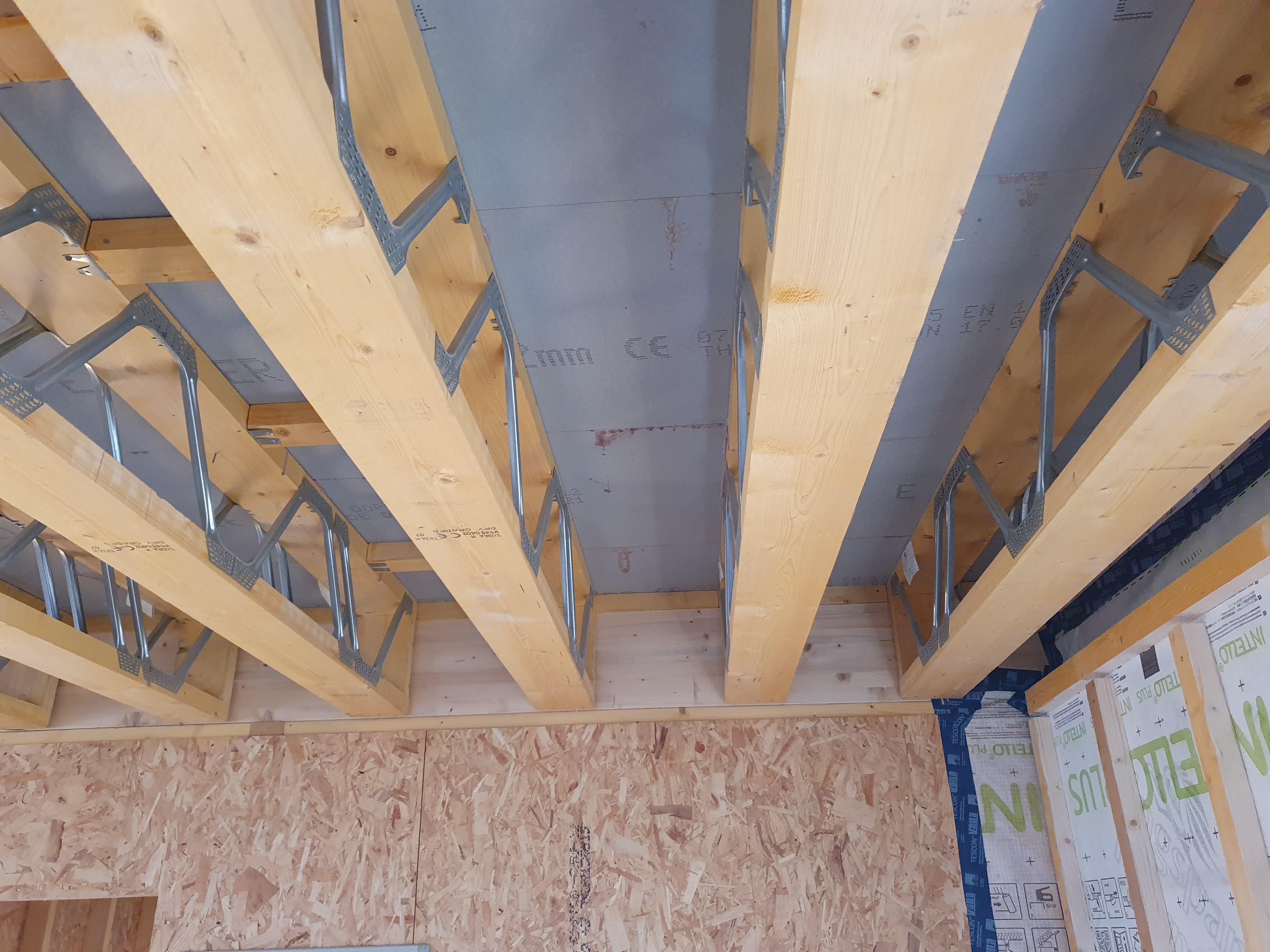
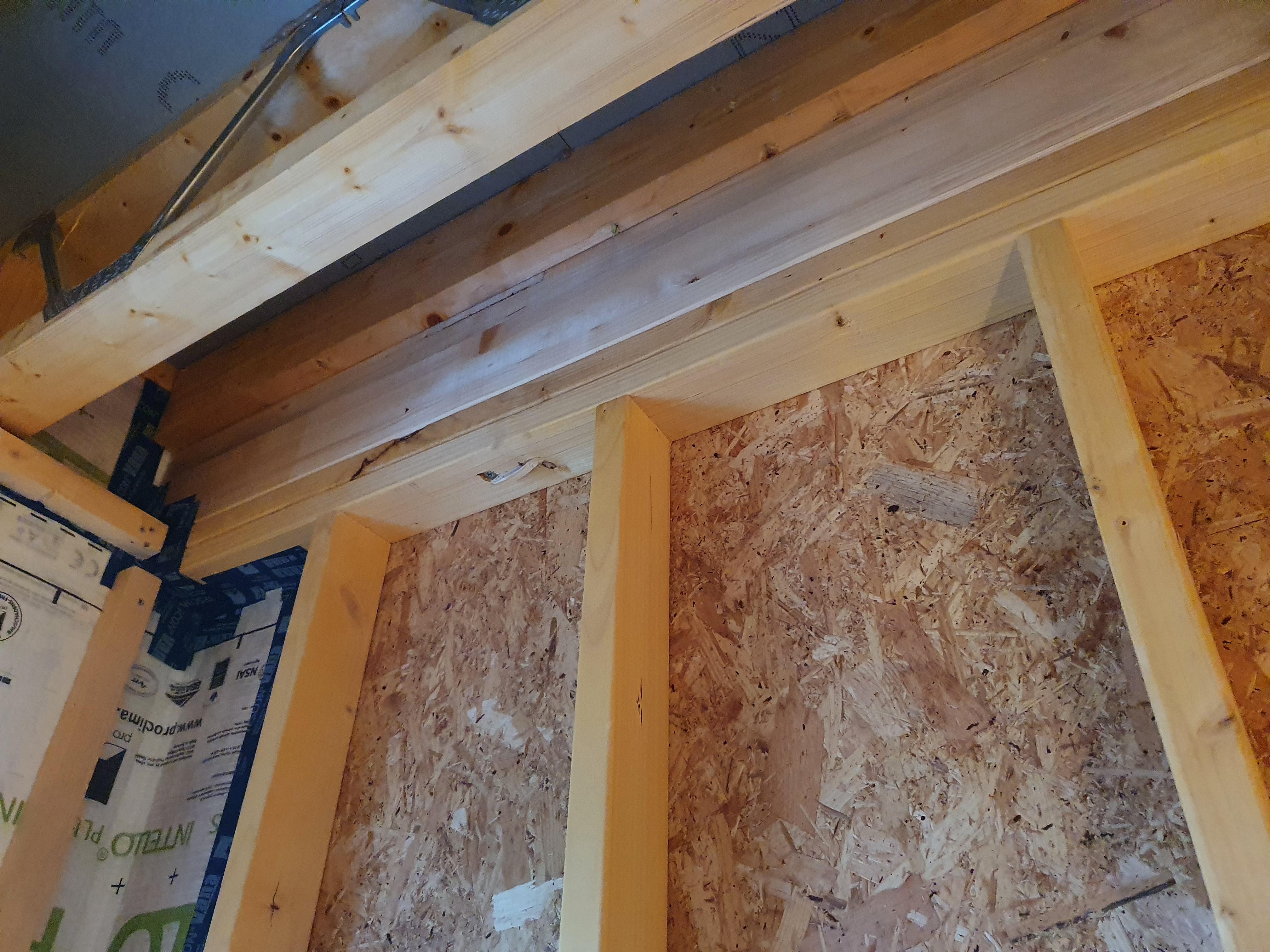
The wall running along my kitchen is load bearing and takes the weight of a wall directly above. The wall above carries three point loads, the ridge beam and purlins supporting the roof and transmits this load down through to the foundations. Ground & 1st floor it is 89mm C16 construction. Ground floor has 9mm OSB racking. The studs for the ground floor are 2.5m high. To fill the void between the top of the studs and the underside of the first floor deck solid 89mm timber (glulam) has been used (approx 350mm deep). Now to my question. Can I put a 110mm dia hole through that solid timber to run a soil pipe through? It would be right next to where the stud wall 'T's into the external wall. No door openings below it so the timber isn't acting like a beam there. No point loads from purlins directly over it. To my mind that timber is just a space filler for the most part except over the two doorways where I expect it acts as a structural beam so I'm leaning towards it not being an issue. Thoughts from my fellow self builders would be appreciated. Attached are pics of the offending article from both sides.
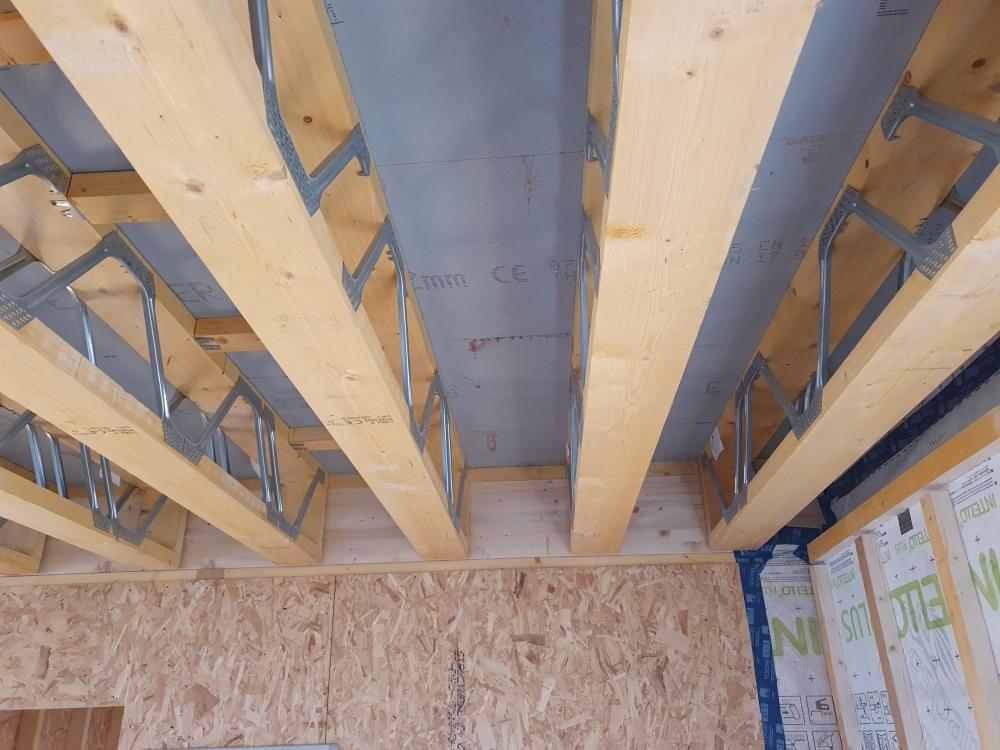
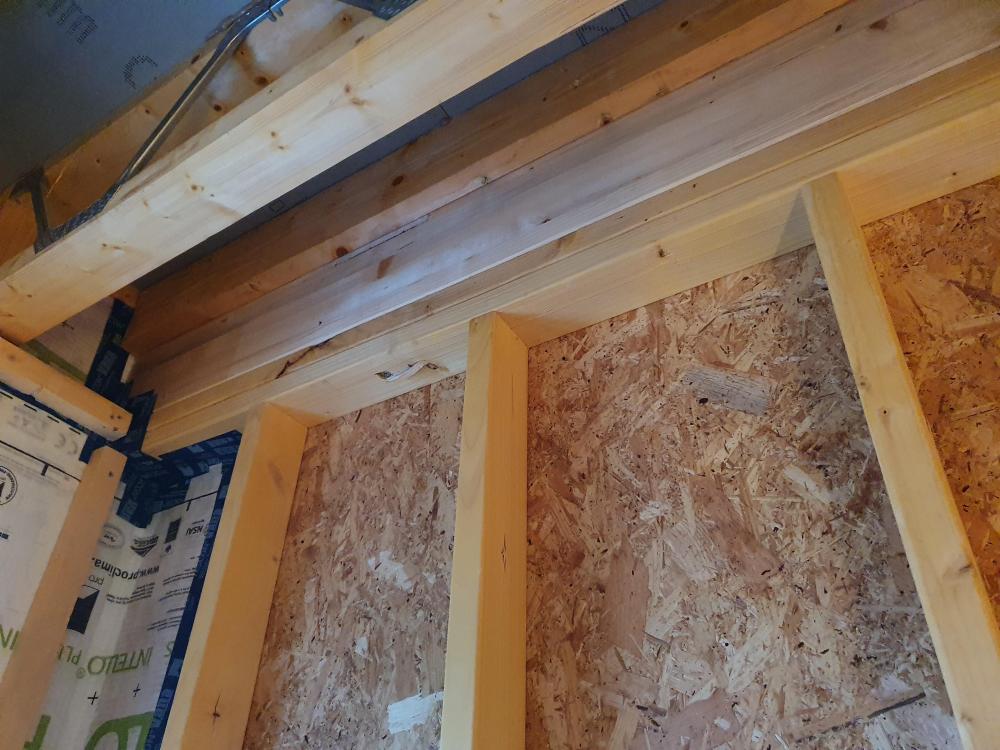
-
That seems like a good choice. I did have English Brothers in my sift, ultimately went with SIPs though however English Brothers were an attractive option. Hope everything goes well for you?
-
Part 0 - The start of the middle or the end of the beginning?
LA3222 commented on SuperJohnG's blog entry in Scottish SIPS build
Good to see it went ok for you bud. 4 acres is nice, I only have half of one? Its funny how self building can skew your perspective, I've never lived in a big house or had a big garden and they all seemed fine. Now I'm in the countryside with loads of space, big garden, big house, everything else just feels small and claustrophobic now. Its great for the kids to have so much space available to run around in. -
Heating design, calcs and process - ASHP/UFH
LA3222 replied to SuperJohnG's topic in Underfloor Heating
You get your insulation John? -
I cant see one either. The only conclusion I can draw is that the French are upset about the 'fish' issue and are taking the opportunity to create some mischief.
-
Manifold system versus hot return system
LA3222 replied to Russell griffiths's topic in General Plumbing
@Dan F I have the kernels of a plan at the back of my mind. Going to have manifold for everything located in my plant room. This is in one corner of my house (14.5m wide) so not ideal for runs but such is life. All the big stuff will be in 15mm Hep2O and the smaller stuff in 10mm Hep2O. Only things I will put on a HRC are the basins. All the other hots go to things like baths, showers, sinks where waiting 30s for hot to come through isn't an issue. The 4 basin hots will have a flow and return manifold. So as IUI the each of the 4 loops will have a tee coming off it at the outlet. So the hot in the loops get circulated and there will be a small dead leg at the appliance outlet. -
Heating design, calcs and process - ASHP/UFH
LA3222 replied to SuperJohnG's topic in Underfloor Heating
When that tips up its a great sight, actually feels like you are making some progress then. -
Heating design, calcs and process - ASHP/UFH
LA3222 replied to SuperJohnG's topic in Underfloor Heating
Indeed. Funny, for some reason I never queried anything that designers produced, not sure why, I can only put it down to inexperience and juggling the many pieces of a build. You've managed to get rid of your padstones and get your UFH pipes in the thickening both of which are big pluses for you. I'm not overly concerned about my pipe placement as I think of it as a homogenous piece. Once up to temp the heat should distribute to some extent towards the outer extremities and those areas won't be walked as such anyway. Its good that you are sorting all these niggles, I look forward to hearing how you get on with the slab...pics are always good too. Yes, as you say, this will no doubt be good info for other newbies in the future. When do you get your kore delivery? I'm nearly finished insulating internally and installing VCL, battening out. Looking forward to getting on with some actual first fix stuff!! -
Heating design, calcs and process - ASHP/UFH
LA3222 replied to SuperJohnG's topic in Underfloor Heating
A spiral layout puts all the pipes parallel to the thickings, the serpentine one means that the loop ends can technically go through it as they would be perpendicular apart from a short parallel piece as the loop turns back on itself.?♂️ -
Heating design, calcs and process - ASHP/UFH
LA3222 replied to SuperJohnG's topic in Underfloor Heating
Says you can't run parallel to the thickening, so depending on the orientation of the pipe run in some areas it will be parallel to the thickening so you can't go into it. I decided to stay out of it to keep things simple. The thickening have the load bearing walls going over them so you then have issues with working out where soleplate fastenings will pass through. The only areas I went though thickening is doorways so I knew I'd not mistakenly puncture a pipe. -
Heating design, calcs and process - ASHP/UFH
LA3222 replied to SuperJohnG's topic in Underfloor Heating
Tanners sent me this along with my foundation design, it was a sheet with standard details on one of which refers to UFH pipes in the slab: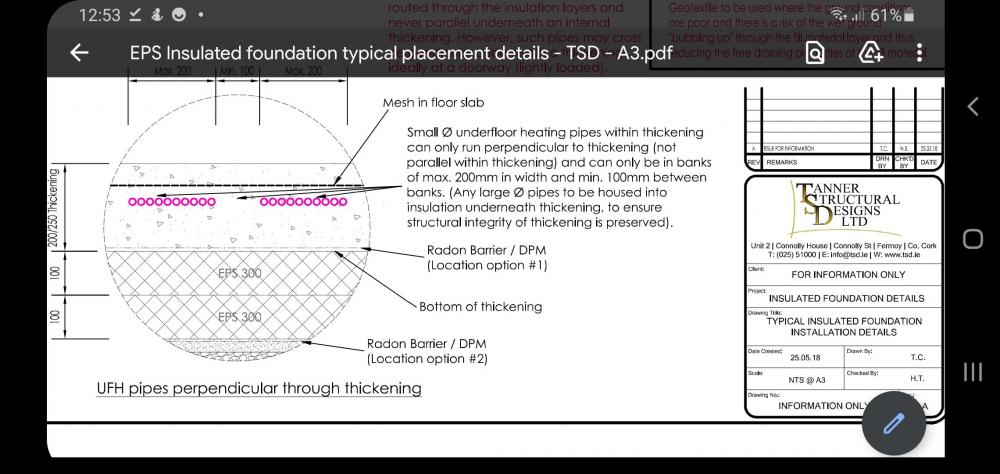
-
Heating design, calcs and process - ASHP/UFH
LA3222 replied to SuperJohnG's topic in Underfloor Heating
I went with how wunda did the design for mine. However you won't be able to go right up to the external walls anyway as with a insulatednslab design you can't run pipes in the thickened perimeter strips of the foundations. The details i got from Hilliard showed that you can run the pipes in banks of 10 through those areas but not in them. -
Wonder what that does to pressure/flow rate?
-
It will get a lot worse before it gets better. The EU will do nothing to ease congestion in the hopes it create enough domestic pressure on Boris Johnson to leverage him back to the negotiating table. This is bad because if that happens the deal will not be good as the EU will see themselves holding the trump cards. Personally I think if they want to leverage imports/exports to create pressure then the UK should leverage paying the so called divorce bill. Refuse to pay that. If it gets worse I'd rather see the country rough it out as industry will innovate and pivot how they do business to overcome such challenges. Likewise the Government agencies will get better at it - eventually?♂️
-
Did you mean to use the word xenophile or do you mean xenophobe? ?
-
Thanks for the steer, you've got me looking at 'control groups' now. So aiui some of the components I have drawn individually are actually all part of one part. I will redo my drawing to show this. What manufacturer/supplier would you recommend for parts to go with the UVC like the control group. A quick Google shows im looking for something like this?:

-
I've just been reading an article in the guardian and had a look at the comments section. It was an interesting echo chamber - comments along the lines of cut the North loose etc. There are some very bitter people out there!
-
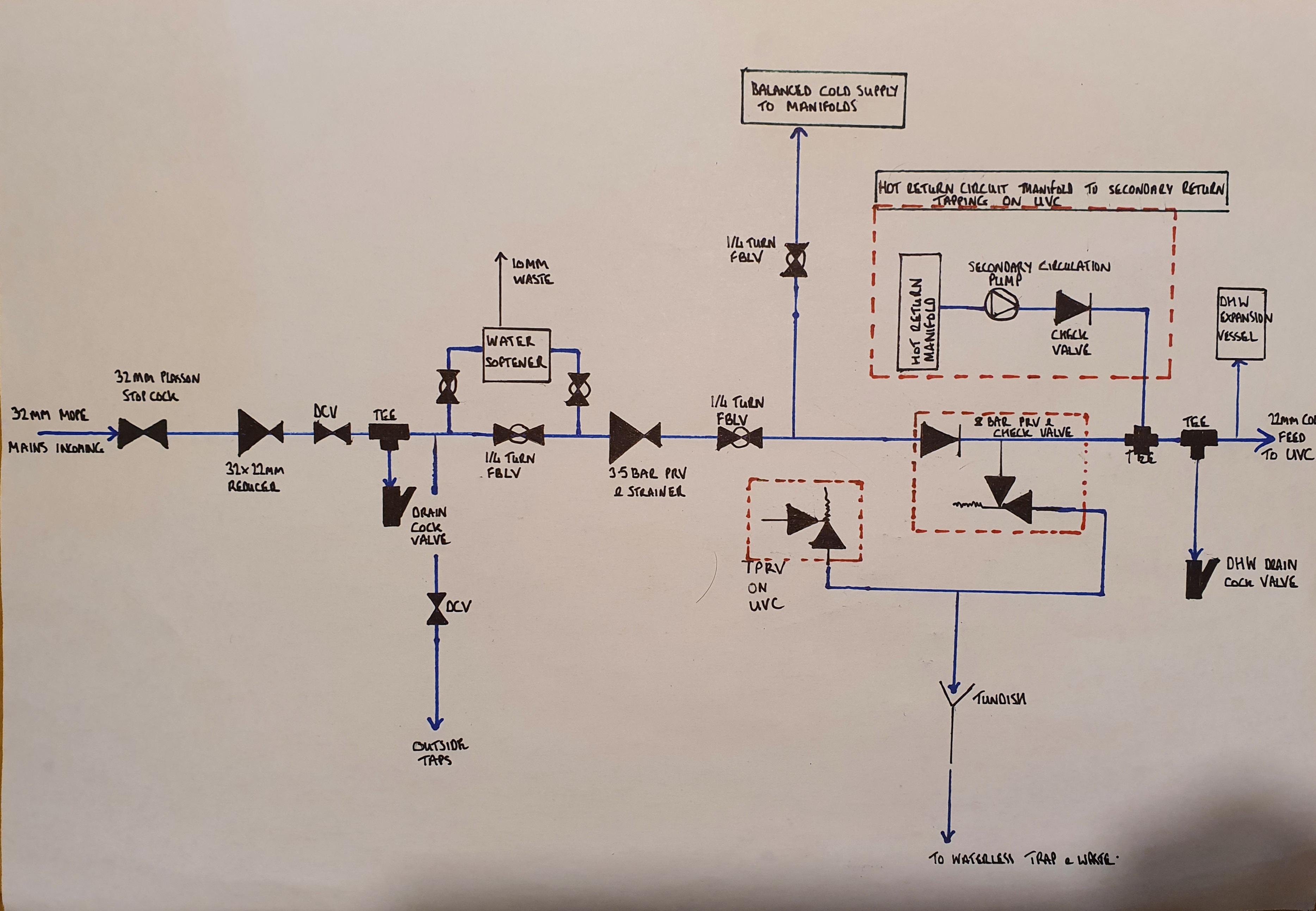
I've drawn the layout as if I have a naked cylinder and I'm plumbing in everything required. With that in mind is the 3.5bar PRV drawn in the right place? I believe there needs to be one so that the pressure into the cylinder does ot exceed 3.5bar and the balanced cold needs to come after it? I've drawn the UVC cold drain as second to last, physically it would be right before the cold inlet on the UVC. The HRC, not sure now why I drew it like that as I'm sure I read summat about it bot going in at the bottom as it disturbs the stratification etc in the UVC? - I understand which tapping you refer to. Unsoftened water - I've been scratching my head over this one as there are conflicting POVs throughout the threads on the forum. Kitchen tap is the main one as I want a quooker tap so more reading needed here!
-
Right folks, in particular @PeterW if you would be so kind to cast a critical eye here - this is the next piece of the plumbing puzzle. It covers: Mains incomer --> UVC and other Outputs A few things I am pondering: Are Y strainers required anywhere? Pressure gauges anywhere - any harm in putting them in anyway? Additional isolation valves required? Worth having more to isolate individual parts for maintenance etc? Expansion vessels -missing? In wrong place? Any feedback is much appreciated?
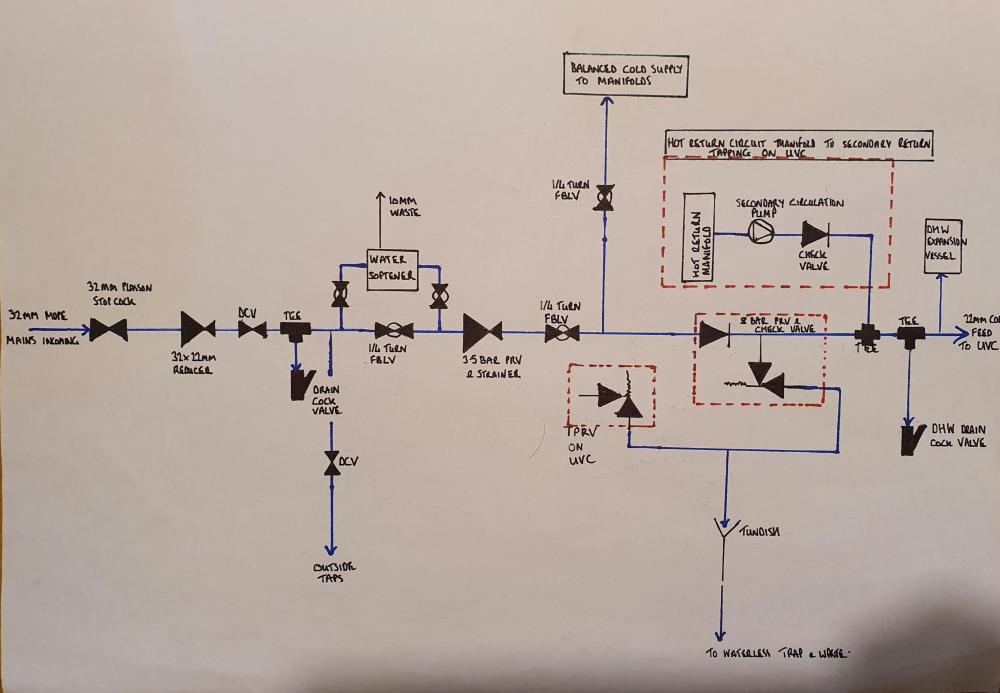
-
Correct installation of Willis Heaters
LA3222 replied to Jeremy Harris's topic in Other Heating Systems
If you have your UFH running via a buffer tank then you can have an immersion in that tank. If your UFH is running direct from the ASHP then its something those with more know how on here should be able to answer for you. -
I had the same issue with 90mm long stainless steel types, couldn't use an impact driver with them as it trashed the heads. I've been using 110mm and 150mm long carbon steel ones inside and not once has the head stripped whilst using an impact driver and I've done a few thousand now ?♂️
-
Kingspan directed me to Ejot, when I spoke to their tech department they told me the length of fixing to use and offered up a couple of options. They had done all the 'pull-out' (can't recall the correct name) tests on their fixings in OSB panels and advised me accordingly. I've mentioned on here before that I didn't rate their fixings because with the roof battens the heads kept chewing out. My opinion has somewhat changed now as I am several thousand screws in with adding insulation and battens to my interior walls and have had no issues whatsoever. The ones used outside were stainless steel and rubbish, I'm using carbon steel ones inside and they're great. With regards to things like fixings, spacings etc you really need to speak to the necessary tech departments if only to put your own mind at rest that you are doing it 'right'.
-
Ah, I see your issue - most of us are talking blockwork but you have carrier boards. Someone on here had issues with billowing I think the term is of their carrier boards which was visually very obvious so may be worth finding that thread - if memory serves me correctly it was @Bitpipe but I may be wrong?♂️ I didn't go to much into it at the time as it wasn't an issue i would have. I'd say the carrier board manufacturers are the ones to speak to if you haven't done so already? Like @MarkyP says, there is a good chance you'd be fine without them but its up to you to whether you're willing to accept that risk - albeit small.