

Nickfromwales
-
Posts
31382 -
Joined
-
Last visited
-
Days Won
346
Everything posted by Nickfromwales
-

Unvented Expansion Vessel Pre Charge
Nickfromwales replied to Mattg4321's topic in Boilers & Hot Water Tanks
I would pump this back up to 2.5 to stop damage occurring. It was incorrect for this to have been dropped back so far imho. -
Unvented Expansion Vessel Pre Charge
Nickfromwales replied to Mattg4321's topic in Boilers & Hot Water Tanks
👇 👍 Rely on that taps NRV at your peril. I wouldn’t! If this was a clients project there would be no chance I’d leave it like that. My shower mixer had these and I shut the cold inlet off to my combi the other day to work on it and water kept coming out of the hot tap at the sink. When I listened to the shower you could hear water squeezing back through the hot NRV so I then had to turn the temp dial to max cold to stop it enough for me to do what I needed to, but it goes to show that these factory ones are pretty crap, even with such a good make as you’ve selected. Noise issue you are experiencing is defo the EV acting as an accumulator, and very likely the issue will go when you have a better supply installed. The washing machine etc would be best off the cold mains if practicable, which will give the showers better dynamic performance if the appliances are filling simultaneously for eg. I have a combi so the rule here is if you hear the shower going don’t run taps full blast. Flow just speeds up or slows down with an UVC but with a combi these fluctuations cause havoc (aka entertainment). Anything you can do to improve that is a plus, if doable. -
Thanks for updating the thread, much appreciated.
- 30 replies
-
- 1
-

-
- leaking mvhr
- poor heat recovery
- (and 1 more)
-
Like...."who's coat is that jacket?" Welcome, and fire away. 👍
-
Hello, hoping to find a place to off grid
Nickfromwales replied to Ollie B's topic in Introduce Yourself
☝️? Or another? -
Unvented Expansion Vessel Pre Charge
Nickfromwales replied to Mattg4321's topic in Boilers & Hot Water Tanks
Ok, as is you are compliant. If, however, you do install a new tap (which mixes in the body) then you aren't. That would need the second PRedV at the stopcock and the NRV on the hot outlet of the UVC. Easy going plumbers will tell you it's fine to rely on an added non return valve on the kitchen tap hot feed, but it's just not reliable enough. These start to let-by after a while and then the UVC will get reverse pressurised by the cold pressure at the kitchen sink mixing with the lower pressure hot, and this is particularly problematic when the tap is run on low flow for a decent amount of time. This should have the 2 items, PRedV #2, and a NRV on the UVC hot outlet, to be fully compliant (and to not come back and bite you on the arse in the future). Without these, the UVC expansion vessel will routinely get over pressurised and fail early. You chaps are spot on, if they knew the kitchen sink tap was for unbalanced, but they should have assumed that would be changed one day and have gone the extra distance (IMHO). So they get a 9/10 lol, for not getting the kitchen sink fed off the balanced cold. -
Unvented Expansion Vessel Pre Charge
Nickfromwales replied to Mattg4321's topic in Boilers & Hot Water Tanks
Ok, good news, but is the kitchen tap a mixer tap? -
Unvented Expansion Vessel Pre Charge
Nickfromwales replied to Mattg4321's topic in Boilers & Hot Water Tanks
Ok, then this is a non-compliant install methinks; unless there is NO thermostatic shower / bath mixer taps, and any other mixer taps / mono block taps that don't have separate water pathways to the open ends of the spouts, eg so the hot and cold supplies cannot 'meet' and interfere with each other (aka unbalanced). The PRedV (that is an integral part of the control group valve with the 6bar PRV) that the guys have rightly installed at the UVC gives you a balanced cold outlet for cold taps, and a balanced cold output to go to the cold inlet of the UVC. So I don't quickly assume the worst, lets ask some questions. Was the whole hot and cold pipework altered to have ALL the cold outlets in the house fed ONLY from the control group at the UVC? Does your existing stopcock pipework now only run, with zero T's off it, direct to the UVC control group? -
Unvented Expansion Vessel Pre Charge
Nickfromwales replied to Mattg4321's topic in Boilers & Hot Water Tanks
I've fitted loads of UVC's to existing 15mm cold supplies and they work fine, retrofit rules applied in every single instance. -
Unvented Expansion Vessel Pre Charge
Nickfromwales replied to Mattg4321's topic in Boilers & Hot Water Tanks
No issue with plumbers, I just wanted to clarify if they've done the install strictly to G3? I see loads of failed setups from the fitter not being 100% clued up about retrofitting an UVC into an existing plumbing arrangement. Is there a 22mm non return valve on the hot outlet, immediately outside the cylinder? Is there a new second 3 / 3.5bar PRedV installed at the stopcock? -
Self building a SIP by the sea in Berwickshire
Nickfromwales replied to Louise B's topic in Introduce Yourself
Welcome aboard. Another member and I drove to Dunbar on a heating and hot water rescue mission. Nice place, but not exactly overflowing with good plumbers...... Choose well! -
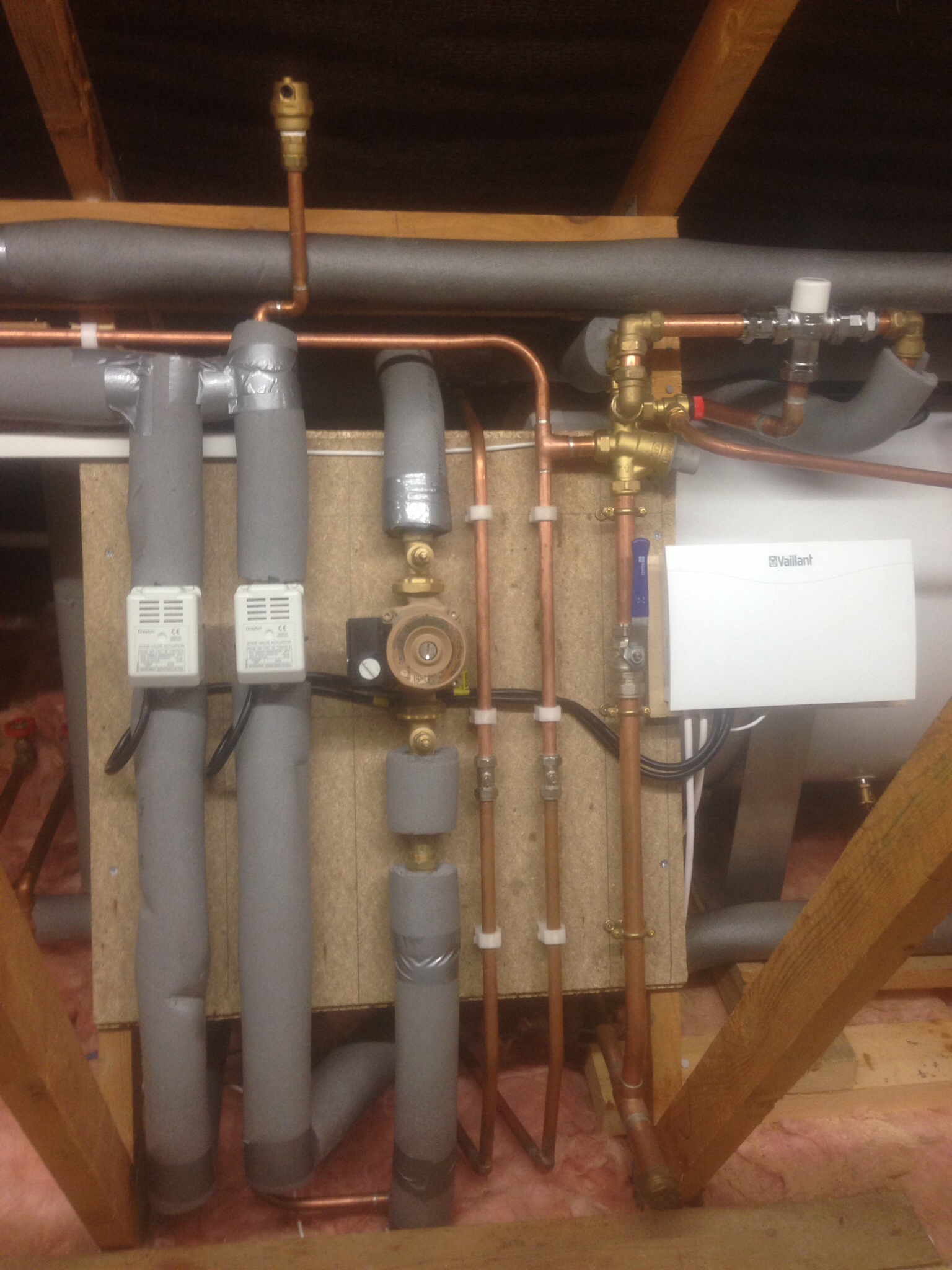
You'd need a thermostatic mixer valve to connect to the 2 pipes, then this setup pictured receives the output of the valve. This is also only suitable for a concealed arrangement, so a PITA to fit. Here you go... LINK Great make and cheaper than shoplifting.
-
Unvented Expansion Vessel Pre Charge
Nickfromwales replied to Mattg4321's topic in Boilers & Hot Water Tanks
I think what's happening is the expansion vessel is acting like a cold mains accumulator, and the stored energy inside it is reinforcing the flow until it equalises. Basin taps would be better (less noise / less problematic) as the flow rate is slower / lesser, so that makes sense. When you say just had it fitted, is this a retro-fit? edit: crossed post with @John Carroll’s comment. +1. -
Concealed shower valves too recessed?
Nickfromwales replied to tokyotecubate's topic in General Plumbing
Yup. Moves the handle head off like a Parliament hinge moves a door. -
Concealed shower valves too recessed?
Nickfromwales replied to tokyotecubate's topic in General Plumbing
I was just sick in my mouth...... "no" to that too. C'mon people, it just needs taking out and doing again, properly, then just move on with life and admire a nice shower install free from 'ugly' or 'compromise'. I've been fitting bathrooms for decades, and this just can't be fixed as is. @tokyotecubate can you get to the valve from behind? If cutting a plastered and painted wall is the only obstacle then that's 100% the way to attack this, and leave the tiles intact. That could be fixed in a day if there's access to the rear? -
Concealed shower valves too recessed?
Nickfromwales replied to tokyotecubate's topic in General Plumbing
Nope. The pivot point of the handle, which moves up and down + left to right, simply won't move enough, if at all. The head of that 'tap' moves upwards physically, and from the pic you can see immediately that the possibility of that being operated is "not a chance". You should be able to get more tiles if a new job, so time to just remove the 4 tiles around the valve, move it, and re-tile. The problem will not go away by any other means, sorry! -
Hello, hoping to find a place to off grid
Nickfromwales replied to Ollie B's topic in Introduce Yourself
@Crofter yes? -
100%. Folk will prob bid more on the devil they can see and therefore know.
-
Great feedback, thanks!
-
First toilet flush of the day making strange noise
Nickfromwales replied to Adsibob's topic in Waste & Sewerage
Yes, just noted it, no reference to your noise issue. 👍 -
Which product do you recommend for getting rust off tiles
Nickfromwales replied to Adsibob's topic in Floor Tiles & Tiling
Make some nice oak slippers for it? -
First toilet flush of the day making strange noise
Nickfromwales replied to Adsibob's topic in Waste & Sewerage
Nope, but on reexamination it looks like the boss for the smaller waste pipe is leaking? -
I'd just walk away and auction as is. Likelihood is anyone developing this will do the work anyways, quicker & cheaper, and you may do work that they'd be doing routinely; the money lost / time invested won't boost the sale price much if at all. A developer, for eg, may want / have to convert the roof to a warm roof so the work you first suggest may be one of the first things to go in the skip
-
Nasty clickety pipes and how to avoid them?
Nickfromwales replied to MikeSharp01's topic in General Plumbing
I was discussing this exact thing with a client this morning, and I mentioned that I use offcuts of PVC conduit at the start / end of straight runs, flexible conduit at turns if they're pinch points, and to not allow pipes to rest on thin timber such as the OSB webs of I-beams. In most instances where we install all the domestic plumbing for a self build client I make sure the pipes are insulated the whole length with a cheap 9mm wall EPS for all colds, and the same for sporadically used hots, and if there's a hot return then they get done in 19mm or 25mm wall insulation, bigger the better for those, but depends on bottlenecks and actually getting lots of that size insulation to congregate at the manifolds / UVC. Then use all round patent band to hold the insulation not the pipe. If you don't want to (or retrospectively cannot) insulate the whole run, then just use a 100mm section of insulation where you need to mechanically fix (clip) the pipe, and the patent band to replace the regular clip; so as to have the pipe slip freely inside the insulation. Cold pipes actually don't really need to be done as they just go from ambient to cold and back again, just the hot pipes tbh. Insulating the colds is a 'thing' if you fear condensation will be an issue, but that's more prevalent with copper vs plastic push fit pipework so possibly moot. I just tell the guys to insulate it all so I don't have to program them with the information of which pipes to do / not do, for sanity. -
Architrave round shrunken door linings
Nickfromwales replied to MortarThePoint's topic in Doors & Door Frames
The mitres will birds-mouth out then unless that is factored into a compound cut. Sanding the plaster down will be a bigger PITA and less controllable than planing the architrave imho. And dusty / messy as heck. Planing the timber means no filling and sanding, where the sandpaper went astray, as it will for sure!