AdamSee
-
Posts
158 -
Joined
-
Last visited
Everything posted by AdamSee
-
Don't suppose you have any pictures of this while it was been built? Keen to do something very similar in one of my rooms, but unsure as to the best way to construct it.
-
Electric cars are going to be the future, granted we have issues to sort out such as recharge times, battery construction and lifespan. But you can work on these while rolling out cars and without much change to the current infastructure. With hydrogen cars it would take large investment to upgrade certain filling stations to hold gas. Granted that some around me are setup for autogas already but it's a much more intensive process compared to fitting a charger. I've posted a link before showing our current energy generation which shows just how much electricity we produce from low carbon sources. The main problem with the slow development and uptake of electric vehicles stems from places like Germany. Their manufacturing industry is so heavily reliant on car manufacturing that it would be devastating to their economy if there was a sudden switch over. Think of all the factory's churning out pistons, valves, spark plugs, specialist grinding processes for engine components like the valve seats and engine blocks. Not only are these used in huge numbers for new cars but as spares aswell. None of these would be needed in the future. Hence why countries with small to non-existent car industries such as Norway have been the best adopters of EVs becuase it generated jobs for, rather than losing them.
-
I recommend Excel cabling as well. Seems to have been "problem free" in the past.......or it may just be the the problems are insignificant in comparison to the other problems you encounter when you have to feed it around a building. Make sure you test your connections once you've done them. For £10 you can buy a tester and its incredibly useful. Most often problem is down to not punching the patch panel properly. You can just press it down a second/third time to fully terminate it. But its a bugger to do once the panel is full and in a small cabinet.
-
Could be down to a faulty packing batch. I've gone through quite a few boxes of the stuff from different suppliers and its quite rare to have it kink like that. Should be fine along as your pulling it from the correct hole. Take it from the wrong place and it just becomes a tangled/kinked mess. Same applies for opening the box and trying to sort it out as their often 305m boxes, its worse than sorting out the Christmas lights.
-
Yea I've noticed a similar thing in my bathroom. I've don't have a tanking membrane but instead I have a fabric looking uncoupling membrane with marble tiles and it takes an age for the heat to come through. We used LVT in the bedrooms and the heat comes through within 15/20 mins. instead of the hour it takes for the bathroom floor to get warm. I assumed it may have just been down to the density of the tiles but still seems oddly long to me. It is however a upstairs bathroom but with no insulation underneath as there will be (although not at this present moment in time) a heated room below.
-
Trade discount
AdamSee replied to Pocster's topic in Self Build VAT, Community Infrastructure Levy (CIL), S106 & Tax
You could get someone with a legitimate company to buy these goods for you and sell them back on for the same price. I cant see why that wouldn't work for the purpose of claiming VAT. I'm assuming then, that they wont offer a account to a sole trader? -
Trade discount
AdamSee replied to Pocster's topic in Self Build VAT, Community Infrastructure Levy (CIL), S106 & Tax
Often when selling stuff to the trade they will alter the terms of the sales. In exchange for discounts / credit accounts they will offer a shorter amount of time to return a item and returns can incur a restocking fee. I would imagine that some trades are less picky about the item they receive and less likely to return stuff. Not helpful info.......but felt like mentioning it -
Does dial up still exist? Either way im sure that wont be the case. The day BT becomes nationalised is the same day their planning on striking, so nothing will work. Pocster - I think that a combination of the two is the way to go. Get yourself a small network cab with a patch panel and network switch and route everything to it. Solid core with facepates or keystones to places where its needed and for everything else use stranded cable with both ends crimped to RJ45 connectors which can get connected to the network switch.
-
That's a nifty tool, A basic punch down tool would do the same job, just 8 times as slow. In the video their using a keystone module. That's not a bad way of doing the connection but it is still reliant on having a patch cable between the solid core cable and the device. Where as you can buy a RJ45 to connect straight on to the solid core, (they teeth are slightly different in the connector compared to standard connectors) The only downside to crimping the solid core cable is the lack of flexibility and the connection isn't as good, so constant wobbling may eventually break it. As for choosing the cable type. Personally i went for cat5 for the same reason PeterW said, the increase in speed isn't necessary in a home unless your streaming 4K video maybe or moving large data. But the bottle neck can then be your network switch or hub, or you could accidentally have used a cat5 cable somewhere in they system and forgot about it. My favorite approach is to use link aggregation on my home server using multiple cables.
-
Or you could use these: https://www.comms-express.com/products/rj45-utp-2-piece-cat6-plug/ There RJ45 connectors that can go on to UPT / solidcore cable. Haven't used them myself on solid core, but have used the standard ones alot to make my own patch cables, not to difficult to do. This way you have the option of fitting a patch cable and wall plates in places where its necessary or terminate straight in to a RJ45 for a camera Edit: I think thoes connectors are actually for patch cable not solid core....currently cant find the solid core variant.
-
Options for Insulating suspended timber ground floor
AdamSee replied to AdamSee's topic in Heat Insulation
In reality there both a pain for the tiny amount of space that needs dealing with, but something needs to be done because theres currently a hole that my toolbox is sat over which lets in a draft. Hoping to get this done over the weekend. I guess pictures will follow once I've made my mind up. Considering the amount of ginger fur I keep finding around my house....yes, if I fit the breather membrane, it would eventually fill up. -
Options for Insulating suspended timber ground floor
AdamSee replied to AdamSee's topic in Heat Insulation
woops.......typo, should have said "now occupied" By myself, wife and the dog -
Options for Insulating suspended timber ground floor
AdamSee replied to AdamSee's topic in Heat Insulation
Yes the rest of the house is insulated with 75mm celotex, not exactly great, but only had 2x4 joists to work with and 100mm dosent actually fit This space im trying to insulate now is in the middle of the house and is the last bit of suspended timber floor to do as the remaining will be swapped out for block and beam when the extension happens. Currently im leaning towards the celotex with loads of expanding foam as it just seems a bit simpler but I will just have to careful in the future with filling the UFH loops. -
Options for Insulating suspended timber ground floor
AdamSee replied to AdamSee's topic in Heat Insulation
The VCL over the top acts as the air tightness layer. And taping it to the wall with "pro clima contega Solido SL" so that you can plaster over it seems to do the trick. -
I'm trying to figure out whats the best way of insulating my suspended timber ground floor in the under stairs / under upstairs landing cupboard. (roughly 1.5m wide x 1m deep x 2.5m high) My usual go to method is to lift the floor and fit 75mm celotex with a VCL over the top which is then taped and plastered in to the wall. On this occasion tho im leaning towards using rockwall or similar, held in place with some breather roofing membrane and then VCL as per normal. The reasons for wanting to mix it up are because 1 - I hate cutting celotex, the dust goes every where and it would have to be done outside this time around because the house is not occupied. And 2 - because my UFH manifolds are in this area, I have a habit of making a wet mess every so often with the ongoing plumbing works, and im worried that with the celotex the water may sit between it and the floor and cause some issues. At least if it has mineral wool it would pretty quickly pass through. Also, unlike the other floors, this will be old joist that ill be insulating, so there pretty uneven in comparison. So my question really is - What would you do?
-
I vaguely remember a tv show where a guy built outdoor BBQ pits/areas for peoples gardens. On quite a regular basis he had concrete worktops made at a company that let you chose the cement colour and the stone colour. Once it was cut and polished it look pretty good....well....it had the potential to look "tastefull" except he chose pink / pale blue on a regular basis. Anyone else remember this? I guess if you were set on making it yourself, I would recommend adding a waterproofing to the mix. We have a smooth polished floor in our warehouse and water soaks in leaving a mark. It dries out pretty quick. Oils are the main pain, they eventually spreads so far that it joins up to the other stains.
-
Soil pipe adapter - Cast Iron upper to plastic lower
AdamSee replied to Gooman's topic in Waste & Sewerage
This is the comapny you want to check out - https://www.flexseal.co.uk/products/flexible-couplings/ They do a coupling for every type of waste pipe. Takes a while to find what you need but you guarantee it on there. I usually find what I need the look at Wolsleys Plumb and Parts centres website as they usually stock these. -
Things to find lost TV remotes
AdamSee replied to Ferdinand's topic in General Self Build & DIY Discussion
Train a dog to sniff out the remote? I didn't intentionally train my dog to bring me my slippers, but regardless of where I hid them when i try to watch the tv in peace, he will find them and bring them to me in return for treats.....he brings rocks when he cant find shoes. -
looks good. I can see how it would have some good acoustic performances. I guess it also gives the option of completely overseeing the ceiling with rockwool to help as well. How come you decided to lower your ceiling? I'm was planning on using this system to do my living room ceiling as I need to lower it 100mm to make space for some semi rigid ducting and various other pipes. But I'm still a bit lost as to the best method to fit the perimeter track. Should I dot and dab the walls first getting it nice and flat, then fit the track using some long rawl plugs? Im guessing that as long as I drill through the continuous strip of adhesive at the top of the board, I shouldn't have a problem. The other option is trying to fit to very uneven old brickwork.
-
So what did you decide on in the end? I didn't realise that you could buy conduit from SF so cheap. I guess that works just fine with plenty to spare.
-
The speedfit cold form that Toolstation sell (but keep limited stock of) is the same as the Hep2o ones, I've used a lot of them rather than putting in joins everwhere and its been just fine. When passing it through a wall its best to use a bit of conduit as to not score it. I've found a dishwasher waste pipe to be the perfect size for the job and comes in handy lengths rather than having to buying 25m of the dam stuff.
-
To loft or not to loft?
AdamSee replied to Barnacles's topic in Mechanical Ventilation with Heat Recovery (MVHR)
I have a similar issue to yours. My plan was to partial convert the loft to a insulated "room/hutch" for the MVHR using stud walls and filling them with insulation. I could lift the insulation below it so its heated with the rest of the house......not sure if this could lead to over heating in the summer tho. The new "room" would only be about 1.5m x 1.5m. But should be enough to squeeze everything in. -
It certainly sounds like a plan. I guess that as you're having heating downstairs as well it should be just fine to localize the heating upstairs. Currently we don't have any heating downstairs and the UFH upstairs in the bedrooms is more than enough to warm it up. Granted its not that cold yet. Because the pipe channels run in one direction you usually do need to pass the pipes under the floor and through the joists. But if you putting in regular T&G panels around the edges you could route these to send your pipes to the necessary location without needing to get underneath and drill things. would make for a tidy installation.
-
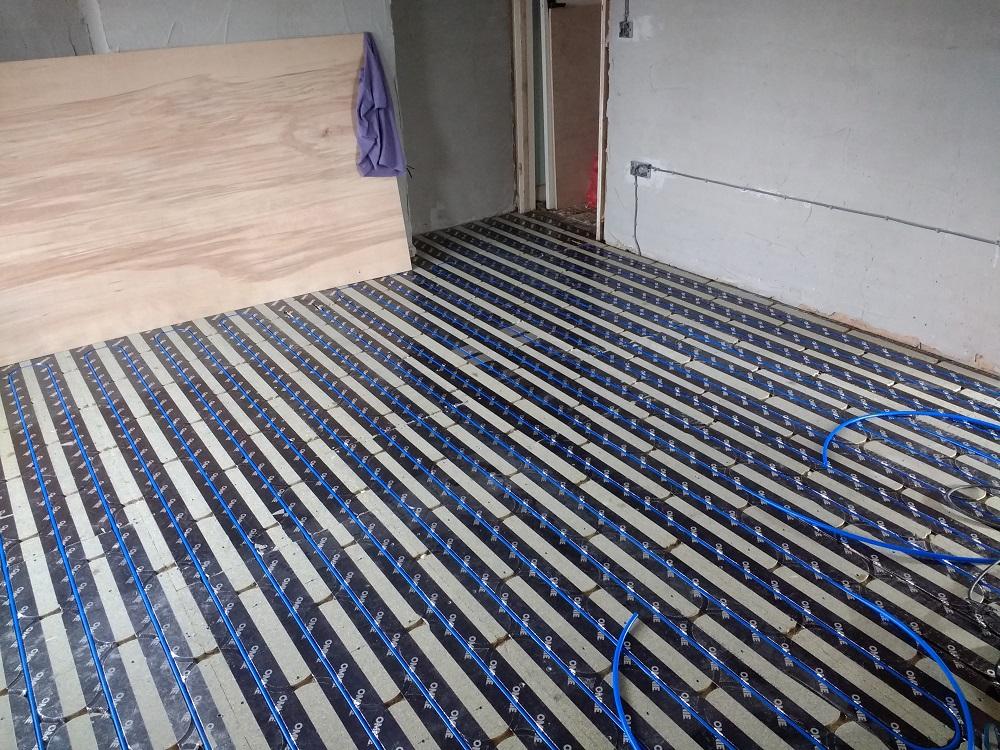
Hello I've used the Torfloor produced by Omnie for the entire upstairs of my house. For a retro project its great, there were plenty of small issues with the installation of it. Such as my joists been wonky and oddly spaced. It uses only 12mm pipe, so for the bedroom it requires two loops. Because theres only 6mm between the pipes and the floor covering it heats up really fast. unlike the spreader plates which I presume would be slower as the heat has to get through a 18/22mm thick piece of chipboard. The foil diffuser is exactly as you would guess, its just a very heavy weight piece of foil tape. Flimsy enough to easily push through it, part tough enough to find its way under your finger nail and hurt. I did do one room with 9mm ply and it doesn't seem to have changed the heat output at all and the floor feels rock solid. The general installation of it was moderate, idealy, access from below makes your life much easier. Willbish, I can send you the quote i received if you want to see how much it cost.
-
Sounds like a plan, I usually just wait until my wife is available and then give her the sharpie.