


AliG
-
Posts
3211 -
Joined
-
Last visited
-
Days Won
11
Everything posted by AliG
-
tanking around floor core holes?
AliG replied to magnethead's topic in Bathrooms, Ensuites & Wetrooms
I don't think it is, but that doesn't mean it is not a good idea to fill the holes. I am not sure about the best way to fill them. The biggest reason is not flooding, which is rare, but noise. We have a concrete upper floor but there are a couple of points I can hear noise coming from upstairs, I have realised it is because there are pipes drilled through the floor and I don't think the builders sealed them fully up. -
It was, there have been some quite tough stories this year. Very sad that she also lost her son. I couldn't really understand why she couldn't sell her house, I guessed it was sold as they had already had a sale fall through and had quite a bit of time.
-
Very nice house last night. Another absurd budget. Also I do wonder how honest people are when they say how much they have spent as it seems consistently low. I suspect the don’t include professional fees and the like. Another house built with a full filled cavity with 100mm of rockwool. You could see the plasterboard being put on the inside and that appeared to be all the insulation there was. I would like to see some of the heating bills for the houses being built. Looks like that gives a U-value of 0.3 for the walls which is the maximum allowed in England. I am not quite sure how the English regs work, can you only go that high if other areas are better than the maximum?
-
I managed to find a picture, it is the street my parents used to live in. All the houses had this area like a carport in front of the front door. We only really put a car in there if it was going to snow or be frosty. If you could do away with the little pieces of wall that narrow the opening it would make it a lot better to use. As the car sticks through the opening it is very hard to get past it at these points. If you put a car into the area that you have designed, the back edge of the doors will be very close to the door frame, depending on the car it could even stop them opening or make it difficult to get out.
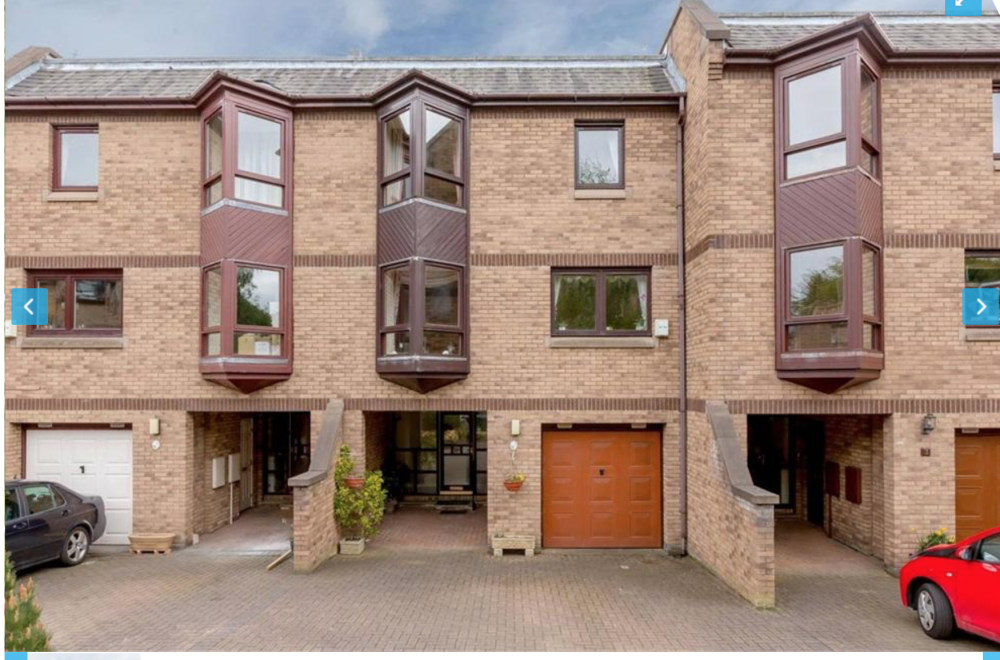
-
In Scotland you have to have an accessible shower or bath or space to provide one later and it cannot be off a bedroom. It is a bit stupid really in that if you have a downstairs en suite bedroom that does not satisfy the regs.
-
Thanks for taking the effort to respond to people. The stepped back front is unusual and will both reduce space and add to the costs as you will need a steel beam on each side to hold up the outside walls, extra small sections of roof, flashings, guttering etc. Not sure I understand. Do you mean remove the garage door? Or make the door from the kitchen an open walkway? The idea is that we won't use it as storage for a car, but we wanted it to be 'theoretically suitable'. We'd probably put a door halfway, so there is still an outside(ish) space for trash bins, bikes perhaps, and have a more heated 'utility' section. My point here is that as it is a car port, don't spend money on a garage door that serves no purpose, make it a car port. If you do this you can lose the small pieces of wall that frame the garage door which will make it much easier to get in and out of the car. We used to have a house with a very similar arrangement, a covered area shorter than a car, and it rarely got used as it was a pain to squeeze past the car, open the doors etc. If you make the opening as wide as possible this will help. No, the reason is twofold: 1/ to have the walkway 'disappear' as to give an idea of space. If you can't see where it's going your mind imagines much more space then there actually is 2/ To be able to split Bed 2 into two bedrooms. It's 1m.. not that bad? But, we could perhaps open into Bed 2 downwards (we left space..) but then you'd have to walk around a corner to get back in. I see what you have tried to do, but the awkward entrance to the room is worse than the illusion of extra space IMO. My point about how tight it was is the width of the corridor between the play area and sleeping area. It seems to be only 700mm wide, so that wall will be right in your face when you open the door. I thought maybe the dotted lines either side of the door were arches between the rooms. They might just be lintels or something else. It seems like you went through all the same thoughts as me on the master bedroom. I played around with it a lot see attached, but never got anything totally satisfactory. A small thing, but I think less than 1m for the landing down to bedroom 4 is a bit narrow, I would keep it at the same width as the rest of the landing. 2-FP44.thumb.jpg.c277276aaa788a0039a340adda510973.pdf
-
I don't see the problem as long as you have a decent WC for visitors. We almost did it but kept one and it is a bit of a wasted room. I far prefer an en suite, having my own bathroom.
-
1. Do you plan to have a cupboard under the stars? Or is that a cupboard across from the WC? We have a load of coats shoes etc in a big hall cupboard. 2. If you aren't having a garage and plan to put the car in there I would lose the door and widen the opening which won't need a door frame anymore. It will be easier to get in and out of the car and get past the car. 3. The sliding doors that separate the kitchen are pretty close to the island. I would move them over 1-200mm to the right on the picture. TBH I doubt they'd even be closed and it might be better just to lose them altogether, I don't like the pinch point between the island and the entrance to the garden room. If you wanted to separate an area, the lounge would be better where between the office wall and the pillar in the bifolds. 4. I guess the door to bedroom 2 is recessed to make the hall more symmetrical, but that looks like way too tight an entrance. You would open the door onto a wall right in front of your face. I would put it back where it was before, you could still have arches between the rooms. 5. I am not sure what you are trying to achieve on the master bedroom. I think it would be better to walk into the bedroom where that stair that I assume is a glitch is shown then have the walk in between the bedroom and the en suite. I guess it makes the bedroom feel wider as it is shown. You couldn't walk in there and close it off without disturbing the other person in the room. I don't think the massive sliders are a good idea, so I would either just make it a big room with wardrobes or I would make that a wall with an archway. Alternatively you could put the bed where the ensuite is and split the area where the bed is between the en suite and dressing room. Or you could make bedroom 4 a little narrower and put the walk-in there, making the room longer and narrower which fits a bed better. 6. The bathroom door opening out onto the landing is not a great idea and there is room to open into the bathroom.
-
I'll make a few comments on the plans in that thread Do you mean a planning team can 'approve on the condition I make xyz (e.g. the gable) smaller'? Yes, planning can easily say things like that. The architect is probably worried that the gable is already ahead of the houses either side and that you might be pushing it. Tempted to agree with you. Can you define 'small' though? The moves I'm thinking about are 50cm either direction I suspect legally speaking almost anything would officially be an amendment, but if it is so small no one would notice then I think you can get away with it. I would probably put this in the 10-20cm range. PD? Why would neighbours care? I'm .. tempted for sure.. but it is expensive of course. I should perhaps wait to see if my financials bounce back after covid.. PD is permitted development. There are things you are allowed to do to an existing house without needing to apply for permission, but it doesn't kick in until the house is built. Neighbours will definitely care. In general assume they will object to anything because they don't want building work next door. Their objections, however, usually are not over relevant matters. If you want a basement near to one of the houses next door the neighbours will complain that it will affect their houses, I doubt it is close enough to be an issue, but it won't stop them trying. Thus they are less likely to object if there is no basement.
-
Having looked at these questions, people could probably help if you post some plans. Is it that your architect just doesn't want to make minor amendments? Maybe they think that you will either give up on them or you can be charged to do them later. Certainly interior changes that don't affect the outside can be left until later, but not much later if you are going timber frame. Planning are very slow usually, so the less you have to deal in the future the better. 1. Window move. You might get away with a small move without an amendment, but that is large enough that it should probably have an amendment. Why not just change now to avoid future cost and time. 2. It seems that basements might be PD, however that would only count after your house is built. Thus I think the correct route is to add one, you don't have to build it. It may rile up the neighbours if they are close by so only add it if planning to have it. 3. Again seems the architect is being awkward unless there is more of a planning issue than we know about. Planning can always ask you to make it smaller. 4. If you want to add extra to the house it would need PP. Again it could be PD but assuming that you would add it as part of the build it needs permission if it changes the size of the house. If you do it the other way then move the window in, I am not sure about the letter of the law, but doubt it would be an issue. At worse it is an amendment, 1m of extra roof would likely not be. 5. Timber Frame Company - You can get a price from the current plans. The price will not change materially with minor amendments. I just got two quotes through on a 96% completed plan. Passivhaus Builder - Not sure exactly who you mean but you would get better advice here than almost anything you might pay for. Your architect should know these things but most do not. If you are planning a passive house you likely need to assume that the outside walls are around 450mm thick. Indeed looking at the small plan above it does not look like they are thick enough. This considerably adds to the footprint of a house. Home cinema guy - No harm asking here, I got advice from guy. Wiring shouldn't be a problem. The unusual things you may need to allow for are extra deep walls for speakers to be in them and the minimum distance needed for the projector to throw on the size of screen that you plan, usually around 5m. I know nothing about awnings.
-
Research into the motivations for and barriers to self-build
AliG replied to CharlD's topic in Research Resources
Done, might have been too late. Number one impediment to self building planning, followed by NIMBYs getting involved in planning. -
Starting point is how do you want to use the space. Do you have a family? Do you ever use the dining room as an actual dining room. If you have kids and don't use the dining room, a kitchen/dining/family room at the back and quiet lounge at the front would probably be the more expected arrangement nowadays. You might want to get a separate utility room also. The of course there is what can be done and how much will it cost. You are probably looking at 40-50k for a new kitchen, rear extension and taking down/moving a couple of walls. But you house won't be any bigger after all that, although it might be nicer and more usable.
-
Thanks for coming back and taking what has been said on board. I think you should be able to get it approved with some changes. I thought that the stone was probably a bit of a personal decision. We are in the middle of planning for my parents' house and my mum is absolutely adamant she doesn't want stone on the outside of it. As a lot of houses around here have a bit of stone and we thought they might ask for stone, I would have been in the same situation and told her she would have to accept the stone to get her house built. She wouldn't have been happy, but getting the house built is more important. It is easy for me to say though because I am less fussed about the exact look and more interested in living inside the house, I know for some people the exact look may be more important. I think you can make a few changes, put it back into planning and start again. The main comments in the appeal report give you a good starting point. Also, I don't know how the architect is charging for it, but really if you start with the simple change to render that is no effort in terms of redoing the plans. Changing the look of the front isn't a big job either so hopefully it shouldn't be too expensive to reapply.
-
Current Elec/Gas Deals + COVID-19
AliG replied to Ferdinand's topic in General Self Build & DIY Discussion
I tend to go with the best deal I can get from someone I have heard of, so I probably would go with British Gas. I was with So for a while and they had v good customer service and in reality I doubt there is a big reason not to go with the cheapest deals unless you have heard that they have really bad customer service. As there is no cost to change you can easily move again if it gets cheaper. I move all the time due to our high usage. I would tend to stick with a fixed price because if the price falls you can always move but if you go variable and the price rises then all prices will probably be higher by that point. Don't forget to go through Quidco to get cash back. -
Already answered, but yes. They show you the settings for 3 and 6 litres, but there is nothing stopping you setting it as high as the cistern will take, which when I have looked at them looks like how they are set. Older toilets often have holes in the rim that the water comes through slowing it down. Newer toilets send the water round the rim more quickly and flush better, I don't know what kind of toilet the original one is.
-
I watched a toilet being installed in the in laws in California a few years ago. I was very surprised to find that most American toilets have the waste in the bottom and sit on a seal between the toilet and the floor. It took the plumber ages to get it to not leak. Standard flush valves in America are 2 or 3 inches so the water comes down faster, but they too have been making the flush volumes smaller. Actually I go to America a lot for work and hotel toilets are awful for blocking there as they are really pushing the water saving. Standard flush in the US was 1.6 gallons (7.2l) but now it seems to be moving to 1.28 gallons which is basically the same as our 6 litres with smaller bowls also. I checked the spec on my cistern and it is also sold in the US so can take 7.2l.
-
I had a bit of a Google on this as I wanted to know if you could tell why some toilets flush better than others. The toilets where I work have hands free flush and block all the time for example. Worth checking the current toilet for a couple of things. You get 1.5 inch and 2inch flush valves. The larger valve will let the water through faster so should flush better. If it is 1.5 inch you might be able to replace the valve or cistern/valve which wouldn't be too expensive. Does the toilet have a flush handle or a button system? Some syphon flushes with a handle can be set to do a smaller flush. Worth checking if it actually empties the whole cistern when it is flushed.
-
We have Porcelanosa WCs with Noken in wall cisterns. The cisterns look very similar to Geberit ones to me. I think the plumber ignored the measurements and set them to fill to the maximum level possible. I don't know if it is this or just the design of these cisterns but they send the water into the bowl with way more force than the toilets we used to have. The water definitely travels faster and leaves the bowl a lot cleaner. If you look at the design of the even the cheap concealed Geberit cistern it sits about a foot above the bowl, so maybe that helps compared to a close coupled toilet. My wife just told me that we have a friend with a son who has a similar problem and constantly blocks the toilet in their house. He had zero issues when they stayed with us for a week. You might also disconnect the half flush so they can only use the full flush.
-
Thanks @Ferdinand that's a lot of useful information. @Dicky what advice did the planning consultant actually give you? I think this is going to sound a bit blunt, but really I want to be honest and help you get your house built. That is what the planning consultant should have done. The house is larger, taller, different materials, different design and differently placed on the plot to the other houses in the street. Virtually no compromise has been made to try and get it approved. It seems clear from the report that they gave you the chance to alter these things. Many people on here have had very difficult dealings with planning and would often love them to be specific about what the actual problem is. TBF it also seems that they are somewhat obsessive about the bat issue and have ample time to write up massive reports. Three very easy changes can be made that would make the house much more likely to be approved. 1. Render the front, the stone would look out of place. 2. Remove the front bay and make the centre window smaller, I can see that breaking up the front might improve the look of the house which might also be your thinking, but planning disagree. It doesn't really add much useful space inside and can easily be designed out if planners don't like it. 3. You could change the windows to have a vertical aspect. Pairs of windows with a vertical aspect on the front would be more in keeping with the street and might actually look better. These things are all mentioned in the report and changing them doesn't really alter the house. I think if you compromised on these you would probably get away with the size, height, spacing etc. However the fact it has already been refused won't help. But I would make these changes, put it back to planning and see what they say. 4. If the wanted a larger gap to next door, you could probably lose 500mm off the width, making the dining room narrower, turning the table around and moving the wall across at the entrance to the kitchen if you want to keep the lounge the same size. Narrowing the entrance to the kitchen wouldn't lose much useful space. I don't think it would compromise the bathroom or bedroom which are quite long. 5. It would be useful to show the height of the existing house relative to the proposed house. The planners seem to be assuming it is much taller, it probably is, but it is hard to argue without the numbers. If it is much taller and they really object to it, you could knock about 800mm off by making the centre part of the roof flat. Often this has to be done when a house is quite deep to stop the roof getting really high. It would be more expensive to build but it would considerably reduce its bulk from the street. Of note when I looked at the plans, two things that I though so odd I had to comment. 1. The stairs are 800mm wide and turn back on themselves. This would leave not only a narrow 800mm wide hall upstairs, but harder to see is the return would be less than 1.5m above floor level in the downstairs hall, narrowing the downstairs hall to only 800mm at that point. I am not sure if it is to be boxed in putting an odd wall across the hall or maybe the stairs are to be open. When you come in the front door you would be looking at the back of half the staircase. It is not a great design, I cannot fathom what the architect was thinking about. A wider(0.9-1m) straight stair, 3m long, would be much better although it might a bit tight to fit in front to back, downstairs you could move back the entrance to the kitchen, but the problem would be the master bedroom entrance. If this is the case you could have a quarter turn in it with the bottom turned 90 degrees in the now wider hall. People would also be able to see right through to the kitchen, really improving the sight lines. 2. Downstairs and upstairs ceilings are both 2500mm high then the kitchen is 2640mm tall which would mean it has a step in the ceiling randomly across the room. Why not make downstairs 2600mm tall and upstairs 2400mm tall which would more befit a large house anyway and make the kitchen ceiling all one height. Hopefully with a bit of compromise you can get your house built.
-
This thread actually has a lot of good info for my question.
-
Part of the roof will be a sedum roof, under this and for the rest of the roof I would assume EPDM although nothing has been specified at the moment.
-
I had a look on Google Maps. It looks like the house is at the end of a row of 8 houses that all look broadly similar in that the have totally flat fronts and are mainly render with some bricks. Indeed virtually all the houses in the street are rendered some with more brick than others, but there is very little use of stone. There are a couple of bungalows about 150m away at the end of the road with some stone on them. They are close to the house you show opposite the end of the street and around half of the houses in that street use stone, it has quite a different mix to your street. Now would I mind your use if stone, no not really, but is it an unusual material for the street, yes it is. The street doesn't look that uniform that I would care but it is not being entirely unreasonable to try and keep some similarity. There is a wide variety of architectural styles in the street I live on with houses built at various points over the last hundred years. But every house is mainly rendered and planning like to see some continuity of materials. Also no house on that side of the street has any kind of porch or anything jutting out of the front. Most of them are totally flat, so again I can see the request to be the same.
-
I assume that the house isn't in a conservation area or anything like that? Did the appeal include pictures of these various different finishes nearby? The whole planning process is oddly personal in that planner may like a design and be happy with it and someone else may not. This really is why design should not be that important, it is very subjective. I would have thought the planning inspectorate would take this view and with information on a large number of different finishes nearby would have approved it. TBH though, this is all moot. You can either put in a slightly different application with more supporting information and try again which will probably take some time and expense. OR I know it may seem tough on you, but considering the cost of building a house and the value of it to you as an asset, if all you have to do is make a change from stone to render and a minor design change to get it approved then that is probably the best course of action.
-
Ok. Finished now. I’m just gobsmacked. My wife would have throttled me. Two years off work and hardly anything to show for it. Lovely looking house from the outside. They finished by counting up the massive profit they have made. Not if it’s never finished. Also two years lost work and living in a garage. That’s effectively a cost of a hundred grand right there that they are ignoring.
-
For reference this is what you want to replace. Is the main bone of contention that the replacement isn’t rendered? If that’s all it takes to get the house built then even if you don’t want render I’d just go with it. I think you’ve tried hard and it is probably now time to compromise. I can see how they might think the front elevation is too different. The plot looks plenty big enough and so it seems that the only concern is making the front look similar to the other houses. Is there any other issue like the shape of the windows or the proportions? I am trying not to be mean but I can’t see how anything new wouldn’t be an improvement.



