


bob the builder 2
-
Posts
118 -
Joined
-
Last visited
-
Days Won
2
Everything posted by bob the builder 2
-
HI @Big jimbo - replacement dwellings may be ok as there is an existing house which already has a nitrate output (i.e. no new nitrates) @Mulberry view - worth checking if you will be allowed to clear those conditions without being blocked Bob
-
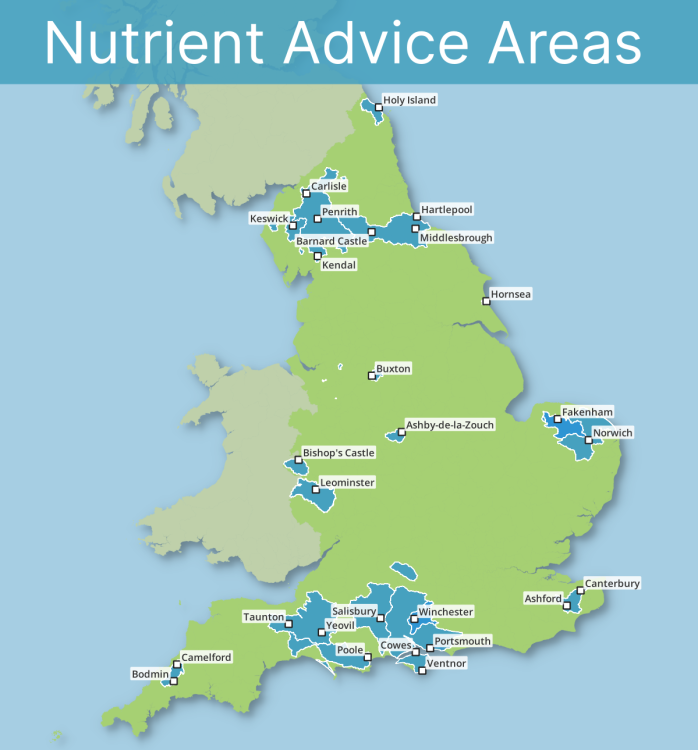
Hi All Any new build, even if it has permission, which has not signed off any condition related to drainage or sewage is blocked in all impacted 74 English local council areas. Obviously if you are waiting for permission in these areas of any new build you are also blocked. Even areas like the Solent which started to arrange mitigation schemes in 2019 are now blocked as 'Phosphorous' has now been added to the existing 'Nitrate' issue. No scheme in the country has a mitigation for Phosphorous ! For those of you considering starting down the self build route in these areas - stop - go an buy a house and forget about it (or go to another area) Those of us who are too far down the line and committed realistically we are in a 12 - 24 month delay. Madness...
-
Mulberry Unfortunately yes - we also have a full planning approval which is now blocked under the drainage condition and some minor amends. Madness ....
-
Thanks to everyone who has commented / added advice. So we are now 6 weeks since the 'surprise' natural England advice effectively halted all new build planning approvals in England. Appreciate if anyone has any news on things improving or ways to unblock this planning madness. Bob
-
Dear Build Hub Members As many of you will be in the process of considering plots, preparing planning, or like us waiting for an approval, the enclosed news may be (i am afraid) very bad news if you are living in one of the 74 local planning authorities which received the enclosed guidance from Natural England on 16th March 2022. The report below provides a lengthy but complete overview of the situation which in short means that if you are planning a new build which increases the amount of nitrate your application will at best be delayed by several months and if approved come with a significant additional tax to mitigate the new nitrates. (in the Solent the average house requires x2 credits costing c£25k) Whilst i hope not many of the forum members will be impacted those of you who are may find this a valuable source of information and perhaps (cold) comfort that you are not alone in the madness of the UK planning system Bob ----------------------------- England planning news, April 2022 (lichfields.uk) -------------------- Further Natural England advice leads to more housing and leisure decision delays Natural England advice setting out requirements relating to Habitats Regulation Assessment of protected sites can have the effect of preventing certain planning decisions being made. Protected sites include Special Areas of Conservation, Special Protection Areas and Ramsar sites. While the issuing of such advice is not new, advice has been issued to 74 local planning authorities at the same time, 42 of which had not received Natural England advice on this matter in the past. Written Ministerial Statement This follows a written ministerial statement from the Environment Secretary on 16 March 2022: "Many of our most internationally important water bodies are designated as protected sites under the Conservation of Habitats and Species Regulations 2017. Under the Habitats Regulations, competent authorities, such as local planning authorities and the Environment Agency, must assess the environmental impact of planning applications or local plans. As a result of these regulations and European case law, Natural England has advised that in areas where protected sites are in ‘unfavourable condition’ due to nutrient pollution, Local Planning Authorities can only approve a project if they are certain it will have no negative effect on the protected site. "Following further work to understand the sources of site deterioration, Natural England has today issued updated advice and support to the 32 Local Planning Authorities currently affected by nutrient pollution, as well as 42 new LPAs. So far this approach has too often been complex, time-consuming and costly to apply, and government is clear that action is needed to make sure that we both deliver the homes communities need and address pollution at source." The statement goes on to explain that Natural England has devised “a ‘nutrient calculator’ to enable development to take place in a sustainable way” and that £100,000 grants are available to each affected catchment “to support cross-Local Authority work to meet Natural England requirements and enable development to continue”. The written ministerial statement concludes by saying that legislation to further strengthen requirements to reduce nutrients at source will be brought into force. Natural England advice letter On the same day Natural England issued a 25 page advice letter to the affected authorities. According to a subsequent letter from the Leader of Havant Council to the Levelling Up Secretary and the Housing Minister, the letter was issued with no prior warning. Tables setting out the affected LPAs are included within Annex C of the letter. Table 1 shows “Existing sites in unfavourable condition due to excessive nutrients which require a Habitats Regulations Assessment (HRA) and where nutrient neutrality is being deployed as mitigation”. It identifies the habitats site and catchment, the LPAs affected within that catchment, the type of nutrient to which the advice applies and provides a summary of the development types affected by the advice. The table also shows whether there is Nutrient Neutrality Methodology and Calculator produced by Natural England or LPA. However, there is a footnote stating “Nutrient neutrality calculators have been provided for all the catchments listed above, even where there is an existing nutrient neutrality calculator”. So even where nutrient neutrality calculators were in place, Natural England has made changes that are likely to make mitigation more difficult. Some of these LPAs have received new advice regarding other catchments too. Table 2 of Annex C is a list of “Additional habitats sites in unfavourable condition due to excessive nutrients which require a Habitats Regulations Assessment (HRA) and where nutrient neutrality is a potential solution to enable development to proceed”. This table simply identifies the habitats site and catchment and the LPAs affected within that catchment and the type of nutrient to which the advice applies. These are the LPAs that have previously not been issued with advice. The advice letter affects proposed developments for all types of overnight accommodation including new homes, student accommodation, care homes, tourism attractions and tourist accommodation and permitted development for new overnight accommodation. Chief Planner letter A letter from the Chief Planner to the affected LPAs said: "For planning applications in the affected areas, this means you need to consider the possibility of adverse effects, as a result of additional nutrient loads (including from residential developments); as part of a Habitat Regulations Assessment (HRA). "In practical terms, this means that before granting any new permissions following the receipt of the Natural England advice, you will need to be confident that the development in question does not require nutrient neutrality to be acceptable under the regulations or that nutrient neutrality is secured, as part of the proposal. […] "I appreciate that this will have an immediate impact on planning applications and appeals in affected areas. There may be a need to reconsider the acceptability of current proposals, in light of the advice issued. […] "We recognise that in the newly affected areas, it is unlikely for there to be mitigation solutions in-place or readily available and so the ability for development to be made acceptable will be necessarily limited in the short term. As we have seen in catchments already affected by similar advice, it may take time for applicants to secure mitigation to be able to demonstrate neutrality”. More than a development industry matter A Natural England blog, published on 18 March acknowledges: “The sources of excess nutrients include sewage treatment works, septic tanks, livestock, arable farming and industrial processes. These are long-running issues spanning decades and will be complex to resolve”. It continues: “The best we can do in the short term is to stop the situation getting worse which is why we have developed a neutral approach to nutrients. This isn’t legalistically driven, it’s an environmental imperative that the regulatory safety net has caught. In the long term we need to work in partnership across catchments and sectors to enact Environment Act targets of reducing nutrient pollution in water by reducing phosphorus loading from treated wastewater by 80 per cent by 2037 and reducing nitrogen, phosphorous and sediment from agriculture to the water environment by 40 per cent by 2037”. Comment Harry Bennett’s Lichfields Planning Matters blog considers the impact of the Natural England nutrient neutrality advice on the requirement for LPAs to demonstrate a five-year housing land supply of deliverable sites, with reference to a recent appeal decision. This is the first in a series of Lichfields blogs on the matter – you can subscribe at the end of any blog page. For an insightful discussion on the broader and legal implications of the latest Natural England advice we recommend the Clubhouse sessions convened by Simon Ricketts of Town Legal “More Natural England development bans : what to do?” and also Simon’s blogs. Water neutrality In addition to nutrient neutrality, there are existing requirements to be water neutral in parts of North Sussex within that fall within parts of Crawley, Arun, Chichester and Horsham LPAs. A position statement with an interim approach having been issued by Natural England in September 2021. Strategic solutions for recreational pressure And on 14 March 2022, Natural England issued advice to Buckinghamshire Council (Aylesbury Vale and Chiltern Districts), Central Bedfordshire Council, Dacorum Borough Council, St Albans City and District Council, and Hertfordshire County Council. The advice is in respect of concerns about recreational pressure on Ashridge Commons and Woods Site of Special Scientific Interest (SSSI) within the Chilterns Beechwoods Special Area of Conservation (SAC) and says that a strategic solution to that pressure is required. “Natural England understand that Strategic Solutions can be a time consuming process, and will lead to a period of time where strategic-level mitigation hasn’t yet been identified. During this period we advise that HRAs will be needed, detailing how each individual site is going to avoid adverse impacts on the integrity of the Chilterns Beechwoods SAC. This is for all planning applications that result in a net increase in dwellings, within the entire 500m – 12.6km ZOI”. The advice also refers to around 20 existing Strategic Solutions nationally and notes: “The tests of the 2019 Habitats Regulations (EU exit amendment) are a high bar to pass for any individual planning application. In essence each application would need to prove that in itself it wouldn’t harm the SAC either alone or in combination with all other planning applications in the ZOI”. Natural England Advice for development proposals with the potential to affect water quality resulting in adverse nutrient impacts on habitats sites, uploaded by Cornwall Council, 16 March 2022 Lichfields Planning Matters, Nutrient Neutrality – A housing supply headache Natural England advice regarding recreational impacts upon Chilterns Beechwoods Special Area of Conservation (SAC) and the need for a Mitigation Strategy, uploaded by Dacorum Council Natural England’s Position Statement for Applications within the Sussex North Water Supply Zone, September 2021 – Interim Approach, uploaded by Chichester Council Map of the Sussex North Water Supply Zone, uploaded by Horsham Council
-
Hi Just having issues with nitrate approval from Natural England in the Hampshire area. Interested to hear if anyone else if being blocked or has any idea how to get round it ? Many thanks
-
HI All Has anyone worked out the best way to satisfy a condition that requires a 10% net gain ? Also - any views on cost of such a report (or potential suppliers) would be appreciated. Many thanks
-
Hi - also been asked to prove a 10% biodiversity net gain in my landscape plan - any ideas how to do or calculate this would be appreciated ! bob
-
It appears they would like someone other than themselves to take this responsibility. Still not clear what they actually want as they could not provide and example
-
Hi Timber frame company have asked for it. Many Thanks
-
Hi All I have been asked to provide a construction phase plan. If anyone has any examples or sources of information i would be grateful. Many Thanks
-
Hi All I have been asked for a 'Fire Risk Mitigation Report' If anyone has any tips or examples on what this is and should contain i would be grateful. Many Thanks
-
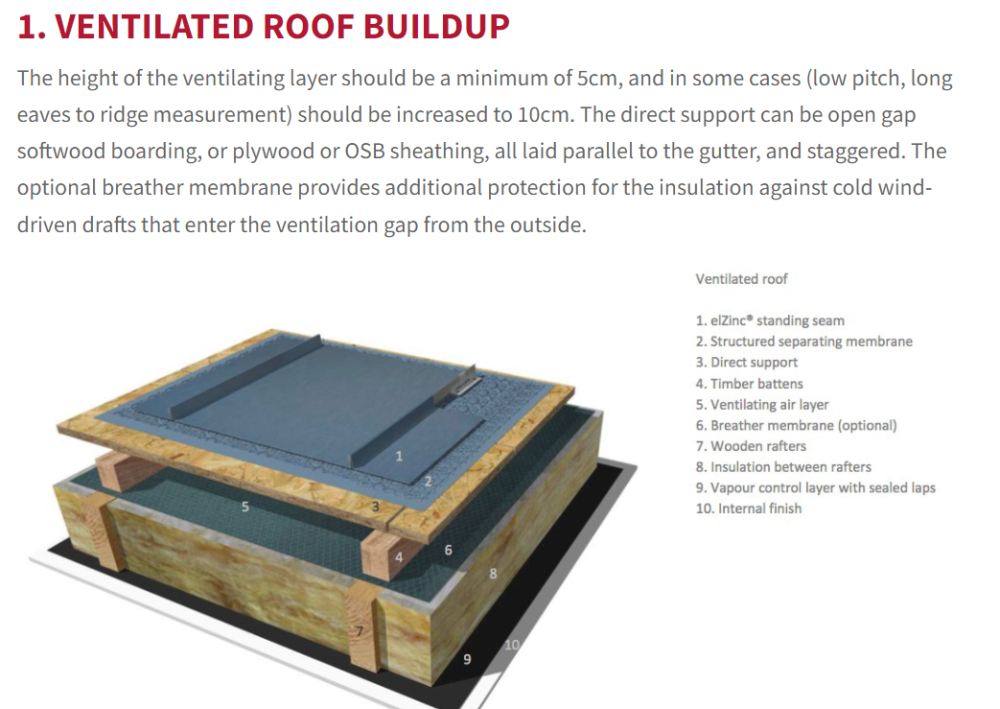
All Thank you as ever some great advice. So i think this is what i must do then given my timber frame is specified to a 'warm roof' build-up. Am i right to call this a 'Ventilated warm roof' ? Many thanks
-
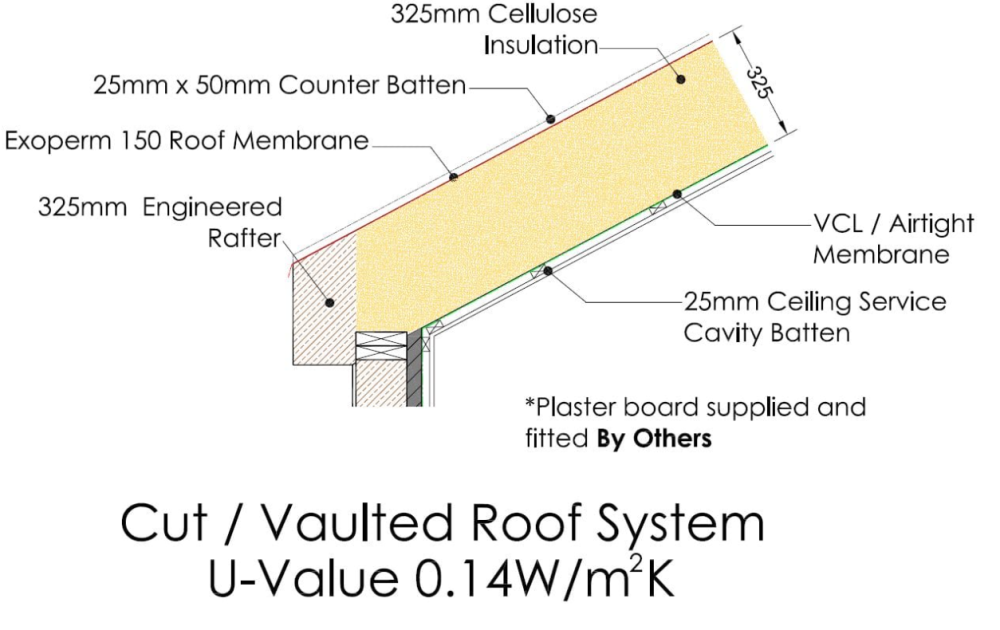
Thanks to everyone for the input so far. We are going with a well known TF provider who will leave us with a vaulted roof as per this picture (hope you can all see it) So the question is if we want to go standing seam (zinc or PLX) what is the best in terms of depth and performance (we are just a bit tight on headroom hence the desire to make the depth as narrow as possible) Thanks again for your thoughts Bob
-
Hi All It decision time on roofing at our build and i wonder if anyone had experience of specify the best approach (Warm v's Ventilated) The key constraint is roof depth as we are working to a tight height restriction. Ideally we would like to go with a zinc or Greencoat PLX standing seam finish. Reading around there seems to be various approaches to deliver the roof structure above timber rafters the TF company will leave us with. Any experience in achieving the best mix of cost and depth would be greatly appreciated. Thanks Bob
-
Appreciate any experience with this company ? thanks
-
HI All I am considering some exposed glulam beams. Will these also have to be clear coated with clear fireproof coating ? Many thanks
-
HI just catching up on the posts above - 3 things jumped out to me 1) You need to obtain class Q approval before falling back on it for full planning 2) If you can go for a 'new build' via full planning - i too thought long and hard about conversion but am glad i now have the chance to build from scratch which is much more straight forward / cost effective and will definitely deliver a better house 2) This will take time - unless you need to sell sit tight - the cost of rent and pressure to take short cuts are not worth it if you can possibly avoid it Good luck Good Luck
-
rerouting overhead power cables underground
bob the builder 2 replied to cipn's topic in Introduce Yourself
HI There The break down and cost above are approx. the same for my 40k black hole .... In addition i have to do my own trenching and pay legal fees on top. So the question is how can this be reduced ? cheers -
Neil Class Q is a well worn path and the key is the interpretation in your local area. I would strongly advise you find a local planning consultant who can show you successful local Class Q applications and follow their advice on what is applicable and passable. Two thoughts 1) Many people obtain class Q and then convert that planning right into a completely new build on the principal of 'fall back' (i.e. you have the right to build under class Q and therefore the planners are compelled to allow the new scheme particularly if it is more aesthetically pleasing and environmentally efficient) 2) Up to 500msq can be sub divided across barns on your site - this may mean you can get approval for more than one barn and 'reallocate' to make a scheme that is the right size - again you are going to get class Q first and then go for a new replacement scheme as above. Finally like you i wanted to do it the right way and stick to the rules - getting an approval under class Q and then a new scheme is what the rules allow - what you must do is use the law and the rules as others have done and follow a methodical process to get what is best for you and your family. If you want to dig any deeper drop me a line - i have just completed the above process, Cheers
-
Section 80 - Notice of Intended Demolition
bob the builder 2 replied to Mania's topic in Building Regulations
HI All Just at the same stage and hoping to get the existing structure down very shortly. I have the complication of HV overheads and asbestos to work around. Any tips on preparing this document or word examples i could use would be very much appreciated Thanks BoB P.S - can i do this step before full building regs ready ? -
rerouting overhead power cables underground
bob the builder 2 replied to cipn's topic in Introduce Yourself
cipn i had a similar quote from SSE who i think might also be your supplier as above its all regulated now and off a common price book it appears our fellow forum members may have been lucky with the supplier contributing to the cost or getting it done before everything went by the book only way round is to cancel the wayleave and wait it out (if you have time) -
rerouting overhead power cables underground
bob the builder 2 replied to cipn's topic in Introduce Yourself
I suspect the new rules are behind the cost increase 1) You cannot reuse existing transformers = new one c10K for 11kv 2) HV shut down 5K (11kv is HV) 3) New pole (as will not move old ones) 3k for a single, 5.5k for an 'H' pole. 4) Legal for all parties (depends how many TP's involved ) So that's c20k - 30k before the contestable works, carding for the shutdown and the actual cables and man hours and the trenching and jointing holes As before if you can wait for the wayleaves to be cancelled and the works done for a % of the above go that route - if you are actually planning to build in the next 36months its time to pay up... -
rerouting overhead power cables underground
bob the builder 2 replied to cipn's topic in Introduce Yourself
If you have a 'new supply' installed at the same time as the overhead removal / burial the whole lot is zero rated for VAT and often the quote time is shorter !! But an 11kv will still cost you c £40k (before you dig the holes) and very few will do the contestable works if any. deep breath and carry on bob -
rerouting overhead power cables underground
bob the builder 2 replied to cipn's topic in Introduce Yourself
Hi Yes its very expensive and unless you have lots of time to wait out the wayleave process then that cost will be yours to pay. this is a very good thread with the best guidance i have found. https://forum.buildhub.org.uk/topic/10951-overhead-cables-movingburying/ good luck




