jayc89
-
Posts
1389 -
Joined
-
Last visited
-
Days Won
1
Everything posted by jayc89
-
I've spent months waiting for the builder I want to do some structural work. Whilst it's been frustrating having to live with parts of the house unfinished, it'll be well worth it in the grand scheme of things, IMO.
-
I bought some of that stuff too, and forgot about it, so used the same adhesive as what I used for the tiles on top of the mat. Seems to have worked a treat.
-
For the price of the mat, why wouldn't you? Commission the UFH first, make sure all's good, then get the screed primed and a mat laid before the tiles. Upstairs I have similar. I'm priming the caber floor (which is generously glued and screwed on 400 centres), laying UFH mat and using self leveller to bring it up to the same height as the shower former, then laying a decoupling mat across the lot and tiling.
-
I can only dream of having spent the last couple of weeks trying to figure this out. Unfortunately there's been plenty of other things to tackle on this renovation. Agree with the point though!
-
That might be my only option, quite galling to pay £61 for it though
-
Most of the Geberit stuff I can see is electrofusion welded, which I don't have the gear for. I don't think the provided 90 bend will clear the underside of the bottom plate on an angle for me to get a coupler on to, without butchering the bottom plate and losing support for the frame itself.
-
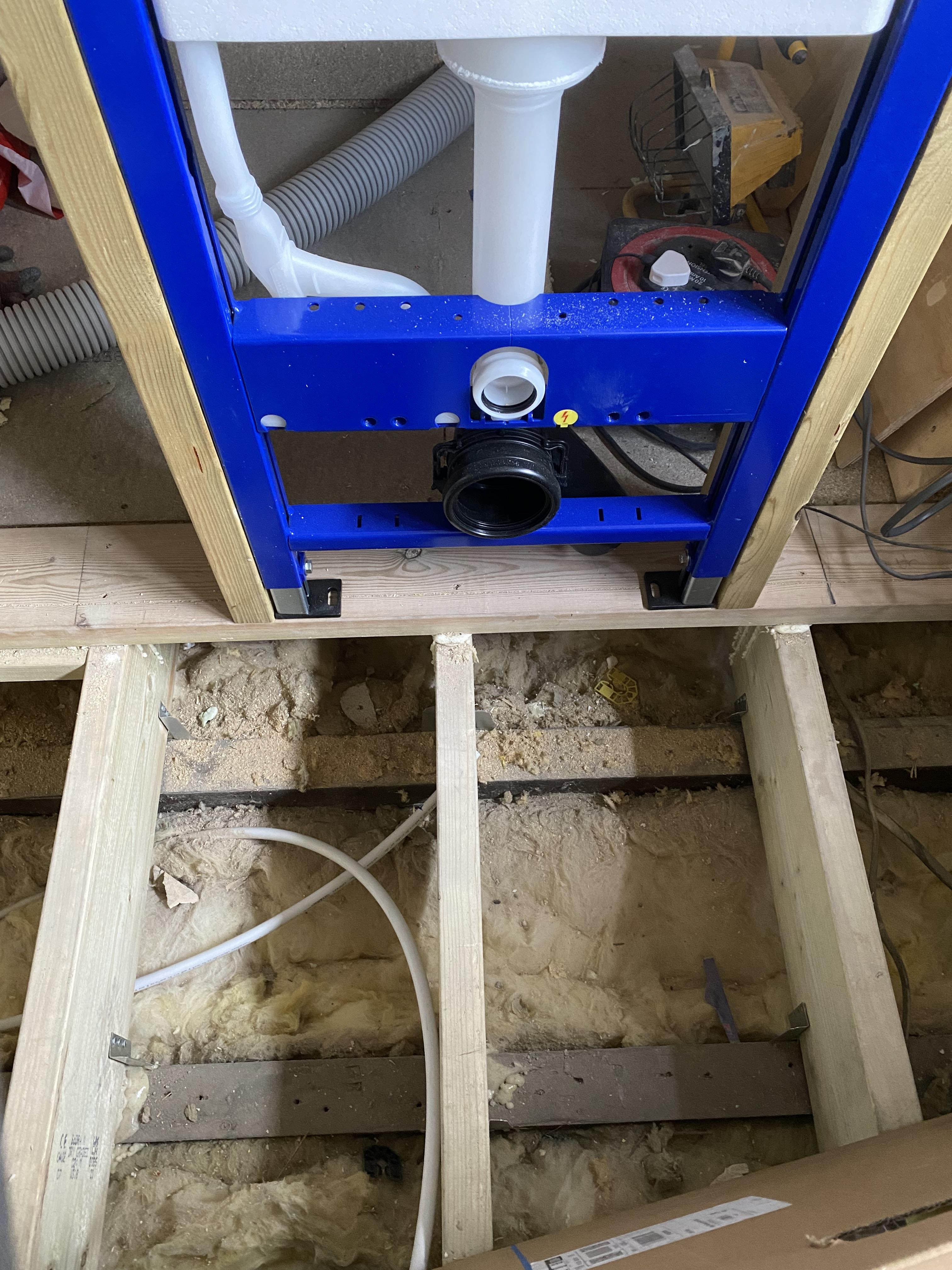
the pipe needs to drop down and run to the external wall which is in front of the frame. i can’t see any suitable offset connector available in the UK
-
Solid wall Internal Wall Insulation (Warm Batten) design
jayc89 replied to Annker's topic in Heat Insulation
The problem with gypsum isn't its breathability, but the fact it's hygroscopic. With a permeable construction you're allowing water vapour to travel as it pleases, but if that condenses, your skim and plasterboard is knackerd. Either go with a IWI solution recommended by the likes of Mike Wye/Ty-Mawr which will include a breathable insulation layer (wood fibre, sheep wool etc) and a lime plaster, which requires a lime wash/clay paint, or go with a impermeable build up, like PIR and warm batten and plasterboard. Don't mix the two. There isn't enough data out to make informed recommendations either way. I've done sections of my house using both; vapour permeable in the cellar, PIR elsewhere, and I'm not seeing any ill affects, however someone else could quite easily come along and show you images of damp/rot/mould caused by the same, or similar, build ups. There are clearly a number of variables to consider before making your choice. -
Any ideas how I can offset the soil pipe run? I had seen these https://www.amazon.co.uk/366-914-16-1-Geberit/dp/B003NXHN6A which look like they'll do the trick but my local plumbers merchant, that stocks Geberit stuff said they can't get them and on Amazon they're ludicrously expensive!
-
Fitting our ensuite, the W/C frame is going to straddle a joist, near enough perfectly, I couldn't have designed it to be more central! So I need to offset the waste run. I've seen Geberit do a 90mm 135 bend, but it looks like it needs electrofusion welding. The pipe they supply with the frame is push fit, is there any compatible 90mm push fit bends I can use? My plan is to angle the supplied 90mm pipe + use a 135 bend to offset horizontally, then drop down to a 110mm 90 bend to run parallel with the joists out of the house.
-
Looking for some tile in lighting strips for a couple of bathroom niches. Just plain white, not looking to turn it into a rave. I've seen the Genesis Vision profiles, are there any others I should consider before placing an order?
-
It's been in around 6 months now and hasn't budged, so far so good!
-
Windtightness on the cold side of the insulation, airtightness on the warm side. For a suspended timber floor, I'd do this - https://www.ecologicalbuildingsystems.com/post/best-practice-approach-insulating-suspended-timber-floors
-
I used something like these to screw through the frame into the stud work - https://www.screwfix.com/p/easydrive-hex-bolt-self-tapping-coach-screws-10mm-x-70mm-10-pack/9147T I also added a couple of noggins, top and bottom, behind the frame and screwed into that for additional support. Then CT1 the face of the frame before boarding.
-
Internal wall insulation - bedrooms / solid stone walls
jayc89 replied to RichardL's topic in Heat Insulation
How thick are the walls and what's on the other side of them? Exposed brickwork, render (lime or cement), etc? Typically, stone walls are quite good at retaining heat, albeit not to the same level of modern properties, a room shouldn't lose that much heat, unless there are other causes; air leakage, dampness etc. It might be worth discounting those things first, before decided on an appropriate insulation method. -
Leaking distribution boxes
jayc89 replied to jayc89's topic in Mechanical Ventilation with Heat Recovery (MVHR)
Pulled them out and the rings had wrinkled. Lubed them up with some silicone spray and refitted them, seems to have done the trick. Going to need to check the plenum ends as well now 🙄 -
Leaking distribution boxes
jayc89 posted a topic in Mechanical Ventilation with Heat Recovery (MVHR)
Finally got around to commissioning my system. The flow rates at the terminal weren’t as high as I was expecting, and I tracked it down to air leaking from each of the spigots on the distribution boxes, I have two of these https://www.bpcventilation.com/90mm-10-point-re-dis-box all ducts were fitted using suitable rubber o-rings and secured using the supplied spigot clips, should I have used something else too? Duct sealant, tape around the duct/spiggot connection? -
Assuming you know the heat loss and the mean water temperature of the system (open loop, no mixing), is there a mathematical formula used to calculate the most efficient pipe spacings? Assuming 16mm PERT. I've seen nomograph's used to work it out, so presumable there is a known equation?
-
Makes sense, thanks. I've dropped Baxi an email, will wait for their Tech Support to get back to me. With regards to the individual radiator runs, is there a recommended number to keep the pressure drop below? I've seen 350Pa/m recommended by CIBSE, but it's the first I've heard of them...
-
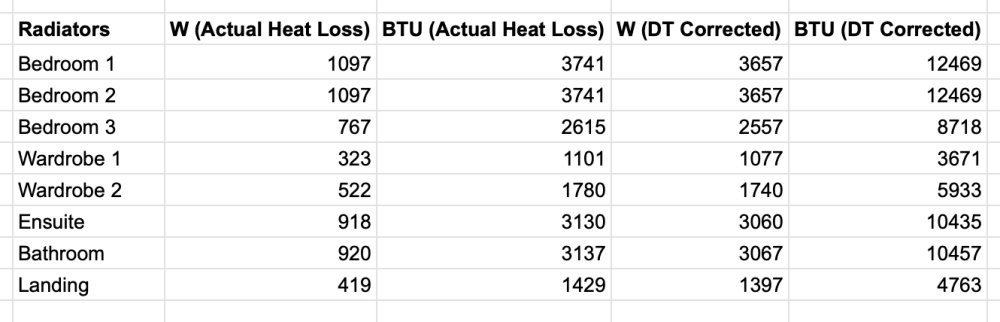
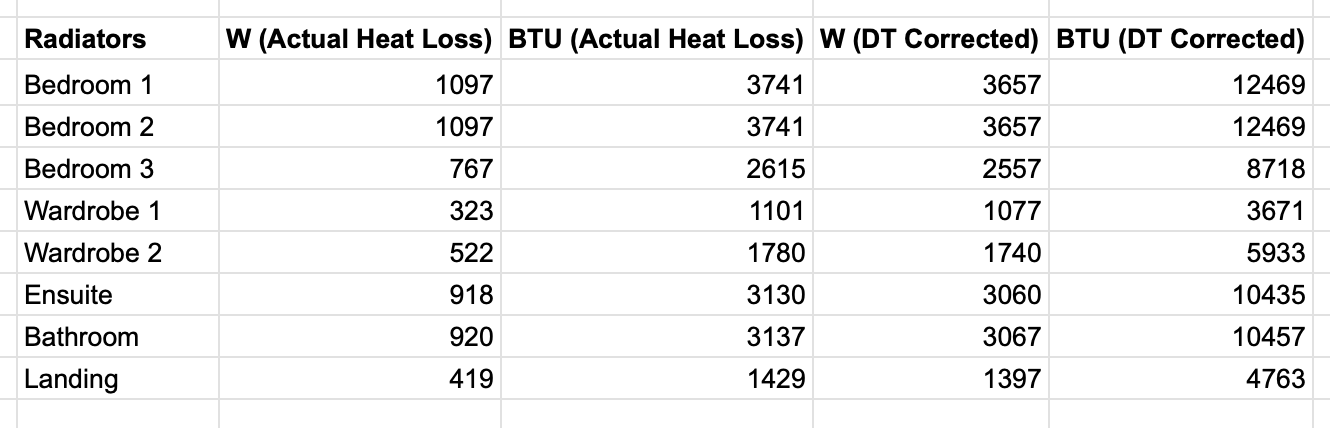
Not a fan of Heat Geek? The sizes in that screenshot were all based on their suggested kW/pipe size table and were very much as a guide until I calculated them more accurately, which I'm taking a stab at now. 35mm on a domestic set up does seem, large... I was, perhaps incorrectly, using the "corrected" kW requirement of each radiator. I.e. the size I need to purchase because they're all spec'd at dT50. So I was basing it on 3.6kW for Bedroom 1, not the actual heat loss of the room, which is 1.1kW. Does the length not factor in when calculating pipe diameter? Is that only relevant when calculating the pump requirements?
-
Having pulled them off the internet, I assumed they'd be for dT50 and therefore would need some tweaking for a lower dT. It makes sense to spec the pipework for a future ASHP too, which I assume would optimally run at dT5, using Heat Geek's Cheat Sheet for pipework at keep velocity below 0.9, it suggests the following pipe sizes would be required; If I use the same formula for the UFH supply (minus any correction factor for rad sizes), it suggests that also needs a 35mm run !? They seem pretty beefy. I will of course calculate the run lengths, elbows, tees etc to confirm these.
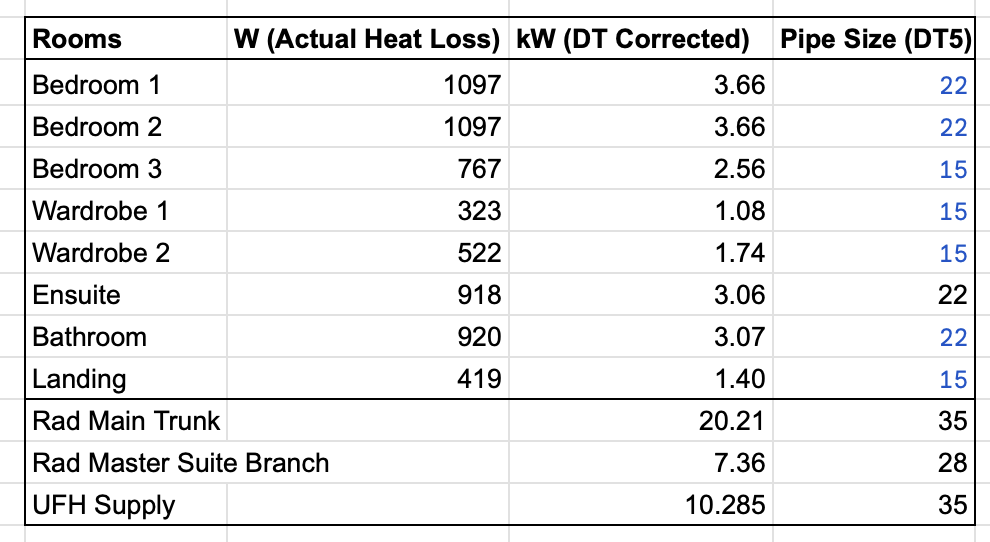
-
Fixed it Forgiven, @SimonD @JohnMo?
-
Boiler is 33kw, massively oversized for what we need, but that's another story. I believe it's max heating output is 30.3kw, so using your calcs; 30.3*860/60/20 = 21.72 LPM 3.5*(23/21.72)^2 = 3.924678395 Presumably a LLH, or CCT, on the heating loop would be required, with an additional pump for the rads? Anything running at max, instinctively, feels like it'd be inefficient though?
-
Yeah exactly that, which gives me a total max heat transfer of 69,000 BTU at dT50 and a max heat transfer on the Master Suite branch (bedroom, wardrobe and 2x towel radiators) of 25,000BTU at dT50. From what I've seen online copper is good for; - 15mm up to 13,000 BTU - 22mm up to 36,000 BTU - 28mm up to 64,000 BTU So the majority of runs are clear; 22mm for the Master Suite branch, 15mm tees for all single emitters (which we already have) albeit Bedroom 1 and 2 are pushing the max capacity of a 15mm run, but the main "trunk" from the boiler (which only has 22mm tappings) looks like it could be a struggle. Do I really need to run that in 35mm?
-
Separate question, I have the upstairs heat loss, and applied a correction factor to it to work out the radiator sizes required at DT19 (well, I actually used DT20, for simplicity). When spec'ing the flow/return pipe sizes, which set of numbers should I be using? The actual heat loss numbers suggest 22mm teeing off in 15mm to the radiators will be fine, whereas the "corrected" numbers suggest I'd need 28mm from the boiler with an intermediate branch of 22mm (to supply the master suite), before teeing off to 15mm for individual radiators.