SteamyTea
-
Posts
23850 -
Joined
-
Days Won
200
Everything posted by SteamyTea
-

Electric Boiler with Underfloor heating costing a fortune
SteamyTea replied to Richvet's topic in Underfloor Heating
Was wondering that. What are your neighbours paying, might be useful to find out, just in case there is a wiring error, or you all want to club together and make the place better. Your usage figures seem the wrong way around. To give you an idea, on my much smaller place, this is what I have used this year (well 56 days of it). Mean Power / 0.7 kW, Percentage E7 / 89 % Total Energy 924 kWh Day Energy 106.4 kWh Night Energy 817.6 kWh That works out at 16.5 kWh/day (yours is 18.8), if I have worked it out right, that is £268.80 with meter rental and VAT. Thankfully spring is just about here, so that will go down significantly.- 38 replies
-
- 1
-

-
- electric bolier
- boiler
- (and 2 more)
-
No idea as I have never once looked at Reddit.
-
LG Therma V mono block Air Source Heat Pump
SteamyTea replied to ProDave's topic in Air Source Heat Pumps (ASHP)
Your actual electricity demand, can be done as a total power draw or by individual devices. Is that in kWh, or just hours? -
You thought you were on mate's rates.
-
What's the issue? Help Please ?
SteamyTea replied to canalsiderenovation's topic in Air Source Heat Pumps (ASHP)
So assuming an electric shower, that is £100 a month. A weeks rent as a lodger. To get me to move out the house, my Mother charged me a third of my take home pay. Was only there a few weeks. -
So 6 hours on, and still fine. When it stops raining, I shall fit the other logger to the front of the house.
-
Electric Boiler with Underfloor heating costing a fortune
SteamyTea replied to Richvet's topic in Underfloor Heating
Basically electrical boilers are all the same. So no point looking for a different one. Was any insulation put below your UFH? You may be helping to reduce your neighbours bills. How large is this flat? You can get ASHPs that hang on external walls, would that be an option? But if you are really heading towards £8k heating bill, even a third of that is expensive. Can you fit PV on the roof? Insulation, and airtightness are the way to go. As thick as you can get it. Or sell up. -
Electric Boiler with Underfloor heating costing a fortune
SteamyTea replied to Richvet's topic in Underfloor Heating
Problem solved, somehow. Your post, when displayed in my phone was as I typed my reply. But now seems fine. So shall go and read it. -
I was there but did not post much. Had not realised it had gone till you said. Sub Reddits seem to be where refugees go.
-
UFH and CH pumps from buffer tank question
SteamyTea replied to andygo's topic in Underfloor Heating
N O T T H E O N L Y P R O B L E M. -
Me to. It is a no weather day today. And a no diesel one by the looks of it.
-
Planned ASHP 1930s semi retrofit - experiences please?
SteamyTea replied to Greenbot's topic in Air Source Heat Pumps (ASHP)
While that is true, arithmetically, traditional boilers are often sized for the DHW, especially if they are combination boilers. So a proper heat loss calculation needs to be done all the same. You can, if you have monthly bills (or your own data), work out the non space heating loads by subtraction the usage in the non heating season usage from the heating season usage. -
Mine is still going, 2 hours now. It was still logging the data OK, just the WiFi was dropping out. I made the same changes to the other logger I have, the one with the wobbly wire (though I could not see a problem and it was working fine before I moved it), and that seems to be logging OK now. Logging started at 02/03/2022 07:11:22, and now it is 02/03/2022 08:51:03. Purely for scientific interest, my wall probe has shown a rise in temperature from 9.9°C to 10.1°C, and the OAT is 9.5°C and 9.7°C. So the wall temp seems to be tracking the OAT temp nicely (a good thing). Off for a hunt for diesel now, I may be some time.
-
@Radian and @ProDave And anyone else that has had this problem. So far it has been stable. Just got to find the loose wire to the sensors now (but that is one the RPi that was stable).
-
Why not use a PC/Linux/Mac, most TV is now streamed.
-
Useful for putting PV on. Can tune the angles and areas to benefit more from overcast days and winter days. They are also part of the vernacular down here.
-
Possibly, but there are so many words in them, I would need to print them out. Giving it a go now, it usually drops off the network within half an hour.
-
LG Therma V mono block Air Source Heat Pump
SteamyTea replied to ProDave's topic in Air Source Heat Pumps (ASHP)
Not got one of the as I only have storage heaters. Do you log electrical demand data? -
Getting via ssh when on the USB to Serial always works (as it should). I have read this, my network is my phone, or my neighbours WiFi, not sure how to turn it off on phone. The unit I fitted @joe90's connected up right away after almost 18 months being left alone. So I don't think it is a router problem.
-
I have 3 RPi Zero W. Two happily connect, and stay connected to the wireless network, but one just keeps dropping out. The only way I can restart the WiFi is to reboot. This seems to be a known problem, but no definitive solution. I have tried a batch file that pings one of the good RPi's address, but it drops out. Tried a crontab command to stop and restart the wifi, if it has already dropped out, it don't reconnect. Even put a line it to stop the power management turning off WiFi. I have also tried most of the solutions online, and like most of the people that comment, it does not solve the problem. So it may be a hardware problem and just getting a few new ones may solve it, but was hoping someone with a lot more networking experience knows the answer.
-
Reminds me of this tune.
-
Your Home Base Load / Background Power Draw
SteamyTea replied to MrMagic's topic in Photovoltaics (PV)
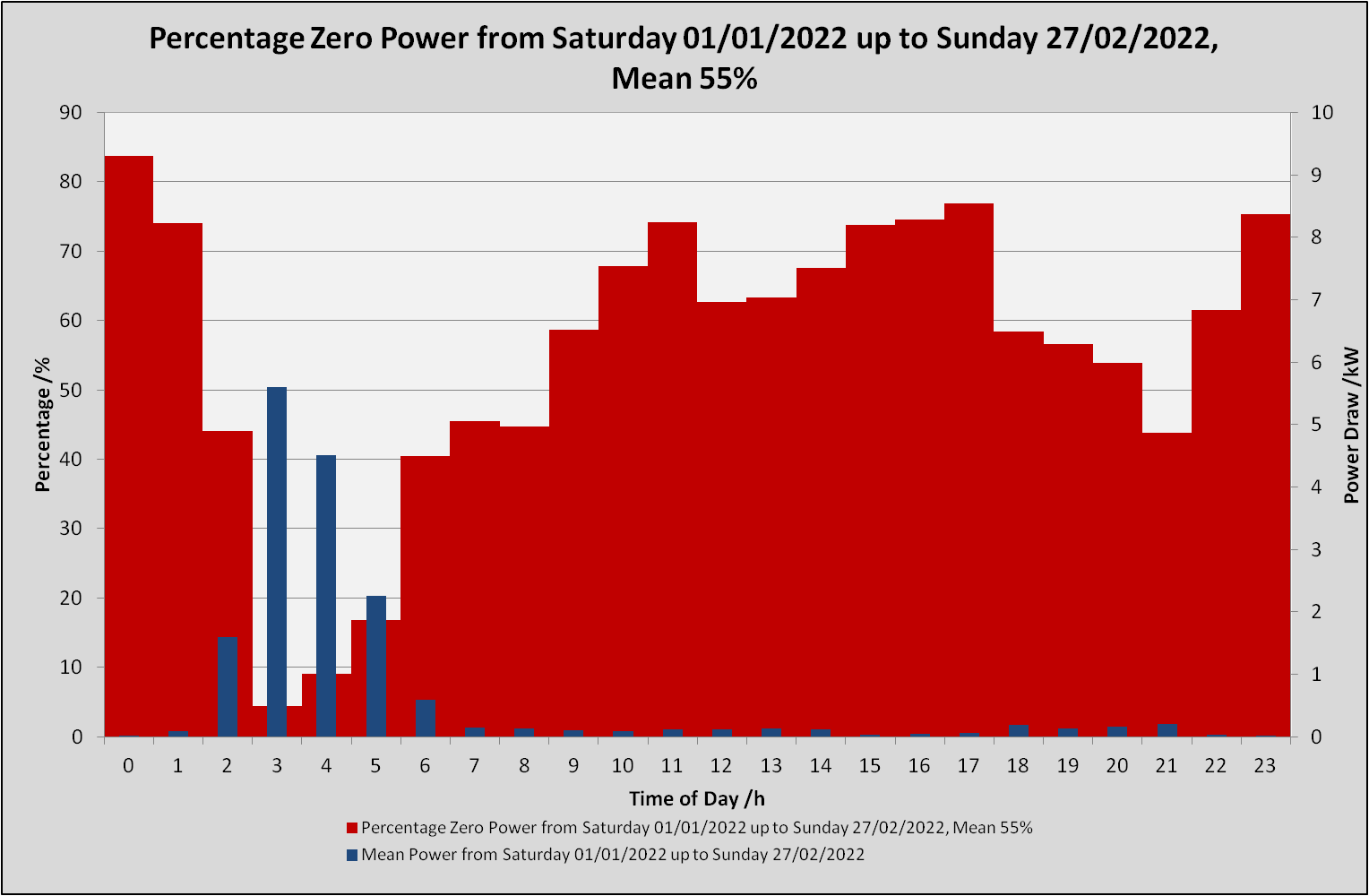
I have tried really hard to get rid of parasitic loads. Now down to 0 W, 55% of thee time. Easy for me as I live alone.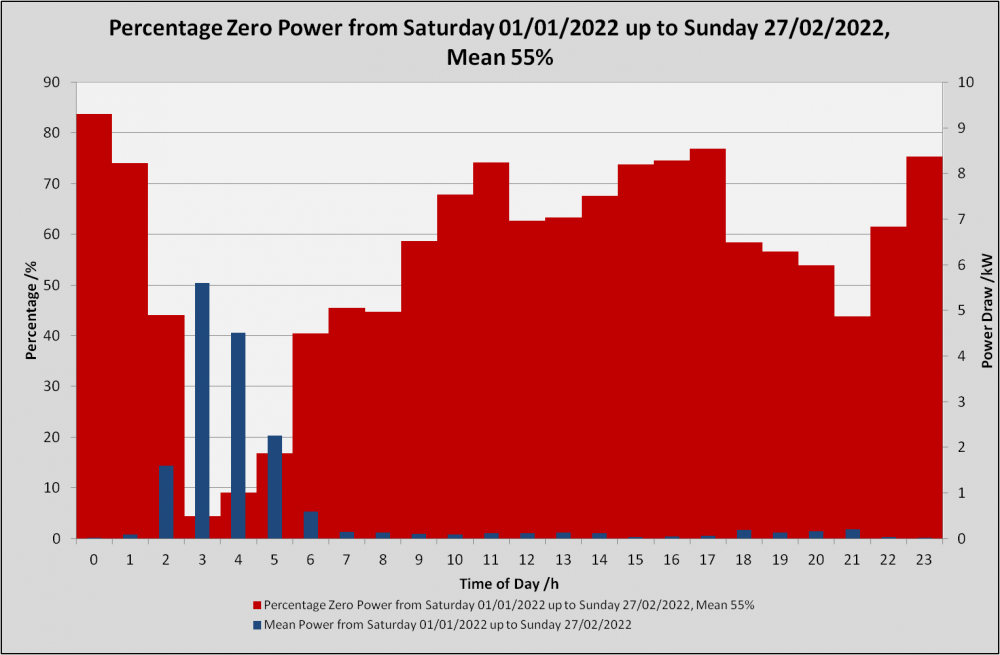
-
Your Home Base Load / Background Power Draw
SteamyTea replied to MrMagic's topic in Photovoltaics (PV)
Do you know what devices are causing that? -
We need there local planning officers working over here.
-
How does infrastructure get upgraded?
SteamyTea replied to Radian's topic in General Self Build & DIY Discussion
To heat the local environment. Having a quick, early morning, look at the Weston Power site, they have a value tool. https://www.flexiblepower.co.uk/locations/western-power-distribution/value-calculator Looking at Mullion you can earn £34,513.66 for connecting up 1 MW of generation (terms and conditions apply). But for Isles of Scilly it is £2,809.56 And the Hayle-Camborne is only £1,239.42 Not sure that that correlates to, but I know a flower farmer at Cury, told him 20 years ago to get some big turbines on his land.