


SteamyTea
-
Posts
23850 -
Joined
-
Days Won
200
Everything posted by SteamyTea
-
This is what I hope to find out, can log at the minute interval, or finer. Yes it will, it will do nothing to change the thermal properties of what is already there. Yes, see above, but all data is useful when it comes to modelling. It may show that it is worth having extra insulation on north facing wall, rather than assume that the difference will be too small to bother with. Same as above, but the other way around, it may show that less is needed, and what the wall, rather than the windows, contributes to overheating.
-
It is now unnecessary. You can get wireless switching, which gives greater flexibility as you can use any socket or existing lighting circuit. Why waste time, and cash, on all the extra wiring. I have never bothered to work it out, but I would not be surprised if the length of wiring for the light circuit in a typical house was greater than the power outlets circuits. To give you an idea of what I mean, the person who designed my house assumed that the front door would be used as the primary entrance. The car parking is at the rear, so we all use the rear door. The light switch is on the opposite wall from the door. Now to put this right with traditional wiring would be a major job, pulling up chipboard flooring, drilling though joists, wall chasing. Much easier to just get a wireless switch and remember to change the battery after 300,000 uses. As it is, I know where the switch is and walk the 3 paces to it. When I press the remote on my car, the interior light comes on. I have had the facility for over 30 years, and I buy cheap cars, but not in any house I have owned (though this is the newest house I have ever had).
-
Is this partly because the domestic electrical industry has not kept up with changing demands/trends. What people where happy with 30 years ago, i.e. two sockets in a bedroom, maybe 4 in a living room, is now so out of date where even a TV needs 3 sockets, and aerial and an internet connection. Surely it is time that conduit was run around the place so new cables can be more easily run, no more pulling up floorboards, let alone chipboard boards. Plumbing seems to be going in the right direction with UFH and manifolds. Wiring seems stuck in the 1950s, people are still fitting 5 A lighting circuits FFS.
-
Welcome. Buy one. They all need work. Improved insulation, airtightness and proper ventilation. And then you can work on a half decent heating system. A2AHP would be my choice. Could even fit it in with a a ventilation system.
-
As it is 20 m from the sea, was it just wind damage. Seen roofs missing after storms down here and after talking to people, seems an extra large wave, and the associated spray, caused the damage. A properly installed GRP flat room will last decades. A badly done one, weeks. GRP work should not be done by normal builders. There is much more to it than just mixing in lots of hardener and slapping it down.
-

How does infrastructure get upgraded?
SteamyTea replied to Radian's topic in General Self Build & DIY Discussion
Interesting. Why is the PF for AH Bunkers Hill Solar A - Solar and Battery 7% lower than the others, except for BOC Fawley (a customer), which at 65% is worrying. -
How does infrastructure get upgraded?
SteamyTea replied to Radian's topic in General Self Build & DIY Discussion
Is that the old Fawley oil powered site? -
Well I have cobbled together some kits, so BME/P280s and some DS18B20. Left them on the window cills logging away, while I am away. Went I am back, later in the week, I shall fit them in the proper places and see what comes out in the wash.
-
Yes, maybe ask for it is white Russian pine, or vodka. We swapped some old military gear for Bulgarian tinned tomatoes in the early 80s.
-
Last time I made a comment similar to this, it got deleted. I see that the bank rate in Russia is now 20%. Worth putting a few quid in surely.
-
I see they do a 400 W module. I am tempted as I could get 2.4 kWp on one side of my roof. This is a useful amount for me.
-
I have mentioned this before about performance warrantees. The way it works is as follows. Say a manufacturer makes a batch of modules, nominally 300 W ones, when they are flash tested, ones with a higher performance i.e. 310 W, and ones with lower performance i.e. 290 W are labelled up to the next lowest performance range i.e. 300 W and 275 W respectively. So say you were lucky and got a batch of top performing 300 W ones, so 310 W in reality. It is easy to see how a performance warrantee of say 90% performance after 20 years is offered as it is not taking into account the over production in the first decade, and you are working on 0.5% loss per year of the nominal performance, not the actual performance. Trouble is, the customer will notice a quite large decline in overall capacity over that time. The other problem is that in the last two decades, the performance has generally improved from 250 W to 330 W for the same form factor. So by over paying for a warrantee now, will just take cash away from retooling in the future. Generally, do what the big solar farm developers do, buy the cheapest per peak watt.
-
How does infrastructure get upgraded?
SteamyTea replied to Radian's topic in General Self Build & DIY Discussion
Weston Power Dirstribution has a map. Don't know what any of it means (can't be bothered to look into the detail). https://www.westernpower.co.uk/network-flexibility-map-application I shall let others look at the detail.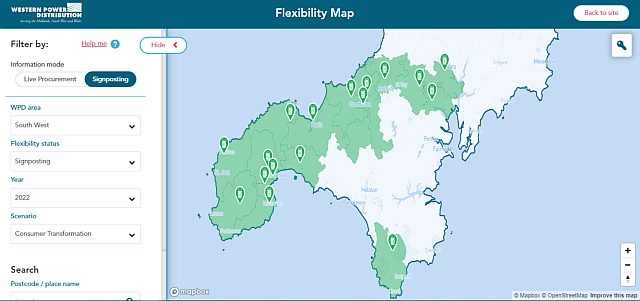
-
A public, council controlled, swimming pool is pretty good. Very good safety record.
-
Odd that, in 1984 I moved to Buckinghamshire. I watched the roads around London become the M25. Things vastly improved in 1986 when it was completed. What used to be a 3 hour journey to Gatwick became an hour and a half. It is still an hour and a half.
-
Ask his views on all metal fixings. Swimming pools have chlorine in the water. This can cause a lot if problems.
-
Calculating COP/SCOP on Air Source Heat Pumps
SteamyTea replied to cuttsy's topic in Other Heating Systems
Would tend to, but I suspect that it is also metering the electrical resistance heater that kicks in for the legionella cycle, and when the heat pump cannot cope. Have you had your system 'tuned' or us it at factory defaults? -
The colour may change in a few days time. Or might not. Did you pay with a credit card?
-
You can go and build @Omnibuswoman's place. And @BotusBuild
-
I read on. So many questions to ask, where is the free version of codes/regs. The arithmetic looks manageable, but the devil is in the detail.
-
Or they think, by some unproven magic, that it will harm them. I have a power line pole outside my house. Luckily it distracts from the pretty awful house below.
-
Um I wonder if they read my paper on it. Maybe I should take a quick look at what they wrote.
-
Not in the cupboard under yours stairs though. We need to pay for a certificate to have a DHW cylinder running at 3 bar, just imaging what a fast spinning device with 5 kWh of energy will need. It is already used for grid balancing, if you go to WPD substation near Redruth, you can hear them humming sometimes. https://botlanta.org/converters/dale-calc/flywheel.html
-
Life. Wind and solar have been the cheapest new generation source for a few years now. Just a case of deploying it.
-
I looked into it as well. The energy density is not that great, even if the power density is good. And the thought of having a washing machine sized bit of kit with a flywheel, rotating at 20,000 RPM, is a little worrying. Williams Engineering used one in their cars in 2009, when KERS first came along. They sold it to GKN back in 2014. Think there may be a system on Eigg, not sure if it is running.
