SteamyTea
-
Posts
23848 -
Joined
-
Days Won
200
Everything posted by SteamyTea
-
Don't they usually put the VCL on the outside in most of Canada? Different climate from ours in a lot of it. Most of habitual Canada is south of even me at Lat 50⁰.
-
There possibly are problems there. Usually they use 'aged' foams, which have already shrunk quite a bit. It may also be hard to tell if a slab has shrunken or dipped a few millimetres over a decade or two. Buildings do that anyway. A good SE should have designed for shrinkages I would have thought ( @Gus Potter, @saveasteading). What most likely happens is that the shrinkage is uneven, so some parts will pull away from the slab, other parts will be compressed a bit more. hard to tell without sawing a slab open, but would be fun to find out.
-
We used to work on 3% shrinkage when moulding polyurethanes. Some mixes where better than others. If you have ever wondered why new furniture has cushions that seem tightly fitted, and old furniture seems loose on the bench part, this is down to long term shrinkage. In the late 1980s, melamine powders where introduced into the mix to help with fire retardancy. This caused mixing problems (wear on mixing head and the pumps), this could make the curing inconsistent. An inconsistent mix causes uneven curing, adhesion failure and excess heat spots, all things that need to be avoided with sprayed products. When foam is moulded, or sprayed, there is an initial rapid expansion. As curing takes place, there is then a rapid contraction as the blowing agent (a gas) is released and thermal contraction takes place. Then a slow contraction takes place over time, usually months. One material we used carried on contracting at about 0.5% a year, for a decade at least. Long term contact with moisture, or even just high humidity causes polymers to break down. Excess temperature can cause initial softening, then brittleness. As much as I like polyurethane polymers, and there are literally hundreds on the market, I would be reluctant to use them as insulation. Great initially, long term they absorb about 10% of their mass in water, then, with thermal cycling, disintegrate. I have a feeling that a polyurethane is not allowed in aeroplanes as a structural element (skinned wings), though may be wrong on that.
-

Reducing heat loss through the keyhole of an exterior door
SteamyTea replied to november romeo's topic in Heat Insulation
It is always lunchtime somewhere. -
Land grab of unregistered land
SteamyTea replied to JonC's topic in Party Wall & Property Legal Issues
I have heard that super glue in a lock stops the lock owner using them. Works a treat on car park machines. -
Reducing heat loss through the keyhole of an exterior door
SteamyTea replied to november romeo's topic in Heat Insulation
How about not heating the house, then you can consider the keyhole as controlled ventilation. -
I tend to agree. Some systems are going to be more airtight than others i.e SIP, ICF. Brick and block, on its own, is probably the worst there is. To a certain extent, airtightness has to be designed in from the start, not something to be put right later. There is a contradiction in the UK where the vapour control later is on the warm side i.e. inside. Then, usually structural elements and insulation, then a wind tight layer. It is too easy to think that the VCL is there to help stop air movement though the walls. Its main purpose is to stop high humidity air moving to a cold area and the water condensing out. After the VCL, the materials need to be more vapour open, this is to allow any water, or water vapour to be released. Here it is too easy to think that, as the VCL has made the inside of the building airtight, and the test shows it is airtight, the problem is solved. It isn't. Airtightness is also to do with making sure that cold air cannot bypass the the insulation, which will reduce its effectiveness. This is why buildings, especially timber frame ones, are wrapped in a windproof, but vapour permeable later. They stop the air movement but allow the moisture to escape.. So when thinking about mechanical ventilation, think of it as humidity control first, then how much energy it can recover. As a final year project I built a model of a room, then added mass to it so that the thermal stability could be measured. As I was studying active solar thermal, I had fans that blew air through the mass, or did not blow air though the mass, then measured the temperature variations, it was the data collection and analysis I liked, not the rocks and thermal inputs. If I was asked to look at the performance of MVHR now, the first thing I would do would be to build a physical model and start measuring energy input, temperature, humidity and airflows. Fairly easy and cheap to do these days (the Raspberry Pi did not exist when I was at university, so used a desktop burning 300W). Physical models are also essential to calibrate mathematical models.
-
You ca get an air test done on it. Either ask/beg a company that does tests, or make your own tester with a car radiator fan, manometer and a flow meter.
-
Whoops, more than, not too leaky. Shall go and edit my post.
-
In a month? What are the standing losses? I take it is a diesel. My 1.8TDI only does that on a decent run, locally it seems to be about 55 MPG.
-
Is this a final year project? One area that would be interesting is how the overall building airtightness affects the performance of the MVHR. There seems to be 'rules of thumb' about not worth it if your house has more than 3 ACH@50Pa. Another area that I would like to know is, how does different mass flow rates affect the energy transfer. Do you have a Passivhaus to play with at the university?
-
How to get an extra 2 SAP Points?
SteamyTea replied to Andeh's topic in General Self Build & DIY Discussion
Hotter than my shower. Not suggesting bath in your used water though. -
External air ventilation for log burner
SteamyTea replied to SBMS's topic in Energy Efficient & Sustainable Design Concepts
Room sealed or not, airtight house or not, putting a WBS in your house is going to cause a change in air quality. I don't think the seals, even when new, are that brilliant. Ask yourself if you are happy to invite me around to smoke a packet of Marlboro in your living room one evening. That is about 16gm of combustible material, WBS will take several kilos. Why not fit a WBS with a back boiler outside the house, then pipe in some hot water to an emitter. Then when the power cuts come, fire it up, let is thermosyphon and keep you warm. -
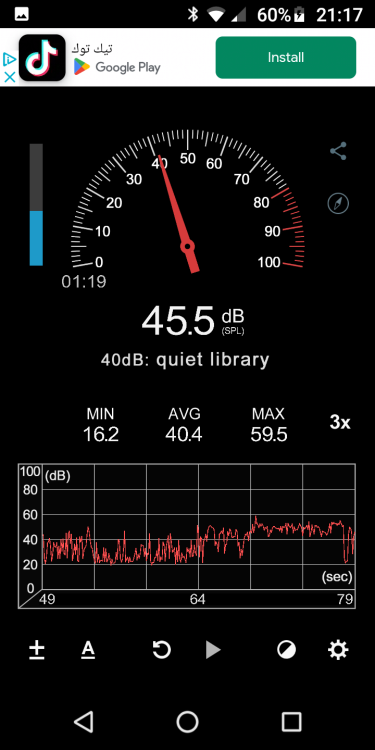
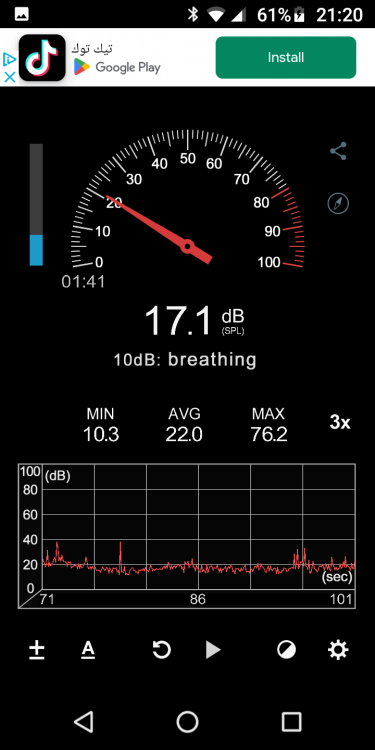
@Alwayslearning22 Not sure what you tried in the end, but last night was the first proper storm to hit since I secondary glazed. Here is a few screenshots. First is weather map, then two of the sound meter. First SM is on the window cill, second is about a metre from the window. Not very noisy.

-
I hope @MikeSharp01 sees this, then he can tell me how to make a better energy monitor. I wish I understood all this communication business better.
-
Welcome. Ventilation is very misunderstood on here, any input would be useful.
-
So glad I have hacked into my neighbour's, saves me worrying about being vulnerable.
-
Reducing heat loss through the keyhole of an exterior door
SteamyTea replied to november romeo's topic in Heat Insulation
Seem to remember that old @Jeremy Harris worked out the actual heat loss though a keyhole. Decided it was too small to worry about. I hate the draught that comes though mine now I have fixed the leaky door. -
More like the local Bobby
-
Safe as houses https://time.com/5922897/us-nuclear-weapons-energy-hacked/ Liz Truss has had to hand her phone back. It is in a box with Donald Trump's.
-
Purchase as a Service then. Not going to end well.
-
Yes, but not an American's techno bitch, being spanked daily.
-
Technology taking a nosedive then.
-
Plus roof and wind load calculations, cabling installation type (part of Part P), predicted generation ( needed for MCS), and probably more things.
-
Done my days work, now it is time to scare children.