SteamyTea
-
Posts
23836 -
Joined
-
Days Won
200
Everything posted by SteamyTea
-
 Is the world's biggest fusion experiment dead after new delay to 2035? ITER, a €20 billion nuclear fusion reactor under construction in France, will now not switch on until 2035 - a delay of 10 years. With smaller commercial fusion efforts on the rise, is it worth continuing with this gargantuan project? By Matthew Sparkes 27 June 2024 An aerial view of ITER ITER Organization/EJF Riche ITER, the world’s largest fusion power project, has been hit by a 10-year delay, meaning plans to switch it on have now been pushed back to 2035. This could see the state-funded effort overtaken by commercial fusion projects, leaving some to question whether it is even worth continuing with the experiment. Is it time to shut ITER down, or is there life in it yet? The reactor, which is under construction in France, is a vast international effort chiefly involving the European Union, China, India, Japan, South Korea, Russia and the US. Work officially started in 2006, although discussions date back to 1985, and the first run of the reactor to create the super hot form of matter known as plasma, where nuclear fusion can occur, was initially scheduled for 2020, but later pushed back to 2025. Construction costs have boomed, with early estimates having already tripled to over €20 billion in 2020. Now, ITER’s management has revealed that the first plasma run won’t occur until 2035, a delay of another 10 years. The full details behind this decision and future plans are due to be announced at a press conference on 3 July. Juan Matthews at the University of Manchester, UK, says ITER now feels like “the elephant in the room” in fusion circles. He believes that advances in containment technology made since ITER was designed may lead to cheaper and smaller reactors, often being developed by small commercial teams. These could offer a promising path to fusion power without the vast scale previously thought necessary. “The problem is if you’re sat in France on the site, in charge of the programme, you’re much more likely to say ‘well, we’ve gone so far, we might as well finish it’. But if I was an economist I would say ‘don’t chase sunk costs’,” says Matthews. “There’s no reason why the people and the skills that are on the ITER site can’t be used to make something else.” One of those promising new reactors is being constructed by the UK start-up Tokamak Energy, which is a spin-off from the UK Atomic Energy Authority. But there are dozens of similar companies working on various designs around the world. The UK also has its own state-run project, the Spherical Tokamak for Energy Production, which it hopes will create plasma by 2035 and reach net energy gain – where more power is created than input – five years later. David Kingham at Tokamak Energy says that he welcomes ITER’s willingness to share information. “This includes lessons learned – good and bad – and more detail of materials selection,” he says. “ITER has validated the performance of many important materials and stimulated the development of supply chains for materials and other enabling technologies.” Laban Coblentz, the head of communications at ITER, told New Scientist that the project has been hit with a run of bad luck that forced it to pivot from its original strategy; the covid-19 pandemic, the death of its director-general in 2022 and the discovery of defects in thermal shield panels that necessitated lengthy repairs. Once a new director-general was in place, and the scale of delays became clear, more difficult decisions needed to be made. The initial plan for ITER called for replacement parts that could be fitted once the machine had started operating, allowing it to push to higher energy levels. Due to delays, those replacement parts are now ready for installation before operations begin. Bringing their use forward in this way could shorten the ramp-up to higher energy levels once the reactor fires up, but the process of fitting them will also also contribute to the extension of the time before the first plasma is produced. ITER has taken the pragmatic decision to spend more time preparing rather than pushing ahead with experiments that have a lower reward. For instance, says Coblentz, ITER was initially due to run with 100 kiloamperes of magnet current, but will now ramp up quickly to 15 megamperes – 150 times more. “When you have all the magnets in there, but you don’t have some of the protective components like the diverter or the shield blocks that go in front of the vacuum vessel, you have to be very limited in the magnet current,” says Coblentz. “You could end up proving that the machine works and destroying it in the process.” He says that because of these drastic changes to the plan, the organisation is now unable to say how complete the device is – despite previously stating in 2020 that ITER was 70 per cent finished. The result is that ITER will no longer be a project that represents the global pinnacle of fusion research in terms of energy output or cutting-edge design. Instead it will become a learning facility hosting researchers from other academic, government and commercial projects that does valuable work on component design, developing processes for building, running and recycling a reactor and training talent, says Coblentz. “The old way of thinking, if I could call it that, has always viewed ITER’s purpose as being technology transfer, but it was seen as a sort of sequential thing – you build the public facilities over time, you finish those, you answer more scientific questions, and then the private sector comes in and starts to take over,” says Coblentz. “But what we’re seeing is an acceleration in the knowledge transfer. The private sector, none of them want us to stop or shut down our facility. In fact, what they’re saying is ‘for God’s sake, keep going, go as fast as you can’.” Cool solutions could head off the climate-damaging rush for air con Demand for air conditioning will only grow as temperatures rise, sending energy consumption soaring. But there are some interesting ways to deal with the issue, finds Graham Lawton By Graham Lawton 3 July 2024 Air conditioner units on a roof of industrial building Markus Thoenen/Alamy As the Paris Olympics and Paralympics approach, there are warnings the games could be the hottest on record, beating the current holder of that dubious title – Tokyo 2020 – and putting competitors at risk of heat exhaustion and potentially fatal heatstroke. In fact, average temperatures in Paris have risen by 1.8°C since the city last hosted the games a century ago. The reason is obvious. The organisers are aware of the danger and have fitted an energy efficient system of underfloor pipes that carry water to cool the Olympic Village. Nonetheless, the US team has said that it will be installing its own air conditioning (AC) units, and several others are considering doing the same. These plans have reportedly miffed the mayor of Paris, Anne Hidalgo, who wants the games to be the most sustainable ever and doesn’t want energy hungry air-con units busting their green credentials. The heated tête-à-tête between greenness and coolness is one that will increasingly play out across the world as temperatures continue to climb and as people in low-income countries become more affluent. Both trends will vastly increase the demand for cooling tech such as air con and fans. In 2018, the International Energy Agency (IEA) warned this “cold crunch” is “one of the most critical yet often overlooked energy issues of our time”. The numbers are indeed chilling. In 2016, there were around 1.6 billion AC units in operation globally, responsible for 20 per cent of all the electricity consumed by buildings. By 2050, the IEA forecasts that there will be over 5 billion AC units. All things being equal, their energy consumption will increase by the same factor. The number of household electric fans is also predicted to go from 2.3 billion in 2016 to 3.9 billion in 2050. They aren’t as power-hungry as AC, but will still contribute to the cold crunch. According to the United Nations Environment Program, greenhouse gas emissions related to cooling are predicted to more than triple by 2050. That is partly because AC units contain refrigerants, chiefly hydrofluorocarbons (HFCs), many of which are potent greenhouse gases. They inevitably leak from units that are faulty or have been badly disposed of. Thus we potentially enter a vicious circle where spiralling temperatures add to demand for cooling, which just exacerbates the problem. Once an overlooked issue, the cold crunch is increasingly going mainstream. Shortly before the latest major climate talks – COP28 in the United Arab Emirates in December 2023 – a project led by the Africa Centre of Excellence for Sustainable Cooling in Kigali, Rwanda, and the UK’s Centre for Sustainable Cooling at the University of Birmingham released a report arguing that cooling must now be considered critical infrastructure. As the report said: “The provision of cooling is not an optional extra or a lifestyle luxury. It is a critical service for a well-functioning, well-adapted, resilient, and healthy society and economy.” I’ll throw my hat into that ring. I recently bought a new fan to make my bedroom bearable during the increasingly hot London summer nights, and would vehemently deny that it is a lifestyle luxury. The message hit home at the COP talks: over 60 countries signed a voluntary agreement called the Global Cooling Pledge, which vowed to hugely increase access to cooling while actually cutting its emissions. The main tools for achieving this are decreasing the energy intensity of cooling technologies, early phase-out of the most damaging HFCs and wider adoption of passive cooling, such as insulation and green roofs. These measures could reduce emissions from the cooling sector by 68 per cent compared with today, according to a UN report. We shall see – voluntary agreements at COPs have a history of over-promising and under-delivering. But if countries are serious, there is a cooling system on the way that could actually help reverse the underlying problem of too much carbon dioxide in the atmosphere. Xi Chen at Columbia University in New York and his colleagues have designed a CO2 purification module to be added to existing AC units. It captures CO2 from indoor air and locks it away in a material called a sorbent. The principal goal is to cut indoor air pollution, but if widely used, Chen says this could suck CO2 out of the atmosphere in quantities dwarfing those currently possible or economically feasible with the outdoor-air equivalent, an industrial endeavour known as direct air capture (DAC). One big problem with DAC is that CO2 concentrations in the atmosphere are so low. But put a load of people in a building, all exhaling CO2 all day long, and that problem disappears. Enough, indeed, to use indoor DAC to bring global CO2 concentrations down to pre-industrial levels. Cool. Solar boom has replaced farmland that could feed millions of people More than 1300 square kilometres of cropland worldwide was covered by solar panels in 2018, an area that could be producing 4 quadrillion calories per year By Madeleine Cuff 1 July 2024 A solar energy project built on farmland in Anglesey, UK Christopher Furlong/Getty Images The boom in solar energy around the world has led to huge numbers of panels being installed on prime agricultural land, taking quadrillions of calories out of the global food supply. More than 5000 square kilometres of the world’s surface was covered by solar photovoltaic (PV) panels in 2018 – 1655 times more than in 2003. Much of that has happened on cropland that could produce enough food to feed millions of people, according to a study by Wu Xiao at Zhejiang University, China, and his colleagues. The team used satellite imagery to detect where cropland has been covered with solar panels around the world, before calculating the food production impact. “Our research reveals an exponential increase of PV installations on cropland,” says Xiao. Around 27 per cent of all solar installations worldwide took over cropland in 2018, the latest year of data, totalling about 1371 square kilometres of land, the team estimates. This was responsible for food production losses in the region of 4 petacalories in 2018, an amount that could feed 4.3 million people for a year. In scientific terms, the “Calorie” used in common parlance, for example on some food labels, is actually 1000 calories, while a petacalorie is a million billion calories. On current trends, the lost food production could climb to 62 petacalories a year by 2050. “If we continue to encroach on cropland of similar cost (food loss per solar energy gain) at the current rate, it will lead to a 16-fold increase in annual food production losses compared to 2018, driven by the rapid growth in demand for PV solar energy,” says Xiao. China, eastern North America and western Europe face some of the most intense conflicts between using cropland for food or energy production, the research found. However, Xiao says the study, which hasn’t yet been peer reviewed, may have overestimated food production losses because it assumed there would be no crops or pasture below solar panels. Grazing sheep alongside solar panels, for example, has been shown to be an effective method of raising livestock. The losses will continue to climb as solar energy encroaches on cropland, unless policy-makers take action, says Xiao. “I think the biggest concern is sound planning, choosing the right place for the right land use,” he says. “A blanket ban on PV construction on all cropland is clearly unreasonable. What we are looking for is a win-win situation between energy demands and food security.” Eric Larson at Princeton University notes that the paper doesn’t account for future productivity improvements in agriculture, which would allow more calories to be produced per acre of cropland. “I would expect that it [productivity improvements] would more than compensate for the loss that comes from the solar,” he says. Efficiency improvements in solar technology could also reduce the amount of land needed for energy generation, says Max Zhang at Cornell University in New York. “I’m hoping we will still see more efficient panels being adopted and better designed solar farms that use land more efficiently,” he says. Some see demand for solar energy as an impetus for change in the farming industry. Arable farmer Martin Lines, of the UK’s Nature Friendly Farming Network, says farmland could be used more efficiently to make room for solar. “The reality is that 62 per cent of the grain that we produce in the UK feeds livestock,” he says. “We need to be realistic around the amount of land we use globally to feed livestock.” In the future, people might see farmers as producers of energy as well as food, he says. “We need to rethink the role of the farmer and the outputs they produce.” Reference: Research Square DOI: 10.21203/rs.3.rs-4387232/v1
 -
They do for deputy PMs. I keep saying, for every law we have that states you must do something, we have another law that makes it illegal.
-
I wonder by how much, really. My council tax is £1200 a year, that don't pay for much. LA funding info is here, but can't be bothered to unpack it all. https://lordslibrary.parliament.uk/local-government-finances-impact-on-communities/#heading-2
-
Build a small house on a driveway....possible?
SteamyTea replied to Tokyorob77's topic in New House & Self Build Design
Define a micro home? My house is 4m by 8m, on the outside, 48m2 inside. Trust me, that is small. -
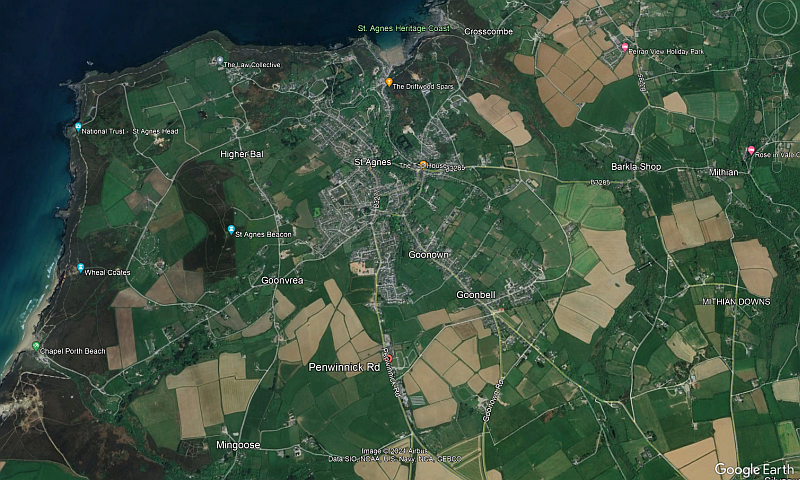
St. Agnes on the north coast of Cornwall is protesting about the proposed new Co-op. The locals can walk, cycle, drive, take the community mini bus, or the local busses, use a taxi, skateboard, and for some cartwheel there. But the locals claim that it will make their high street unsustainable for local traders. The proposal is for 235 m2 for shop and 115 m2 of storage. so about the same as 3 houses. Now let us look at bit closer at this 'high street'. Takeaway Pizza at the top, then a Spar, news agent, chemist. Opposite is a solicitors and pub, bit further down a bakers, veg shop and estate agent. Opposite again is a zero waste shop, whatever that is. Then an empty shop. On the corner to the carpark, a cafe. Miner's and Mechanics, which does a bit of everything as a community hub, diagonally opposite is some sort of consultancy in the old Barclays Bank house. There was a Chinese takeaway, but that closed down years ago. An Indian restaurant has recently opened, and the Cornwall Cafe is still there. A couple of hairdressers. Then a Costcutter store, but called something else now since taken over, another veg shop, financial services, chip shop, deli, butcher and the art shop. A pub and hotel, the bakery, before dropping down the hill to another pub, a bar, a cafe, surf shop, a Chinese restaurant and some sort of faith healing place. Now I suspect that most of these places only employ no more that 3 people on full time hours equivalent, with most jobs being part time, limited hours on minimum pay. The parish has a population of 7.5k and the village itself has 2.2k (2011 census). Every time I pass though in the evenings I see Sainsbury, Tesco, Waitrose, Ocado and Morrisons delivery vans, with the usual Amazon ones. So after that rambling description of a place I am not too fond of (it is just an isolated small place on the windy north coast, but not actually on the coast). My point is that locals should not be allowed to decide what is allowed in their places of residence. I am sure that the same people that are complaining about a new store, are the same ones that complained about the latest housing development (39 houses and the Co-op would be next to them, and the development before that. So if you want a 'sustainable' community, support all development, especially if you live in a rural area. Not as if St. Agnes is a concrete jungle, it is surrounded by farms (an industrial process).
-
Really comes down to building the right type of housing, in the right place and at the right price. This is easy to to do with other products i.e. TVs, cars, but because of the higher purchase price of a house, and the fact it will be in a fixed position for decades or more, the risks of getting it wrong are too high. Governments, and especially local government, have to be quite risk adverse by default (they are playing with our money). I have no idea what the perfect solution is, but a bit of extra tax here, and a small subsidy there, is not going to make a difference. Maybe a big tombola with geo coordinates as the prises. £10 per ticket and a daily draw. If you win, you can do what you like with the bit of land.
-
20kw system Some help for the uninformed
SteamyTea replied to bjhmilla's topic in Photovoltaics (PV)
All the above, but before you start invest in energy reduction. The kWh you don't need is worth a lot more than the kWh you generate costs. As winter is the problem, you need modules to face the lower sun angles (more vertical). This compromises land usage as you cannot have module rows too close together because shading becomes an issue. In the past this was dealt with by modules tracking the sun, but as module prices plumetted, tracking systems fell out of favour because of the high costs. The secondary part is storage. Storing energy in water, especially if efficiency is boosted with a heat pump is the cheapest and easiest, but does require lots of space, mainly for the insulation. Chemical battery storage gets a lot of people very excited, but financially is a disaster and relies on some very dodgy accountancy to make it price parity with grid supplied power. Cut your usage first, it is so much easier and cheaper. -
Microcontroller based power switching revisited in 2024
SteamyTea replied to TerryE's topic in Boffin's Corner
For others that may wonder what a Snubber is, or like me, what it does and how. https://eepower.com/technical-articles/snubber-network-choices-design-and-evaluation/ It is really just a bucket with a hole in it, and a one way valve, that can deal with a variable input and produce a steady, but limited, output, without overflowing. -
This is from the Cornwall Council Website. Noise In addition, as air source heat pumps can be noisy. You must comply with the Microgeneration Certification Scheme (MCS) or equivalent in order to be permitted development. https://www.cornwall.gov.uk/planning-and-building-control/planning-advice-and-guidance/air-source-heat-pumps/#:~:text=Noise,order to be permitted development. It is the old 'MCS or equivalent again. I think all we want is an agreed standard and a testing methodology.
-
Define a child. I am still one.
-
It fails catastrophically (most composites do, why Kevlar used to be mixed in with carbon fibre) when buckled past the yield point. There is very little elasticity with normal GRP compared to the tensile strength. I think timber has other engineering characteristics, mainly the grain, with very different properties across and along it. This, as has been noted, can cause problems at joints.
-
You have to do some real studying as well.
-
-
I think we are at cross purposes. I thought you meant using harvested water to replace mains supplied water. Buffering rainwater is probably a giid thing, though there will be some places with high water tables that may get localised issues if natural gullies are removed.
-
Based on 95% of potable water usage. Then some formula for that incorporates the surface and highways. While it may be a bit hard to find out if one individual is gaming the system, other than through unexpected reduced usage, if a few people on a main sewer did it, then I suspect it would trip a warning. Flow rates in sewers are measured as they need to manage unexpected discharged to the sea/rivers. When a neighbour put a bag of cement down the drain, SW Water sorted the problem very quickly, they did the same when the manhole cover collapsed on my local waste pipe (serves 6 houses). As much as I dislike paying over 8 quid a cubic metre for water, it is really very cheap considering the quality delivered, and what is involved in cleaning it up. There are not many things that can be delivered at £2/tonne to your door, and that are good enough to drink, and who would take away 950 kg of my wee and poo for £6/tonne and dispose of it safely.
-
the waste quantity will be measured as your water purchase quantity Yes, but not legal, and certainly immoral to not pay for waste.
-
I fell out with my PhD supervisor for that reason.
-
https://oilprice.com/Latest-Energy-News/World-News/EU-Hits-Record-74-Zero-Emission-Power-Generation.html
-
- 1
-

-
I have just replied to this on another post. Take it you are the same person.
-
Welcome Tam Sustainability, the migrating metaphor, it can mean whatever you want it to mean. Personally, my take on the use of timber (in all forms) needs to be from new development, on old industrial wasteland (we have a lot of that here. Cutting down old stock and replanting is carbon dioxide equivalent release positive (generally released more CO2) and causes other environmental problems. Production needs to be in countries that have the lowest CO2 emissions (lots of renewable energy) and must be done at the largest scale that is practical. Midern mass production is generally the lowest environmentally damaging, old infrastructure and work practices are generally the worse. There are some crops, like bamboo, that can be in effect coppiced, and make a hard wearing product, so I would tend towards them. Retail price has very little to do with quality, more to do with marking and PR (I could employ a recent graduate at £25k or £70k per year to do the same job, the product would be the same). One problem with end of life usage is that timber burns, and that is how most will be disposed off, hopefully in a waste to energy plant (have a large one if those in Cornwall). Trouble is, regardless of how recently, or distantly, the tree was grown, and how long it took to grow, burning it release CO2, and that is a bad thing for a CO2 saturated atmosphere. But there is no system, that I know off, that will take used flooring and reprocessed it into a useful product that will sequester the embodied energy and carbon for a century. Transport cost do not bother me in the slightest, they are such a small fraction of the whole they are not worth considering. Transport is getting much 'cleaner' by the year. I recently had the latest round robin email from Craig Jones about ICE, I really need to look at the database again and see what has changed, it is usually surprising what has low processing emissions, and what does not. So to answer your question, I can't really. My preference would be floorboards, or chipboard, and carpet. I do like a bit of parquet though. One area I have never looked into is the processing of timber composites (I worked with plastic composited). I suspect they use very little 'chemicals' in reality and most, if properly controlled, do not pose a large scale environmental problem.
-
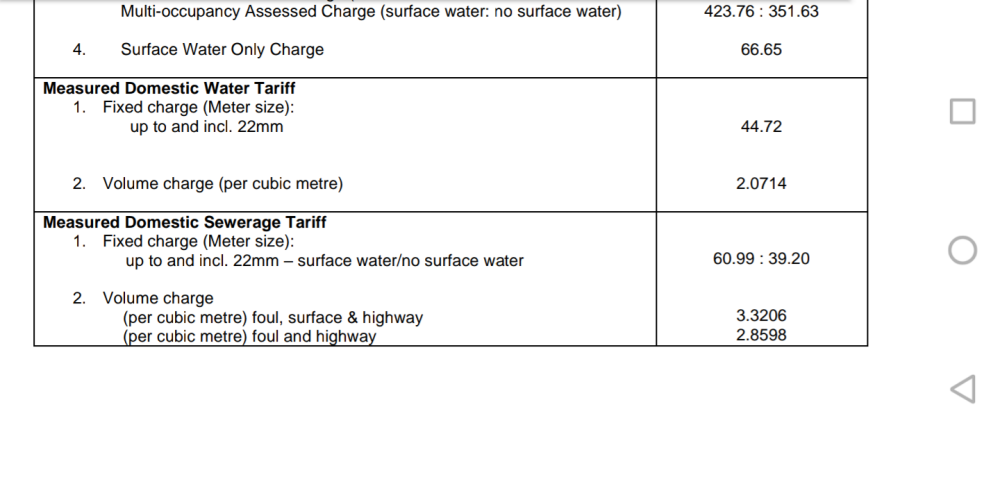
Down here, if you have a borehole, but use mains sewage, you pay. Now I could collect rainwater and not tell SW Water I was doing that, and hope they assume the house is empty, but in all fairness to SW Water, there is unique topology and geodemographics in Cornwall that makes dealing with waste very expensive. Here is a screenshot of what my charges are Water a couple of quid, waste over 6 quid.
-
Wish mine were, most expensive in the country. Mainly the sewage charge, so RWH loo flushing still needs to be charged for. How else can the beaches be used for sewage dumps.
-
How acid is your rainwater? Does it matter?
SteamyTea replied to sharpener's topic in Rainwater, Guttering & SuDS
I wonder how much the pH changes over different parts of the UK. Be a good Citizen Science project. -
Not as if existing roofs never leak. In fact, traditional roofs (UK) are pretty easily damaged, and because they are made from multiple components, hard to repair.
-
Why not get it sheathed in GRP (in a workshop). Then install and get the joints GRPed in situ. Is SIPs considered vapour impermeable?