SteamyTea
-
Posts
23368 -
Joined
-
Days Won
190
Everything posted by SteamyTea
-
Worked in the health and leisure industry and we called them bacterial breeders.
-

Floor slab insulation. Test my logic please?
SteamyTea replied to saveasteading's topic in Barn Conversions
Not really that much difference. -
Just ended up stuck there when I first finished university.
-
Having grown up in the Far East and the West Indies (very close to Caracas), I would have my home at 24°C and above all the time.
-
Floor slab insulation. Test my logic please?
SteamyTea replied to saveasteading's topic in Barn Conversions
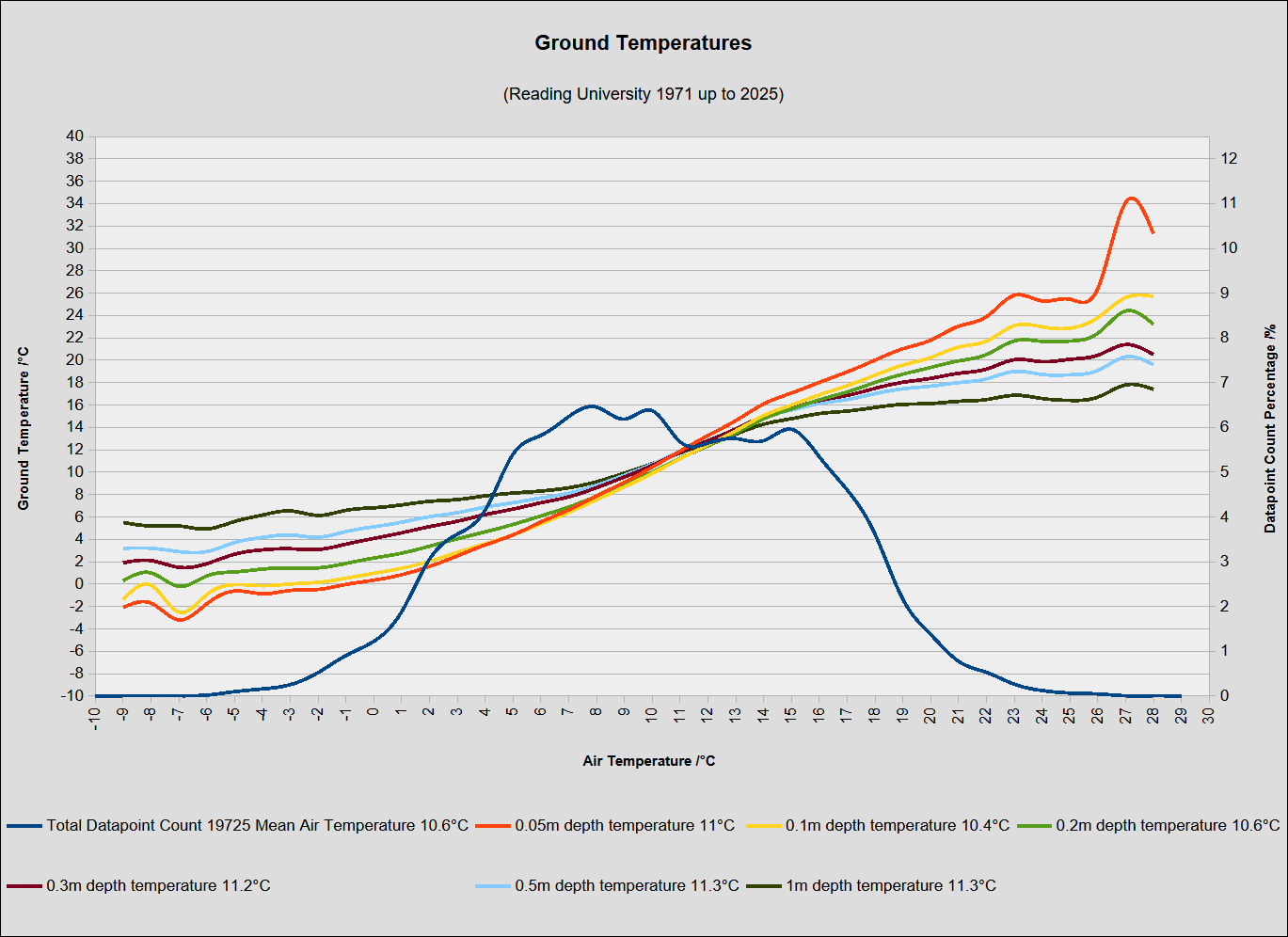
Found that old spreadsheet about ground temperatures. Quick, simple chart from it.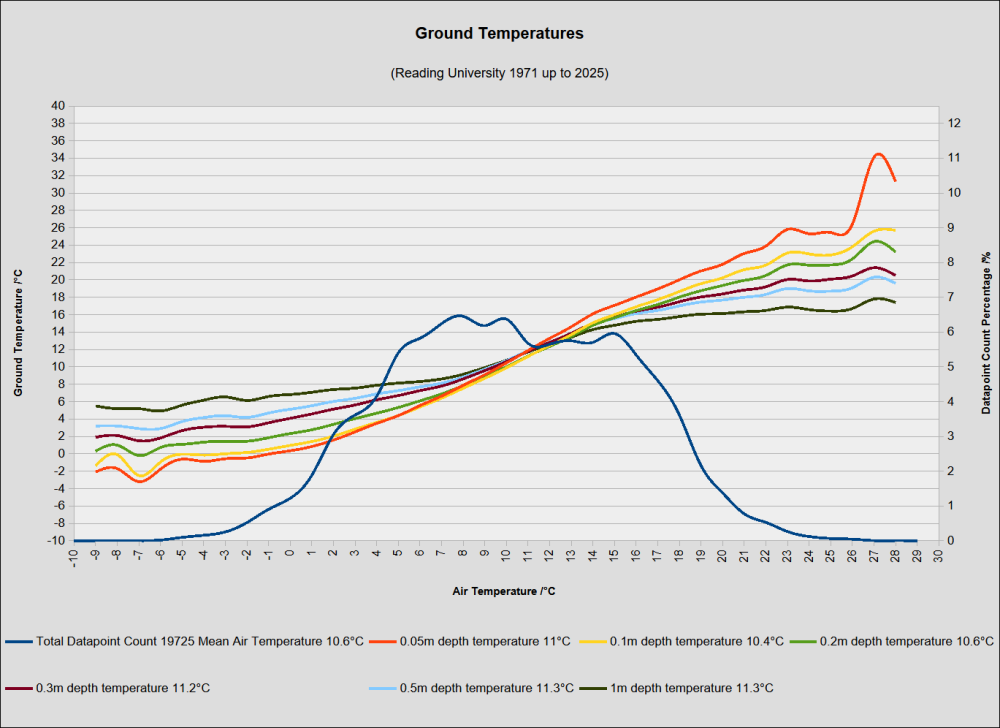
-
Mainly the challenge and CO2. The grid intensity CO2 is outside of my control, but then I started it was around 0.7kg.kWh-1. Initially I saved 30% by just managing my usage better. That was a no cost option. Changed to LED lighting (less than £30). I then started by spending some money, mainly £60 on some digital timers to limit my E7 window better (heat up in the last 4 hours rather than the first 4 hour). Then extra loft insulation (still got some more to add). Then I started the miserable job of draughtproofing, cheap to do, but time consuming. Then the secondary glazing (less than £200 for all but 2 windows, so 12 windows in all. Left 2 windows for escape routes). I also reduced parasite loads. This really involved making sure any standby loads were very low. Getting rid of a desktop PC and using laptops has made the biggest difference. There were setbacks, mainly my lodger who, until I beat her with a pointy stick, would stand under the shower till the water went cold. Eventually she learnt her lesson. If it was not more the orientation and the small roof, and having to spend my spare cash on bi-monthly visits to see my Mother, I would put some PV on the roof. As my DHW usage is about 4 kWh.day-1, I could probably get 80% of my DHW for nothing (I could also reduce usage, but I love my morning baths). To celebrate, I heated up the room I am in to 24°C this morning. Hansom it was.
-
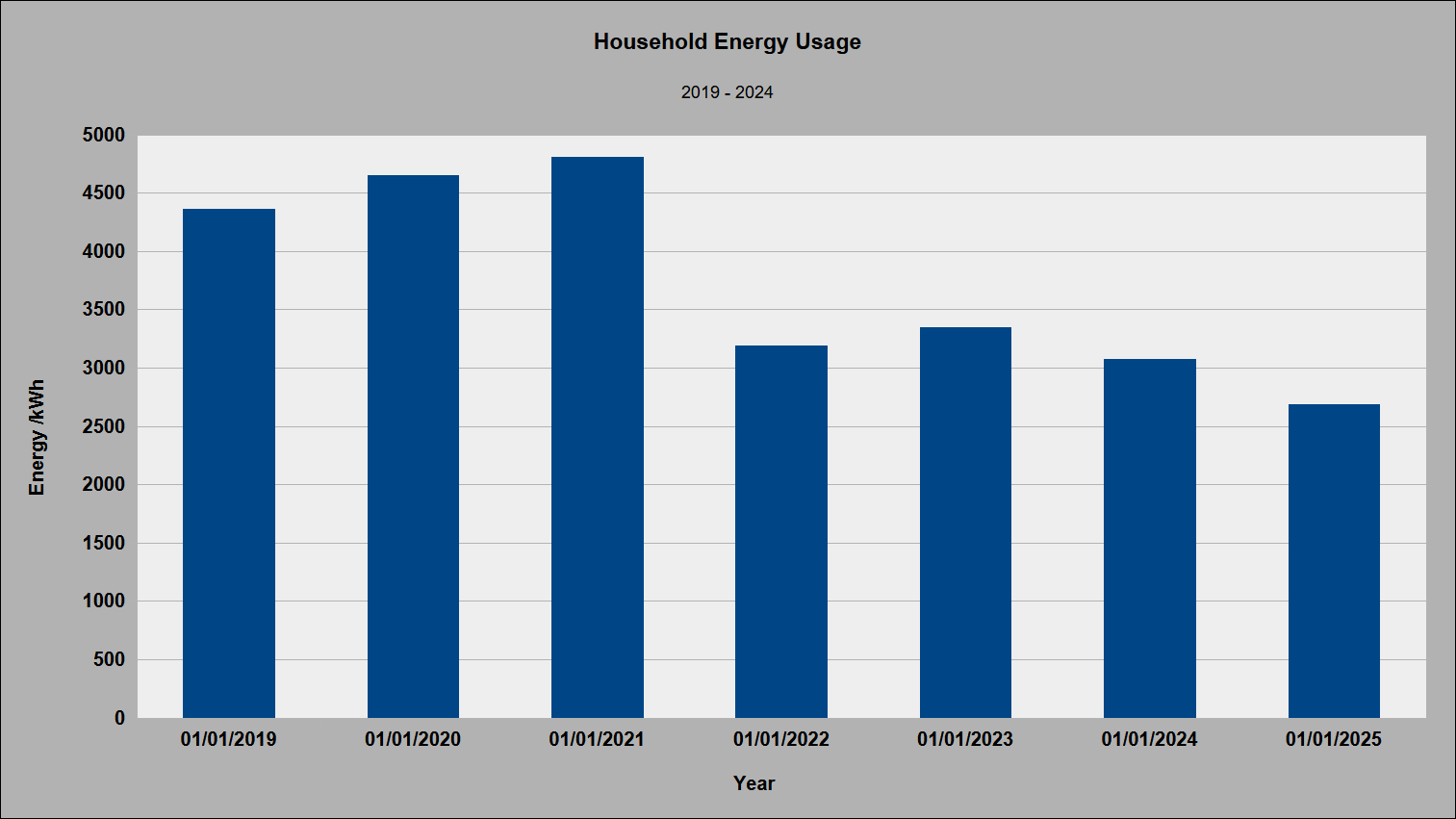
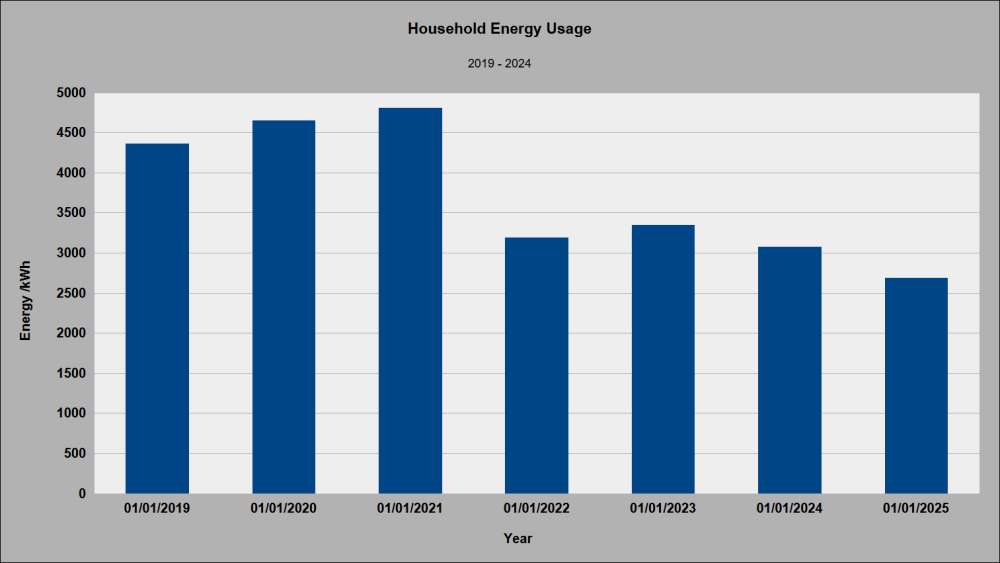
Take me 20 years, but very little cash to to reduce my household energy use to below 3MWh.year-1. When I first moved in, it was around 11 MWh. This last year, I used 2,780 kWh. That is 335 kg of CO2. Feeling pretty chuffed about that as I have been warm, but never too hot, fed and bathed. If you are wondering why there was a big drop from 2022, that is because I fitted my home made secondary glazing (making my windows triple glazed).
-
Husqvarna stone saw popping and flames out of muffler?
SteamyTea replied to flanagaj's topic in Tools & Equipment
I am just impressed that you used a noisy ICE powered tool on New Years Day. Glad you are not my neighbour, but it has inspired me to do more noisy things on a Sunday morning, I feel like upsetting my neighbours who have got into the habit of parking on the white, demarcation lines in the parking area. On a good day, I cannot open my car doors. (expletive deleted)ing wankers. -
Floor slab insulation. Test my logic please?
SteamyTea replied to saveasteading's topic in Barn Conversions
It is, by definition, not what it was. -
Floor slab insulation. Test my logic please?
SteamyTea replied to saveasteading's topic in Barn Conversions
A bubble. I think it is proven, but may have to ponder it a bit more. Then do a bit of modelling. Thermal losses can be quite accurately modelled using the cube root of the sum of 3 dimensions, 4 dimensions if you want to add in time. Or use a Fourier multiple sine wave calculation, but I never intuitely understood that. -
Floor slab insulation. Test my logic please?
SteamyTea replied to saveasteading's topic in Barn Conversions
Regarding the perimeter losses, a fairly accurate way to compensate for it is to work out the periphery distance, multiply by the square of the slab/insulation thickness. This will give you a volume i.e. 20m3. Spread that volume over the floor area i.e. 0.2m extra thickness over 100m2. That will compensate for the finickity losses. Alternatively add extra insulation outside the thermal envelope around the perimeter. The Kore slab system, if I remember correctly, has that built in as part of the design. -
Floor slab insulation. Test my logic please?
SteamyTea replied to saveasteading's topic in Barn Conversions
By the new mean yearly temperature. Ground at a metre depth is generally about the mean yearly air temperature. But as I mentioned earlier, it is more complicated than that. -
Floor slab insulation. Test my logic please?
SteamyTea replied to saveasteading's topic in Barn Conversions
No, just a dT of 20K. Somewhere I have a spreadsheet of ground temperatures, they are not as warm as people think and not very stable sub 1m deep. -
Floor slab insulation. Test my logic please?
SteamyTea replied to saveasteading's topic in Barn Conversions
At those prices (shows it is worth hunting around), and if my spreadsheet is correct, EPS comes out at £30 (0.35m thick) and PIR at £26 (0.25m thick per meter squared. Those are for a U-Value of 0.1, which in reality, is pretty good. If there was a 20°C temp difference (quite possible with UFH) and you have 100m2 floor area, then: 20°C x 100m2 x 24h = 4.8 kWh/day. That would be for a very cold day. -
Excess can also be easily and cheaply stored as domestic hot water
-
Have you run the system though PVGIS, I think they have a storage calculator now as well, but not sure on that.
-
Floor slab insulation. Test my logic please?
SteamyTea replied to saveasteading's topic in Barn Conversions
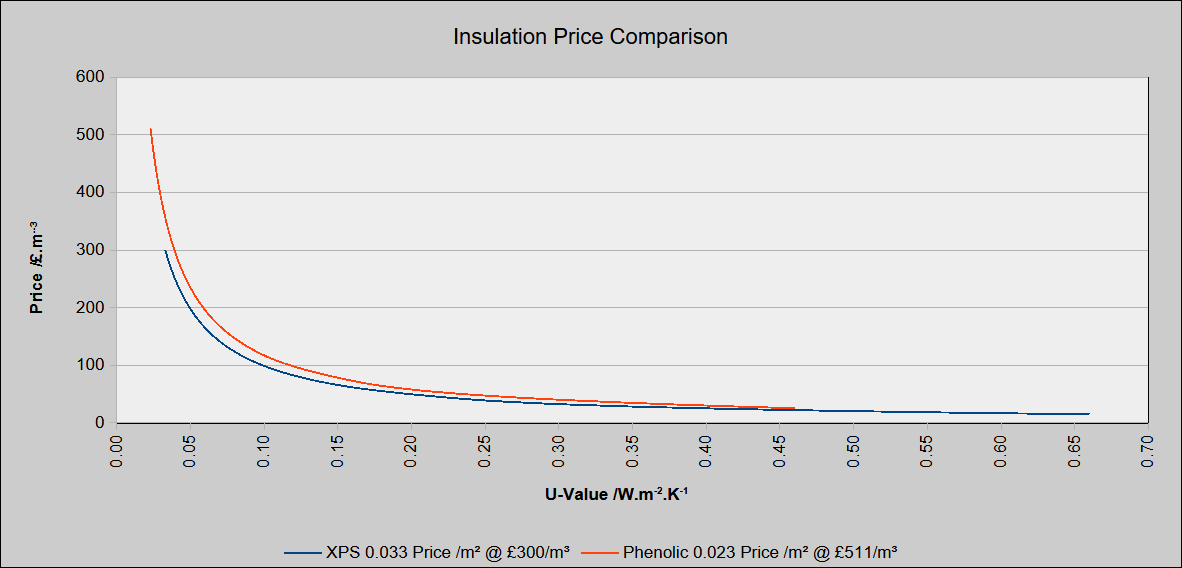
I must be bored. Here is a chart showing price comparison between insulation types. I have only got the prices from 1 site, and have used median k-Values. To get better results, do your own research. There is little difference between XPS and Phenolic at the 0.1 W.m-2.K-1 level, about £10.m-2. There is a 0.1m thickness difference though, which may or may not be important depending on how you excavate and dispose of the dirt. (as usual, there may be errors as I am tired)

-
Floor slab insulation. Test my logic please?
SteamyTea replied to saveasteading's topic in Barn Conversions
That gets me to @Pocsterland, or about a third of my bi-monthly trips up country. I find filling my mind with thermodynamics problems passes the time. -
Ffs, I’m going to take up darts!
SteamyTea replied to crispy_wafer's topic in General Self Build & DIY Discussion
Is this New Year confession time. I drilled though a wall to install a water pipe for a shower, long drill bit. Went through the wall fine, and then into the 300lt cylinder that was the other side. Measure twice, drill once. -
Floor slab insulation. Test my logic please?
SteamyTea replied to saveasteading's topic in Barn Conversions
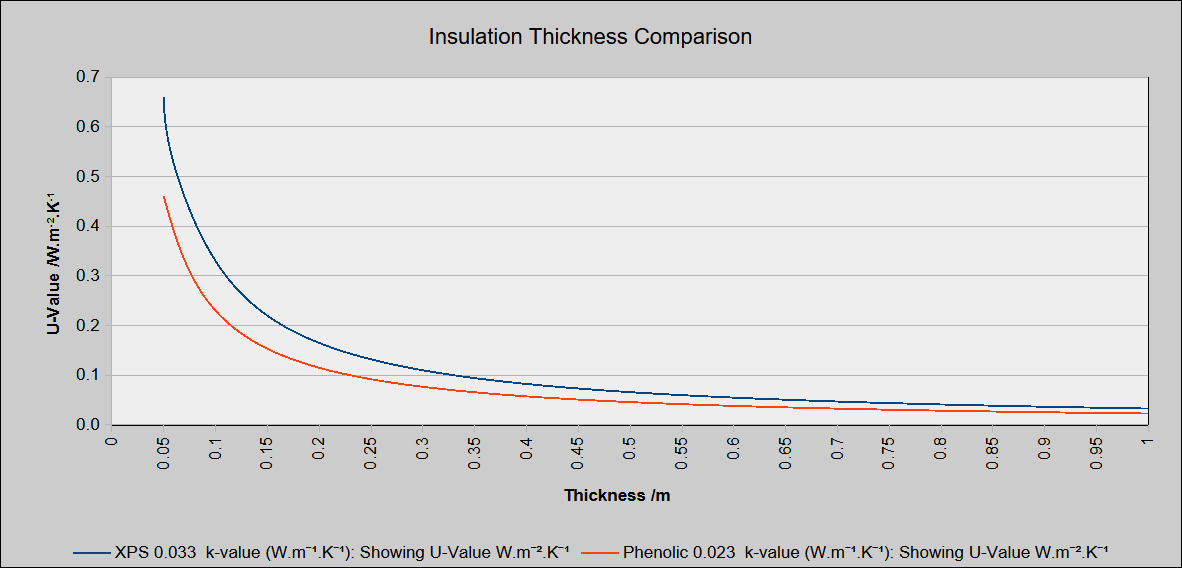
I just knocked it up from assumed k-values. It is a 1D model, so edges, which can have greater losses, would need to be added on. I think that is caused by the charting software, see below for a different curve algorithm (changed to a B-Spline from a Cubic Hermite Spline). This is where it gets difficult. It depends, primarily, on energy prices and installation prices. UFH would cause greater losses than just heating the air in the building, the building form factor would make a difference as well. This is why individual buildings need to have heat loss calculations and not have the heating system sized by a rules of thumb i.e. just floor area or number of windows (I have heard a plumber assess the heat loss that way). Losses though the slab are uneven as they can be affected by the room temperature above, the ground type below and if there is any ground water movement nearby. So probably safer to pop a bit extra in, rather than too little.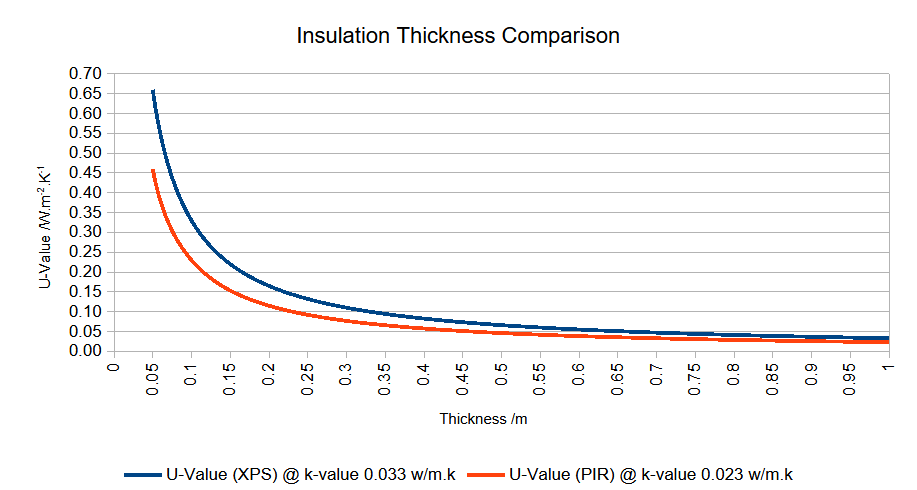
-
Floor slab insulation. Test my logic please?
SteamyTea replied to saveasteading's topic in Barn Conversions
Use this simple cut out guide to work out your ideal insulation thickness for your desired U-Value.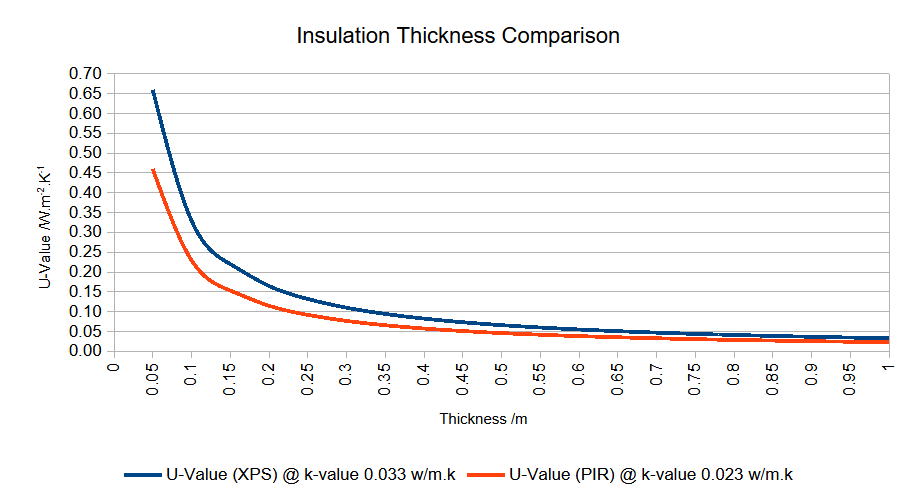
-
Floor slab insulation. Test my logic please?
SteamyTea replied to saveasteading's topic in Barn Conversions
No idea. Would be OK for windows and doors, but not very good for slab insulation. -
Floor slab insulation. Test my logic please?
SteamyTea replied to saveasteading's topic in Barn Conversions
You are still comparing overall thickness though (I know you had a (expletive deleted) up are limited on thickness). What you need to do is pick a U-Value (i.e. 1.2 W/m².K) and compare the prices to achieve that, not compare prices to fill the gap up. Not if you had made that decision in 2015, 6 years before our energy prices doubled. -
Floor slab insulation. Test my logic please?
SteamyTea replied to saveasteading's topic in Barn Conversions
Have you work out the price by U-Value, rather than thickness. Regarding unfaced sheet. Unfaced are used a lot in the composite plastic industries because it is easier to adhere to. For any sheet insulation there will be a certain amount of compression when the initial pour of concrete is added over the top. There has been some discussion in the past about whether it should be polystyrene first then PIR, or the other way around. I can't remember what the outcome was, but seemed to remembered it was counterintuitive. The insulation manufactures should have that information. There will also be a long-term creep as well. PUs can keep shrinking for years. They also absorb moisture (as do most materials) that can affect the k-Value quite significantly. I think polystyrene is a bit better in this respect (though it does depend on density. It really comes down to what you want from your floor insulation. I am with @JohnMo in this respect. Get the very best performance you can financially justify, you can put it right later. -
If you read the work of J Richard Gott, he states that the longer than something has been about, the longer it will last. AC lighting has been around a long time compared to modern DC lighting. So you have to consider the replacement costs, the potential difficulties of getting like for like replacement, separate wiring circuits etc etc. You can buy, from Poundland, LED builds that plug into an ordinary bayonet or Edison Screw fitting for a pound. Why complicate things, it is a light build.