SteamyTea
-
Posts
23937 -
Joined
-
Days Won
203
9 Followers



Recent Profile Visitors
29838 profile views


SteamyTea's Achievements

Advanced Member (5/5)
5.9k
Reputation
-

Insulation layer for shorter time constant?
SteamyTea replied to Alan Ambrose's topic in Underfloor Heating
Lower case w is not a derived unit for two reasons, it is lower case, and no one famous has a name starting with W. Except a watt, W, named after a man. There is ω Which is angular frequency, radian per second. ω is not a w though, it is a lower case Greek omega. Sometimes it is printed in bold, ω. -
Most of that will depend on the starting points i.e. if only a third of your country has access to reliable electricity. Also there is land use rights. The UK has a system set up to stop change, so everything takes a long time. And keep in mind new RE is extra capacity i.e. new generation. You can't compare costs to legacy generation easily, or fairly.
-
Insulation layer for shorter time constant?
SteamyTea replied to Alan Ambrose's topic in Underfloor Heating
H is used to denote a henry, which is electrical inductance. A small h is generally used to denote hour, though it is not an SI derived unit. When it comes to energy, we should use J, for joule, as that is the agreed SI unit. Would be much easier if we stuck to that. Imagine that when you fill up your car, you buy by energy unit, not a volume. Then efficiency could be easily compared between fuel types. -
Insulation layer for shorter time constant?
SteamyTea replied to Alan Ambrose's topic in Underfloor Heating
kWh Thermal inertia is what you need to be looking at. https://en.wikipedia.org/wiki/Thermal_inertia -
My father was severely allergic to wasp stings. I have never wanted to put it to the test as I have all sorts of allergies. Apparently some people react normally to the first sting, then can get sever reactions to subsequent ones.
-
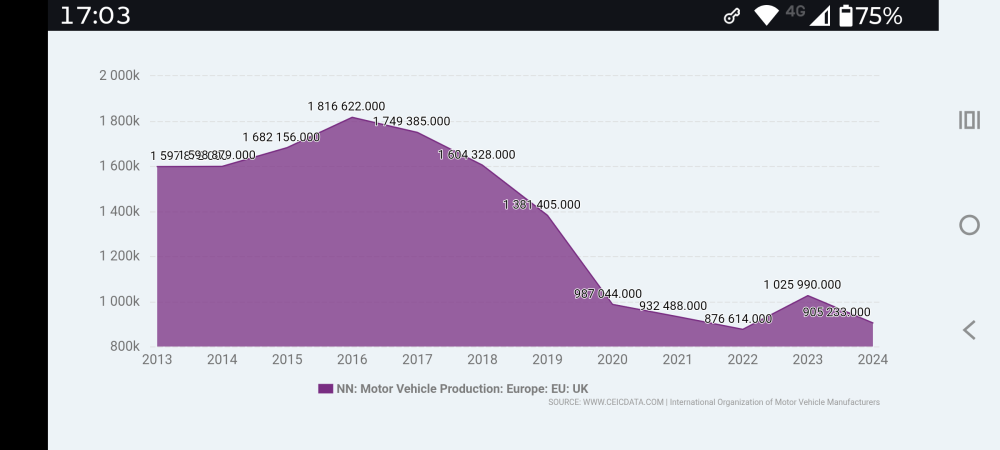
Generally, manufactured goods are now of better quality and last a lot longer. So 'industry' can produce more with less. Vehicle manufacturing was at all time records untill 2016, don't think the decline has anything to do with 'net zero', energy prices or lack of investment. Trying to think what happened 10 years ago, seem to remember that we were going to become world leaders.
-
Summer holidays have just finished, should be easier getting hold of people now, until last week of October.
-
Cancer is a generic term, it is not one condition, why I always take those sort of stories with a pinch of salt. I will just stick to using it to write erotic stories about you.
-
Higher memory prices and a cure for cancer. https://www.bbc.co.uk/news/articles/c0m39g7xzevo
-
New self build design, heat and architect
SteamyTea replied to Jack757's topic in New House & Self Build Design
Really. May work if you suspend yourself naked a few mill above the floor. -
New self build design, heat and architect
SteamyTea replied to Jack757's topic in New House & Self Build Design
It is a lot more complicated than it first looks. Will you want cooling? Why place radiators against a potentially colder wall Wil any of the bedrooms be used for other purposes i.e. children doing home work in them. Will forced ventillation be fitted, with, or without heat recovery. Will secondary heating be fitted i.e. a wood burner (just don't fit one). How is the house expected to perform during the day and different seasons i.e. solar gain, or lack of it. How simple do you want the system. How controllable do you want the system. Do you want to take advantage of different, and potentially unknown, time of use tariffs. -
Depends how it is worded and chatted. If x-axis is accidents, and y-axis is volume of useful paperwork, then if my hunch is right, it should be a negative correlation. Swap the axis around, and it becomes positive (but still shows the same result). if, on the other hand, the paperwork is too voluminous, badly written and unorganised, them the correlation could be 0, or flat, but with a lot of variance between data points.
-
Probably best to check them at the end of the heating season, rather than the beginning of the new heating system.
-
I suspect there is a stronger correlation between sites with good paperwork and low accident rates.
-
Like China is working towards, very rapidly. And India, sub Saharan Africa as well. I get the feeling that people that think 'Net Zero' is expensive rubbish think that we should have done it already, not done anything, blame others, not blame others, we are a good example, not a good example, it will make a difference, won't make a difference. I suggest that you all get together and come up with a coherent plan as why we should drop the policies and just carry on as normal, rather than divert the climate change debate to one about personal finances.