SBMS
-
Posts
1064 -
Joined
-
Last visited
Everything posted by SBMS
-
I think the challenge on here is that there are those in the reverse ASHP camp and those in the separate AC camp. I don’t think there’s anyone that’s had both and can say which is more optimal, comfortable etc. I think the neatest idea is running heat pump in reverse (it’s there anyway) but the added complexity of dew points, lagging etc makes this more risky than AC. That’s where I am at moment. AC = guaranteed cooling, no risk. But more expense.
-
So when designing the UFH loops do we need to target a w/m2 To account for cooling demand? Ie we need an output of 63w/m2 in this instance?
-
How would one go about calculating the cooling output of the slab running in reverse? Say I have a room that is 11sqm with a cooling requirement of 700 watts... How could I calculate if the slab could cool that space?
-
What did you put in?
-
I don’t disagree with your logic @JohnMo and probably the average is even lower. I think the AC units have the ability to modulate pretty low so oversizing isn’t a massive deal and the price difference between say a 15kW or 25kW unit is pretty marginal. So does it hugely matter if I have a system larger than is needed most of the time? Appreciate it’s different with ASHP sizing and that’s important to get right. It might be different in the world of AC but all suppliers I’ve spoken to size to peak cooling load. fyi lots of south facing glass
-
Just to be clear that is Peak Cooling Load (the maximum instantaneous cooling demand). As I understand it, most HVAC designers will size equipment based off the peak load. I used these figures when calculating the peak vs the average for solar gain, temperature delta etc. Component Peak Value Average Value Ratio Solar Gain 600–800 W/m² 300–400 W/m² ~2× ΔT (cooling) 9°C ~5–6°C ~1.5× Internal Gains Max occupancy 50–75% occupancy ~0.5–0.75× Total Load 100% 50–70% ~0.6× typical My Average Cooling Load is much lower, around 9kW in the summer.
-
Continuously second guess as to whether to go fancoils and ASHP in reverse or true AC. Would be much more cost effective with FCUs and ASHP in reverse, but have concerns that it won't cool house sufficiently (how to calculate the ground floor cooling capacity??) and how hot water generation can happen at same time? I hear lots of people talking about manually setting jumpers on heat pumps to run in reverse, lagging of pipes for condensate etc. Sounds difficult to do as a whole house system. That, and the peak cooling load for our house (worst worst case) is circa 24kW. I don't even know what the 'cooling capacity' of a 12kW heat pump actually is (is it the same?? 12kW??)
-
What units you got there @Dave Jones?
-
We've decided on UFH downstairs (ASHP) and a VRF AC system to upstairs bedrooms and downstairs. This has removed any wet heating costs upstairs - no rads etc, and will allow us to use AC for top up heat in very cold weather (if needed - unlikely) and benefit from cooling in summer.
-
Aluminium Vs Alic-Clad timber windows cost difference
SBMS replied to flanagaj's topic in Windows & Glazing
Thanks Nick good to hear! I’ve gone round the houses on this. Currently wondering whether the double height south facing atrium glazing justifies solar control glazing (extra £1200)! -
Aluminium Vs Alic-Clad timber windows cost difference
SBMS replied to flanagaj's topic in Windows & Glazing
We looked at norrsken etc much higher price than our current supplier. We are going with senior architectural pure line of windows triple glazed about 0.7 u value all aluminium. Sliders about 1.0 and bifolds about 0.9. Much better price than Alu clad. -
Did you do ducted AC upstairs or wall units? Think we are going this direction..
-
Are these MVHR numbers correct?
SBMS replied to SBMS's topic in Mechanical Ventilation with Heat Recovery (MVHR)
It doesn’t you’re right I was reading someone else’s article on a blog and I don’t think the regs say that. I initially thought it was the greater of 43l/s for 5 bedrooms or 0.3 * square meters floor space. Think i went down a rabbit hole reading someone else’s blog. I think it’s as simple as 370*0.3=111 as I put originally for BR?? -
Are these MVHR numbers correct?
SBMS replied to SBMS's topic in Mechanical Ventilation with Heat Recovery (MVHR)
Sorry typo before. I read the above and worked out that the BR ventilation rate is 124l/s. 43l/s as per your table plus the adjustment as the floor area is greater than 100sqm. (370 - 100) = 270 m² × 0.3 l/s/m² = 81 l/s 81+43 from the table is 124l/s. Which I think requires a unit size of circa 450 cubic meters per hour. Seems close to the ideal 60% most recommend running a unit at although I wonder if the BR calculation is on the high side. Paul heat recovery calcs just seem a bit on the low side but I don’t know. -
Are these MVHR numbers correct?
SBMS replied to SBMS's topic in Mechanical Ventilation with Heat Recovery (MVHR)
To be fair the AI calculated the BR value which I checked and it was correct (111l/s). The occupancy figure was around 120-130l/s. So fairly similar. -
Not for new builds. They require developer contribution capped at 2k. Although sliding scale - the more you build, the cheaper it is.
-
Are these MVHR numbers correct?
SBMS replied to SBMS's topic in Mechanical Ventilation with Heat Recovery (MVHR)
It’s coming out at around 650-720m3 according to the ChatGPT estimate… who knows which is right?! -
Are these MVHR numbers correct?
SBMS replied to SBMS's topic in Mechanical Ventilation with Heat Recovery (MVHR)
I asked ChatGPT to do me an estimate and it was surprisingly useful. It asked me bedrooms, volume, sqm etc and concluded with the following: 🧮 Here’s what that means in practice: Normal continuous mode: You can expect around 400–460 m³/h (≈ 110–130 L/s), depending on your ducting layout (). Boost or peak mode: Up to 600 m³/h (≈ 166 L/s), assuming your duct system doesn’t exceed 200 Pa pressure drop . Free-air (no duct resistance): Might get up to 700–750 m³/h, but this isn’t realistic once ductwork is in place (). ✅ So: Is the Q600 enough for your needs? Continuous operation (~430–470 m³/h needed): ✅ Yes, Q600 handles this well, especially with low-pressure ducting. Boost mode (~650–720 m³/h ideal): ⚠️ It’s a bit below ideal, maxing at ~600 m³/h. You might see slower clearing during showers/cooking, but this is a common and workable compromise. -
Are these MVHR numbers correct?
SBMS replied to SBMS's topic in Mechanical Ventilation with Heat Recovery (MVHR)
Would You agree with Paul heat recovery’s assessment of the size of unit required or do you think the unit would run undersized? -
Are these MVHR numbers correct?
SBMS replied to SBMS's topic in Mechanical Ventilation with Heat Recovery (MVHR)
If ventilation is nothing to do with volume why do all the calculations and sizing reference volume and why do the units have sizing related to volume (genuine question as this repeatedly confuses me. If ventilation is to do with number of occupants generating co2 then shouldn’t mvhr units be based on number of people in the dwelling?) -
Ours was not - openreach wouldn’t entertain it apparently in the last 12m they had sought advice from hmrc who stated it could not be zero rated.
-
Are these MVHR numbers correct?
SBMS replied to SBMS's topic in Mechanical Ventilation with Heat Recovery (MVHR)
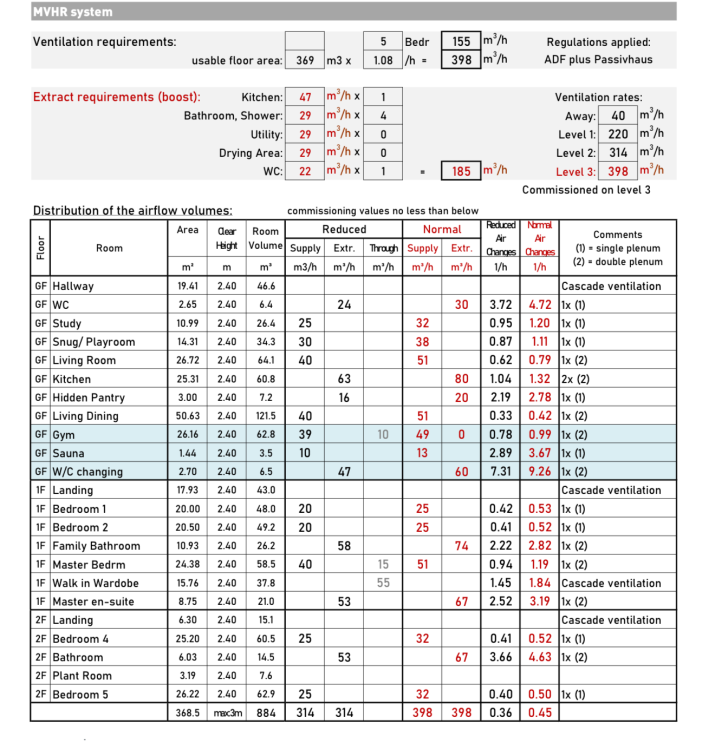
The thing for me is the fact they’ve excluded the volume of the hall and landings as that is quite a bit of volume. -
Are these MVHR numbers correct?
SBMS replied to SBMS's topic in Mechanical Ventilation with Heat Recovery (MVHR)
Same dilemma. And Paul heat recovery have over estimated mine as the top floor bedrooms are rooms in roof so not 2.4m high for the whole room… -
Are these MVHR numbers correct?
SBMS replied to SBMS's topic in Mechanical Ventilation with Heat Recovery (MVHR)
Who have you had quotes from? Have you tried Paul heat recovery (what did they say if so?) -
So we’ve got a fairly large sqm required for MVHR - circa 400sqm. A couple of other MVHR suppliers (including BCP) have suggested large units such as airflow and komfovent to shift up to 900m3. However Paul heat recovery has come back with the zehnder comfoair q600 with a much lower estimate required for airflow. Does the below look right? In particular it looks like they exclude the hallway and landing areas from their estimates (cascade ventilation)?