


Mr Blobby
-
Posts
616 -
Joined
-
Last visited
Everything posted by Mr Blobby
-
Thanks for this. Please let me know how you get on and the end result.
-
 Moved the house 5 metres back. We have a massive garden now, way too big, but hardly any turning circle at the front onto a main road. I was so focused on the interesting stuff that I overlooked the basics 🙄 I would have said no to full height windows. Terrible to get the thresholds thermally broken, leak lots of heat in winter, too much solar gain in summer, and don't increase light much. But architects love big windows. Be warned! No bay window type rooms poking out. Nightmare. I would have thought about room sizes and solar panels earlier. I thought I did but we should have made the rear return wider to accommodate more south facing panels. If doing it again I would do things simpler.
 -
The first statement is correct but it does not follow that increasing demand will always uncrease co2 emissions. In Ireland, where admittedly wind penetrations is much higher than GB, at about 50%, and almost all on-shore with no nuclear here, then wind is regularly curtailed at night when demand falls off a cliff. Wind is curtailed because the increase in demand at 6 am requires fossil fuel plant to remain on, close to min gen, to ramp up quickly and exceed total wind capacity. Any increase in demand here overnight when wind is curtailed is satisfied with zero extra co2 emissions as the turbine blades are not feathered. Wind is not curtailed just because of cost (ok there are start costs in the market for fossil plant) but there is just more wind generation than there is demand. The grid stability question here is an interesting one. Ccgt plant running near min gen during periods of low demand is less efficient and increases emissions per MWh. For such ccgt plant the increase in demand would improve the heat rate and reduce emissions per MWh generation. The increase in domestic batteries and EVs charging overnight and smoothing demand will ultimately reduce overall emissions per MWh.
-
Our internorm AT540 entrance door is an ongoing headache. The door is connected to 1m sidelights either side. The first time it was installed the window fitters didn't bother with the coupling unit but just glued the door frame to the sidelights with silicone glue stuff. Messy to look at and I could see daylight between the door and sidelights. Fitters also pinched the electrical cable in the join and the electrics are knackered. Reinstalled now but where the cable was pinched this has prevented the sidelights and door frame from fitting tight together, either because the cable is pinched again or the frame is bent from the first install. The coupling unit is a set of bubble seals and small plastic "H" shapes that fit in internal grooves in the frame. Fitters reapplied silicone at the joint in the second install. Not sure if that's a good idea. Its still a crap job and we need to decide waht to do. As far as I can see the installation instructions for the entrance door coupling units are not in the public domain. They would be useful to show the installers! Does anyone have a copy or some experience of how the coupling unit should be installed? For anyone with an internorm, or similar entance door with big sidelights, how was your door coupled to the sidelights, and am I right to think the use of silicone here is just wrong?
-
We want a big, 1800 shower tray and our local bathroom showroom tried to sell us an enamel one. This one https://www.my-bette.com/en/product/shower-trays-and-shower-areas/betteultra-1600-2000-mm This is the first time we have seen enamal trays. Has anyone on here installed one in their bathroom? Should they be avoided or are they ok?
-
Is there any reason why I shouldn't put the extract manifold on to of the supply manifold in the picture? Unit is on the loft. Plenty of room but would use less space if stacked. I ask because every installation and design I've seen has the manifolds adjacent to each other.
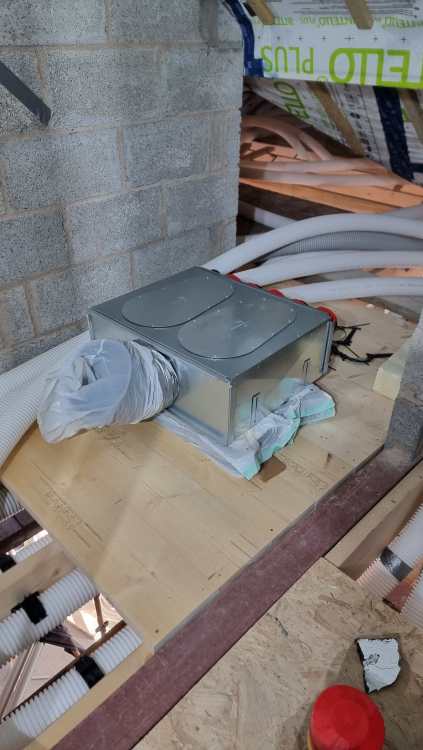
-
.
-
.
-
I don't think your house was rendered when we visited. It is reassuring that you are happy with the sto rend on your build. I guess ours would have a different base coat on a block build? Which sto product did you use? Yes please PM me Kevin's details. This rendering looks dead easy. I think I'll just do it myself in an afternoon and save a bucket of cash. 👍
-
Thanks @nod, this is exactly as I suspected. I like my builder but he does love to do things as cheaply as possible. You think K rend is ok then? With the proper backing coat, which I assume is the first (of two?) coats over the blocks? And would that typically have mesh in it? (I am neurotic about cracking)
-
For us we have screed going on top of hollowcore slabs so easy to lay the UFH pipe. I just don't know how we'd plumb in a second manifold without adding another pump. In our passive house I agree that first floor UFH is probaply unecessary. Our builder struggles to understand this however, and keeps telling me we should put the UFH pipes in the bathroom floor so the tiles aren't cold in the morning. Is he right? Will the floor be cold?
-
Our thoughts exactly. The world has changed since we did our original kitchen design with two integrated ovens. Counter-top air fryer and microwave just seems to make more sense for us now.
-
Sorry to hijack this a bit... @Conor, Do you mean an integrated air fryer? We are thinking of dropping our planned combi microwave/air fryer for simpler stand-alone units on the worktop in the pantry. ... I agree with other comments on here, hob on island, sink behind is a good layout.
-
We need to decide on render to go on block house. Our builder is a big fan of K Rend, but I'm not so sure, having read horror stories about algae growth etc. Also builder says he puts down a base sand/cement layer and then sprays K rend on top. I did ask him about mesh to resist cracking but this doesn't seem to feature in his approach, leaving me a little concerned. So what are the other options? And then there are options within options, like monocouche, silicate? What about sto, or weber? I have no idea about this so please help!
-
Our builder keeps telling me I should put some UFH loops under first floor bathrooms to have a warm floor. Should I? And if so, then how is that connected when running an otherwise very simple single-zone system with no additional pumps? A second manifold in series?
-
No. I remember our M and E consultants tried to persuade to install a combined buffer/DHW tank some time ago. I didn't like the idea then and still don't. Call me old fashoined but I like to keep these things seperate. And also at 285L DHW maximum capacity is perhaps a little smaller than we would like. And now it looks like we will bin the buffer all together and go for a single zone UFH.
-
Monitioring hardware/software recommendations
Mr Blobby replied to Dam0's topic in Air Source Heat Pumps (ASHP)
What flow meter do you use? What do you use to read the data? -
MVHR Design: Feedback & Mythbusting
Mr Blobby replied to joshwk's topic in Mechanical Ventilation with Heat Recovery (MVHR)
Why are you running a branched ductwork? Far better and easier to install with zhender manifolds with attenuators on top of the zhender unit and then 90mm semi rigid ducting to each of the rooms. And probably less noise transmission between rooms (hence all the silencers in the ducts on your plans) Is your loft space warm and inside the airtight envelope? If not then do not even think about putting the unit in the loft space, too much hassle insulating ductwork and sealing penetrations. -
So the water pump in a panasonic heat pump can push water all the way round the ufh loops? That would be good. For some reason I just imagined it would be too feeble. We know our heat loss calcs and 95% ruled out UFH upstairs except possibly to add a bit of cooling. Just in case. Agree that fan coils better, maybe need to think about this some more. Maybe one or two upstairs above dew point at UFH temps to avoid condensate drain. External blinds will hopefully control the worst of any overheating but we only have this one chance to put the pipes in now for extra cooling, just in case. So your ashp water pump controls flow rate through the UFH loops? ... Its funny how the decision to install a buffer tank was cast in stone two years ago but is now, like so mamy other decisons, going to change. Keeping it simple and running a single zone without any actuators or additional pumps is very appealing. Apart from the cost, it just seems like a better way to do it.
-
Our heating system is currently designed for ground floor UFH and ASHP. So far so good. It has always been in the plan to fit a buffer tank. I'm now beginning to re-think the buffer tank and remove zoning. To give some context, we have a block house on insulated slab and <3kW peak heating load. Floor temperature will change very slowly hence individual zone control seems to make little sense, even with solar gain moving around the house. We have about 600 metres of UFH pipe in the floor at 200 centres. I see from discussion here that there is a school of thought that questions the conventional wisdom of installing a buffer tank to stop short cycling because there is already sufficient volume in system. And so it may be more efficient to remove the buffer tank all together and connect the ASHP diretly to the UFH manifold. Is this a contentious area, or is this well established? If we delete the buffer tank, are we then limited to a maximum of one UFH manifold? I am toying with the idea of another manifold on the First floor, but only for some additional cooling, or maybe heating under bathrooms. What about hydraulic separation? I would need a pump at the manifold of course, so what if this manifold pump runs at different flow rate than the ASHP pump? How does that work without seperation? If I did decide to add another manifolfd for some UFH upstairs, would that mean a buffer tank must be included? Our plumber will be horified at the suggestion of dropping the buffer tank, so I need to be certain of this before I give him his next heart attack.
-
Latest Generation Auctions
Mr Blobby replied to SteamyTea's topic in Environmental Building Politics
I suspect part of the problem in GB is the rampant nimbyism that forces turbines off shore where generation costs are twice per KWh than onshore wind. Here in Ireland there seems far greater acceptance of turbines. Only about 2% of Irish wind generation is off-shore compared to about 50% for GB. Its ridiculous. -
This is great in theory but in practice architects don't give a hoot about value engineering. During the design stage I asked my architect about costs and he flat out refused to comment and told me to appoint a QS to cost the project. Which is completely unhelpful. If I was building a house again I would get the SE and builder involved far earlier, to do a proper sanity check over the plans, and rely far less on the architect.
-
This. Do not ever pay a % fee. And get a builder to look over the plans before going to planning. We asked our 'passive house' architect for a simple design to passive house standard. We got big full height windows, parapet walls and voids, all costly to build and very bad for PHPP. Architects just can't help it. It's not their money so they will design in all sorts of unecessary crap.
-
Panels are on our roof but we haven't purchased the inverter yet. Theses are the panels we have on the roof. https://leisurepower.co.uk/solar/solar-panels/rigid/15139/10-x-aiko-455w-all-black-solar-panels-aik-a-mah54-455-ab-g2?gad_source=1&gclid=CjwKCAjwodC2BhAHEiwAE67hJIC4gQq28yAfvy0rndgda032mOLPHGcf0UW0m6trniTA3LBsW8jIqRoCGsUQAvD_BwE ... we purchased the panels from an installer who put them on the roof for us. We're very pleased with his work so far. We used S5 pvkit clamps onto standing seam. The UK suppliers only sold the old version so we ordered the new version 2.0 clamps direct from the US. Our installer can't source our chosen inverter within the UK but he is happy that we supply it and he installs it. This 3-phase hybrid inverter has been available on the continent for over a year but the last time I looked all the UK suppliers were selling the old series 5 model. Which is no good for us because we want the latest model with >2 MPPTs. https://etronixcenter.com/en/8176291-se307-solis-solis-s6-10kw-hybrid-inverter-compatible-with-pylontech-force-h2-hv-battery-including-logging-stick-wifi.html Yes its fully G98 compliant... https://connect-direct.energynetworks.org/device-databases/search-gen?model_number=S6-EH3P10K-H-EU We will be plugging in a pylontech H2 battery. Probably this one.... https://etronixcenter.com/en/8173159-pyl-h2-1421-pylontech-pylontech-force-h2-hv-system-1421kwh-1x-fc0500m-40s-v2-4x-fh9637.html ... and conected to this will be a couple of zappis. And maybe an Eddi.
-
It depends on your DNO. Here in Northern Ireland NIE are probably the least flexible. Temporary cabinets must be brick built and cannot be made perananet and meter cabinets must be in a permali box on the wall. I did try to reason with them but they were having none of it. Can you not make your temporary box permanent? That would have been my first choice if the DNO allowed it. There are no smart meters here and so the meter reader needs access to the meter, hence it is so restrictive. I assume it is more progressive in England so you will have more choice of where the meter goes.



