
Jump to content

Marvin

Members
  • Posts

    2382
  • Joined

  • Last visited

  • Days Won

    3

Blog Entries posted by Marvin

  1. Marvin

    Understanding PV energy production variations
    Energy production is as variable as the weather. 🙄 But how much does it change the results in a month or year?
     
    Based on calculations using the PGIS data over 10 years I thought I would share the results.  In one calendar year the energy produced can vary from the average by +/- 5%.  In one calendar month the energy produced can vary quite widely!  From +24% to -28% from the average!
     
     
    Here's my summarised results:
     
                            Jan Feb Mar Apr May Jun Jul Aug Sep Oct Nov Dec Yearly hi/mid percentage 12.73% 24.94% 20.62% 12.17% 17.89% 9.83% 10.29% 10.72% 15.01% 21.15% 17.98% 10.59% 4.18% Mid/ low percentage -15.0% -20.7% -20.6% -12.7% -13.9% -13.0% -8.6% -13.6% -12.9% -20.1% -28.8% -17.6% -4.4%  
    Worth considering when relying on PV results.
     
     
  2. Marvin

    PV energy use
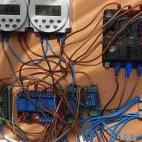
    PV to hot water and heat storage controls schematic:


    This system only uses the excess PV power (unless the Solic 200 button to use any power is pressed, and then it will allow any power for 90 minutes).
     
    There are three output choices. Firstly to the hot water tank immersion until the tank reaches the temperature set point, then to one of the two storage heaters as chosen.
     
    Although some people have mentioned that the Solic 200 (other types I cannot comment about) will limit the power through it, this design is limited to one output at a time which is a maximum of 3kW.
     
    When the hot water tank has reached its target temperature the controls automatically offer the excess power to the MK 3 way switch( K8).  This part of the system is designed for our home.
     
    The choices are power to the hallway day storage heater or power to the timer which switches between the hallway and living room one.
     
    Today we stored about 2.8kWh for overnight heating.
     
    Any questions, let me know.
     
    Marvin
  3. Marvin

    layout and catch pit details
    We use 4 phases from rainwater to flushing the loo with it and they are:
     
    Collecting, separating and storing in bulk tank. Fine filtering and storing in barrel. filling the gravity tank in the loft Filling the cistern  
    This is not the only system that is possible but one that works with our property limitations.
    This design and its controls take into account freezing conditions.
    We use two 12V pumps run from batteries and PV.
     
    Here is our system:

     
    We were limited for space and you can use gravity to your advantage 
     
    Here is the design of the catch pit:


    A circular chamber with a flat base side entry pipes angled to make the inflowing water circulate around the edges.
    A Tee set vertically with the branch horizontal. 
     
    Construction details could be concrete slab and engineering brick sides with manhole cover and frame like ours.
     
    Needs to either be under the ground or drained before frosts if using a plastic tank.
     
    Ours was 900 internal diameter, really the bigger the more sediment settles, but this is for about 200m2 catchment area. If your going for smaller 
    I would go for as tall as deep as you can.
     
    The separated water goes directly into your bulk storage ready for further filtering. 
     
    Ours has just been cleaned out and I will take photos tomorrow.
     
    M
  4. Marvin

    PV energy use
    This is the latest system we have:


    There are 4 CT relay clamps, 3 for the EV charging, (and one will be for battery charging), which are set at different PV output levels depending on the month of the year which decides what rate of PV needs to turn on the charging of the EV. This relates to a 3kW charger and the expected power requirement for the EV on a particular month and the expected production using the PGIS web site calculator.
     
    The summer 3.6kW rate is because the house typically uses about 0.6kW and during the summer there are plenty of hours when the power is over 3.6kW.
     
    There is of course an override for when we will charge irrespective of the PV supply.
     
    When the mains option is chosen a red light indicates this choice.
     
    When the car is being powered the green light indicates this.
     
    The theoretical result is not as good as I hoped as M2 relay is time delayed to stop the charging going on/off quickly during cloudy/sunny days, and because of the lack of supply during deep winter, however for 4000miles we hope to use about 730kWh PV and buy 70kWh from the mains.
     
    This will improve if we manage to obtain a bigger power storage EV as the PV history for hear over the last 15 years shows good days are usually grouped together meaning during winter we might not have used up the power in EV before another glorious day comes around and then have a week of cloudy weather.
     
    The only works because the car is plugged in to the EV charger most of the day time. (like today).
     
    I'm hoping someone can use this to help them develop a similar system. 
     
    If you need any info on the parts are, ask.
     
    Good luck
     
    Marvin


  5. Marvin

    PV energy use
    Results for us as they come forward...(and not what I expected)
     
    Our Cool Energy inverTech Air Source Heat Pump CE-iVT9 4.3kW-9.5kW has been on standby only, for the last few weeks, and I have measured the power consumption. It appears to use about 0.1 kWh an hour. That's about 2.25kWh a day in 24 hours.  
     
    We use a Solic 200 to direct our excess electricity produced by the PV to the hot water immersion.
     
    Whilst the Solic way of heat the hot water uses more energy, because it only runs using power we would otherwise give to the grid, its better for the bills to turn the ASHP off all together rather than use it to heat the hot water tank.
     
    You would think that with a high COP it would be better to use the ASHP but with the other things on in the home and the car being charged, you can never be sure your not buying all the power.
     
    Secondly I think the ASHP runs at  a minimum of about 1.5kW when heating the water. The Solic can use any spare power from the PV: 10 to 3000 Watts.
     
    We could turn the ASHP off altogether and on only when we need hot water and I have decided this is a bit fiddly so won't do it.
     
    Another benefit is the fact that the hot water tank is set to 70C ( the ASHP will only do up to 60 and that is at its least efficient) and this lasts us at least 2 or 3 days before needing to be heated up again! ( We do have a super insulated tank) Days when it could be cloudy and we would have to pay for the power. ( We will turn it up higher in the winter and use it as a thermal store for night time warmth...)


    And finally I would rather wear out the £50 immersion than the £3180+VAT ASHP!
     
    Good luck with your project.
     
    M
  6. Marvin

    Rainwater
    This info relates to a DIY rainwater harvesting system, not a commercial system, and therefore the water must not be drunk!  
     
    You should be careful using rainwater not to mix it with mains (Potable) Water as it is not suitable to drink and you could poison your house supply! To be clear birds poo on your roof and then it rains.  However there are ways to elevate the problem in a DIY system so there is no smell or colour problems but it still cannot be drunk! 
     
    You should not use the recycled rainwater for cooking, bathing or showering.  SHMBO will not allow it to be used for clothes washing either. The main uses are for garden watering and toilets, and some people use it for car washing and some for clothes washing (we do not have enough storage).
     
    How much rainwater are you going to use on loos?  Rough estimates suggest that you use about 70 litres a day flushing loos for 2 people. That's about 25m3 a year. More people more flushes more water...
     
    How much rainwater are you going to use in your garden?  Well that's a good question and trying to work that out is basically a waste of your time because when its raining you won't need to water the garden. Is it going to rain when you need it is the impossible question to answer. so we used a pessimistic view. 
     
    Our calculation about storage volume went like this:
     
    The averages on the isle of Wight where we are suggest typically 4 rainy days in each month from April through to September, however the actual events over a year are much more uneven. In 2 months, it was assumed no rain for 6 weeks:
     
    So   2 people 70 litres a day for a 6 week drought = about 3000 litres or 3 cubic meters.  and Garden 200 litres a day for a 6 week drought = about 4200 litres or 4.2 cubic meters. (This was based on 200 drippers supplying plants (no lawns) 0.5 litres a day each)  Total requirement about 8m3  
    Well, we don't have room to store that amount of rainwater so for us it came down to what we did have room for which was about 4.5 cubic meters. If we had the room I would have gone for 10 cubic meters.
     
    So this is what our loo water looks like after 4 years:

     
    No smell, no clogging up valves no discolouration.
     
    and the garden:

     
    Yes we run out of rain water, and have a backup from the mains.
     
    Based on the volume of water used and the cost of, our DIY installation, we will not save money doing this for many years, however it will reduce our bills going forward for as long as it works and we prefer to use rainwater on the garden.
     
    Good luck
     
    M
     
  7. Marvin

    Power storage alternatives
    Having had no response about the Ridgeblade product, I am now looking towards the MDi Airwall as a form of power storage.
     
    This uses excess energy to compress air and use the compressed air to produce electricity.
     
    The basic unit indicates a 7kwh storage capacity. 


  8. Marvin
    Having now had a 5.12kW system running for about 6 months, usage seems to be forming a pattern. It appears we are buying an average of about 11kW a day so 28p times 11 times 365 days means a bill of about £1,200 including vat and daily charge etc (This includes charging the EV but see below). We are trying to improve this without becoming anal about it.
     
    When you consider that our PV system realistically reaches, about 5kW max (due to orientation and roof angle) and about 1kW on a good winter's day, you begin to realise that the more you can reduce high energy peaks and spread the load over the day the less you will have to buy. Most of the time we need to think of equipment that uses electricity at a low rate of power per hour over a longer period to use most of the PV power.
     
    To replace our old tumble dryer we purchased one with a heat pump. We knew that it would take longer to dry clothes and that they still use less electricity to do the job, however it was hard to find info on peak wattage. We were please to see that the peak wattage was about 1000W during drying  and overall less kWh's used, so low and slow compared with our old dryer.
     
    We have a 4 ring induction hob, which to be honest is a good thing and a bad thing, as far as I am concerned.   I love being able to wipe the surface clean easily which keeps it looking good, however, when it comes to power usage I don't like it.  It is very hard to test because I would need a 45amp amperage tester, but based on timed meter readings the sounds the induction hob makes and the reaction to the contents of a pan of water, I am pretty sure that it works like this:  When you turn a ring onto full power, the small ring uses about 1-1.5kW continually. When you turn the ring down to half power it still uses 1-1.5kW but for only half the time: You can hear it ring clicking on and off and observe the water boil  / not boil. so the peak power is always the 1-1.5kW. so not good. Also easy to scorch a little of something in the bottom of a pan.... 
     
    Interestingly slow cookers seem to work the same way as the induction hob, but at a different level, and turn on and off for periods of time to achieve the different levels indicated on the controls (i.e. warm, low or high).  After testing 5 new ones the results seem to show they run at about 300W peak power and turn on and off on the low setting, and so more cooking has been done recently using the slow cookers.
     
    If your into bread makers they also run at a low wattage and power usage and we use one.
     
    My mother had a low wattage kettle which required you to decide if you want to have a cupper in about 10 minutes time. I was not designed to do this and must have been faulty, however we are not going to use it! 
     
    The item that I got wrong was the Immersion heater. I thought of low and slow but this is wrong. What happens is that as other house equipment turns off and on in the gaps suddenly there is 1 - 3kW pf power.  However I changed the immersion for a low wattage one and so a lot goes to the grid during these times which could be used to heat the hot water. I kept the original 3kW one and will swap the before the end of the summer. The immersion heater temperature setting will be set higher in the winter than the summer and the 200L HWT will be used as a thermal store in the winter. I have noticed the heat leakage from the HWT to the buffer so wish to avoid this during the summer when the ASHP is cooling the bungalow.
     
    The charging of the electric vehicle is achieved in 2 ways. Using a CT relay switch, during the summer, the car will be charged when the PV produces over 3kW and in winter when the PV produces over 1.5kW. The other option is to charge whatever the PV is producing. I admit that the EV is only doing about 4000 miles a year and is plugged in when at home (most of the time). As it belongs to SWMBO I'm not allowed to transport the mixer in it!
    If you drive 10,000 miles a year, spending 5 days a week at work and out at weekends, PV will not help much with charging the car (unless you spend THOUSANDS (at present) on a 80kW battery system). Note the EV is not charged at home but elsewhere about 5 times a year.
     
    Going forward we are looking into a possible Ridgeblade system/ type system to produce power from wind as we live near the coast. We have installed a weather station on a shed but aim to move to the top of the ridge to obtain more accurate wind direction so hopefully we can calculate if we have enough in the right direction to think of installing something.
     
    Rainfuel. We are still searching into power production from the electrical charge in rain water. Search for technical information has produced very little result and I fear needing to eventually conduct large scale trials. To do this I will need to do small scale trials and before that I need to consider as many alternative set up options related to a building installation and as many alternative ways to introduce the rain water to the contacts.
     
    Good luck with your project.
     
    Marvin
     
     
    Situation that this information relates to:  100m2 Bungalow, 2 people, 200 litre HWT, 13amp EV charger, Solic 200 immersion controller, Energy source only electricity, with AIM and APE elements. That is Airtightness, Insulation, Mechanical Ventilation with Heat Recovery, and Air Source Heat Pump, Photovoltaics and Electric Vehicle.


  9. Marvin

    Rainfuel
    Rainfuel is a concept that has recently come to my attention. Like all inventor types into not wanting to buy power, the mind jumps to having the whole of the north facing roof covered and obtaining power when wet, day or night!
     
    The principle seems to be (I am now opening myself to being corrected) that each rain drop falling form the sky has a small charge and collecting all those small charges could produce sensible power.  
     
    The first things I want to know is will this work in a practical way!
     
    In order to work this out my first questions are:
    How much power per square meter can be produced from what sort of amount of rain: Too little power and I will not bother. What are the limitations to production: rain to light or too heavy (a bit like the challenges with wind power.) Does it have to have the "right sort of rain" Based on local rain records what would be the annual typical output for my roof.  
    Like hydro power this has its problems: The rain usually falls far more during the winter months (well it used to) and so it does hardly anything during the summer months. This means that to manage all the power when at peak-supply the inverter required will have to be very high compared to the average load.  What I mean is the system could be doing nothing and then on full throttle.
     
    The other thing is what you do with the power supplied. (Used, grid or stored).
     
    Obviously there are videos showing this working. but has anyone seen any videos of technical information?
     
    In one video the rainwater was taken from a beaker and dripped across a absorber. Can I fill my rain butt and use that water by making it drip? Can I use absorbers in my rainwater down pipe? 
     
    There are going to be two outcomes to this blog:
     
    It will abruptly stop as the results are rubbish It will carry on and on as more information develops.  
    With your help we will have an answer.
     
    Marvin.


  10. Marvin
    This is what my system controls would look like if I didn't have a computerised home automation system:


    Wait a minute,  I haven't got a computerised home automation system!


  11. Marvin

    Theory
    Yes we all agree the challenges regard domestic wind turbines: too small to produce the power or too big to get permission and so on, so let move on...
     
    My wife often comments that it's very windy here and we have been thinking of how to utilise the wind to produce electricity when we came across these ideas:


    The first thing to be done is to work out the direction and wind speed on top of our roof to see if this is at all practical. 
     
    Being on the Isle of Wight we have had a blast or too recently and our PV stayed on the roof! (thank goodness its always embarrassing asking the neighbours for bits of your home back).
     
    Situated in a dip/shallow valley the wind seems to pass us north to south or south to north which would suit the ridge.
     
    So I have ordered a wind direction and wind speed monitor and will set it up to see what we have. With this information I can then consider if we have enough wind to make it worth while.
     
    Wish me luck!
  12. Marvin

    Rainfuel
    Well there has been a lot of comments and generally it seems that I am wasting my time. Thank you posters.😒 
     
    However I am struggling to obtain any information on which ways, and what designs, would produce what power. Can anyone point me to technical data that I can hopefully understand so I can see that the idea is dead in the water (so to speak)?
     
    Otherwise, its controlled experiments, which have to be done big scale to try and reduce the errors.(I can see sheets of OSB being required...) The problem with small tests is the inaccuracy. 
     
    Any help before I go all in on the experiments greatly appreciated.
     
    Marvin 


  13. Marvin
    Since January 5th we have used 222kWh on the ASHP over the last 26 days. That's about 9kWh per day for heating and hot water.
    However some days the hot water temperature has been boosted by the PV excess power going into the immersion heater so let's assume 8kWh per day for 100m2 home. The heating is running 24 hours a day at an average of 20C. The outside temperature has been low (I will look up the records later) with only about 4 nights of frost.
     
    Results from trying different programmes seems to indicate that running the heating all night at about 2C lower than day temperature uses less energy than turning it off over night and letting the building drop lower and then reheating in the morning.
     
    Some mornings at 6am it is a lot colder than between 10pm and 4am and I think the ASHP has to work alot harder in a colder temperature a lot longer to enable the house to reach the required temperature.
     
    Interestingly, when we were out all day the system used even less power to maintain temperature even though we left it running.
     
    Another item that effects these results seems to be the amount of power used in the building almost  regardless of the purpose of its use.  I will start keeping a record of the whole house energy use to observe the results.
     
    Another is solar gain. Others are leaving doors open for extended periods of time, and body heat from things like housework.
     
    When we were leaving the heating off in the night I noticed that the north east bedroom became colder than the rest of the house. Having installed the insulation and vapour barrier myself I reason that this is due to wind chill as this is the most exposed part of the building. 
     
    The ASHP Ambient Temperature probe registered 15.6C two mornings ago at about 9.30 in the morning although it was actually only about 6C.  This caused the ASHP to lower its output temperature and the house was a degree or two lower. So I have shielded the probe against direct sunlight and this seems to be working.. 
     
    The weather compensation mode in the ASHP control system relates the outside air temperature to the ASHP output, in an attempt to produce the minimum heat required to satisfy the temperature required in the building. Set up correctly this will lower the temperature of the ASHP output in line with a rising outside temperature and vice versa.
     
    In my opinion, the setting of the weather compensating levels would need to be adjusted for each individual property in order to have any chance of success.
     
    Because this bungalow can over heat when the outside temperature is above 10C I have adjusted the water temperatures down in the weather compensation control area.
     
    We have not tried out the cold settings yet as the weather has been mild.
     
    The coils in the mechanical ventilation heat recovery (MVHR) ducting work well in heating mode. The air from outside , at about 5C, goes through the heat exchanger ( raising the temp to about 19C, then along one of the main supply ducts and through the heated water coil (water circulated from the buffer tank),  before splitting up into outlet ducts and entering the rooms at about 26C.
     
    The cooling opperation will have to wait until the summer to be tested.
     
    Having installed additional insulation around both the hot water tank and the Buffer tank the loss of heat greatly improved. The utility room is now at about 21C unless washing is going on.
     
    I am very glad we managed to keep all the tanks etc inside the building's thermal envelope and all the 28mm pipes with maximum pipe insulation.
     
    It may be this is long and boring but hopefully someone will read this before installing an ASHP and benefit from my experience.
     
    Good luck.
     
    M
     
    The best combination:


  14. Marvin
    Running all 4 in the winter is quite interesting:
     
    PV generation:
    About a week with overcast skies and then a couple of days of sun.
     
    January is supposed to be the low point for PV generation. Based on the EU calculator we should produce about 180kWh in January. We measured 195 which is about 6.3kWh a day on average. However generation happened spasmodically along with the weather.  For example 14kWh on a good day and 0.86kWh on a poor day.
     
    EV
    Having the electric car meant that on the few days in the month when the PV generation was over 2kW we charged the car. We use a 3kWh plug in charger.
     
    Even with a 5.12kW system on the roof at peak generation during January we only saw a top of about 3kW, so rather than waste (send to the grid) maybe a kW or two we charge the car when  generating  2kW or more and reduce the overall cost of charging the car. We calculate that over a ten year period that 1kWh used will have cost us about 10p.
     
    Hot water:
    Most of the excess was captured in the hot water tank using the Solic 200 controller and a 1kW twenty seven inch immersion. Twice even reaching over 60C resetting the countdown timer designed to warn us when the tank has not been over 60C for more than 10 days.
     
    MVHR
    The MVHR is now running smoothly with all controls working. One of the interesting items is the water coils that have been installed in the air ducts. These have increased the inlet air temperature from 17C up to 25C depending on the heating water set temperature and flow rate through the coils. Quite nice to have warmer air into the rooms in winter. Can't wait to use them in summer when cooling the bungalow using the ASHP and powering the ASHP using the PV.
     
    ASHP:
    ASHP kWh use over January roughly 9kWh a day for 100m2 for average 20 C over 24 hours indoor temperature. 
     
    Had to move the ambient temperature sensor on the ASHP the other day because it was exposed to direct sunlight and effecting the temperature compensating mode. 
     
    If it wasn't for Build Hub and the helpful contributors I would have struggled with half of this.....  Thanks to everyone on here who helps.
     
    Many people who are new to the idea of ASHPs will find this a good place to start.
     

    Good luck with your project.
     
    M


  15. Marvin
    There have been lots of discussions about the effectiveness and efficiency of an ASHP and so I am keeping basic records. I have my own electric meter on the supply to the ASHP so I know how much power has been used whether from the mains or the PV.
     
    The result so far using the ASHP installed is 123 kWhs have been supplied to the ASHP from Jan 1 to Jan the 21st to heat the building and hot water. As it is difficult to split the power used for hot water (and we have an immersion using the excess PV power on the hot water tank) from the power used for heating if we assume all of this power was used for heating that would equate to an average of roughly 2.6 Watts an hour per m2 of floor over the 20 days. Normal living with 2 people, showers, average 20C inside all day. Last night -2C outside some of the time. Used in the last 24 hours: 12kWh's.
     
    Whilst we are happy with the results now being obtained, I would like to point out that the results were completely different when we installed the ASHP, when the very thick lagging was missing and we were using it like a boiler!  
     
    Good luck with your endeavours.
     
    M


  16. Marvin
    Well the combo is coming together and my wife insists that I make the controls as clear as possible "in case your not here". I wondering what she means. 


    Still a lot to do though.. 
  17. Marvin
    @Iceverge  recently pointed to@TerryE 's blog "Heating the Slab- an overview" which made me think.
     
    TerryE has a concrete floor that he is using as a giant heat sump, heating up overnight with the warmth slowly emitting from the floor during the day. Such a simple design when the maths is right! 
     
    @SteamyTea pointed to a report about boilers and ASHP's which had various recommendations.
     
    Having installed an electric meter for the ASHP the effect of changes can be measured on the amount of power used during similar weather days.  Also having used bottle gas for 3 years there are records of how much energy was used before the ASHP was installed for heating and hot water combined.
     
     
    So I've decided to try various changes to see what energy efficient improvements can be made.
     
    When using the inverter ASHP the heating temperature was set at 35 degrees as apposed to 50 and this kept the home warm enough and used less power. (During mild days)
     
     
    The report recommended having buffer tanks in certain installation. Ours was one of them because we have thermostatic radiator valves (TVRs) so I was glad I took the manufacturers advice on having a buffer tank.
     
    Another item was the relatively high thermal loss from both a hot water tank and a buffer tank. 
     
    The existing design is being upgraded at present with additional insulation to both tanks.
     
    The 28mm pipes from the ASHP to the tanks has been additionally insulated. 
     
    The 35C heating water temperature was a little low so now using the ASHP's most economical setting which adjusts the temp related to the outside temperature. So it's currently running at 40C whilst outside is about 10C. 
     
    The temperature setting rises 2 degrees over 40C before stopping and I have adjusted the starting temperature down to 7 degrees below. This has made the heating cycle last over 10 minutes which is what the report recommended.
     
    The controls will be altered to make the ASHP go into heating off mode between cycles ( I think that's right. It's not off, off. Just off.), and various other controls will be added to manage the cooling aspect of the system, hopefully.
     
    As for results it's very difficult to state anything precise because of the mass of variables:
     
    Going round the bungalow there are many heat contributors, including cooking, hot water tanks, fridges/freezers, the sun ? through the windows, people, washing machines and so on. Also it's not as obvious where the heat is coming from because the MVHR runs the warmth through the building.
     
    I am of the opinion that almost all electrical energy used in the building is converted into heat one way or another.
     
    I will start logging results once all the alterations are complete.
     
    Good luck with your project.
     
    Marvin.
     
  18. Marvin
    Well the ducting is all buried under a foot of insulation in the loft.

     
    The coil boxes have also been covered more since the photo.
     
    Noted the temperatures of the incoming air at the inlets in the ceilings against the outside temperature. Inside 20C ish, outside 7.8C, incoming air 20C ish. 
    By my calculations this seemed to good to be true and I realised, eventually, that the air was being warmed up as it passed along the ducts inside the thermal envelope of the building. 
     

    When I get a moment in the next week or two I will try measuring the temperatures just before and after the MVHR unit to find out what the efficency is. I'm hoping for about 80%
     
    The 100m2 floor area bungalow requires 30 litres of air a second in and out the building and running at that volume it's now using about 15 Watts an hour, which is about 135kWh a year.
     
    However, working on the cost of the PV system I estimate that 1kWh costs us about 15 pence half the time (daylight hours) so running cost is about £30 a year.
     
    The coils definetly work. Ran one briefly as a test and the inlet air was 25C. Will need to wait for a much colder day to test them properly, but basic result was 14 litres a second gave a temperature rise of about 7C between coil on and coil off.
     
    The pump for the radiators and coils has been set to maintain the same pressure as the flow increases and reduces as the TVRs open and close.  The flow to the coils will need to be adjusted as the return temperature is too high.
     
    A rather large amount of controls still to be wired in to finish off the MVHR side of the work.
     

  19. Marvin
    Not really having much information to go on when installing an ASHP on my flat roof, we decided to go ahead anyway. 
     
    Questions that arose were about things like will it blow over, can the warm roof take the weight, can the warm roof take all the vibration,  will it wear away the EDPM, is the condensation OK to go into the soakaway, is there much maintenance required, how heavy is the ASHP,  can we get it up there, can we get the power up there, will the control cables reach where we want them, can we drill through the roof to get the pipes into the utility room without going through any services, can we waterproof the water and cable pipes to the EDPM, can the pipes be insulated.
     
    Well we couldn't find definitive answers to all these questions but we decided to do it anyway.
     
    So far, if we were to install it again, I would add to the list auto vents to both the flow and return pipes just before the ASHP as one has not been enough, and fitting later is a pain in the ...
     
    M.
  20. Marvin
    We don't have a big information system on our ASHP.  I decided just to add electric meters as a way of seeing what is going on. Our home is just about 100m2 floor plan bungalow. 
     
    Decided to run the water coils in the MVHR ducts just to draw out any air.  Left them on by mistake until we realised we were too hot but all the radiators were off!  After this I fiddled with the ASHP heating temperature. Decided to set the ASHP heating water temp to 31C last evening for the hell of it. Last night's outside temperature was about 8 degrees. Got up this morning it was 20.5 in the bungalow. Running an ASHP system is very different from a gas boiler! Is it ok to run the ASHP at 31C?
     
    Presently I am finishing off the insulation in the loft and working on finishing all the pipe and duct insulation.  Once done I am going to record the results of the MVHR efficiency. Once this is done I am going to record the effect the coils are having on the inlet air temperature.
     
    Good luck with your project
     
    M


  21. Marvin
    The holistic set I am installing is:
     
    ASHP main parts:
    : Air to water Cool Energy inverTech Air Source Heat Pump CE-iVT9 4.3kW-9.5kW
    Cool Energy 60L Stainless Buffer Tank CE-B60
     
    MVHR main parts:
     Domus HRX2-D Heat recovery System with "summer bypass"
    125mm and 150mm rigid circular ducting and Domus duct insulation.
     
     
    Electricity Generation main parts:
    PV Sofar Solar Grid Tied Inverter 6KTLM-G2
    16 Longi  320W Mono Solar Panels
    CT clamp to limit power generation into grid.
     
    HOT Water system:
    206 litre indirect hot water cylinder.
    1kW by 27 inch 240 volt immersion heater
    Pump to showers
     
    Heating system:
    Panel radiators and two CWH 160-3 VentMatika Circular duct water heaters in the MVHR ducting.
     
    Cooling system:
    Two CWH 160-3 VentMatika Circular duct water heaters in the MVHR ducting.
     
    EV charging point:
    13 amp plug-in point direct to ring main
    13amp plug-in point controlled by PV production via CT clamp.
     
    Controls:
    Dampers to the MVHR.
    water flow sensors
    CT clamps 
  22. Marvin
    This is posted during the design and installation phase during the winter 2021/2022.  The cooling side results are not expected to be known until Summer 2022.
     
    As the air passes through the water coil it changes temperature depending on the coil water temperature. If the coil is going to be used for heating only it can be used without a condensate trap. However as this is going to be used for cooling as well I have constructed a drain in the bottom.
     
    Coil with lid off. Air flow from top of picture to bottom. Drain in bottom side of coil where air would be coldest.


    This is a picture looking down into the bottom side of the coil. I have added water to test that it runs away which it does.

     
    Because the coil is on the push side of the system ( inlet to rooms ) the condensate pipe requires a set of bends to form a sort of trap that the air would not escape from but water would.

     
    The air pressure in my system is very low as an MVHR pushes in and pulls out air in the building at the same time, so quite balanced.
  23. Marvin
    The existing loft insulation irritated the .... out of me. Mainly because I needed to change a lot of pipes in the loft and the roof is only 22.5 degrees and the fluffy was very thick.  What with the 150mm insulated MVHR pipes (190mm thick) 2 high and a roof at 1300 ish it was too cramped. Anyone looking at the ducting photos will see the loft was bare.

    Before insulating, the bungalow was loosing 87% of the heat through the roof because the rest is so well insulated. Gonna have to turn the ASHP down a bit .. 
     
    Now started replacing with this stuff.
  24. Marvin
    The existing loft insulation irritated the .... out of me. Mainly because I needed to change a lot of pipes in the loft and the roof is only 22.5 degrees and the fluffy was very thick.  What with the 150mm insulated MVHR pipes (190mm thick) 2 high and a roof at 1300 ish it was too cramped. Anyone looking at the ducting photos will see the loft was bare.

    Before insulating, the bungalow was loosing 87% of the heat through the roof because the rest is so well insulated. Gonna have to turn the ASHP down a bit .. 
     
    Now started replacing with this stuff.
  25. Marvin
    More of the same...
     
    When insulating the ducts I noticed that the top of the MVHR was not insulated so I have installed flexi conduit on the cables ready to throw fluffy over the top.


    This is the inlet pipe running under the ridge. 150 diameter with insulation held on with cable ties


    An installed air damper in red. More about these later....
     
     
    Water coil with thermal lid. Lid made from PIR.


    Lids off:


    The coils had no condensation drain so I installed one in the bottom. I cut the bottom 100mm PIR layer so the bottom if the box falls both ways to the corner with the drain and painted the bottom with a protection coat of metal paint.

     
    White 22mm drain pipe sticking out with temp cap off. Water trap still to be fitted...  


    Side view of MVHR unit. Note the black  "Summer bypass" with the white block on the side


×
×
  • Create New...