


saveasteading
-
Posts
10107 -
Joined
-
Last visited
-
Days Won
82
Everything posted by saveasteading
-

So...I'm about to do Rainwater Harvesting
saveasteading replied to mike2016's topic in Rainwater, Guttering & SuDS
That's pretty standard. You are laying out funds that could otherwise earn interest. It also depends on catching all the rain in any storm. So for a dual pitched roof there may be more drains and deeper runs. Yes, or part of the proposal at least. But anything differing from the accepted hierarchy can be difficult for a planner to accept, and you get into the need for an expert proposal. I showed planners why a harvester was better than a green roof, for example, which surprised them. -
Generally yes. That's why I m considering that the wall might be contributing stability in some other way.
-
If your ceilings are simply screwed up to the trusses, and there are no other joists, then it may indeed be that simple: you have a big empty space subdivided, and the walls are all nonstructural ( and no lintels.) Should have asked earlier...what is the wall built of?
-
OK I see that now. Also I now notice that you have shown the retention of the wall at the doors. That will help a lot. If you include a builder of some standing, they may include the Engineer and BCO in a package price, and warranty.
-
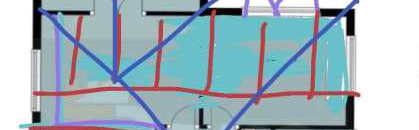
OK, sounds sensible to look at builders' rough costings first for feasibility. But allow a contingency for some remedial works, as I'm pretty sure you will need a beam / long lintel over where these 2 doors are, and a pier left on the outer wall, plus bits and pieces that the builders will exclude. what does this indicate please? the long red line looks here to be a beam with joists sitting on it., but then a big gap with no joists.
-
So...I'm about to do Rainwater Harvesting
saveasteading replied to mike2016's topic in Rainwater, Guttering & SuDS
In my office example above the calculations said use 5m3. I went for 10 which I think was right as it never ran dry. Negligible garden use. I think the ROI on the extra 5m3 would have been very short as it was only the extra tank cost...about £1k? Well done on the exercise. -
So...I'm about to do Rainwater Harvesting
saveasteading replied to mike2016's topic in Rainwater, Guttering & SuDS
Nice to see your calls. From a quick skim. The garden usage looks high. A) perhaps showing a falsely high cost/ potential cost.. b) you would empty the tank in 3 weeks of no rain. Water cost sqm should be cm ? Does waste cost belong here as a cost? You could show the saving due to lower purchase volume perhaps. -
If you take out all of that wall, then you have a double door opening. Joists must be sitting on lintels above the doors if not on the wall you want out. So yes you will need a big lintel. Also, although that wall may not be supporting joists it may be important to the stability of the building in other ways. This is not to be taken lightly. I think it needs building control at the least. The builders should be advising this.
-
So...I'm about to do Rainwater Harvesting
saveasteading replied to mike2016's topic in Rainwater, Guttering & SuDS
That is important with long dry summers becoming more the norm. Excuse me if you've said already, but what capacity? was changing the pump very technical? ie is there justification for a specialist? -
Drain in wrong place. Can this be fixed somehow ?
saveasteading replied to Spinny's topic in Waste & Sewerage
IF. It's best to know. Put some water down and see if it comes through. -
So...I'm about to do Rainwater Harvesting
saveasteading replied to mike2016's topic in Rainwater, Guttering & SuDS
OK. So I specified a rwh for our own office development. Try it on yourself principle before recommending to a client. I forecast a 10 to 13 year return on capital. There were about 30 occupants, us and tenants which is rather different to a house. It paid itself in 4 years, because I hadn't thought about the sewage saving ( sewage quantity is based on water supplied). BUT I haven't included electric supply to the pump, or a replacement pump or future maintenance. Also, the duplicated pipework cost was a guess. Sustainability? How much carbon in manufacture, construction and operation? Hence my logic that you don't do it for a house not connected to the sewer. -
So...I'm about to do Rainwater Harvesting
saveasteading replied to mike2016's topic in Rainwater, Guttering & SuDS
So you don't have a sewage bill. That's half the advantage of a domestic rwh gone. You can put a tank on or in the ground without connecting to the house plumbing. That's my current plan. A 3m3 underground tank is about £400. Plus buts at downpipes for everyday gardening. That should result in little or no bought water for garden or car washing. I'm wondering if an ibc can be buried. £60 for 1m3. -
So...I'm about to do Rainwater Harvesting
saveasteading replied to mike2016's topic in Rainwater, Guttering & SuDS
And put a timer on the pump so it doesn't fill the tank in the night. All more cost though. My philosophy is: If you connect to a foul sewer then rwh may be worth it because you save water and sewage costs. £/m3. I have payback figures for commercial but not domestic. Otherwise the capital and maintenance cost is too much. A replacement pump costs hundreds, and the electric power is a bit of an unknown. Do harvest water for the garden and send the surplus to a pond or soakaway. -
Design 1 is simplest but there is a very big load off the stair trimmer, carrying over to the wall at 2 points. Needs a check. Design 2 also needs support across the gap. SE time.
-
I wasn't aware of that. Can you refer me to it?
-
Perfect energy rating – until he got a heat pump
saveasteading replied to Temp's topic in General Self Build & DIY Discussion
I guess it uses energy so gets a down rating. I've met the people who create these programmes. They didn't understand the real world and their role was to create the system and earn fees....ditto air tests which only they could do for a few years. Mh business rented the breaam programme for a while and we played with it. Lots of anomalies but they wouldn't change them. -
That isn't really a soakaway that would require 5m as the water will drain slowly into the ground and can't wash it away. The amount of water is small and it is spread over the length of the pipe. If I was your Engineer then I would be able to write a letter to satisfy the bco. (subject to knowing and being happy with all the details). Plus, if necessary, you could change the perforated pipe to solid and it is just another drain. Even for a rainwater soakaway pit I got leeway for 4m once, but that depends on the ground.
-
Perfect energy rating – until he got a heat pump
saveasteading replied to Temp's topic in General Self Build & DIY Discussion
Possibly an old version of the program. We built an office block 15 years ago with ashp and got a D, because the program at the time marked us down for using electricity. The very same building, assessed last year got a B because ashps are now 'a good thing'. Very slow learners at BRE but they got there. So do ask them to look for any input errors. It can be ticking the wrong box. -
Are you saying the manhole or soakaway is the issue? Have you lifted the cover? I'd expect to find a pipe in and out. If you push a drain rod along, you should find the soakaway distance. Probably where you guess. It's worth getting a pair of lifting keys as you will be doing this often. If it is a rainwater soakaway then the 5m rule applies, as it is the movement of water in the ground that is the concern If it is a manhole it doesn't. Sounds sortable. More detail please. What's in there? Distance? BUT you say foul soakaway. That would be illegal and so a very nasty thing to have on your land.
-
How much is a stone built outbuilding worth
saveasteading replied to Triassic's topic in Costing & Estimating
how does the neighbour access it, and what is its use. -
I expect it will be this stage. But whatever they say, take photos at every stage...really boring ones showing the whole area and closeups eg the hardcore before dpm ( compacting machine in action or background) and that the dpm is lapped and taped. Keep them safe til sign-off. As a bonus you will likely find yourself referring to some of them later.
-
Eureka. The overflow is leaking as I latterly suspected. Then some of it runs along the angle strengthener to where the photo shows, confusing the issue. So the tank is filling and the inlet is dripping overnight...dry in the day when I have looked before. Access isn't easy but about to venture in. Plan A I think will be to convert all to mains and throw these tanks out. That will be a proper plumber. Only a few appliances run from these tanks.... 2 x wc, and one of our 2 hot water tanks.
-
Yes. The door and the corner. You will need a brick pier or a steel column. FYI, an RSJ (rolled steel joist) is a fairly lightweight category. You will need a UB ( universal beam), probably about 300mm deep. My gut feeling is the cost is about £450. Add column , fabrication erecting, perhaps foundation. £2K? @Gus Potter and the other SEs on here.... could we consider plating a very big timber on that cross wall and flying it across the space to pick up 4 or so joist ends. or bolt a steel channel there? Al joists then parallel to the stair opening.
-
Garage floor paint/resin/epoxy resin
saveasteading replied to BotusBuild's topic in General Flooring
Depends. I've had fancy 2 part stuff in commercial garages, specified by well known marques, and it was great but hideously expensive. For family garage businesses we tried the cheapest floor paint from their trade magazines. Tt wore out eventually along the repeat wheel routes, (thousands of passes) and simply needed a local touch up every 5 years. So it saved them thousands. -
No. And crack? It's in the dark, presumably made for the job, and feels flexible still. It would be a lot of work, especially as my improved loft ladder (one that doesn't disappear under me), restricts access for part sizes. I may check again whether there is any problem when the tank is full. Perhaps a leak from the overflow.It occurs to me that this may have been dribbling for a very long time. I had the other tank leak, sorted it, and didn't look again. Maybe this was always adding to it. It hasn't come through the ceiling in that time, but i think it may have mostly evaporated until yesterday..for who knows what reason. Today it is tamed, i've used a hitech system of a bucket under the dripping point, a hole in the ply deck and a string to encourage it to that hole. No ordinary string though.... a piece of fibre optic cable....that's the hitech bit. What is the pressure relief pipe for? the one that loops over the tank. I know what hey do in hot tanks, spluttering and splashing hot water. Is it the same for cold but more as a precaution than ever really spitting water? As a precaution I could bend the float valve down a tad. Does anyone have a clever method of doing that in situ?
