
saveasteading
-
Posts
10074 -
Joined
-
Last visited
-
Days Won
82
Everything posted by saveasteading
-
`Basements, and the change to B.S.8102
saveasteading replied to Big Jimbo's topic in General Structural Issues
Yes, but that is probably for the best if it prevents poor quality basements being built. On a big site perhaps the earth is disposed of easily. But digging out town earth and dumping it in the countryside is only good for the farmer, and that only in the very short term. I wasn't aware people were using brick or block or eps for it. No wonder they don't work. -
That probably means permanent access. But you wouldn't want to be digging it up again if it is a significant length.
-
`Basements, and the change to B.S.8102
saveasteading replied to Big Jimbo's topic in General Structural Issues
Not that I have read them.. it seems obvious that a new build basement should be waterproof from outside, but that internal measures are allowed to remedy existing leaky basements. Think swimming pool and would you waterproof that on the inside: yes of course. As well as keeping the water entirely where it should be and not keeping the concrete wall and base constantly wet, there is the effect of water pressure on the membrane. The water pressure trying to force the membrane off the wall or onto it. There is always a doubt that BS are not entirely logical, because the committees include proper experts but from companies with a product to sell. Ask me about "Constrado" as an example if anyone is interested. -
You can also hire conveyors to shift the stone if it can't be dumpered. But a tracked excavator won't disappear and could form its own track in. Any reason against a stone access, apart from cost?
-
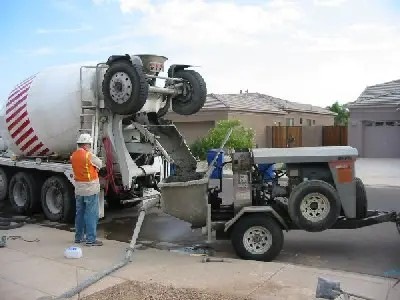
OK, so you are being told to hire a boom pump. A hopper pump will do it.
-
`Basements, and the change to B.S.8102
saveasteading replied to Big Jimbo's topic in General Structural Issues
I didn't know it was ever a principle for a new basement. . Like letting a dam or swimming pool leak but catching the water! It's obvious, but maybe not to the academics changing the codes. I think I've only done one basement, and I had no thought of including a sump, 'just in case'. -
Oops my comment went into the quote box and is etaying there. Also, a concrete pump doesn't have to be a boom, if you can get round the obstructing building. Or bring in 4 barrowers for the occasion.
-
Why do you need a cavity in the foundation? My default is concrete bed then 2 normal blocks. The 2 beds gives more chance to get the lebeks right.
-
Made mine now too. It's what we do on bh, saving the nation millions, £100 at a time.
-
Our project is Nairnish. Invernesshire is huge, so a little more idea of location? NSEW? Mountain high or coast? Etc.
-
So do I but it is 6m x 6m. Take away the 4 corners that it can't reach....
-
Or concrete then epoxy paint, that is done in most commercial garages.
-
I always found that it needed the right current ethos from the merchant , but also the right manager. Example. We had an account with Travis, so approached the branch local to the projuct for blocks. A lot of blocks. We knew the right price but they refused to reduce it. It was cheaper at b &q, delivered. Our base TP also gave a better price by far. We ordered from b and q, and the blocks were delivered by .....local TP, who must have paid b&q a commission. What they were playing at we never found out. Jewsons. Bag of 100 big washers £8. Presumably cost them about £5. Needed more in a hurry and went to another depot. £35 less 10%. I complained and got a full rebate but that was the time to change, to TP as it happened. Then after 6 years to MKM. It really is down to relationships. You don't have to be expert to be treated fairly. My family doing our conversion are not from construction, yet have a great relationship with the local merchant. They will occasionally not quite be cheapest but the service! I was there when they had an error in the timber delivery. They came back in 2 hours with the right stuff. Visit every merchant. Talk to the sales manager, with drawings to prove the project size. Discuss the first order and get quotes. Compare but also look online and ask here.
-
Wind from ASHP on the neighbor's door - barrier?
saveasteading replied to Garald's topic in Air Source Heat Pumps (ASHP)
Genius. Allow plenty of isolation to stop it rattling the walls. -
Put 4 professional estimators to price a fully designed project for 4 specialst contractors and you will get a variation of perhaps 20%. Allow for less well defined design methods, unknown (to them) site conditions and that could typically be another 20% variation. A spreadsheet could be anything from one line. "Provide building as drawn...£250,000", to many hundreds of items. My own project spreadsheet had very broad items such as ....new concrete floor complete 310m2. @ £45, Roof 310m2@ , rainwater drainage 110m.@ Plumbing and heating, sum £60,000 etc. 20 doors @ £200. Etc.. About 100 items. Then add risk. But you have to know what cost to put in each item. Unless you have commercial construction knowledge i think someone elses spreadsheet could give a dangerous sense of security. So, sorry, you can't have mine. Pay someone as above, but even then assume it is very approximate. If you search here for £/m2 guidance you will find a vast range (£1500 /m2 to £4,000/m2. Sometimes a conversion costs more than newbuild. If you can share more specific info on a property then people here might offer guesses at the budget.
-
Is your metal roof noisy?
saveasteading replied to CalvinHobbes's topic in Roofing, Tiling & Slating
Warehouse and retail roofs are noisier because they are very shallow slopes, and so every raindrop clatters hard into it. Also the insulation may be minimal, for an unheated or reduced heat building. Plus the cladding is screwed to the structure and may form thousands of direct links to the inside. Not sure about Lidl except that it won't be top spec. On your house you will have a steeper slope for the cladding, then an air gap, then a board then the structure with insulation. So no problem, but rain on skylights will be noisy. -
You can't take the risk of not getting access permission. Ask the agents about it. Can't tell from the plans. You need a minimum distance line of sight from an entrance, and it depends on speed limit and any obstructions. If the county doesn't permit it, you simply won't get permission.
-
I omitted to say that I was referring to fitting doors and windows supplied by the client, and you fitting only, previously unseen I presume. That, to me, would be high risk, but is what the original question was.
-
What a big IF.
-
Why can't covenants be written in plain and simple English? Because it is often ambiguous. Because it would require ancient documents to be translated, and that increases the chance of confusion. Because such documents are formulaic and avoid missing or confusing an issue. Most importantly, because commas are in short supply.
-
As PD says. It is 3.3 You cant spoil the neighbours rights. Plannning and regs define that anyway. Looks ok. Joining the 2 red lined areas, are you looking at taking the combined area? I would continue to research the plot to confitrm your interest but get that covenant looked at profesionally before committing. A conveyancer would likely give free advice on the promise of the following work.
-
How often do you find a problem that requires a return? And if the doors don't fit. Does your day rate include a proportion of wasted time?
-
Get a highlighter and mark the important bits, that can then be read as a sentence. Then read it again as a sentencd.
-
That should be " not" to deny cover. Never discount the effect of daytime television, "have you had a accident". They will go after all parties hoping for a payoff or more. Your insurer should take the argument off your hands. And as I have said umpteen times...keep a project diary of personnel on site, what they are doing, and anything of note.
-
If anything was to happen on site, it is very likely that you would be involved in any legal proceedings. You must have insurance, then your people can argue with theirs. Your cover must also be comorehensive enough that the insurers first action is to deny cover.

