


saveasteading
-
Posts
11094 -
Joined
-
Last visited
-
Days Won
98
Everything posted by saveasteading
-

New Garage Floor - Lower than my driveway 500mm
saveasteading replied to iSelfBuild's topic in Garage & Cellar Conversions
Unfortunately not. I think you will have to take the foundation down to next door's ground level. -
New Garage Floor - Lower than my driveway 500mm
saveasteading replied to iSelfBuild's topic in Garage & Cellar Conversions
The sketch is perfect. Thd issue is the load of the new building thrusting against the existing retaining wall. Imagine loads spreading at 45 degrees. What is the wall construction? Keeping the gym dry inside will need careful detailing and some cost. Will there be a door at ground level and steps down inside? -
No. You know better than that. Controlled ventilation requires an absence of draughts. Airtight first, ventilation second. Unless the occupants are wearing warm clothing.
-
I suggest first establish what geometry is best. There is no point in having an unpleasant space. Then we look at the best way to build it. Lots of insulation for sure, and draught free.
-
What next for heat pumps after BUS and MCS?
saveasteading replied to joth's topic in Environmental Building Politics
Good idea. Who starts it? It needs either a leader who has the final say on the submission, or a defined group of editors. -
Missing chimney breast in the downstairs flat
saveasteading replied to Kitane's topic in General Structural Issues
Terraced Victorian houses were generally built with regular rooms and one chimney stack serving 2 houses. It is unlikely to be a convoluted stack with different room arrangements. Could well be OK, is a big assumption. -
Does this small shed not lend itself to 'stick build'? Any decent builder or diy'er could do it and it would be customised and probably sturdier.
-
Sustainability or petty mean-ness. you decide.
saveasteading replied to saveasteading's topic in Barn Conversions
To me yes. I think anybody who might be doubtful won't notice unless i point it out, so i won't. Iive learnt a bit about the foibles of these so the next use, on a more important wall, will be improved. -
Sustainability or petty mean-ness. you decide.
saveasteading replied to saveasteading's topic in Barn Conversions
-
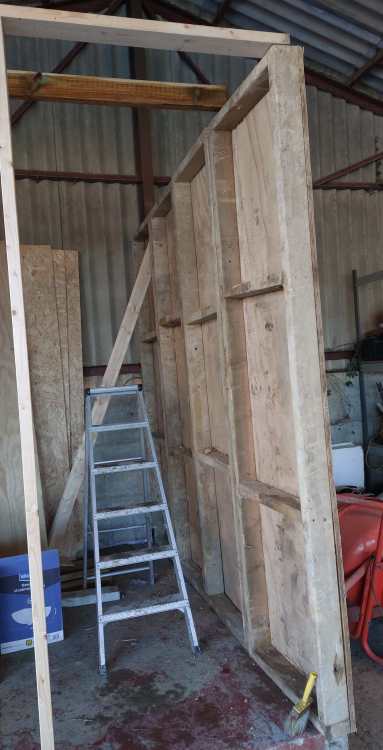
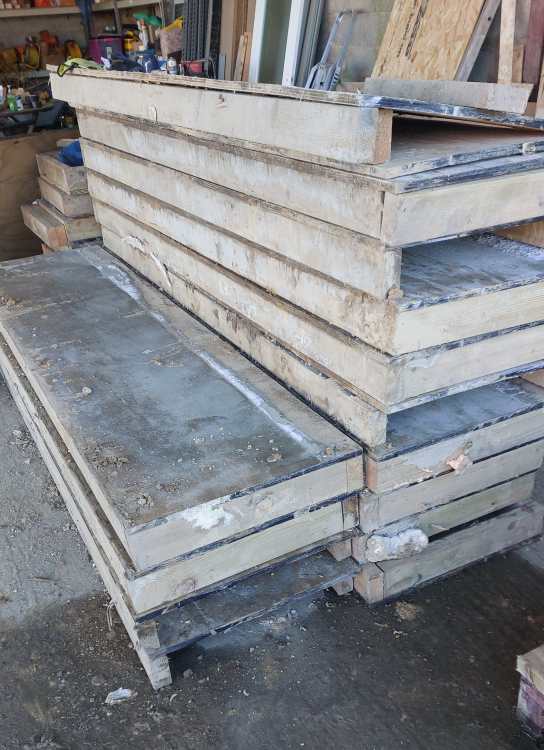
I have been repurposing concrete shutters as timber wall cassettes. We had to do some unexpected work, in removing a perimeter slab edging of insecure blockwork, and pouring a new ring beam in its place. A few £k in the wrong direction. To mitigate this, we made the shutters higher than necessary (could just about have been 400mm, but made them 600). Thus they are mostly half sheets of ply, 2400 x 600, with 4 x 2 framing. The builder understood this and removed the shutters with minimum damage. I have been erecting them as a kit-form enclosure in the garage. I will summarise my own pluses and minuses later. I have pictures and will attach them to a later post direct from the phone, for my own ease. It's obviously better for the world than burning them, and dismantling isn't easy as the screws are well embedded in the ply. They are dirty with mud and concrete too, but most of it will be over-clad in timber or metal. But they are making a rather low quality of wall, so I have dropped my own score from 100% to 80%. Perhaps a proper joiner would do better, but equally wouldn't like working with compromised material.
-
Missing chimney breast in the downstairs flat
saveasteading replied to Kitane's topic in General Structural Issues
Sorry to worry you. But a daughter had a house where the chimney had been removed completely in the rooms but remained in the loft and above. It was not supported in any way other then some bits of wood stuck in gaps in the loft. It had hung on there for many years by the look of it. I had not spotted this before purchase and neither had the surveyor. It hung on simply through the ability of brickwork to cantilever. If the house next door, sharing the chimney stack, did the same then i would likely be disastrous. we built in gallows brackets an all was well. So first look more at where chimneys come out of the roof, and neighboring properties if they are the same model, and talk to the neighbours alongside and below. If you think there has been a chimney removed then don't despair. 1. you haven't committed yet. 2 It may have been removed properly. Doing it properly involves building inspector approval and inspection. Perhaps they can advise. Doing it retrospectively will make a right mess of downstairs, but it is they, or their predecessors who have caused it. Nobody wants the building collapsing, so do not be shy in asking around. If there is a surveyor involved yet, make sure they know your concern. Ask the agent too...they will duck it but it will be on the record. Well done for spotting it. Lets hope it isn't a problem. -
Is that the refrigerant type? So applies to all makes that use it? I have the opportunity to optimise. I'm wondering if locating away from the building a bit, might improve the dispersal of the cooled exhaust, and thus bring in warmer air. Against that we must consider heat losses along the extended route. Perhaps on a plinth as a compromise?
-
That's a worry...not that minus 20 is common. But does it also struggle when approaching that temperature? Do the manufacturers quote their minimum working temperature? Another thought is that a poorly located fan might not be disposing of the cooled air properly, and so the surrounding area gets colder than the ambient? Much less efficient and eventually gives up? I've spoken to a few plumbers on this general subject and they didn't appear to understand. Also I've seen a fan unit tucked into a window recess 'for tidiness' and jammed with leaves behind, despite supposedly having been serviced.
-
Any chance of planning/ideas for use of ground
saveasteading replied to croboy's topic in Planning Permission
You can get your LPA website to post new applications to you. The neighbouring areas too if similar circumstances. Learn from them free of charge. You may even end up being more expert than the experts, but will still need them for their credibility. -
All concrete cracks, and we have to control it. Blocks shrink, so if you use mature, dry blocks, then some of it has been removed already. I would be looking at hollow blocks with bars linking them for the vertical strength controlling the pressure from both sides. But then the inner face is rough and will need coating before waterproofing by whatever means. Surprisingly, there is very little water loss through mosaic tiles in a pool. They are fixed to a concrete base and a wall of concrete or blocks. This assumes high quality construction of course.
-
As well as being rather too fast, I think this is a Greek???? accent plus Scottish touches.
-
Demolishing old external brick wall - post extension
saveasteading replied to Tsst's topic in Demolition
Most things are possible, but the disruption and cost must be considered. -
I look forward to learning how crack control will be handled. Although 'simple' lining doesn't mean cheap. It might be effectively a fibreglass bath built inside the concrere base and block walls.
-
Mice 3 days. Small rats 5 days. Longer but less awful in winter.
-
A "lighting design strategy for biodiversity" :)
saveasteading replied to Alan Ambrose's topic in Planning Permission
It is all that can be done. A future owner might know the ruling, but not care about killing moths or nature at all. But if it is sympathetic from the outset then it is a start. Most people don't change much. -
Porcelain tiles should be laid on concrete, not rubble. Plus they get very slippy when wet. Agreed with the above...that you need 150mm for splashing OR a perimeter drain. But the drain can simply be gravel.
-
Thanks for the extensive research. You may stand down now,. I'd never heard of this but now see that there is lots of this stuff online. I've put a bit of plastic over the area in question, then an extra layer of fibreglass, but will bear this stuff in mind. In lockdown I had a mouse move into the car, in the channel below the windscreen. Anti-Marten spray* would be the business I hesitate to think what is in it that repels rodents.. Reminds me of trying to buy slug pellets in Spain. I asked for bolitas para corocoles. In UK think asking for pellets for snails would be understood. But the guy just stared. 'Contra corrocoles?' ahhhhh si. As I write I am told there is scrabbling in the flat roof area. I can't spray in there. Maybe it needs a third type of poison nearby. Otherwise it has to be traps with chocolate but yeugh, I'm squeamish with impaled mice.
-
Topps Tiles, backing board. There are others like this. Jackoboard. Wedi board. It is much denser, made for under tiles, and it has thermal qualities which the foil would not. And/ or mineral wool in the space below.
-
Subfloor and bricklaying in wet and freezing temps
saveasteading replied to Sunil237's topic in General Construction Issues
Ask your local builders' merchant for a non-woven geotextile membrane. If there is a choice of qualities then tell them the purpose, but it is going to need only middling quality unless you will be driving trucks or buses on it regularly. Terram is the best known name (like Hoover) but there are plenty of other suppliers. Do follow the instructions precisely. The materials should not be too cold, and it is clever, not magic. Whether you should remove the cover to let it breathe is doubtful. Mortar does not get its strength by drying out, but curing into a new material, and needs water for the chemistry. Cement normally takes 30 days to complete its chemical reaction and get the mortar to full strength, and it needs warmth and moisture for those. The additive speeds this all up, but I know no more. Perhaps the instructions say more. -
Subfloor and bricklaying in wet and freezing temps
saveasteading replied to Sunil237's topic in General Construction Issues
3 degrees and rising is the guide for concrete. I've broken this guidance once and it became expensive hardcore....it barely hardened, and then crumbled. The same will happen with mortar. As for the type 1. That shouldn't go down thicker than 150mm per layer and be compacted by roller. I hope you have membrane under it. Compaction over mud would press the stone down into the mud and it would mix if there is no membrane or just rut if there is. Spreading with a tracked machine does not compact it, but is your best compromise for now....and don't run wheeled vehicles over it. An experienced builder should know the basics of all this, buy many don't. They should also expect to lose working days in winter. It's not your responsibility to keep them earning at your risk. It is too important to turn a blind eye. More detail of the hardcore construction?



