markocosic
-
Posts
979 -
Joined
-
Last visited
-
Days Won
1
Everything posted by markocosic
-
Stock stock stock with cool energy. Most of the website is out of stock. Return to base warranty is a joke too. They are a Meccano kit of off the shelf bits so in 10 years they ought to be eminently repairable but it's the timescales that matter. But repairable Vs throwing in a new one off the shelf then fixing/flogging the old one is a different matter. Little monoblocs are like £3k. Most of the cost is installation and cylinder etc. If they go boom in a way that isn't a 5 second fix (e.g. frozen/bust plate, shredded gears in reversing valve or expansion valve) you unbolt and pop a new one on then flog the leftovers for somebody to resurrect at leisure. OTOH if there are skilled fridge people available then even tricky rides can be quick. Friend of mine over here had a noname Chinese split unit (outdoor unit, fridge lines to a hydrobloc thing the size of a fridge that does the gas to water part and has cylinder etc) shred it's expansion valve gears this winter. "No worries, yes it's that widget, we'll vacuum it out, swap it, new dryer and regas, €250" or similar. You don't get that in the UK though hence nervousness about actually fixing something.
-
Fair point!
-
- I guess I think they're a little immoral for continuing to push FGas units. I wouldn't take the first years production of R290 units either. Let somebody else test drive. Therefore unsaleable until 2025. - I've yet to see a performant Mitsi monobloc install beyond the opnenergymonitor folk f**king about a lot to get the things to work well. Probably as much down to their bad design advice (mixing buffers etc) as anything to do with the unit They're robust though; and plenty of them about. Comparing with the "plug and go" of the vaillant setup it seems like only true enthusiasts get the best out of these; and given that they and nine both have well sussed R290 units now why roll the dice? Dad has Mitsi air to air chosen by me FWIW. (as they had a small ceiling cassette to fit between trusses in the upstairs landing) They're all R32 though. And the controls are dog excrement from a usability perspective. Probably wouldn't buy again for the controls alone.
-
Octopus ASHP Quotation info
markocosic replied to lakelandfolk's topic in Air Source Heat Pumps (ASHP)
Yes. They want the option to meter/control from the only location in the dwelling that they as a regulated utility co can contract with. -
Pay £300 for somebody to do the math and advise? (heat geek will do it off visits or plans) You'll not need larger than 35 mm on a unit < 16 kW. You'll not need larger than 28 mm on a unit <8 kW. 22 mm plastic is marginal. splitting 28 copper into 2x 22 mm plastic or 3x 22 mm plastic then running to a 22>15 plastic manifold arrangement fine. Running a single 22 mm pipe for flow/return is unlikely to be ok unless <6kW.
-
Choose based on stock. I wouldn't touch something that wasn't commonly stocked Choose based on heating controls. You probably need load and weather compensation. Cheapo units don't have load compensation etc. That leaves Vaillant, Nibe, Daikin in the UK I think. (the latter only if you pay for upgraded controls and don't mind r32) Samsung don't have heating controls that work. Also all days units still. Ditto the other Asian manufacturers and indeed Stiebel. 300 litre unvented with a big coil. "5" or "7" kW models will give more than this in a mild UK climate and with lowe space heating temperatures. Business partner just did a 7kW vaillant and that's actually 9 kW output at -2 air 45)40c water for example. sCOP for UFHed max 35C unit will be in the 4-4.5 range. Similar effects at occur at higher ambient even at the temperatures. Biggest thing affecting performance will be getting heating controls right. Open zones, balanced, weather compensated etc.
-
Octopus ASHP Quotation info
markocosic replied to lakelandfolk's topic in Air Source Heat Pumps (ASHP)
Think again. Houses are designed for about 1kW distributed demand at the substation. You may get away with drawing 2kW average for each house before the substation pops. Draw 7kW for each house (in an all EV scenario) and you'll quickly end up with 0kW average and the 11kV to 230/415V substation on fire. Or the fuses popped. Heat pumps and EVs will be forcibly sheddable loads in future. It may be that the way they do this - a fair way - is offering dual meters. One is 15p/kWh but not guaranteed/can be shut down. Smart people plug EVs and heat pumps into that. The other is 50p/kWh and never shut down but limited to say 16A. And the third is £1/kWh and never shut down and limited to whatever the fuse will take. Hence running discretionary loads back to the meter cabinet. -
Octopus ASHP Quotation info
markocosic replied to lakelandfolk's topic in Air Source Heat Pumps (ASHP)
The metering - if the utility companies are to get their dirty little hands on it - needs to happen within their meter cabinet. That's why they're running back to the cabinet. The 1970s style emergency load shedding load control is already built into the SMETS2 meters too. (they have control for auxiliary loads via contactors) There will be IoT for "planned" control. "Please reduce your usage" signals. There will be "we pull the plug" for emergency fast grid response. "Rolling blackouts for discretionary loads" signals. It was decided by the industry two to three decades ago when they designed the market structure around smart meters. Doesn't make it right. Does make it the reason for the cable routing you're seeing. Wait for the next thing which will be retrospective legislation to cover the mess they're busy making with EV chargers... -
Octopus ASHP Quotation info
markocosic replied to lakelandfolk's topic in Air Source Heat Pumps (ASHP)
There's good sense in submetering. They as a retailer must buy according to your "nominal" load profile. They as a retailer supplying "electricity" must do so with 100% availability. If they do submeter and have near real time load shedding capability then they're allowed to contract for less than 100% availability and they'd be allowed to buy at the "actual" load profile of that meter point in the marketplace. This would be cheaper. No heat pump leccy 4-7pm in winter? Why absolutely sign here and they'll split the savings. -
Octopus ASHP Quotation info
markocosic replied to lakelandfolk's topic in Air Source Heat Pumps (ASHP)
That doesn't explain why "it can't be done" is given as a response to feeding from an RCBO though. Quote blind. Offer to allow third party cylinders etc. But refuse to use a way in a CU? They're absolutely provisioning to submeter these at a later date; at the only location within the dwelling that they're permitted to install utility company infrastructure. And they're lying to you if there they say that hat pumps can't be fed from a CU. Not a reason not to take up the offer. But not the truth. 😉 -
Octopus ASHP Quotation info
markocosic replied to lakelandfolk's topic in Air Source Heat Pumps (ASHP)
Yes. They'll be making provision for a second meter at the meter cupboard, with a separate tariff, and a separate "Quality of Service" guarantee though. You'll get advance notice to use whatever controller you like to switch the unit down gracefully...and the kill switch if you don't. Or perhaps just separate fiscal metering. Either way this is why they're insistent on powering from the meter cupboard. 😉 -
Octopus ASHP Quotation info
markocosic replied to lakelandfolk's topic in Air Source Heat Pumps (ASHP)
You'll be better off replacing this, using 1/3rd of the PV to heat it via the heat pump, and being paid to export the rest. And you'll have to replace it if you want the BUS as it's a condition that the heating AND hot water are supplied by the heat pump for this. Replacing an OSO with a 200 litre slimline cylinder is a backwards step though. The joule cylinder is naff, insulation wise, compared with your OSO. It's also small at 200 litres. (if you're expecting efficient hot water production by storing at lower temperature than you would with direct electric) They're advising a sCOP of 4 in the letter. You're not getting that with that heat pump and a 50C design temperature and a small cylinder. 3.5 at best. You're responsible for all the real fiddly work here too (making good). The maintenance package will be a waste of time. I see nothing about the antifreeze method in there or where they'll be putting the main iso valves and drain down points etc. Personally I'd avoid glycol in a home that's regularly inhabited in an area where the electricity is reliable. I doubt you'll find any MCS ticketed installers offering it for less though. They're keeping cost effective smaller outfits out of the game by making it too difficult to comply with all the BUS paperwork; with the BUS being too big an amount for them to compete on an offering that doesn't have BUS support. -
Octopus ASHP Quotation info
markocosic replied to lakelandfolk's topic in Air Source Heat Pumps (ASHP)
Agree. MCS worksheet massively overestimates ventilation rate too. It's likely that real world *average# ventilation rate for bathroom will be less than 3 ACH. So existing is fine. -
Octopus ASHP Quotation info
markocosic replied to lakelandfolk's topic in Air Source Heat Pumps (ASHP)
They're dishonest little toads. They *can* use an RCBO from the existing CU. They want to bring it all the way back to the meter cupboard such that l later then have the option to sell you a utility company owner widget, installed in your meter cupboard, that can cut forcibly the supply to the heat pump at times of peak use etc - whilst leaving the rest of the house untouched. They won't tell you this openly though. Instead they'll lie about being unable to use the RCBO. -
Another ASHP flow and return question
markocosic replied to Mr Blobby's topic in Other Heating Systems
Through wall in 28 mm copper for <10 kW. You'd core through larger (say 70-80 mm), lag the pipes through the hole with the watertight/airtight lagging, then foam between the lagging and the masonry. -
If "displace some oil with cheaper lower co2 space heating" is the objective then A2A. If "replace all oil use including winter dhw with lower co2 and fit a decently sized hot water cylinder/heat battery whilst at it" then A2W. Once is a temporary cost reduction/co2 reduction exercise until the existing setup goes bang and you must replace. It makes use of the existing setup whilst there's life in it so that it needs to do less. The other is what you'd replace it with; that also ensures more even heat distribution to the balance of the property and ditches the liability of oil tanks and associated crapsicles. Say 15,000 kWh heat demand. (I doubt it's as high as 2000 litres of oil at 80+% efficiency; boilers usually more pants than you think and controls usually more pants than you'd want) COP 3.5 £0.30/kWh long term £1285/yr in leccy Some will usefully come from PV but let's ignore that. £0.085/kWh marginal rate. 225000 kWh over 15 years adds about £0.005 per £1000 of capex. £0.13-0.15/kWh all in is about right. COP dominates so worth spending on the hydronic installation to improve that. 4 with rads usually doable. 4.5+ difficult. Possibly worth entertaining an A2A today that then gets supplemented by an undersized heat pump later, which can use existing rads to provide heat to hard to reach rooms (where a single minisplit can't distribute to) and a new cylinder to bring down install costs Vs swapping all rads. Not disagreeing with your logic...I have a 15 year old combi and a A2A for similar cheapskate reasons...but the heat distribution does suck and the draughts do suck and two controls suck and it is noisy vs low temperature radiator based heating. But I'm cheap so have it. 😉
-
A2A + A2W ASHP or a more powerful A2W ASHP?
markocosic replied to puntloos's topic in Air Source Heat Pumps (ASHP)
A2W for underfloor; hot water, and chilled ceilings via plasterboard? https://www.variotherm.com/en/products/modular-wall-heatingcooling.html No noise at all. The premium option. 😉 The SEASONAL average COP of the solutions is not so different. You wouldn't be lifting above 35 degC in heating season so 4.5ish nominal seasonal average COP for A2W https://midsummerwholesale.co.uk/buy/mitsubishi-heat-pumps/mitsubishi-ecodan-5kw-ashp https://www.theheatpumpwarehouse.co.uk/shop/heat-pumps/air-source-heat-pumps/vaillant-arotherm-plus-5kw/ I wouldn't go with an R32 or R454 A2W heat pump these days. R290 all the way. Mitsi, Pana, and Samsung are all a couple of years behind the curve on R290. Launching "this year" at ISH 2023 but unlikely to be in stock until 2024. Vaillant, Nibe, etc al are your best bet. If budget allows I'd pop in a ground source unit. 6 kW of heating / cooling / hot water sat under the kitchen sink on in a (genuinely) refrigerator sized unit: https://electrek.co/2023/03/25/award-winning-apartment-heat-pump/ https://www.qvantum.com/ISH23/GSHPM https://www.qvantum.com/ISH23/GSHP These are going to be all the rage in newbuild apartments in the not too distant future so availability of "low energy house" sized units should start getting good. And you're recharging your ground loop in summer somewhat by dumping heat into it. In the meantime chuck a cheap A2W at the problem? Depends on timescales I guess. -
TL;DR is too short @Iceverge Agree throwing in an A2A unit for baseload heat to reduce oil use is something that ought to have been done years ago. That doesn't help you with hot water though. And seasonal COP will not be as bad for the ASHP as it is at peak condition. And you can drop the peak flow temperature (you'll have to) by narrowing the DeltaT - going form 60/45 to 55/50. A system peaking at 55C will have a seasonal average COP of around 3.5; it'll do the hot water too; the heat will be distributed more evenly, and it'll last more like 15 years. https://midsummerwholesale.co.uk/buy/samsung-heat-pumps/samsung-stealth-12-heat-pump https://midsummerwholesale.co.uk/buy/vaillant-heat-pumps/vaillant-arotherm-plus-12kw Run those figures against an A2A with immersion hot water - and factor in oil boiler and tank maintenance/replacement allowance - and I don't think it's as TL;DR clear cut. A2A wins in the very short term. A2W has it's attractions in the longer term.
-
Those speed fit type conduits aren't made for pipe to be pushed through in situ. You'll get a 15 mm pipe through a 25 mm MDPE though. The gas folks shove plastic pipe through rough old iron pipe. First slice the pipe at a VERY shallow angle. You're trying to create a "lead in" or taper about 1 foot long. Slide off the end such that it isn't a sharp point. Then silicone grease up the outside. Then shove. Twist when it gets stuck. That'll move the "tip" out of any groove that it's stuck in / orient it in a direction that it's more flexible for getting around a corner.
-
Answering my own question in part: https://www.sedal.com/pdfs/Sedal Catalogue 2019.pdf IKEA kitchen tap is 08SN35S0003 EN-35 S/D "TOP DUE" is "16 dB" A "premium" cartridge with a "soft stop" at half lift SN-35 S/D "ENDURA" is "20 dB" A "standard" cartridge EN-35 S/D "ENDURA COLD MIRROR DUE" is "24.5dB" A "standard" cartridge with a "soft stop" at half lift AND "centre = cold" layout That'll (partly) explain the IKEA basin mixer being noisier than the kitchen tap. I don't believe the absolute numbers though - sounds much louder than that! Where the heck you buy these / how you're supposed to know about thee remains a mystery.
-
I have noticed that mixer taps vary in how quiet they are - especially at lower flowrate when the valve is reducing the flow. They are all "standard" 35 mm mixer cartridges. Is there such a thing as a noisy one and a quiet one; or is most of the flow noise more about how the cartridge is mounted in the tap itself?
-
ASHP to do hot water and a bit of space heat? Does that not move the payback numbers? If you have UVC anyway getting one with a big coil is not much of a delta. Space heat is pipe the thing into the UFH with a 3-port valve to switch between it and space heat. +£3.5k vs Willis not €6k? https://midsummerwholesale.co.uk/buy/vaillant-heat-pumps/vaillant-arotherm-plus-5kw
-
Double plasterboard all the way. Cheap as chips and will sound better. Kitchens use hanging rails for units and mount to studs. Also with glue. 9 mm OSB is only useful as a "washer" for better spreading load from plasterboard fixings. Useful but not with the hassle.
-
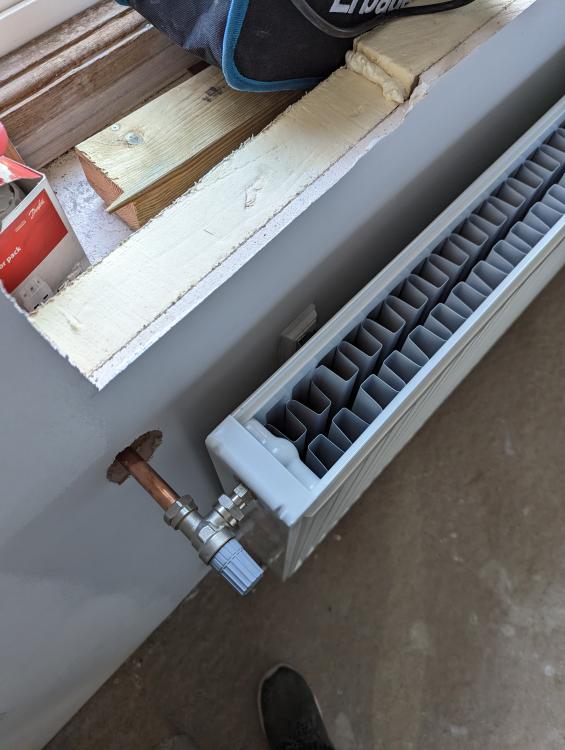
Glue a piece of wood to the face of the plasterboard with some goo: Glue and a screw. https://www.soudal.co.uk/diy/products/fix-all/fix-all/fix-all-turbo That will carry all shear loads AND any torsional loadings on the fastener that "wiggle it in the hole" and make it loose over time. Then clamp the wood to the plasterboard using your choice of "drill a bighole and wedge a thingamy behind it then screw into the thingamy. This will prevent the wood from peeling away from the plasterboard. (a pure tension fixing) You'll only need one at the top generally. That's how you hang huffing great 1600 x 700 T22 rads on plasterboard without them falling off when they're supplied with two brackets only. 🙂 Not my boarding but shows the idea: If you need to use one of those "wedge a thingy behind shove a screw in it fixings you can do worse than gobbing some carberfix style PU bubble glue on the fixing before fitting it. That'll then stick to the back of the plasterboard and you can remove / replace the screw later. 🙂
-
Is my Vaillant ecoTEC working properly?
markocosic replied to PiMike's topic in Boilers & Hot Water Tanks
Nice work 🙂 Presumably: Analogue = proportional control for room influence 2-point = PWM control for room influence That could be code leftover from the days of boilers that fired at a fixed rate or one of a handful or rates rather than fully modulating?