NCXo82ike
-
Posts
76 -
Joined
-
Last visited
-
Days Won
1
Everything posted by NCXo82ike
-
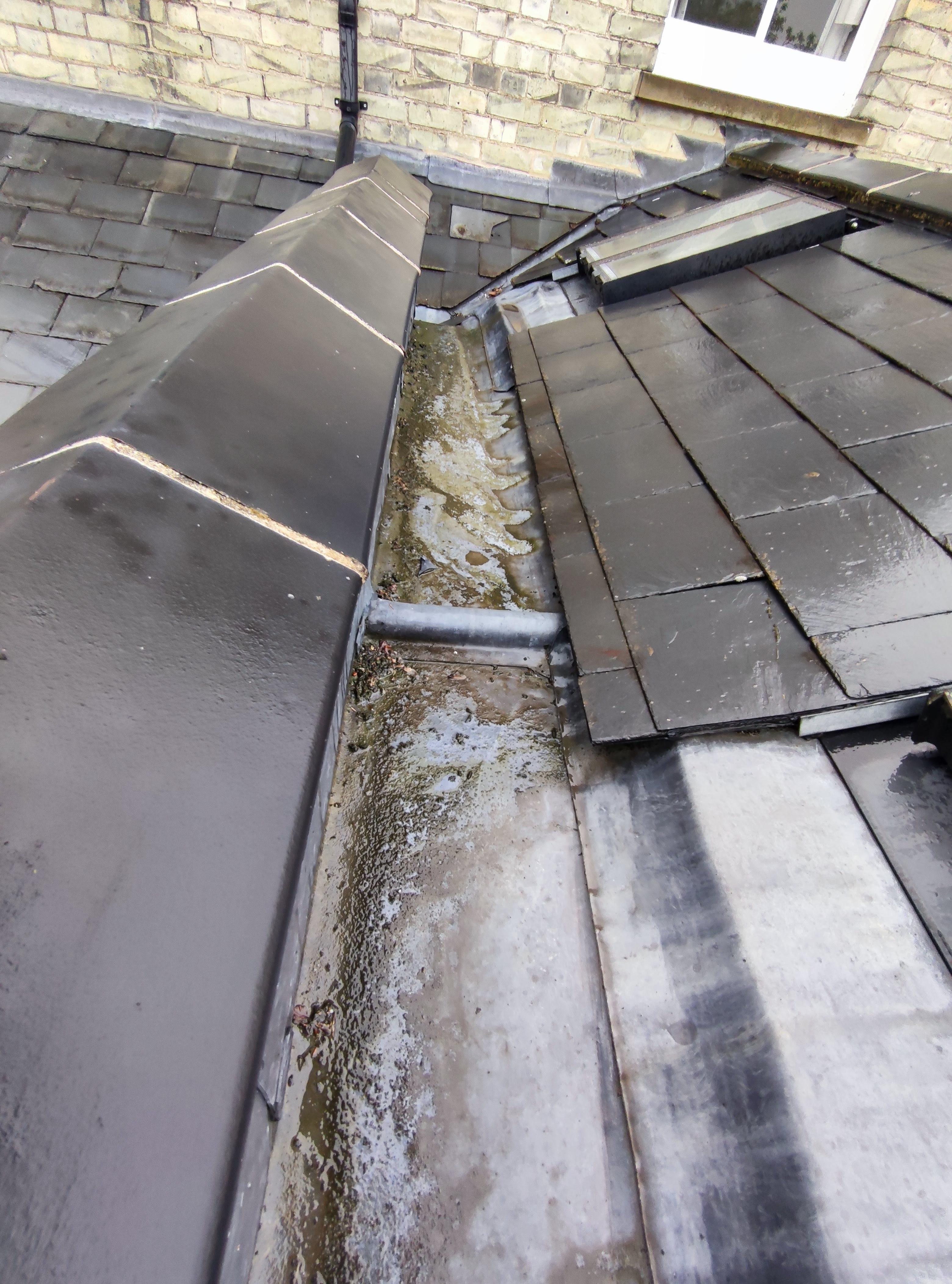
Hi, I couldn't find an answer to this by searching but suspect BH may have good advice. We're planning a wraparound extension and L-shaped dormer to a mid-terrace house (as attached) and I want to pre-empt future roof access. I don't want to rely on the neighbours' side return for access. A future owner will inevitably build there. For the neighbours' amenity, planning will only let us have a pitched roof on the wrapround extension rather than flat, insisting on a pitched design. We need to maximise internal height relative to the allowed party wall height and probably will have a box/hidden gutter here. The left slope is 25 degrees, the right 9.5. Roofing will be EPDM or GRP. We'll have skylights in the extension, one in the loft above the (otherwise very dingy) stairwell, and perhaps one in the bathroom on the outrigger of the loft (although I'm concerned about solar gain from this). The front access of the house is 6m to the soffit with a 35 degree roof- this could be used to access the loft skylight but the rear loft window would still be a problem. I want to make sure we can clean the extension skylights, 3x 1st floor windows, 2x loft windows and 1(/2)x loft skylight. I also want to consider roof maintenance and gutter cleaning. There's a chance I'll get solar panels put on the loft too, also needed cleaning. I spoke to some window cleaners who seemed very gung who about this but I'm concerned they might actually struggle. And other trades with heavier tools/materials might think differently. Grateful for thoughts on the following please: Does anyone ever build in treads to a roof e.g. GRP, to allow walking along a slope as we have on the left, or even some sort of lugs a ladder could be braced against? Would an opening skylight in the loft bathroom be the most sensible way to clean the loft skylight(s)? Is there a value to pre-installing something high up that a ladder can be secured too- like a eyelet/attachment point. Am I just underestimating other people's ability to work at heights?
.thumb.png.fb3b63aceef6a407a9f2b5cc46cd2e12.png)
-
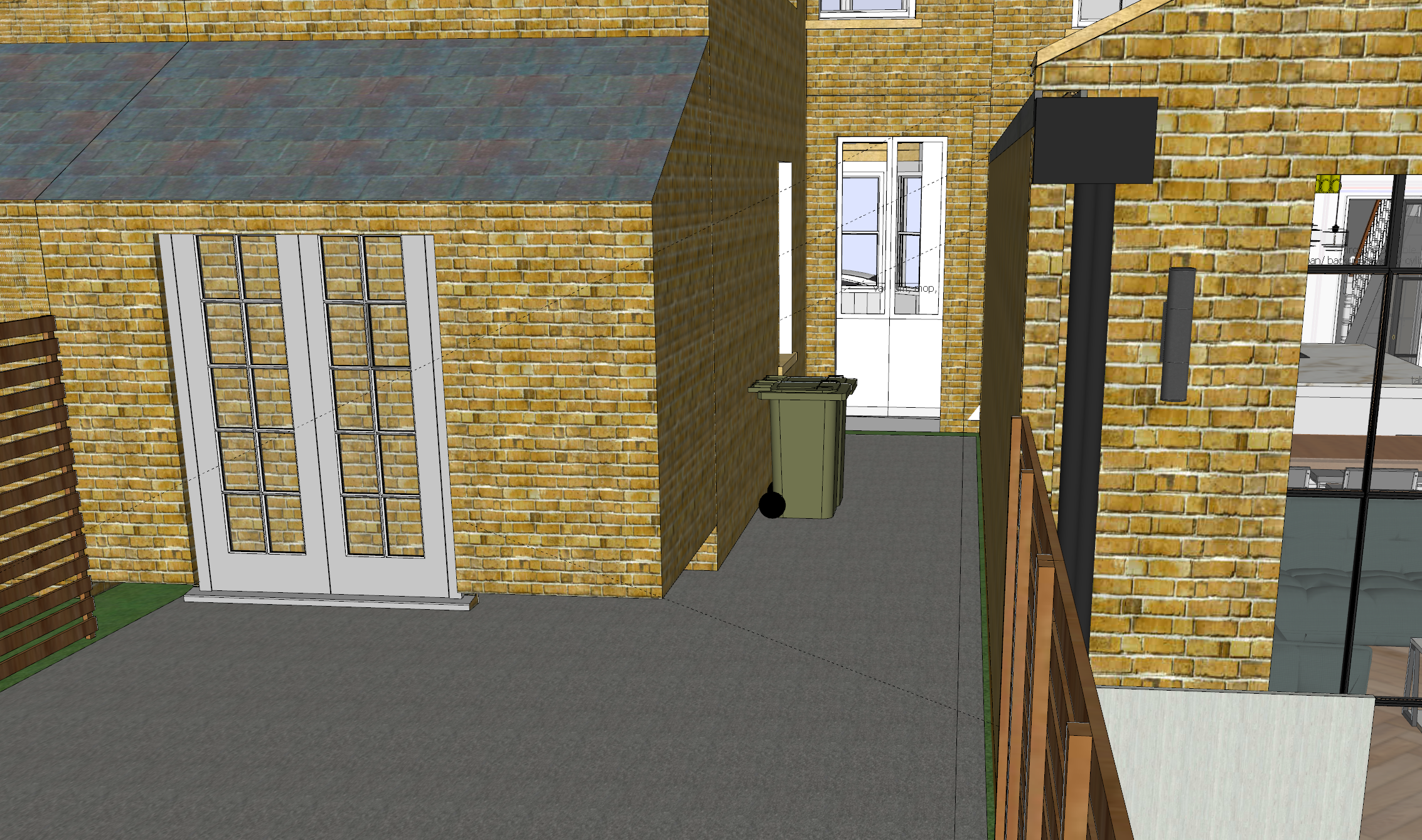
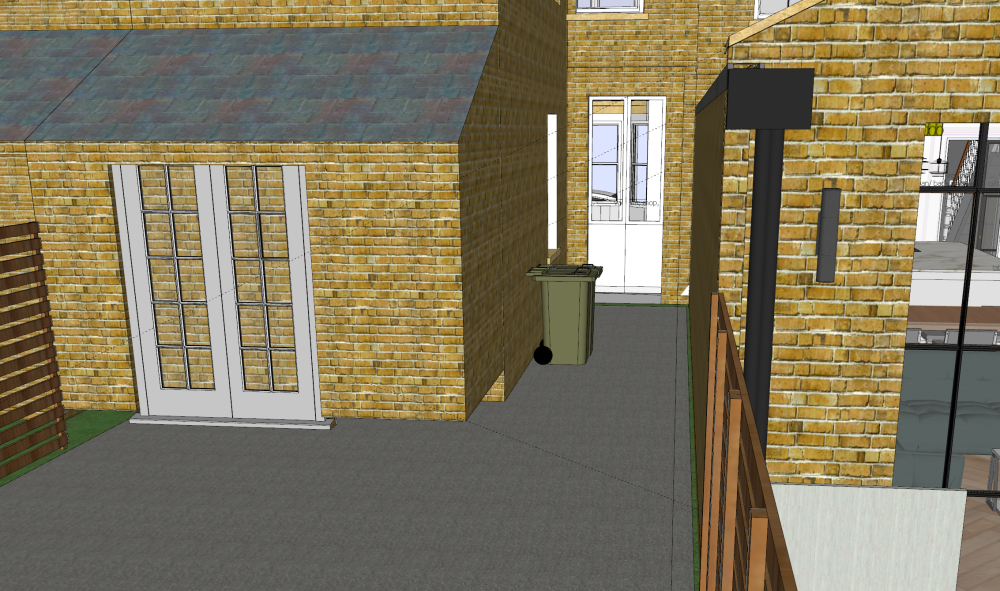
Are you trying to get this done under permitted development? I've not looked again at PD rules: they're online or someone else here will likely know. We just had a pre-application meeting with planning to discuss an extension after a previous refusal based partly on the boundary wall. This will be a wraparound extension with a wall on the boundary of 10m, on the right of the image. We quoted precedent from a property on the street who used a 25 degree angle from the breakfast room window facing the extension (above wheelie bin). The planning team indicated this should be ok for us too (but we're waiting on the report). They didn't make any reference to the neighbours' French doors from a dining room (middle of image) nor the kitchen patio doors (left of image).
-
Fan Coil Units for use with a (cooling) ASHP
NCXo82ike replied to ProDave's topic in Air Source Heat Pumps (ASHP)
I'm early on looking into this cooling. Planning to cool UFH at ~15 and fancoils at 7-8, so running at 2 temperatures. It looks like the Daikin Altherma 3 all-in-one can do bizone heating at different temperatures- so presumably could do bizone cooling too? This would avoid the need for a buffer. -
I think it would be lower energy per time, but would need to run constantly for frost protection. So would probably end up using more? Ultimately if the electric version was pricey, it could stay buried and never used without issue- not the case with wet UFH.
-
The gate sounds like an interesting application. Out of interest, was the track installed to allow for drainage or do you have pooling and freezing water?
-
Thanks, that US context is helpful. The maths is very much an estimate- it's a highball for the energy to heat up that volume of concrete, but doesn't include leakage. I'm assuming sideways would be limited and downwards leakage would be little if there was s small depth of rigid insulation, since the the temperature delta will only be small. I've just found Warmup have some 'snow melting cable' products. They spec 300w/m2 to cover down to -20C. To clarify I was thinking of using a short burst in the morning rather than all day, since I think the main issue is frost overnight i.e. frozen condensation rather than trying to melt built up snow. Snow's no bother, unless it melts and freezes in place. I wonder how high above freezing you'd need to get to and for how long. I understand this might seem ridiculous. For context I'm energy-stingy (currently 16C indoors!) and aiming to be green (ASHP, batteries etc) If the energy consumption is small & green (or even from home own solar), then this might be fun project. If it used large amounts or dirty energy then it would be silly, even if cost weren't an issue (which it is!).
-
Agreed rock salt is certainly suitable and sensible- this is a bit of a what if question. You can buy outdoor electric heating wires, and I wonder what there is to break on the mats, which are essentially just a high resistance wire? The controls would be inside
-
I have a 3m long 1m wide path leading to my house needing a refurb. I slipped on ice on it and smashed up my phone the other day, so got to wondering how hard it would be to avoid this- particularly for kids or elderly relatives. We're in a conservation area, Victorian, mid-terrace. The refurb will probably be flat fired tiles in keeping with the street. We're in the south east so temperatures dip just below freezing, mainly overnight only and not that frequently. I plan to relay tiles with better fall to reduce standing water. I could very easily set an underfloor heating mat with a thermometer into the mortar, perhaps even over a thin insulation layer. I'd plan to set a cycle to heat in the early morning to get up to temperature and then shut off, and have the smart home setup to get granular control. Working off 3x1m and a 5cm thickness, I reckon I'll need <0.1KwH to raise the temperature by a degree. Even on a cold day that would be 14p to raise the temperature from -4 to +1 , and on many days it would need even less heat. So I'd guess it would only cost £10 a year, and on a variable tariff +/- home battery it would be even less. Upfront cost would be minimal. Certainly cheaper than a new phone or hip. At first thought it seemed ridiculous but I'm now wondering why not? 1) Interested to know what people's thoughts are. 2) I can't find a thermostat to buy online which targets less than 5 degrees (obviously sensible in typical indoor installs). Does such a thing exist?
-
Still waiting on planning permission... But still planning on installing the ducting in the chimney at the front of the house.
-
So Vaillant have basically told me that at a distances between 3 and 25m, the distance between the indoor and outdoor units doesn't affect sCOP: ___________ Enquiry: Please can you help with some technical data for the Arotherm split air source heat pump series. I want to install one in my garden as far as possible from the house. Can you send me some data for efficiency losses and performance relative to the distance between the indoor and outdoor units i.e. based on the length of the refrigerant pipework? _______________ From Vaillant: The units performance and efficiency is related to many variables, but important one to take on board are the length runs of refrigerant between outdoor & indoor units. Please adhere to below suggestions for normal efficiency and performance. Please also refer to section 5 Hydraulics unit, page 68 with two tables indicating outdoor unit above the indoor unit and indoor unit above outdoor unit. The unit does come pre-charged with enough refrigerant for a 15m pipe run. If the pipe run is greater than 15m, up to 25m, an extra 30g is added per meter for the small units (VWL 35/5 & VWL 55/5) or 70g is added per meter for the larger units (VWL 75/5, VWL 105/5 & VWL 125/5). For anything above 25m, and extra 47g is added (per meter), for the VWL 35/5 & VWL 55/5, 107g (per meter) for the VWL 75/5 & 83g (per meter) for the VWL 105/5 and VWL 125/5. _____________ From me: Hi, thanks for your reply. I had read section 5 of the installer manual and I'm afraid it still doesn't answer my question. https://www.vaillant.co.uk/downloads/aproducts/renewables-1/arotherm-split-1/vaillant-arotherm-split-1-0-lr-1454128.pdf <page 5 Can you tell me if the technical datasheet above quotes sCOP measured with a particular distance between the units? Has this been measured at the distance of 25m and can Vaillant estimate the change to the sCOP? For example for the 7kw model. ______ From Vaillant: Thank you for your email. As specified on the table: Measured at water temperature 35 deg, and distance between 3 to 25 meters for the Arotherm Plus 7kW unit the sCOP is 4.56. If you adhere to suggestions in my previous email then sCOP should not be affected. If you require any further assistance please reply directly to this E-Mail or call our Aftersales team on 0330 102 8570 for Commercial enquires or 0330 100 3540 for Renewables enquiries. Kind Regards,
-
Amazing, thank you.
-
Thanks @Temp that's clarified it. I had assumed it all came under rear extension given that it's within the existing with of the house. But interesting to note your first example- that does show that a 3m high 10m long wall could theoretically fall under permitted development. Can you share the source for those illustrations please?
-
I've read more detail now about wraparounds and nearly never being allowed under PD- my mistake. However I wonder if you have any thoughts on my question in principle, outside of this specific case?
-
Thanks all, genuinely appreciate the thoughts. Anyone ever seen a data sheet for the split units? Edit: I've just sent an enquiry to Vaillant to see if they have this data for their Arotherm split units.
-
Hi all, I'm just about to get a refusal on a mid-terrace wraparound extension and want to figure out the details ready to appeal. This is in a conservation area and local planners therefore require planning permission. This will extend to 10m total length- no more than 3m beyond the original rear. The side return of each house is 1.8m- so the neighbours on one side would have a 10m wall running 1.8m from their house. They, understandably, would rather keep the (scrappy) fence, noting they can't afford any building work. We've designed a chamfer so the wall is ~2.6m and slopes sharply up to a flat green roof ~0.6m from the boundary. My understanding is that with eaves under 3m and rear extension no more than 3m from the original rear of the house this would be eligible for PD. The planners think this doesn't provide enough relief to concerns about it overbearing the neighbours (who objected, but would object to any wall there). Funnily enough the planner told me there hasn't even been a conservation area report for our application. Other similar and larger ground floor proposals have explicit comments saying there isn't a conservation concern. If I understand correctly, anywhere outside of a conservation area the proposal would be automatically be considered acceptable. Surely the purpose of using Article 4s to restrict PD using Article 4s is to ensure conservation isn't compromised? My key question is this: why is neighbours' amenity considered differently (i.e. given additional weight) in a conservation area? Is there any legal basis for this?
-
Hope this isn't hijacking the thread- related question I think. I'm in a similar situation in a mid-terrace house. The water cylinder and "hub" of the heating setup will be under the stairs. The kitchen will be 10m behind this, and the heat pump will be at least another 8m into the garden. Ideally I'll push it right to the far end of the garden at 30m from the plumbing hub. The site is near-flat with ground level at the end of the garden 1m in ground level below that at the staircase. Are there any stats for how much the distance effects the ASHP efficiency? It'll be a trade-off between aesthestics vs installation cost and efficiency- but I don't know how much weight to put on the efficiency. I've not been able to find this online. Vaillant Arotherm splits have a max distance of 25m, The Daikin Altherma can do 30m, and the Panasonic units quote 40m.
-
Panasonic ASHP for heating and cooling
NCXo82ike replied to Mr Blobby's topic in Other Heating Systems
Sorry if I'm just stating something obvious here- I'm quite new to this. Just wondering if in the heating setup you've outlined with a 45,25 supply to the comfopost and UFH respectively, are you not heating the whole buffer tank to a greater temperature than your UFH would need and then blending the temperature down, dropping your COP on the whole heating setup for the sake of the additional comfopost heat? I guess the reverse is also true for cooling, but in my mind the comfopost would do a greater proportion of cooling that of heating. I've not done the sums yet and that would naturally vary between installations. -
Panasonic ASHP for heating and cooling
NCXo82ike replied to Mr Blobby's topic in Other Heating Systems
This is a really helpful thread and hoping I can learn from the experiences of people on here. Planning an extensive refurb/rebuild of a place with insulation, ASHP, and MVHR. In addition to UFH (certainly on the ground floor, likely upstairs), I'm keen to install a Comfopost, primarily for a little cooling on the hottest days. It's also great to see that you can have different flow temperatures between the Comfopost and UFH, since I was concerned I'd be running the Comfopost at minimal output to avoid dew point in the UFH system. This may be a silly question, but is there any reason why the Comfopost would require a Zehnder MVHR? Or could the supply from another MVHR e.g. Vent-Axia be run too the Comfopost, through a Comfowell, and then distributed? -
We're looking at installing an ASHP as part of a major house renovation. Our place is mid-terrace with a plot width of just under 5m. Further along the street our neighbours have just dropped their plan for an ASHP as they were told it had to be 1m from any boundary. My reading of https://www.planningportal.co.uk/permission/common-projects/heat-pumps/planning-permission-air-source-heat-pump is that the 1m restriction is a condition for permitted development. Can anyone confirm that if we put it in the planning application, we can site the ASHP as close to the boundary as airflow allows? As part of the work we will aim to replace the tired panel and concrete post fence with a brick wall. Many thanks.
-
Exposed brick is a nice option which segments an otherwise 10*5m box. There are probably varied thoughts on heat pumps. I calculate we'll save a little money over a 7 year horizon Vs mains gas, but only a little. The main rationale is having a decarbonised house ready for the (near) future. I don't want to spend £££ on refitting a whole house and not achieve that. I do appreciate the quality of the work next door and wouldn't rule out copying the style. @joe90 this is the solution I'll be pushing for.
-
Thanks- I will.
-
@BramcoI'm pretty sure it's an original build, solid brick wall. @Joe with a beam and block floor level with the existing house and an extensive or wildflower flat roof, we should achieve 2.4-2.5m of ceiling height. Their water crosses the boundary at essentially the level of our proposed ceiling. Thanks again for the answers.
-
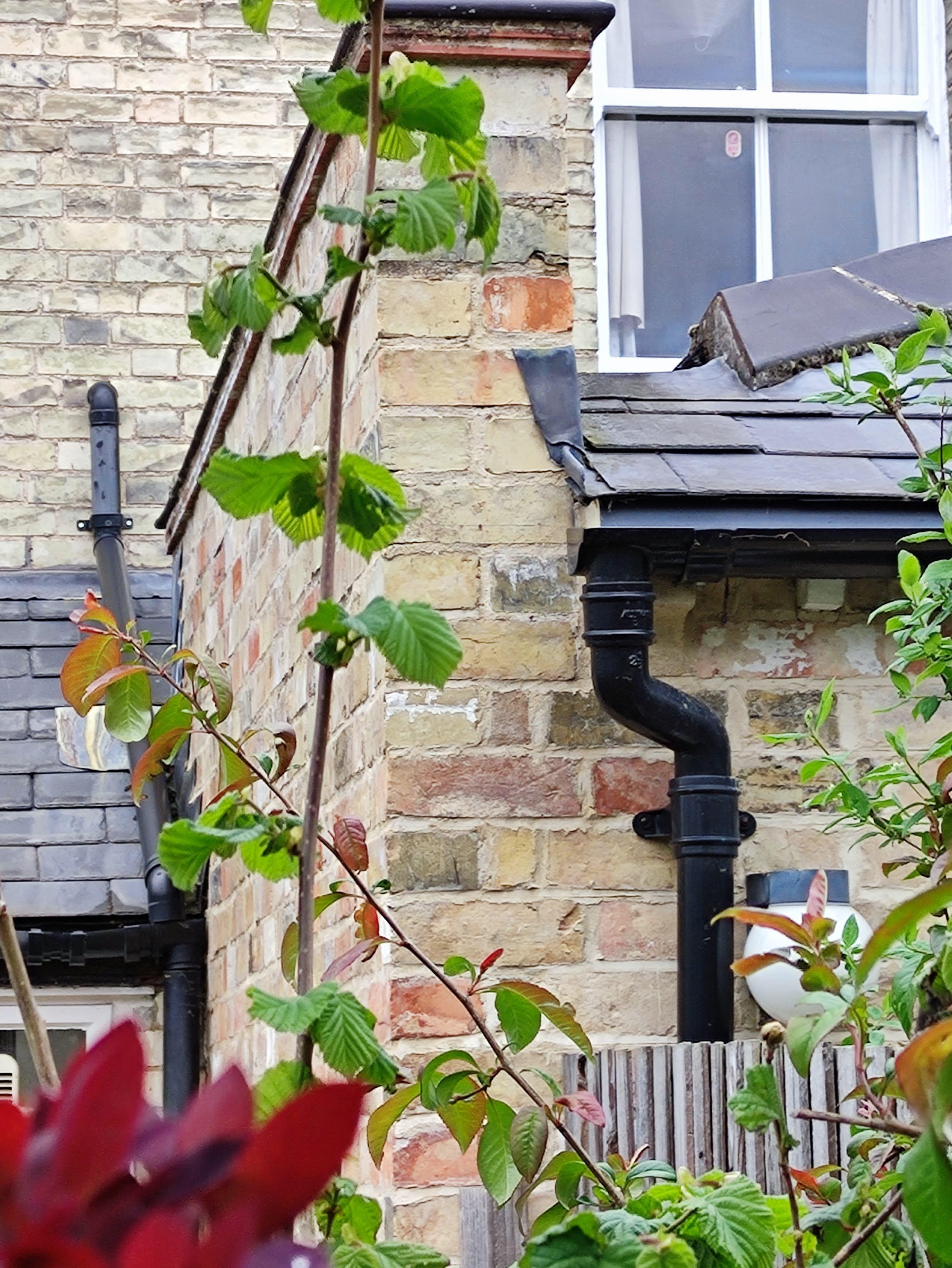
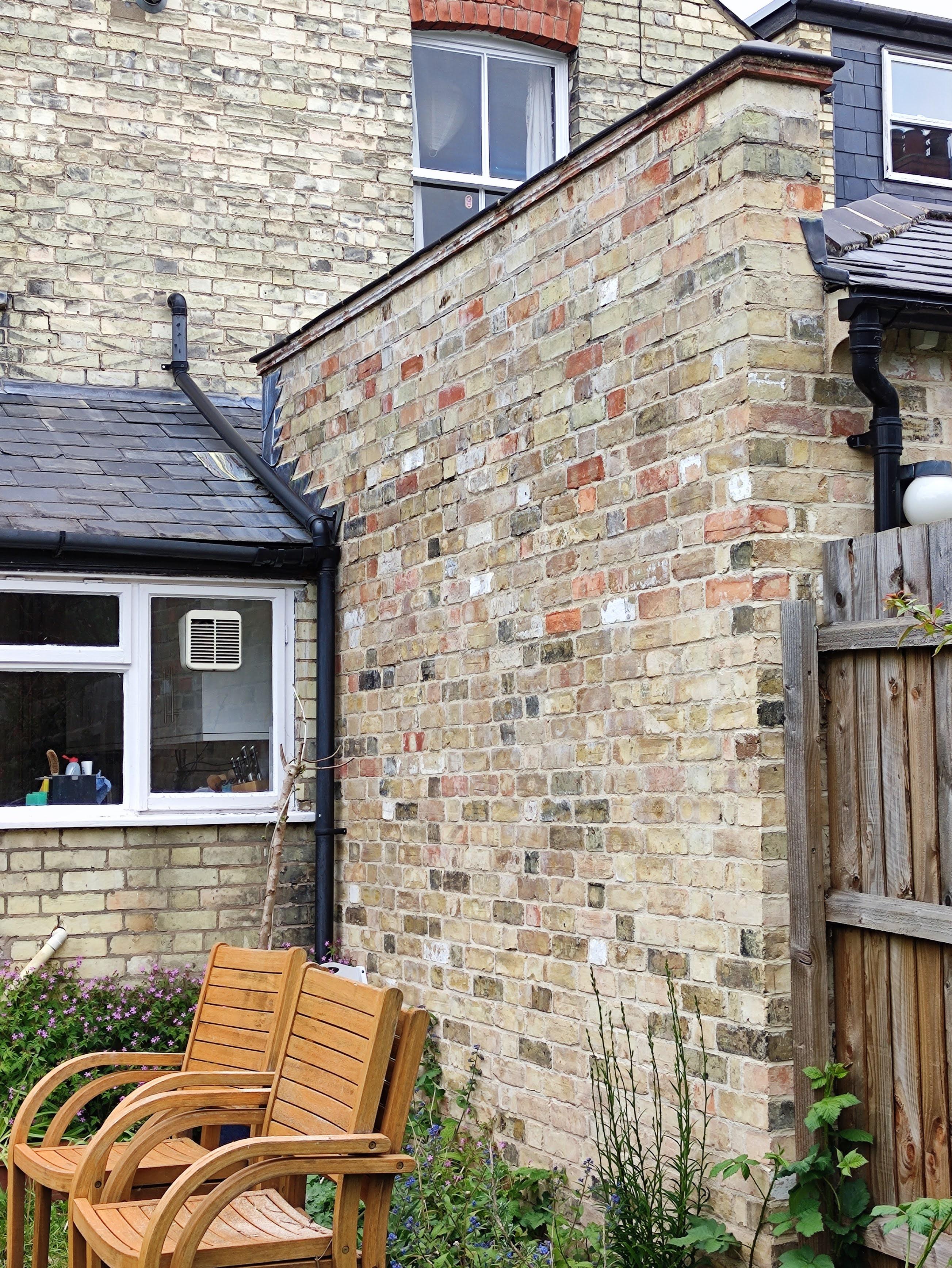
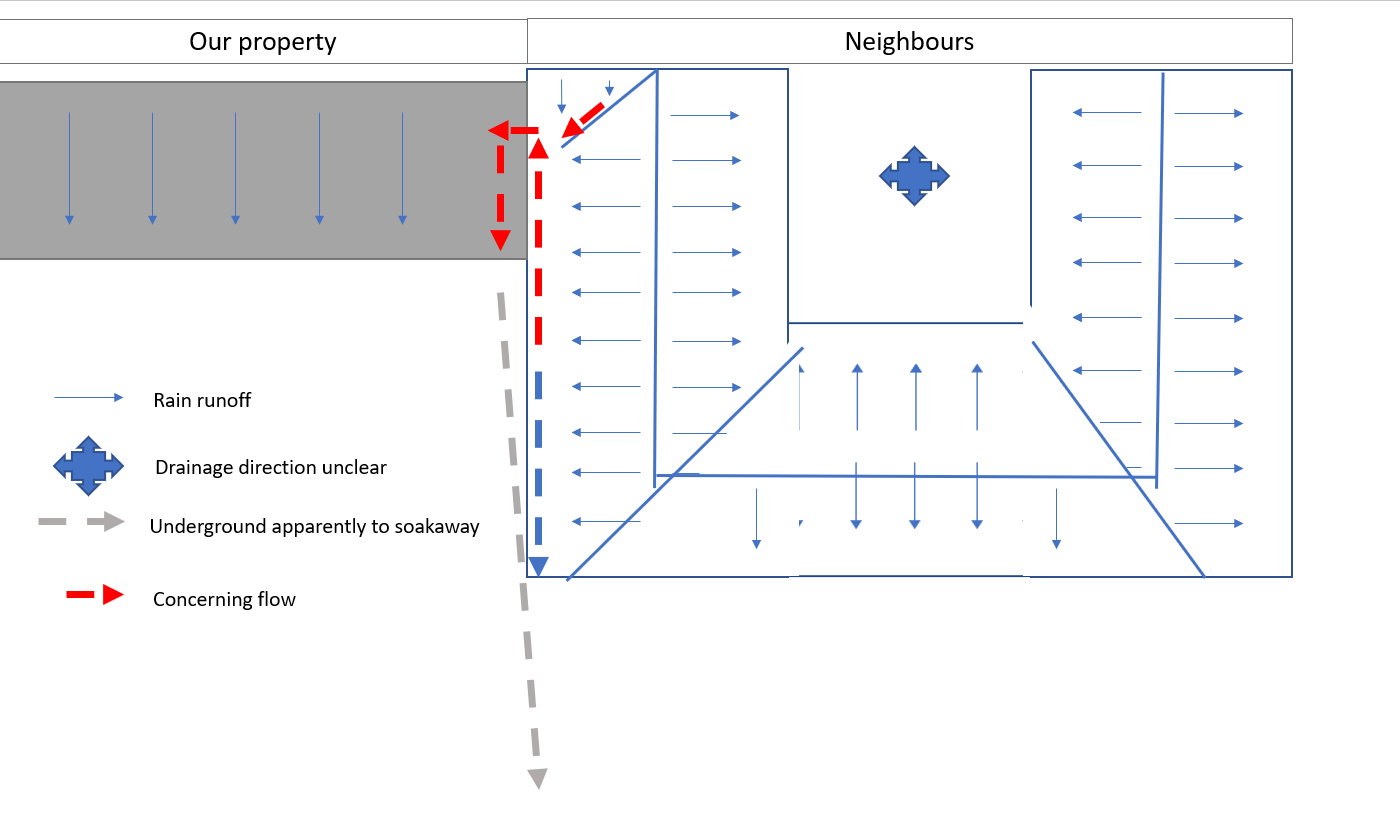
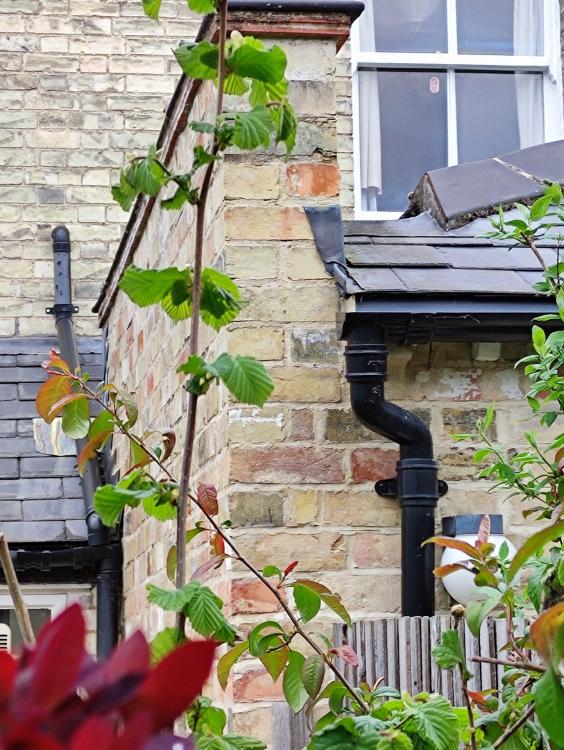
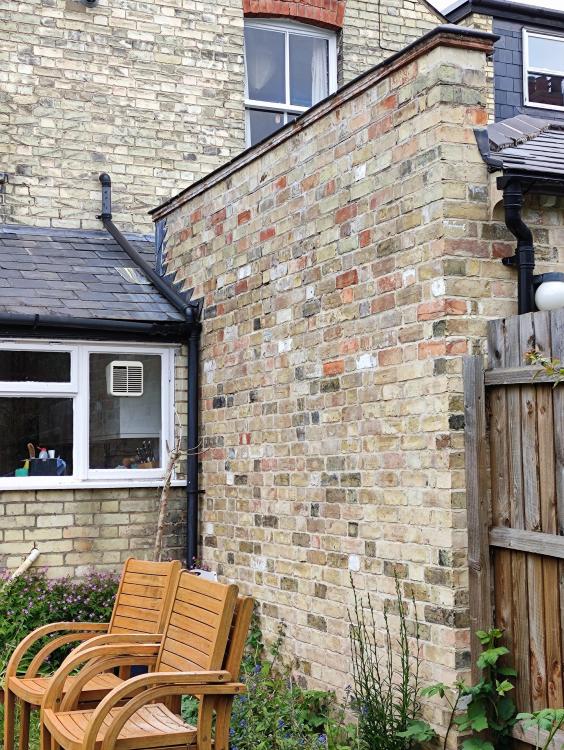
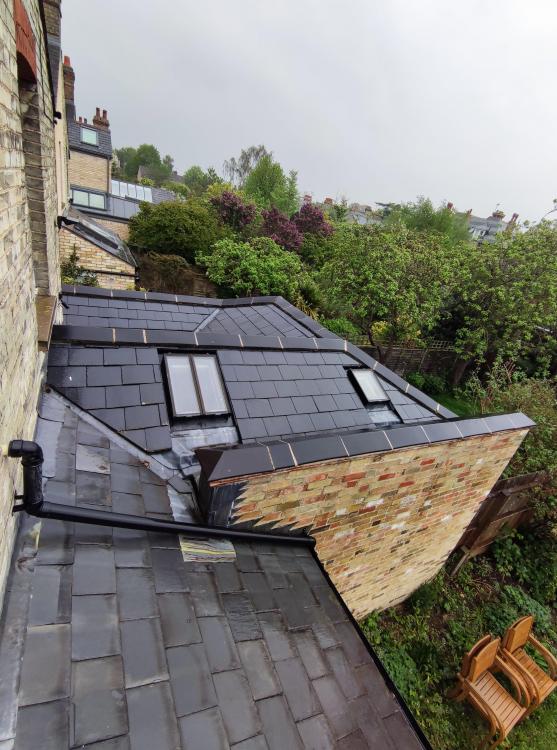
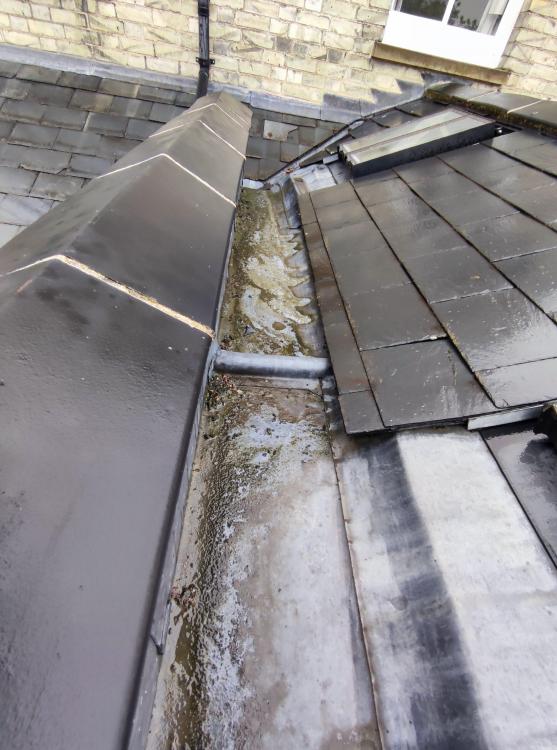
Thanks for all the great input. They have indeed had high quality work done, but I'm surprised it relies on the assumption that any future neighbours would facilitate continued drainage. Surely they cannot lay a claim to this (without legal agreement)? Let's say I wished to build a flat living roof with a height of 150mm below the parapet (~2.85m): this would then blocked the drainage. If I understand correctly from @Carrerahill's comment- liability for damage then falls on us? I expect we can strike a friendly deal- but surely we can insist that their roof is changed? I'm surprised they didn't build the wall all the way back as per @joe90- I'm starting to think it was cunning design rather than clumsy! However were I building this I would ensure we control our own drainage and will certainly be doing that at the other party wall. The downpipe from ours which discharges onto our roof is just a condensate pipe from a boiler (which will be retired for a heat pump). The attached photos show the rear elevation including the discharge of the rear half of the gulley. @epsilonGreedy I believe this are 'Cambridge Whites'- at least the original components. We're probably on a similar clay.
-
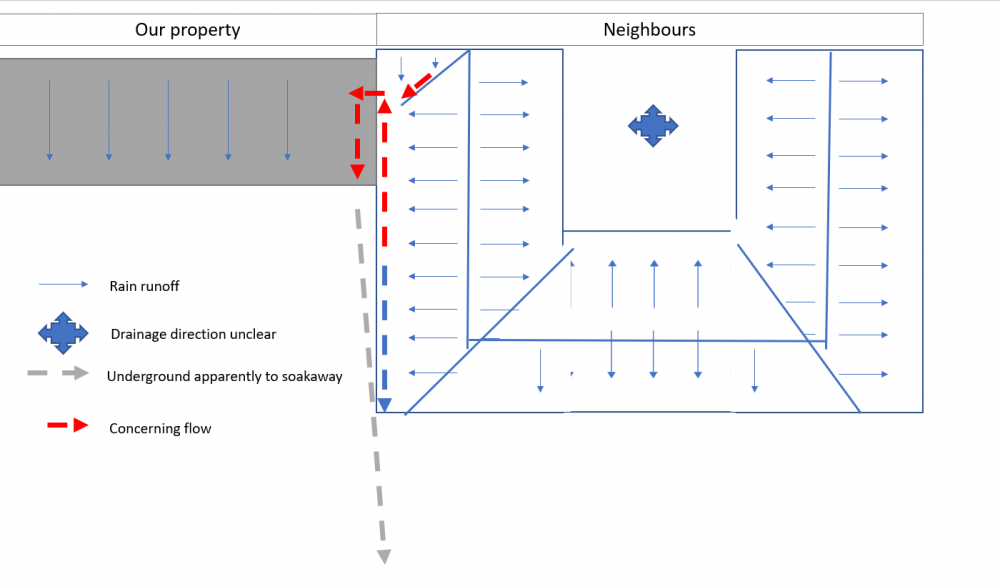
Hi All. We have recently bought a mid-terrace property and have plans to extend to the rear. We have a problem with the neighbours rainwater drainage, which uses our property and would be blocked by any extension we built. Our next door neighbours have already created a garden room, built less than 10 years ago with a parapet party wall and multi-pitch roof. We have a small, original, singe storey pitch roof. There is a gulley drainage on their side of the parapet. The rearmost half drains to the rear edge of their property but the closest edge has been intentionally built so that the drainage runs over our pitch roof. I have attached photos and a schematic. There is a party wall agreement the drainage from this pitch roof apparently runs around the party wall then into a soak away in their garden. The document we have relating to the party wall makes no mention of this drainage. It seems like a strange setup that no owner of our house would agree to, but the house was previously let by a disinterested/cheap landlord. If we build a matching extension, this water would have nowhere to go. We have a good relationship with the neighbours but before addressing this I want to know where we stand. With no written agreement for this setup, could we demand they fix this? We would reconfigure all our drainage whilst building an extension and would not need to make use of their soakaway any longer. Many thanks in advance.
-
MVHCR? Cool or not cool?
NCXo82ike replied to ashthekid's topic in Mechanical Ventilation with Heat Recovery (MVHR)
I've bene wondering the same- will be interested to hear from people's experience
.png.0c36c84eaac95e24c17588d2ff08520b.png)