


NCXo82ike
-
Posts
87 -
Joined
-
Last visited
-
Days Won
1
Everything posted by NCXo82ike
-
Asking builder for steelwork invoice?
NCXo82ike replied to NCXo82ike's topic in General Self Build & DIY Discussion
Thanks for such quick replies. To clarify the works are already underway, all sticking to the original quote other than what are obvious extras. The builders ordered the steels from their usual fabricators. Several are already installed. So we're basically stuck with whatever the cost is. Asking for the invoice is basically peace of mind that we're not being overcharged. I don't know if that's a usual thing to do, or if the builders would take offense at this and we'd upset a good relationship. Appreciate it would have been much better to have this agreed before work started but this would have lead to at least 6 months of delay. -
Morning all. Just wondering if it's reasonable to ask our builder to provide invoices from their steel fabricators. The builders have been transparent about finances. Costs have overall been reasonable for the project we're doing. For complex timescales & planning reasons we booked them in off a quote that excluded steelwork. So it was a bit of a shock when we got the quote for £28k steelwork and £10k planning &installation (each excluding VAT). This is for a mid-terrace wraparound plus loft conversion with all chimneys taken out and supported at roof level. Goalposts downstairs for large glazing and a picture frame for the wraparound etc. After the initial shock, it seems like this is reasonable, and of course there has to be a profit margin for the builder. I'm still inclined to trust but verify with it being so much money. What are your thoughts on the cost, and on asking to see the invoice?
-
Help with leaking MDPE compression to water meter housing
NCXo82ike replied to NCXo82ike's topic in General Plumbing
thanks JohnMo, I did actually watch exactly that video last night. I installed a pipe insert- there wasn't one originally. I presume that was a problem with the original install? Surely having the insert in couldn't be the issue? -
Hi, Please help me figure out what I'm missing. I have a plastic stop tap with water meter housing (no meter yet) at my boundary to the street. Anglian water fitted this in 2020 when the old metal stop tap failed. I dug this (reasonably carefully) during other works in my garden and it was seeping at the connection to the meter. I have taken off the connector and refitted a new length of MDPE pipe. Since then it is leaking significantly. I reconnected it as follows: Nut (original) Clamp (the split plastic ring, original) Thrust ring (original) O-ring (taken off a new 25mm straight coupler) Meter housing There was no pipe insert in the MDPE previously connected. I didn't see any o ring but I was working in poor light and may have dropped it. Any ideas what I'm missing? This is a DIY job but I've done a few similar things in the past. I can't easily find compression fittings to match- would they all be the same inside? Hoping I can find a solution that doesn't involve getting Anglian Water to replace the whole unit.
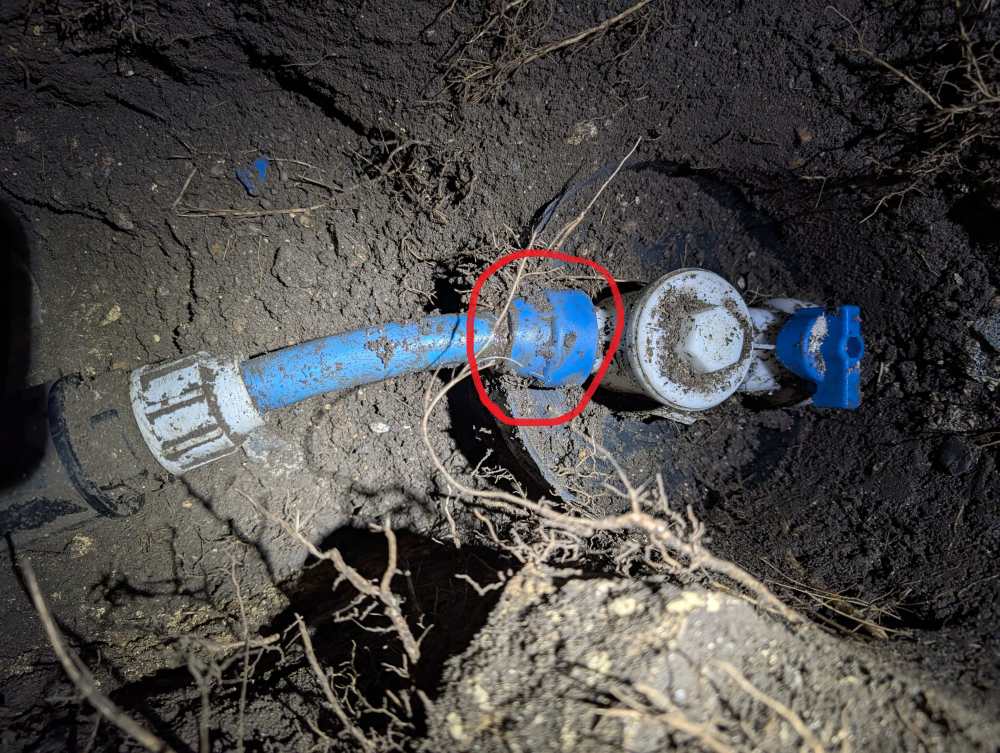
-
In case it's of any interest, I have queried this with UKPN. Unfortunately the only way to escalate it is via complaint. I realise I'm lucky to get the 100a upgrade and the 3p upgrade isn't a bad price. However I'm baffled by UKPN's approach so wanted to fully dig into it. UKPN would use standing charges to do all the work to upgrade a single phase supply for 100a. Yet they will charge me full cost to install 3 phase. I've offered to do everything I can minimise their work by doing/funding all digging on my land for a 3 phase install and pay any increased material and labour costs above the 1 phase install. As a result the 3p would probably cost UKPN, and therefore consumers, less overall. Their response was: "Single-phase replacements are handled by our General Enquiries Team, while upgrades, new supplies, and similar requests are managed by our Connections Department." "As a regulated company under Ofgem, we are required to treat all customers equally. Therefore, we are unable to offer discounts or transfer costs between departments, as this would breach the principles of fair competition." Seems very bureaucratic and not very pragmatic to me. A bit more digging- the ombudsman said: "the charges that you are disputing are not within our remit (ie to determine if these are fair). The charges are part of the DNO's Charging Methodology agreed with Ofgem" May be vaguely interesting/helpful to some in similar situations.
-
Yeah, that's essentially my thought. If doing a once in 50+ years renovation and a new solid floor, seems like now's the time to run the cabling.
-
MVHR and cooling
NCXo82ike replied to flanagaj's topic in Mechanical Ventilation with Heat Recovery (MVHR)
I also see how just putting a multi-spilt in, supplemental to whatever heating you have, could make sense- particularly if you have a good place to put the outdoor unit. In a mid-terrace in a conservation zone we're hiding our heat pump at the end of the garden, and avoiding an additional outdoor unit is valuable. Or as suggested: having an A2A heat pump to include cooling, then an alternative solution for DHW (heat pump cylinder, sunamp etc) would be really neat. That's what I've suggested to my sister in an overheating top floor flat, should the BUS not be so twitchy about cooling -
MVHR and cooling
NCXo82ike replied to flanagaj's topic in Mechanical Ventilation with Heat Recovery (MVHR)
After spending too long thinking I'd get the comfopost, with advice from many on this thread it's clear to me at least that the actual cooling from it is very limited and not worth it. Seems reasonable to me to run UFH for heating wherever possible, giving some cooling ability, then also run pre-insulated pipe on a second zone that could supply FCUs at under dew point if needed. Plus condensate drain runs. Then FCUs can be added as needed. Cheap on AliExpress with the usual caveats. The Jaga units are available in the UK with warranty but are around £900 each. Depending on house type, a more economical strategy could be a mix, e.g. UFH downstairs and FCUs in the rooms that overheat, or bedrooms where a low temp may be most important. I do reckon a dual UFH and FCU setup could be quite neat however. Most of the time you get the lovely heat of UFH. If it's really cold and you want to keep a low flow temperature, bring the FCUs on board for additional heat output. If you want to get the place warm fast (returning from holiday etc), bring the FCUs on board. You can then do gentle cooling, but add on the FCUs as needed. And you can use FCUs at below dew point to dehumidify as needed. The Panasonic Aquarea units can drive two separate zones at different temperatures. I guess if one loop has only a few FCUs on it it may need a volumiser/buffer. -
I'm dreaming of used Taycans with the 22kw AC charger getting cheap!
-
I do see that this may well be excessive for most domestic cases. But if there is already local 3p infrastructure and the equipment cost is marginally more, I do wonder if there's a big downside to heavy future proofing? One particular use case would be 22kw car chargers. Imagine friends stopping for lunch midway on a long journey. 2-3 hours and they could have a full battery ready for the next leg. Admittedly a slightly niche scenario. In another scenario, I not uncommonly get home from work late one evening and have a long journey early the next, where the difference between 6hrs charge at 7kw vs 11kw could mean avoiding a motorway charge.
-
Unbelievable, but also completely believable.
-
I've been told if the incoming supply is insufficient for the uprated fuse, the supply upgrade is free. But if you ask for a new service, or moving the meter, that counts as chargeable (presumably seen as discretionary).
-
After I applied for the upgrade, their crew came round to look at the supply and decided it was insufficient for 100A. Apparently they'll often replace the fuse at that first visit if it's all suitable. Then they booked it in as requiring a supply upgrade, which the crew, and then the team on the phone in a follow-up call, told me was non-chargeable. Next step is a surveyor comes out to plan the supply upgrade, to include closing the pavement, closing the road if needed (not in our case). I have another surveyor coming to look at the property to quote for a plan a three phase upgrade. Presumably doing exactly the same task?
-
Agreed, could be worse, but I'm not quibbling with the cost of the work Instead that they will be doing the vast majority of the work anyway, and for free given that we require a supply upgrade. But asking for three phase, why can't I pay a fair rate for the extra material and the labour above that. It's like winning a free holiday, asking to pay to add inclusive drinks, and being told if you do you have to pay for the whole holiday. Except that I've not won a free holiday, it is policy to provide the benefit (I realise probably from everyone's standing charges, and am grateful for that).
-
We're in a 1905 mid-terrace with the original supply cable from the street. With an ASHP, EV charger, 1 or two inverters and batteries, induction hob and 2x ovens going in, we needed to upgrade from 60A to 100A. Our supply cable was insufficient for 100A so we're booked in for a single phase supply upgrade which would be completely free. We'll make use of time of use tariff. We'd benefit from a 22kW car charger. Doing shift work I have abnormal consumption schedules so our diversity doesn't reliably drop the total load much. As a result we could easily hit 35KVA and up to 53KVA. We can make do without 3 phase, but we'd definitely benefit from it. I understand Western Power networks install 3 phase by default if a supply upgrade is required. So I contacted our DNO UKPN to enquire about 3 phase supply. They tell me a 3 phase upgrade would make all works chargeable, estimated at £6700 (inc. VAT) excluding digging on our property. £370 of that is the 3 phase cable and ducting, and the remaining £6300 is the labour (i.e. digging the pavement 3m from the house on our side of the road and making the connection, most of which would presumably be identical to the single phase work). That's prohibitive. I wasn't expecting to get it as good as under Western Power , but I'd really hoped I could pay just the marginal cost of the 3 phase equipment and connection work- it feels absurd to have to pay for the digging. Are there any strategy documents or consumer rights I can quote to try and just pay that marginal cost? Any advice greatly appreciated.
-
4 years on... Finally have planning and hope to build this autumn. The plan is still to sit the MVHR I'm the eaves. We'll use ended joists to convert the loft and run ducts through those.
-
Humidity and MVHR
NCXo82ike replied to lizzie's topic in Mechanical Ventilation with Heat Recovery (MVHR)
Resurrecting an old thread... this is copied from the PAUL guide referenced. The internal RH of the summer daytime normal heat exchange is 74%. The internal RH of the enthalpy setup is 60%. So I'm not sure it's a like for like comparison? Also wondering if the enthalpy exchanger would help with dehumidification if the house is being cooled in summer?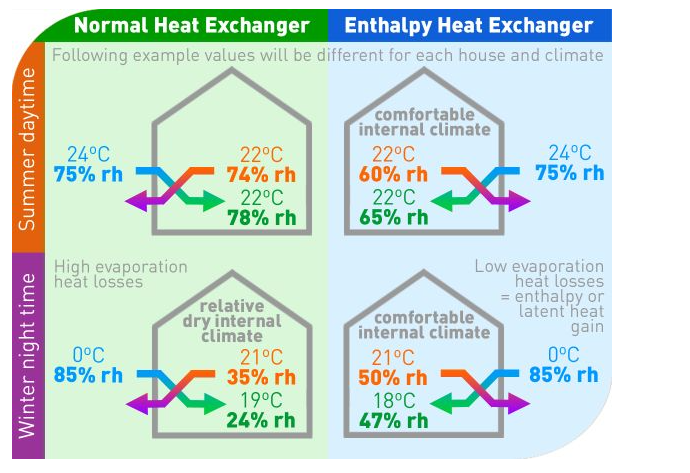
-
Enclosure or longer piping run for split ASHP system
NCXo82ike replied to Jonshine's topic in Air Source Heat Pumps (ASHP)
Great thread I'm a little late to. If trenching anyway, wouldn't it make sense to duct refrigerant lines through solid pipe e.g. 110mm soil pipe, and insulate around the soil pipe e.g. with a combination of XPS and spray foam? That would allow changing out the lines if needed, and minimise losses. I presume the air held in the soil pipe would be static and a reasonable insulator. I wonder if pre-insulated refrigerant lines could be run through the soil pipe, and if that would make much difference vs just insulating outside the soil pipe. -
https://mhclgmedia.blog.gov.uk/2024/11/21/warm-homes-plan-and-heat-pumps/ Great news, the 1m from a boundary requirement for PD is to be scrapped. In worse news we didn't know this when we submitted our planning application in Dec 2024, to include a heat pump down the garden and by the boundary (mid- terrace). So we've now poked the planning and noise assessment bear. Any idea when this will actually come into force? I can only see references to early 2025.
-
Fan Coil Units for use with a (cooling) ASHP
NCXo82ike replied to ProDave's topic in Air Source Heat Pumps (ASHP)
I realise this is the wrong time of year to ask...but what have people's experiences been of cooling at temperatures above the dew point? This will surely increase humidity, and actually get below the dew point in a controlled manner would be beneficial for the humidity. Was there any need to run a separate dehumidifier? If you had MVHR, what settings did you have to mitigate this? We would have upstairs UFH in P5 chipboard, so moisture control is critical, downstairs TBC. I feel like I might end up 2 loops with the option to set them at different flow temperatures: (Loop 1) UFH and (Loop 2) insulated pipework with FCUs. I have a decent Home Assistant automation setup and independent control of each would be really useful. Running both loops at the same temperature would allow a minimised flow temp and maximised COP. If we want a rapid warmup we can run the FCUs at a higher temp than the UFH. If we want a rapid cool down we can run the FCUs lower than the UFH. To dehumidify when cooling we can drop the FCU temperatures below dewpoint and/or increase their fan speed. We could even increase the UFH flow temperature accordingly to prevent overcooling. This does beg the question of why not purely fan coil units. It's not a gigantic property (160sqm after extension). We'll be fitting new flooring to much of it anyway e.g. for the kitchen & bathrooms I think there's a clear benefit to UFH above FCUs. -
Central Fan Coil Unit - run from ASHP
NCXo82ike replied to wardie9025's topic in Other Heating Systems
Do you then have two loops, one for the fan coil+buffer and one for the UFH? How do you control this? The Panasonic (I think) heat pumps allow two zones at different temperatures. I wondered if there was an easier way of achieving this with other models. -
Fan Coil Units for use with a (cooling) ASHP
NCXo82ike replied to ProDave's topic in Air Source Heat Pumps (ASHP)
I can see that if you bring in warm air into the cool house the relative humidity will increase- so in this instance reducing airflow through an MVHR would be beneficial. They may reduce a little of the incoming air's moisture as it is cooled by exhaust air but I doubt I huge amount. Perhaps the main pitch for the comfopost should instead be for dehumidification as part of a larger cooling setup. -
Fan Coil Units for use with a (cooling) ASHP
NCXo82ike replied to ProDave's topic in Air Source Heat Pumps (ASHP)
I'd see the ability from fancoils added to UFH to preferentially cool certain rooms (e.g bedrooms) handy. Without UFH too, I'd go below the dew point using insulated pipe and condensate drains. With the UFH, taking the fan coils below dew point would I think require two loops, a diverter, and a volumiser for the fan coils loop? Unless you can run one coming loop at 7 degrees C supplied in insulated pipe, then blend the UFH to a temperature above dew point? I can see the argument for just adding AC, but as additional outdoor unit wouldn't suit our property (mid-terrace). -
Fan Coil Units for use with a (cooling) ASHP
NCXo82ike replied to ProDave's topic in Air Source Heat Pumps (ASHP)
So all of this has confirmed for me that a comfopost isn't worth it for us. If you're running fancoils on the same loop as UFH, presumably that gives plenty of circulating volume. It would then run offset above the dew point, accepting achieving less than maximal cooling/heating output from the fan coils. It seems to me there's little point in running insulated pipe to supply the fan coils? And is there any need then to provide a condensate drain for the fan coils? -
Fan Coil Units for use with a (cooling) ASHP
NCXo82ike replied to ProDave's topic in Air Source Heat Pumps (ASHP)
I initially thought 3 fan speeds seems a little basic, however the panasonic FCUs are only 4 speed https://www.bpcventilation.com/panasonic-fan-coil-unit


