George
-
Posts
699 -
Joined
-
Last visited
-
Days Won
1
Everything posted by George
-
Have you got some details or sections you could post? It depends how the TF and ground floor slab interact.
-
What size is the building? £50k may be excessive or may be cheap! Mini piles and ground beams is not an unusual foundation system so you should get three quotes to get a true feel for the cost. There are many factors when pricing work and one data point is not enough. If the issue is the roots of the trees then you will probably require some sort of pile. If the issue is heave then a raft (the concrete slab) may also require significant groundwork. Unfortunately spend on foundations is the most unsatisfying part of a build. But it is one of the most important to get right.
-
Unfortunately fires to dispose of waste is very common on construction sites. They do keep defaulting to wood burners as the cause. But I'd have thought wood burners are the third cleanest method of burning wood after incinerators and biomass boilers.
-
Well... maybe. The stats are always 'wood burning stoves and open fires' or 'domestic combustion'. I don't think there's any way of being able to detect what type of appliance a wood PM has originated from so it has to be done via proxy methods. Presumably the wood PM in summer are all originating from BBQs. Also, wood burners tend to be lit on cold nights when most people are indoors, whereas vehicles are driven all day every day in urban areas. So the pollution pathway is not as direct. For thos reasons the cars trundling past my children's schools cause more concern than the wood burners lit when they're in bed.
-
I don't see a role for biomass in new build home heating where insulation + solar panels would keep everything at a good temperature. But still plenty of roles in retrofit as fossil fuel replacement. No argument from me that vehicles are a much more obvious and concerning source of PM.
-
Should be banned for new build anyway. And open fires/old stoves allowed only in exceptional circumstances - for example, listed buildings. That said, PM from wood burners I don't think have as direct a pollution pathway compared to gas hobs, deodorants and vehicles. They contribute to background levels but while background levels continue to fall I can't get too excited about it.
-
What's the reason for underpinning?
-
They might ban open fires and older stoves. I can't see Ecodesign ones being banned.
-
Vertical cuts in soil can never be assumed to be safe. Get them to sort it asap - it's contrary to the party wall agreement and to CDM2015 regulations. If they fob you off, report to the HSE. (Vertical cuts can be stable for a short time but no way to predict this and they don't control the weather)
-
1st Floor Balcony - Glass Balustrading - documents for BC?
George replied to Conor's topic in Building Regulations
So a normal framed glass balustrade has the supporting structure (i.e. uprights and handrail) which would need to comply with Part A - the 0.74kN/m and (technically) PD6688-1-1 requirement of 0.5kN/m^2 over the whole area. If the supplier of that uprights and handrailing structure doesn't provide that calculation and BC want it, then a SE will need to demonstrate it complies. The glass infill itself needs to comply with Part K, which would mean glass meeting the BS EN 12600 standard... Class 3... I think. This will mean it has been tested with the pendulum test to resist a given impact force and if it does break, breaks 'safely'. The system of securing the glass (beads or clamps) would also need to have been designed. Now... with a frameless system I believe you would need to get the supplier to demonstrate BS EN 12600 compliance and give calculations that as a cantilever it can withstand the 0.74kN/m & 0.5kN/m^2 requirement. It would be relatively trivial for a SE to calculate the load capacity of the glass pane as a cantilever at a given thickness. The challenge is what do the support look like and can that be proven by calculation or whether load testing would be needed. -
Assuming the 200mm offset means that the wall above is support on joists which are supported by the wall, then a lintel probably wouldn't be suitable. This is because lintels shouldn't be used to carry point loads without distributing masonry above. However a steel beam could be used. Lateral stability is another big reason to use goalposts and without one I'd be looking to leave at least 600mm return of the existing wall (just above 'A'). There are also construction challenges with this although that's not strictly the SE's remit.
-
I've done a few like this. What you've written in this post forms the basis of a decent scope of works so I'd just send off to Civil Engineering companies for quotes. You don't tend to find many one-man band Civil Engineers as it's a bit more specialised and to make money you need to work on very large projects (whereas structural engineers can make money off small projects). All I ever do is provide a framework for a builder to price from but essentially the builder is the one who would be checking levels and getting building control sign off. Also I believe outflow to surface water from a STP won't need specific EA approval so long as it complies with the general binding regulations.
-
3/8" (9.5mm) bed joints have been used for a few hundred years. Extra wide mortar joints will just look sloppy. Brick choice, mortar colour (not standard grey - go for a lighter lime-appearance) and using snapped headers to create a English or Flemish bond will give it the appearance of age. Edit - didn't see Russell's post. What they said!
-
My preferred system would have been a multisplit a2a for the upstairs bedrooms and an a2w unit for hot water and downstairs ufh. Two small units very rarely run concurrently. However, the rhi grant wouldn't be compatible with this set up so I had to go for a whole house a2w system.
-
Maximum permissible size of holes through 2x4 studs?
George replied to nostos156's topic in Heat Insulation
There's no hard and fast rule. If it isn't a load bearing wall then it just needs to be enough wood to hold itself up. 50% removal sounds fine for that. -
5 degrees usual limit, 3 degrees air temp absolute minimum. Main things are is that the concrete itself is over 5 degrees, the ground isn't frozen, that temperatures are rising when you pour and you have a way to protect the pour from frost. 10:30 is a good target time if the site gets the sun. Blockwork you can start 48 - 72 hours after. If there are points loads should be waiting for at least 7 day cure time. Build plenty of slack into the programme for path critical things...
-
I'd argue that is a UV emitter. You don't need heat to tan / sunburn. Indeed, if you filled a sunbed with regular bar heating elements I think you'd grill the human. Presumably ionising must take less energy than heat transfer.
-
I'm definitely at the limit of my decades old A-level physics... but I don't think you can commonly buy UV heaters. Not sure I want to turn my bathroom into a tanning parlour / skin cancer room.
-
Yeah but anything hot will be emitting infra-red. I'll probably end up just sticking up a bathroom bar heater anyway. Just checked the prices for the mirrors...
-
Sounds like prime https://www.reddit.com/r/TVTooHigh/ territory.
-
Surely any sort of radiant heat (that is, primarily transmitted via radiation rather than convection or conduction) is by definition an infra-red heater?
-
There are some good Youtube videos on setting up the controller. The heat pump are usually set up to be controlled by a third party thermostat for heating and the inbuilt controller for hot water. Usually, hot water is set as a priority over heating (not too bad for a well insulated tank) so the main thing to check is that the temperature probe is properly sensing the water temperature in the tank. I did have to play around a bit with mine and in the end taped the probe to a stick so I knew it would be in contact with the hot water tank. It might be that the hot water is set on a timer which doesn't coincide with what you want. External temperature shouldn't affect hot water. Weather compensation (called water law on Samsung) only effects flow temperature for heating system. In Scotland that may want tweaking from the standard.
-
This is really cool. Think it was on the radio this morning but only caught a bit of the piece. The claims of infra-red are what are frowned on. In the right circumstance they are as effective as anything else. I plan to have a ceiling or mirror panel in my bathroom - short term immediate heat.
-
I'd go with RICS. Usually things aren't limited to only a single institution. Although as I understood it, only RICS can award 'Chartered Surveyor'.
-
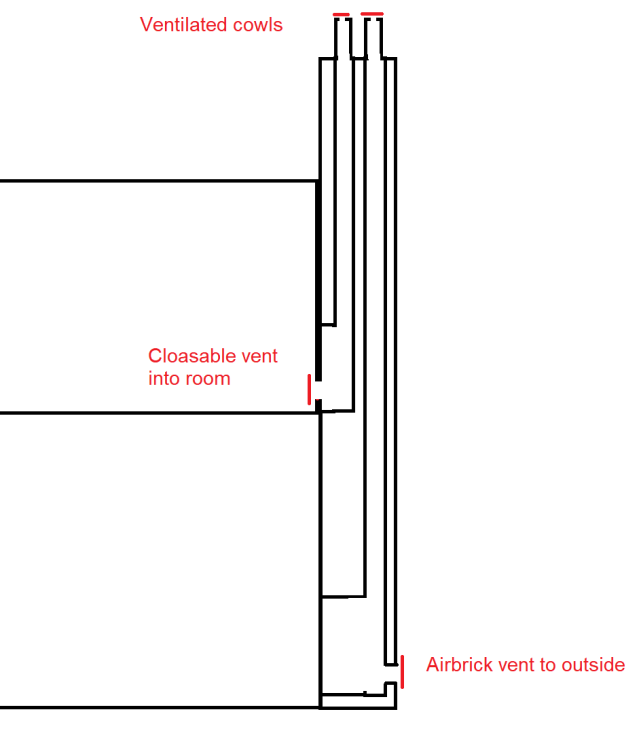
Register plate and flue should already be relatively airtight - it is all intended to keep leaking flue gases out of the home. You could even get HETAS to do a smoke test. But a heat resistant silicone sealant could be used for any tiny gaps if there are any. The disused open chimney will need ventilation to prevent damp. Usual approach is a closable vent into the room and a ventilated cowl at the top. However, you can seal it to the room if you can put a vent on the outside of the wall into the flue. That's what I did with my upstairs disused flues. Spray foam I wouldn't use - just frame it out and tight fit insulation board.