

Stones
-
Posts
3761 -
Joined
-
Last visited
-
Days Won
23
Everything posted by Stones
-
 This might be of use, it might not, but I had a company from Bolton, who were prepared to travel to Orkney and install an in roof system. They currently advertise at £4K for a retrofit, £4.5K for an in roof, covering a large swathe of England and the Scottish borders. Beyond that they add on some travel and accommodation costs. PM me if you want their details. Oh, and welcome aboard Declan.
 -
What was he trying to sell you?
-
I've often wondered why sheets are made 1220 when the standard centre is 600 (or 400). It's as if the manufacturers want you to buy more than you need...although more than likely Ed's post contains the real answer as to why the manufacture the size they do.
-
Yep, welcome aboard.
-
Looks very good Jeremy. We are looking at both engineered oak and bamboo, the latter for its robustness in comparison to engineered. I have a pile of samples sitting in build HQ, but I think the decision will probably be one of those left until later when we see the rooms actually built and have our oak facings so we can compare a bit of finished (oiled or varnished) oak against the flooring samples.
-
+1
-
Yes welcome / welcome back. I think we are all glad to be finally up and running.
-
The thermal performance of a passive slab, when compared to the more common strip foundation/concrete slab design, is far superior, yet there are always going to be instances where a passive slab cannot be used as part of the design. I'm thinking primarily of sites with difficult or complex topography and remote or challenging locations.So what are the alternatives if you want something better than the norm but cannot use a passive slab?A quick search online shows several companies offering their own versions of the passive slab and another where a passive slab is cast into metal form-work built on mini piles. Type in passive strip foundations and you can find diagrams showing what seems to be a fairly standard strip foundation / slab that uses lightweight insulated concrete block and a concrete slab / insulation / concrete screed method of construction.Are there other options? Timber does appear to offer an alternative: Cassette floors systems.Suspended floor - as ProDave is planning, by using thicker joists, more insulation can be installed.SIPs - this may seem a strange one but I am aware of a house that was built near us. Due to site conditions (load-bearing subsoil not present until a depth of around 1.5m) the architect specified a steel frame/skeleton built onto a number of concrete pads, onto which SIPs were laid as a floor deck.I'm sure there are other possibilities - suggestions welcome!
-
I was watching an old episodes of 'Building Dream Homes' which featured a £350K mobile home. Whilst not exactly homes for the population at large given the price, it got me thinking about this subject again.When looking at different building systems back in 2009, I looked for companies that could deliver factory fabricated units which could simply be craned into site, with minimal finishing required thereafter.I was wondering if anyone else had looked seriously at pre-fabricated buildings as an option? There is clearly a market for ready completed garden rooms/studios, but currently less so for habitable housing. Modular construction in certain sectors will continue where large numbers of identical units/sections are required.As far as I can see from a look online, it can be done cost effectively, although this may be more of a challenge for one off or bespoke designs. I did find an article about the MoD building prefab houses for servicemen - can't believe the MoD would pay a significant premium for the housing it has to provide. The UK and EU certainly seem to have more companies offering this type of build system (compared to 2009 at any rate).Materials are going to cost what they cost, but one would have thought there were economies of scale available once output reached a certain size. The big plus for this type of factory controlled construction for me is the protection of the build from the weather allowing it to continue without weather related delays,quality control in terms of installation of insulation and air tightness depending on the type of construction, and speed of onsite installation.Transport however is expensive, especially if you have large distances to cover, with width and height restrictions dictating the size of sections and roof types that could be built. Based on the kind of dimensions used by mobile homes, I reckon I would have needed 7 or 8 modules, or 4 lorries to build my house. Much I suppose would depend on distance from the production centre, although in some remote cases, paying a high transport cost could certainly offset having to pay high travel and time costs for tradesmen building conventionally. Is our reluctance to embrace this type of construction down to collective memories and experiences of holiday mobile homes and post war pre-fabs? Other countries, (I think Japan has a large factory orientated house building industry) seem to be comfortable with the notion so why not us?
-
Went to a very interesting presentation about the following project which has full funding and is in the process of being implemented:http://www.localener...ey-surf-n-turf/which seeks to utilise curtailed renewable energy generated on Orkney to produce hydrogen for a variety of different uses. It is hoped this project will show what can be done, and has a lot of possibilities for communities such as Orkney, the Western Isle and others where grid constraints mean a lot of renewable energy simply has to be switched off and is therefore wasted.Part of the scheme is to be able to train up a cadre of local mariners in the use of hydrogen as a fuel, which in the future should allow the general use of hydrogen / fuel cell powered ships (very much a chicken and egg situation at the moment - you can't operate a hydrogen powered ship until you have trained personnel and you can't train them with out a something to train them on.Other schemes in the pipeline, either at feasibility or seeking funding stage are using hydrogen to provide heat energy for public buildings and a fleet of hydrogen vehicles, and producing synthetic diesel and agri products (fertilizer) for use in the agricultural sector.One of the suggestions that interested me was the use of hydrogen as a replacement for natural gas to heat homes (after all, prior to north sea gas, much of the gas in this country was town gas, which comprised 40% hydrogen).
-
A useful link with information about the economy 10 tariff - suppliers / prices etchttp://economy10.com/
-
I'm looking at an A2W ASHP for my new house. At present the intended location of the ASHP is a 2 metre wide path that runs between the gable end of the house and the garage. The path is a 'through' corridor. Looking at manufacturer (Panasonic) instructions suggests a rear minimum clearance of 100mm and a front minimum clearance of 1000mm. The ASHP itself is 300mm wide, so I do have enough room to position the ASHP, meet the rear and exceed the minimum front clearance distances. The question I have been pondering is whether I will in effect be creating a 'cold corridor' (between the gable end of the house and the garage) which will drive down the CoP of the ASHP or otherwise negatively affect the operation of the ASHP.Any thoughts?
-
I'm thinking of installing a back up generator in our new build, perhaps utilising the generator I will probably end up buying to supply power on site (rather than pay for a temporary supply/paying to move the meter at a later date).From what I've read it seems pretty straightforward. I would need to install a 100A mains / generator changeover switch that would allow me to isolate the house from the grid when using the generator. These seem to be readily available and available from about £60 upwards. I don't really see the need for an auto changeover system (given the significant difference in outlay that this would entail) as in reality it would perhaps only be in use a couple of times per year. All I'm interested in is having enough power to run some essential systems / appliances - lighting, fridge, small heater or ASHP, MVHR, UFH pump.There are however a few things to consider:Conventional or inverter generatorSize of generator (1000W / 2000W etc) Fuel typeShould I wire the house such that there are 2 CU's, one with the essential systems, the other with circuits not required in the short term or just switch off hob, cooker, showers etc when the genny is runningIf I install Solar PV how would this work - something else to switch / leave off if the genny is running
-
Just getting tiling prices back just now. We are planning low temperature UFH. One of the tilers has advised against the use of ceramic tiles with UFH. I'm awaiting his response as to why. Other than the issue of not being through coloured so chips / damage would be clearly visible as compared to porcelain, is there any technical reason why ceramic is problematic with UFH?
-
How well does it tone in with your oak facings?
-
Originally published on the closed forum, on 14th March 2016 Having made the decision to relocate to Orkney, we set about finding a site that matched our expectations and desires. We saw some truly outstanding sites but eventually settled on a parcel of land extending to just over an acre, which had planning for the erection of a new dwelling house. The practicality of the location, the far reaching views and feeling of local community were all key factors that we considered in deciding on this plot. Having identified our site, we started thinking about possible designs, what we could fit on site, what catered for our needs, and how we could reflect the local 'venacular'. Our starting point was our last house. That layout worked very well for us (we like our houses being open plan) and we drew heavily on it for our design. We came up with the following basic floorplan which met our needs and allowed us to reflect the local venacular of narrower 'Longhouse' buildings arranged in close proximity to each other. The following document is a useful reference for this sort of design http://www.gov.scot/...590/0122537.pdf Having come up with an outline design, it was time to speak to the planners to establish whether what we wanted to do was acceptable or not. Next entry - Planning
-
I can't disagree with anything you say. My initial thoughts would be to size the array such that i could use virtually everything I generate, so a 1.5 - 2 kWp system, which I could subsequently add to when battery storage becomes a financially realistic option.
-
I'm considering installing Solar PV, but due to the recent cut in FITs, I am looking at a non MCS installation (to reduce capital outlay). To try and establish whether this was possible, I contacted my DNO, to find out what the procedure would be to connect to the grid. Sadly, the response was limited, advising that only MCS accredited installers could make a G83 connection. When pressed, they referred me to the ENA (Energy Network Association). Thankfully, the ENA knew what they were talking about and confirmed the following -"You will need to comply with the ER G83/2 a copy is attached. ER G83/2 is a qualifying standard to the GB Distribution Code. ENA_ER_G83_Issue_2_(2012).pdf 634.08K 0 downloadsFor a single generator below or equal to 3.68kW then you can connect this without the permission of the DNO but you must by law inform the DNO of the connection within 28 days of commissioning the generator.There is not a requirement to use MCS installers in G83 or D Code but you must use type tested equipment. A list of such equipment can be found here - http://www.ena-eng.o...peTestRegister/Where you decide to connect a inverter that is not on the list then you will need to comply with ER G59/3-2 as that equipment will be classed as non type tested.I would expect the installation to be installed by a competent registered electrician.To qualify as an electrician, you need an industry-recognised level 3 qualification, such as:*Level 3 (NVQ) Diploma in Electrotechnical Services (Electrical Maintenance) *Level 3 (NVQ) Diploma in Installing Electrotechnical Systems & Equipment (Buildings, Structures and the Environment)The competent electrician will also have to sign of the relevant installation forms as prescribed by the building regulations and the model forms can be found in the Wiring Regulations BS 7671. These forms must be made available to the owner and retained on the property and made available when required for inspection by the relevant authorities eg HSE.I would also advise compliance with Part 712 of BS7671 - Solar photovoltaic(PV) power supply systems.If you still wish to export to the grid then you will need to discuss this with your supplier. Not sure what there stance is with regards to non MCS installations. DNOs do not arrange or fit metering." So, for those considering this way of installing PV, it seems simple enough if you install type tested equipment, which the vast majority of self install PV kit currently available is, then all you need is a qualified electrician to do the final connection, and to inform the DNO of what you have done.
-
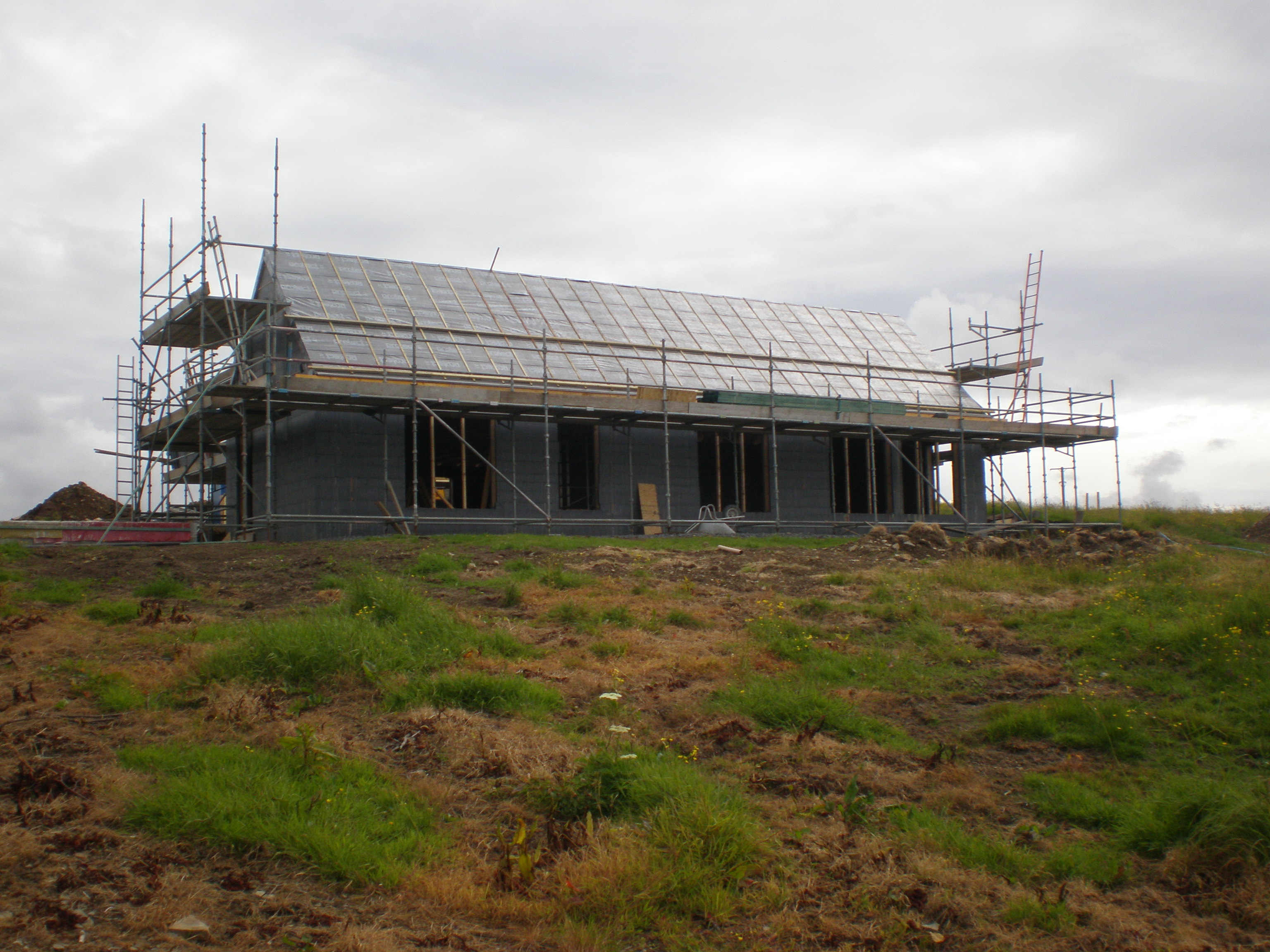
I'm building a generously sized 3 bedroom house on Orkney. It's our sixth (and hopefully final) self build. The big change this time is we are building using ICF blocks (Insulated Concrete Formwork), the previous builds having all been timberframe in construction. The climate, well the wind, is challenging to say the least. I'm certainly looking forward to moving in towards the end of the year and enjoying the comfort and benefits of a well insulated and air tight house.
-
That's one nice view you have!
-
I'm a bit further north (3 hours and a ferry crossing over the Pentland Firth to be precise) in Orkney. I've just started build work on an ICF house, built to withstand the brisk climate with the lowest possible running costs.
