


LnP
-
Posts
449 -
Joined
-
Last visited
-
Days Won
2
Everything posted by LnP
-
+1 . I had screed on a workshop floor. The small print on the floor paint tins I looked at said they were not suitable to be applied to screed. So I went for a two pack product.
-
Sounds like you have things well in hand. Regarding the Principal Designer role, I've come to the conclusion that in the timber frame self build world, very few clients appoint one. I had a conversation with the operations director of a timber frame company and asked him, how many of their clients did he think appointed a PD. He said less than 5%. Bear in mind that according to the guidance, a PD should be engaging with the timber frame Designer, and the Designer would send the pre construction information to the PD to put in the H&S file. Meetings between timber frame Designers and PDs apparently just don't happen. If there was a PD, the timber frame Designer would know about it. If it's a self managed project, the vast majority of his clients are apparently taking care of the PD role themselves. If anybody on here has gone through a project with a third party PD I'd be interested to hear if they thought it was helpful, i.e. did it do any more than tick a CDM box. My suspicion is that it's possibly just another cheque to write for a professional service that doesn't add value. All a third party PD will do is collect the pre-construction information into the H&S file and forward it to the client. A self managing client can do it themselves. I'm not sure what you mean by, "we will have to decide who will be the 'main contractor' on site if we have a few trades at once". According to the HSE, if you the Client are self managing, it's the Client's responsibility to comply with Part 4 of the CDM regs. It's as good as saying the Client is the Principal Contractor. If your groundworker is digging a hole for a sewer chamber, it's the self managing Client's responsibility to ensure his plumber doesn't fall down it (Reg 22, Excavatiions, which is in Part 4). The groundworker won't be responsible for that. Btw, I think most diligent, self managing clients will naturally take all this on. It's not onerous and just about trying to run a safe project.
-
Very interesting thanks. I'd assumed there wouldn't be much more for the PD to do after they'd handed over the Health & Safety File and you'd prepared the Construction Phase Plan. What ongoing involvement are you seeing for the PD? Perhaps you could expand on your way through on the learning curve. No, I don't have much building experience!! Learning a lot though on here and as I discover new things I have to read and figure out.
-
I've discussed this in detail with the timber frame suppliers we're getting quotes from. If the off site fire risk assessment using the STA methodology indicates mitigation is required, the expectation all of them described is to replace the 9mm OSB external sheathing with cement board on the relevant elevation. The membrane will go on top of the cement board in the same way it would have gone over the OSB. The additional cost will just be the difference in price between OSB and cement board. I guess you'd have to wait and see what the risk assessment says though.
-
Interesting ... but do you think this is something to be considered in the purchasing decision for a timber frame kit?
-
I'm wondering if the PD role is another example where CDM 2015 isn't really a good fit for self builders, although the legal duties apply. I've not been through this process yet and maybe somebody who's seen how it works in practice can comment. But the selfbuildportal.org.uk says that PDs: "Plan, manage, monitor and coordinate health and safety in the pre-construction phase of a project. This includes: identifying, eliminating or controlling foreseeable risks; ensuring designers carry out their duties." What authority does a third party PD have over e.g a timber frame designer? Or are they just mail boxing the pre-construction information into the Health and Safety File and passing it along to the client/PC? In which case maybe a client could appoint themselves as PD and do just as good a job ... and save another bill for professional services!
-
For a self managed project, I don't think it does, although to be honest, I don't think CDM was written with self builders in mind. Nevertheless, you need to think about who's in charge when you have more than one trade on site? Who's going to prepare the Construction Phase Plan? CDM 2015 is intended to clarify that where there is more than one contractor, there should be a single PC taking responsibility for those things. HSE have a web page regarding CDM for self builders which points to the Self Build Portal. For self managed projects, it stops short of saying that the client should appoint themselves as PC, but it does say that the client has to comply with all the matters in Part 4 of the regs. Consider the situation where the timber frame company is erecting the frame with a tele handler and at the same time an electrician comes on site to install a temporary power supply. You can expect the frame company to be responsible that their own people are not at risk from the movement of the tele handler (reg 27 in Part 4), but not for the electrician. The client has to coordinate that. Maybe as a self managing self builder one doesn't appoint oneself as PC, but the duties are effectively the same.
-
We're also currently comparing timber frame quotes but are not quite at the point of being able give comparitive numbers. The scopes are all different, so as you mention, it involves estimating the value of the differences. As well as Potton (KTS) and MBC, we're also looking at Fleming and Frame Technologies. Your numbers confirm how it's looking for us though, that Potton are cheaper than MBC for the frame. Additionally, MBC look expensive for the windows, assuming we would get them from the frame supplier. We'd like the frame supplier to do building regs for the whole project. We have an architect, but splitting BR between the frame supplier (who logically should provide the required information for the frame) and the architect for the rest, creates an interface I'd prefer to avoid. Potton will do that. I'm not sure about MBC. @zzPaulzzHave you talked to the frame suppliers about CDM roles yet? I'm planning to self manage which means I'll be Principal Contractor. I'm comfortable with that but the MBC sales manager gave strong advice against it, unnecessarily so in my opinion. That would mean engaging a main contractor, which I'm not planning to do. Also, Potton are the only ones of the four we're talking to who are prepared to take on the role of Principal Designer. In my opinion, the frame supplier, especially if they're doing BR for the whole project, are the only sensible choice for the PD role.
-
No reason apart from ignorance 🙂!! I think we'll change it! Good question. I don't have that information at the moment. Good advice which I'm going to follow! Nice idea thanks. A creative solution. We'll give that some thought!
-
Indeed it is .... and one could concluded it's not a good detail. Just that that was what this timber frame supplier proposes. But I'm asking myself if there's a better way, so yes it looks like that detail would need to be changed. The build up on a warm roof will present a bit of a challenge though. We were planning to make this flat roof a balcony/roof terrace and if we put all the insulation on the top , there will be some head scratching to work out how to avoid a big step up from the FF door onto the balcony. Using shallower joists on closer centres would help but maybe not the full solution. Anybody any further thought on the cold bridging question? Thanks
-
@Redbeard thanks for that. There's nothing hidden by the blue arrow. The stud is 140 mm and as drawn there's already only about 100 mm of the joist sitting on the stud. If the joist was shortened to make room for say 50 mm of insulation, there'll only be about 50 mm of the joist sitting on the stud. Is that enough or is there another solution? Thanks
-
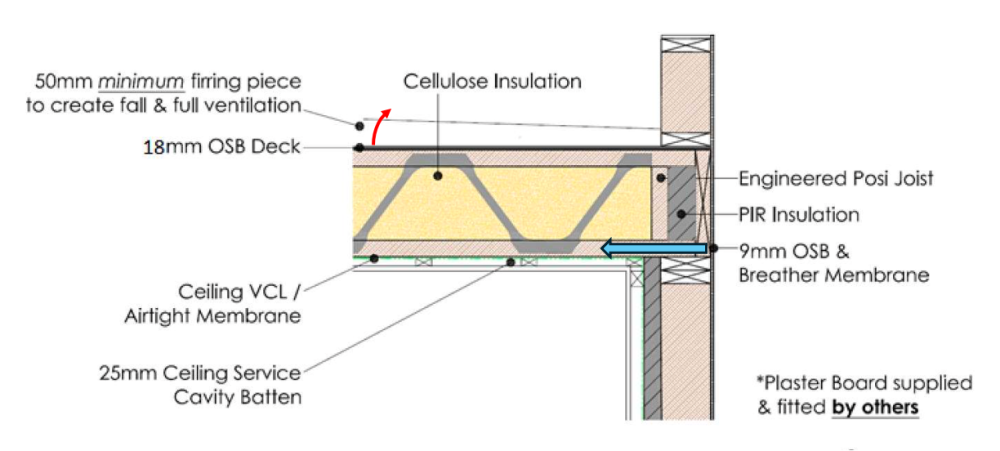
I'm interested in comments on this flat roof and parapet detail. 1. Am I right in thinking it's a cold roof? 2. And is the 18mm OSB deck in the wrong place and should it be moved to be on top of the firring (red arrow)? This would give the possibility for ventilation between it and the insulation? 3. What do people think about cold roofs and the risk of condensation if the VCL gets perforated? Is the risk manageable or are warm roofs always preferred, assuming you've space for the additional thickness? 4. What about the cold bridge along the bottom of the joist (blue arrow)? If so, what could be done about that? Thanks Still learning!!
-
AeroBarrier - a shortcut to air tightness?
LnP replied to LnP's topic in Energy Efficient & Sustainable Design Concepts
I searched AeroBarrier and Aero Barrier but got no hits. Sorry if I missed it. -
Anybody have any experience with AeroBarrier UK? They claim to get the air tightness down to 1.5 ACH by spraying atomised sealing solution into the house, so that it can find the leaks and seal them. A lot easier than going round and doing it by hand. But is it a permanent solution or akin to Holts Radweld which stop your radiator leaking for now.... but probably only for the next 500 miles before it starts leaking again and you have to do what you should have done in the first place and replace the radiator?
-
I just spoke to Quadrant Approved Inspectors. They told me my understanding of the options is correct - 1) revert back to the LA, or 2) cancel the existing notification and start again under the new regs. They told me Option 2 should be possible because the project has hardly started, but I do nevertheless need to confirm it with the LA. I'm still interested in thoughts about what the downside of Option 2, switching to the post June 2022 regs would be. Need to comply with Part O for overheating - is it a big deal or might it be a useful exercise anyway? I read on here that getting an EPC is more hassle under the new regs - somebody said you need to photograph every potential cold bridge? We're looking at timber frame 0.11 W/m2C anyway. ... any other things to think about? Thanks
-
@Mr Blobby would you mind sharing what kit you've gone for, prices and where you got it? Thanks
-
As mentioned elsewhere, PWC Approved Inspectors have gone bust, so I have to decide where to go now for building control. I registered the build with PWC before the BR change in June 2022 and did some very minor works before June 2023 so that I could say the build had started and could carry on under the old regs. We haven't started with the build though. My original decision to go with PWC was on advice from local builders who complained that the LA BCOs were slow to respond. The builder would be ready for the BCO to inspect something, but would have to wait 2 or 3 days for the go ahead. PWC gave a faster response. I now have a choice: 1) "Revert" back to the LA Building Control which will allow me to carry on under the pre June 2022 regs. The LA will charge me £1200. 2) Start again with another Approved Inspector, which I think (but I haven't confirmed this) will mean the build will have to be under the new regs. They might be a few hundred pounds cheaper than the LA. My architect says that the new regs wouldn't be a problem for us as we will anyway be exceeding BR thermal performance and starting again with another Approved Inspector shouldn't be a disadvantage. But are there issues other than thermal performance which would be a downside under the new regs? I'm looking for advice please. Which way would you go? Thanks
-
I went for 3 ph in a new free standing meter box in its final position, adjacent to a side boundary. I used this calculator from SSEN to decide how big the supply needed to be.
-
Quote for ashp - didnt expect that much!
LnP replied to TheMitchells's topic in Air Source Heat Pumps (ASHP)
You might doubt it, but I'm afraid it's the reality. I have a friend who is an acoustics engineer and his company get involved as expert witnesses in cases like this. He tells of one client doing exactly this with his ASHP. Neighbour complained to the LA about noise. It mutated into a statutory nuisance complaint. My friend's company took sound measurements and argued based on published guidance that the noise levels were acceptable. They were unable to convince the environmental health officer .... who didn't know the first thing about noise or relevant guidance. The client eventually got so fed up they sold the house and moved. My friend tells me this case is not unique. Even with planning permission you can fall foul of complaints that the noise is a nuisance and LAs are not well equipped to handle the complaints. But you are at least in a stronger position if you do have planning permission. Bottom line is just to be aware of these risks. If you're planning to use your ASHP for summer cooling and you have choices where to site it, you might choose somewhere further from your neighbours. It also depends on your relationship with your neighbours. -
Quote for ashp - didnt expect that much!
LnP replied to TheMitchells's topic in Air Source Heat Pumps (ASHP)
I agree you're unlikely to get found out, but you should think about the possibility that neighbours complain about noise from the ASHP running all day on cooling mode in summer when they have their windows open. If they dob you in to the council you might have a problem. -
The 4 pipe has two coils and the 2 pipe has one.... so are you saying that the 4 pipe, in total has more coil, a larger heat exchanger i.e. they didn't just cut the 2 pipe in half to make a 4 pipe?
-
Sorry I think I'm missing something .... so regardless of the position of your summer/winter switch, when there's a call for heat from the DHW, the ASHP automatically switches from cooling to heating?
-
Very interesting. Thanks @JohnMo for sharing. I'm not clear though what happens to the ASHP when you're in summer mode and the DHW calls for heat. I can understand how a call for heat from the DHW makes the 3 port valves turn and the CCT pump start. But won't that send chilled water to the cylinder? What tells the ASHP to switch to winter mode and start producing heated water?
-
New water connection. Expected costs?
LnP replied to flanagaj's topic in New House & Self Build Design
My situation's a bit different, but this might help ... We're going to demolish the existing dwelling and build a new one. The water meter was in the existing house and needed to be relocated. At the same time, I wanted to put in a new 25 mm MDPE pipe, running about 15 m across the plot, from the new meter. I got a moling company to that for £780 + VAT. No need to dig a trench. The moling company made the new connection to the exiting stop tap with a suitable Atplas fitting for the new meter. UU then came along and fitted a new meter at the existing connection in the street. Cost was £183. The stop tap is in the pavement on our side of the street. In your situation, I'd start by talking to a moling company to get a price for the new line and stand pipe. They might have suggestions about the best way to approach the utility. It was all cheaper than I expected. Not your situation I know, but might be helpful. -
Well here's one way it affects self builders. I just got this from my approved inspector, PWC: Please find below the Notice of Cancellation of our Initial Notice regarding the above project. The reason for cancellation is: we have become unable to continue to carry out the function with respect to any of the works to which the initial notice relates (as per Section 52 (1) of The Building Act 1984), due to the Building Safety Regulator (BSR) rejecting PWC application to be put on the Building Control Approvers Register. PWC have gone into voluntary liquidation. Apart from losing money, I'm trying to find out from the LA what that means for my project. The Initial Notice was made prior to the change to the building regs in 2022. I hope this doesn't mean that the new regs will now apply to my project.



