larry
-
Posts
169 -
Joined
-
Last visited
Everything posted by larry
-
Not sure this helps but would loose fill/blown wood fibre insulation be any better? That would then give breathability including hygroscopicity, which might help avoid damp? https://www.ecologicalbuildingsystems.com/product/thermofibre#technical-details for instance Never used the stuff and not sure if you have to blow it in or can use loose fill but worth looking into?? I think steico also make a similar product
-
https://www.planningportal.co.uk/permission/common-projects/fences-gates-and-garden-walls/planning-permission I read this differently, ie that a two metre limit would apply. But a hedge is fine. But I may be missing something. Knew a neighbour who had structural issues with Lleyandi, about ten metres from the property, so do watch that if you're seriously thinking it.
-
Blimey what a clever idea. Have you seen this done in practice? Does it look naff or passable?
-
This is an excellent point well made. But I think hugely missed. I'd wondered the same about batteries for PV. I guess in both cases there is the potential for balancing out grid usage if the charge/hot water happens at the right time.
-
Sikaflex EBT is excellent. Sticky. Lasts well outside. A bit pricey.
-
Dealing with condensation…
larry replied to HughF's topic in Mechanical Ventilation with Heat Recovery (MVHR)
It's got a fancy name?? That's more than I paid for my whole house unit....!! I mean, ultimately they aren't complicated pieces of kit. One consideration for the single room ones is how easy it is to change the filter. I put a direction reversal one on for my mum and it says it needs cleaning every 3 months, but the only access is by removing four screws, so that won't ever happen!! -
Dealing with condensation…
larry replied to HughF's topic in Mechanical Ventilation with Heat Recovery (MVHR)
If its a small place I'd probably try putting in two single room MVHR systems, a couple of hundred pounds each and basically replaces an extract fan. There are a couple of options available..I'd avoid the ones that reverse direction every 60 seconds or so and look for the ones that have a split inlet/outlet pipe. Generally means I think a 6" hole is needed, but no harder to fit than an extract fan. I had a query about these at some point and did some research. -
And If option 2, roof above blue square would be what? Top Needs to be below window for bedroom 3 Is wall between existing dining and kitchen bearing any load?
-
Ah OK, I wondered if it would it be potentially overshadowed by the extension? ☺️ But if the neighbours are to the south and they don't have anything sticking out that makes sense Don't quite understand this but can't completely get my head around your attic plans (me not you!) Makes a big difference to planning even at an early stage, though. You'll want to think about heating and DHW and there no better time to get your pipework in the right place than when you're ripping much of the house apart. Ideal time to consider an ASHP also, put in bigger pipes, and possibly UFH or bigger rads. If you've got a combi boiler that means putting a UC in somewhere. Attic conversion would rely on conversion to a warm roof system (presumably you've got felt and tiles presently). What's height like in the loft? Easy to build the new stuff to existing thermal spec but that doesn't help much if rest of house is a leaky sieve. I guess suspended floors in original house if 1930s, so ideally you'd pull up boards and get some insulation under (maintaing ventilation). Cavity walls? If so are they filled, cavity may be quite narrow so you might not get much insulation in there. So thermal PB as well on top? Or EWI? Again, makes sense to think about all this in the round as well be much easier with scaffolding already up etc etc And a big message I've picked up from this forum is to pay attention to detailing for thermal efficiency airtightness etc which is basically about taking time on each bit, but that often means keeping an eye on trades who are just keen to get job done and signed off. Other thought, access to drains OK for your downstairs WC in that location. Considered ICF? Random thoughts and defer to others' expertise
-
Which side do you get the sun on? Bit of a loss of light in bedroom 3 and first floor stairs? Depends what your plans were with the new wall I suppose or roof. Consider whatever you can to upgrade thermal efficiency also. Including the old house. I'd be thinking also solar PV and whilst I've got easy access to floors etc MVHR. But I'm no architect!
-
Retrofitting EWI - solid walls + dwarf cavity - too tricky?
larry replied to larry's topic in Heat Insulation
Well, I've tried to answer at least part of my own question - attached a very rough comparison of what I could see where the main insulating (mostly lime) renders on the market at the moment. Seems they mostly claim to bein the region of 0.12 w/mK but a couple do jump out at somewhat lower (Diathonite for one) but then they both need further finishes on top as well Insulating Renders Comparison - Copy.xlsx -
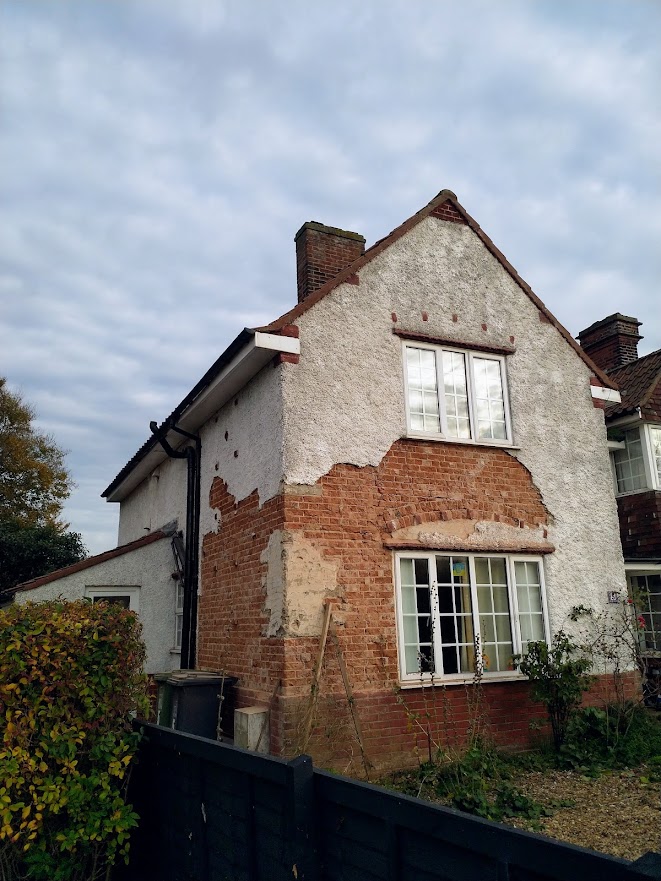
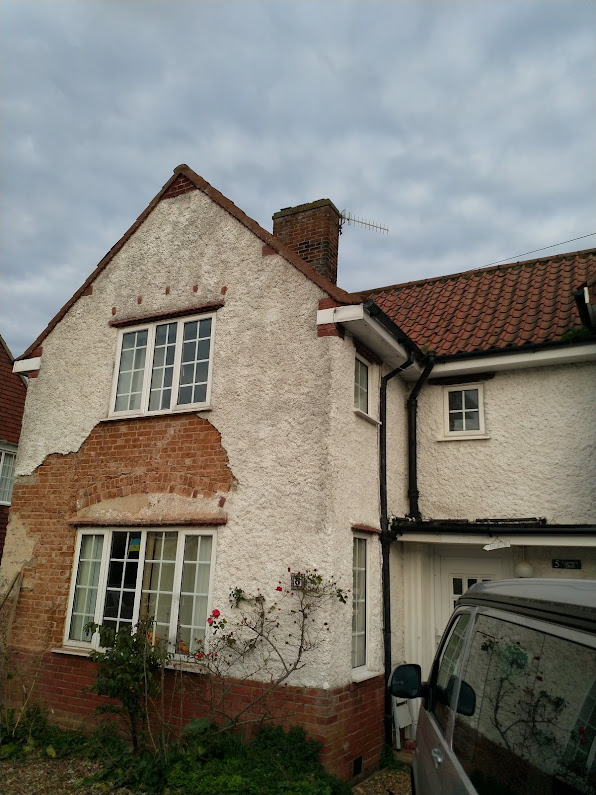
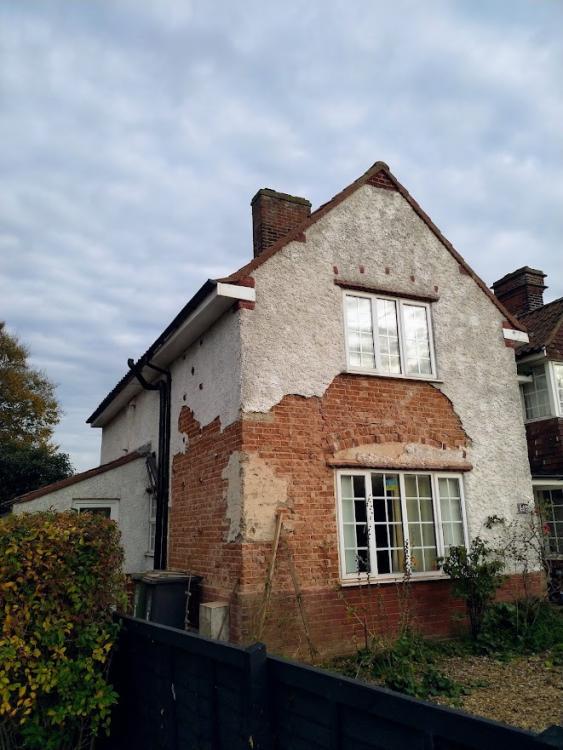
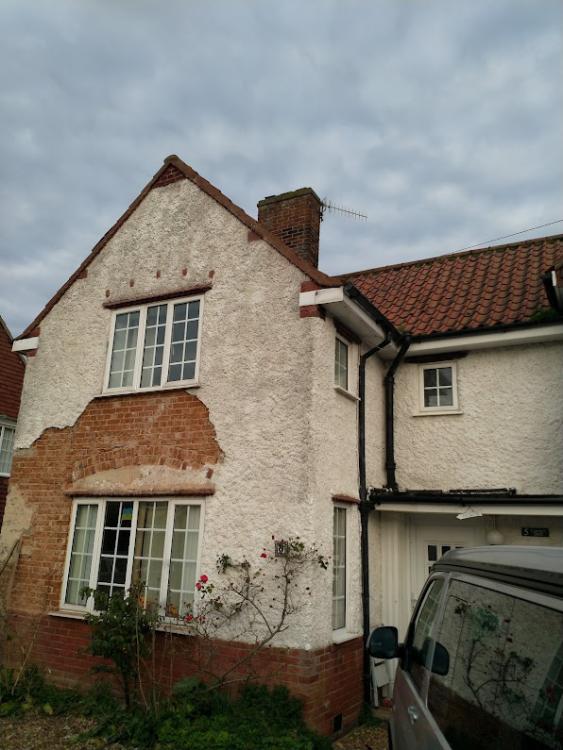
Hi, I'm after some advice from you knowledgable folks... So you've already helped me with several things related to this, but in essence I've been pulling off the render from our solid wall house to solve penetrating damp issue. It worked - hurrah. We then had a dodgy lintel - advice on here, and we've now got some Helifix in - again, hurrah. Now I've just got to work out what I'm doing with the render. It's a solid wall house, though with a dwarf cavity wall approx 800mm high. The solid wall sits on top. The old thick cement render, a good inch or two thick, then covered the solid wall and brought it basically level with the cavity wall. I guess the cavity is about 2" thick as that's about the depth of the protrusion. My starting point was to get somebody to re-render in lime, potentially expensive but bretahable and flexible. An alternative was to rerender in a breathable monocouche. Cheaper. But in the other posts people have suggested I'd be missing a trick not to put in EWI. The only problem with this is that I think it would be a potential pig of a job. It would need to be on three wall faces, one is a big gable end with no roof overhang. And there are two toilet stacks close to the property. And of course the dwarf cavity wall, which has a brick face, which we really like the look of. I know these are all solvable problems but extending the roof line, moving a cast iron toilet stack, and adding a load of brick slips begins to sound expensive. Is that a reasonable assumption or are these just issues par for the course? Moreover, I've already started IWI - the top room shown has wood fibre on walls and am pleased with result. Had planned to do similar downstairs. I'm doing this all DIY so no labour costs. It just takes forever. Whilst I think I can just about get away with plastering an (upstairs!) internall wall with lime plaster I don't think my skillset stretches to rendering... though I could probably fix boards to wall, that sort of thing. My only other thought before giving up on the EWI idea is whether it was possible to add some kind of thin EWI board, say 30mm or so, above the cavity dwarf wall, with only a thin coat render on top, and leave the dwarf cavity wall as is. That would mean the thickness of the board + render would be similar to the thickness of the existing cement render, which means all those adjustements are avoided. I'd still then do IWI in the downstairs room. I could probably fit the boards myself which I guess would save on labour costs. But then do I make the rendering job more or less complex? Is this a bonkers suggestion? If so, are there any EWI boards that can be fixed straight to brick, are breathable (solid wall, right?), and can be rendered on top with a fairly thin render (also breathable)? I know 30mm is puny but it would I think make a difference particularly in addressing the gap between the two floors I'd considered some insultaing lime render instead but the insulating values look very low and not sure it would be adding much? Or no? I am talking the options over with a few people who I hope will give me a quote , but I feel like this is a job where there are so many angles (and different products on the market) so please could I ask the BH brain for collective wisdom - thank you! Am I even asking the right questions?
-
Oh wow! Shame he didn't mention it!! Has he fixed it then?!
-
Just to update/bring this full circle. I managed to find a local builder who uses "Thor" Helical bars and they have (I hope) sorted this with two long helical bars above the whole window and eight separate bits coming up through the arch. Felt I'd reached the limit of what I was comfortable doing myself and pleased/reassured we've had it done. Next job working out what we put on top. Hugely appreciate the advice on here.
-
Isn't it just! Absolutely bonkers!!
-
Agreed with all of this. And yes, sorry I don't want to perpetuate any unhelpful myths about heat pumps. The boiler makers are doing a good enough job of that without my help. (I guess I was oversimplifying my situation slightly. Old boiler needed to come out in any case so created a time pressure. ASHP install cost was much higher. Knew I'd make a big difference with insulation and wanted to avoid having an over specified ASHP).
-
Ouch? In the context I was talking about the general benefits to the world/society. I don't think it's too contentious that an ASHP will produce a unit of heat for less CO2 than a fossil burner. And I don't think it's wrong to consider that a benefit. But, no, that's not my situation. I don't have an ASHP. In fact I first started asking questions on forums when I was considering getting one. The advice I was given was completely sound. Don't, until you've done as much insulating as you can do. That was a few years ago and since then "operation insulation" has been in play. I work full time and my budget is not huge, so I'm doing most of the work and learning as I go, whilst living in the house, and life is busy, so the pace is slow, and there is loads to do... And lots of unexpected issues... but I'm pleased that our gas consumption has already decreased from approx 24000 kWh/year to about 10000 kWh/year. Of course I'm pleased for both the cost benefit and the environmental one. I know in the grand context of things such a saving is a drop in the ocean, but it's the drop that I have control over!
-
Good job we don't run our cars off coffee, I guess
-
Total CO2e/kwh is lower than (say) gas.
-
I'm not sure about the maths on this. Obviously reducing the amount that fossil fuels conribute to the grid will improve the beneift of the heat pump, but I had thought there was still a benefit even with the current grid mix. But I say that without any maths and no disagreement with your main point!
-
I highly recommend the BBC "How they made us doubt everything" podcast. https://www.bbc.co.uk/programmes/m000l7q1 - the essential argument is that oil and CO2 today is the smoking of 20 years ago - with oil companies making huge active efforts to sow doubt about a causal connection between our lifestyles and climate change. It's depressing listening, but well done. Also, if you want current data about grid electricity CO2 impact, look at this app: https://play.google.com/store/apps/details?id=com.carbonintensityapp&hl=en_GB&gl=US&pli=1 -
-
I'd be interested in knowing what the surveyor said when you bought the house given it's so recent a purchase so presumably those cracks have reappeared in quite a short time. Were they the same sort of size? And in the same sort of place? No obvious issues that might be contributing? big trees close to house? water washing away sandy soil over time? (Dodgy drain, leaky gutter??). Had a neighbour once who had a problem from massive Lleyandi, a good 10m from his property, but it was clay soil and they are thirsty trees But as above (non expert here) needs an SE view. Keep us updated?
-
Just so you can all feel smug (and warm), I can see in one of my uninsulated rooms (solid walls, suspended floor, large badly fitted DG window), it dropped from 16 to 14'c in two hours after the heating went off. So that's what, -1.5°C/h. So some work still to do, then!! https://phpionline.co.uk/news/the-alarming-truth-about-heat-loss-from-uk-homes/
-
Ventilation is intended to prevent the risk of condensation within the chimney. My understanding is that being in the middle of the house would reduce this risk significantly in any case as there are no cold walls. There are other posts on this when I was researching a similar question. Is it capped at the top? If so do you know with what?
-
Have you ruled out MVHR? Depends a bit on the layout of your house as to how much you need to rip it out. Easiest probably to get top floor done as you could site unit in loft (probably) and then get access to rooms via ceilings for vents. If you use the radial ducting system it is only 75mm ducting so can also be boxed in eg. Backs of wardrobes. I did mine DIY (I have no doubt a pro would look at it and tell me 30 things I've done wrong) but we are super happy and I daresay my house will be a lot more sieve like than yours. Cost approx £2k total for the unit and relevant vents ducts plenums etc.