


WWilts
-
Posts
782 -
Joined
-
Last visited
Everything posted by WWilts
-
How about doing that + external wall insulation installed on the external face of the window frame or door frame To prevent heat loss regardless of how the frame is fixed to the cavity wall
-
110mm cavity wall, block inner, brick (or stone) outer leaf. Cavity insulation: pumped in bonded EPS beads (after cavity openings are closed & windows/doors installed). Window/door installer would normally fit uPVC windows without any overlap of the cavity insulation. If we want overlap of the cavity, they suggested inserting timber across the cavity into which they could fix the windows (screws). Will cement board do the job? Insulation will be available from pumped in beads, only objective is something that can withstand moisture (perhaps resist fire) and can bear the weight of uPVC windows.
-
Builder might. Want to understand stuff so that we can insist on whatever makes a difference
-
Has anyone achieved non-creaky first floor using 18mm T&G chipboard instead of 22 mm? (joist centres 400mm here)
-
18mm tongue & groove chipboard being considered, glued to 400mm centre joists and screwed with Spax at 150mm centres. Expansion space at junction with walls 10mm Is 22 mm (vs 18mm) chipboard necessary? Can either the glue or the screws be omitted without making the floor creaky? Is 10mm expansion at floor perimeter about right?
-
True. But Celcon claim very very low leakage for their blocks. No reason to doubt them
-
being done routinely as part of good workmanship. Will cement:sand parge coat improve the airtightness of cement:sand joints? Trying to understand that
-
Technical advice from Celcon: 0.1 m3/(h·m2) for the blocks themselves No reason to doubt them. Perpends recur, 10mm per 640mm Beds recur, 10mm per 225mm Large airtight blocks seem attractive as airtightness strategy, minimising area of joints between blocks Concrete blocks are known to be air-permeable. There is a video on youtube that subjects various blocks to smoke tests. Aircrete (Hebel, Australia) did surprisingly well Poor man's test for airtightness being applied here: night time torch in cavity, look for light leakage through inner and outer leafs. Perhaps there are better (low cost) tests
-
Wet plaster going on concrete blocks of internal wall that mistakenly was built into external wall. Might consider parge coat on (large) Celcon blocks, but painting just the joints with airtight brush paint seems easier.
-
So far no cracks, perhaps they will develop in time. Was considering options including painting the perps with airtight vapour permeable paint. Is it the same with bricks (outer face of outer skin)? Will have to look at brick walls more carefully.
-
How airtight can you make well pointed concave tooled joints that use 1:5 cement:sand mix? Hopeless? Some hope? Context: reasonably airtight large Celcon blocks, inner face of inner leaf of traditional cavity wall (Just a very specific question about the best possible performance of such mortar joints, not an invitation to recommend parge coat/wet plaster etc which are already noted as options)
-
Not understood the situation (what was there before, what was removed, what was put up, what you're aiming for). I'm slow, though. In general, having something there tends to improve the chances of permission for putting something else there. Having nothing there tends to make permission more difficult, especially with the kinds of restrictions you listed.
-
Yes
-
Outcome: Movement joint put in. Reason: cosmetic, not structural. To reduce the risk of cracks developing in the stone around that area
-
Insufficient knowledge here. Our simple thinking is that they are deliberate & controlled cracks inserted in the structure, to reduce the risk of unpredictable cracks later. Awaiting SE advice on whether that particular M joint can be omitted
-
Yes
-
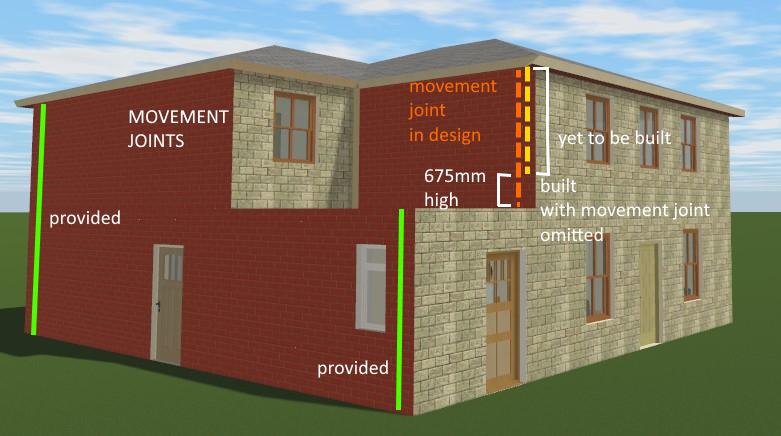
1) Movement joint in SE design, one mistakenly omitted by builder (see diagram). BCO does not mind, apparently. Should the movement joint be included from now on? (accepting that the lowest 665 mm will have no movement joint) Or should we insist that the movement joint be inserted in the 665mm height of masonry that has already been built without it? (context: junction of stone quoins and brickwork) 2) How to make movement joints airtight and weather proof? Expanding foam and silicon bead?
-
True, for window openings any nearer a corner, a "wind post" might need to be incorporated into the design according to SE
-
True. Window opening must be min 665mm from external corner in this particular context. 365mm measured internally
-
why so? 100mm block inner leaf width + internal length of block (200mm) till window opening = 300mm? Trying to understand the principles involved
-
2.1m wide window on upper floor of 2 storey new build. Hip roof trusses. Want to move window as near the corner as possible. Is there a minimum distance required from the corner? Are there considerations other than sufficient bearing for a heavy duty Catnic-type lintel near the corner?
-
Eaves lintels Catnic heavy duty & extra heavy duty cavity lintels, respectively. (Catnic CH and CX). 156mm high Timber wall plate to sit on lintel, hip roof trusses sit on wall plate. What is likely to work reliably for fixing the wall plate to the lintels?
-
Libel/defamatory comments on planning application
WWilts replied to Omnibuswoman's topic in Planning Permission
Council officers typically have too little time to chew on all the issues and come to a reasonable decision on relevant grounds. Anyone who makes zero demands on their time is their friend. Objectors who spout off without reason introduce more work for the officer, who has to show that the objection was at least read before approval was issued. Applicants who simply let unjustified objections flow by without requiring action from the officer are likely to be aided by objections, paradoxically. Because the long-suffering applicant is the only one making no demands on the officer's time. Only those objections which are firmly based in the development plan or other material considerations need be shot down by the applicant, if at all. Often officers will do it for the applicant, rather than issue a refusal that allows room for an appeal. Officers are merely trying to guess how an appeal might go, and to issue decisions accordingly. -
Thanks
-
Is that "scrim"? Our builder says his plasterer will use scrim and then skim over that

