
Adsibob
-
Posts
3604 -
Joined
-
Last visited
-
Days Won
10
Everything posted by Adsibob
-
I’ve checked the drawings, and they do show cavity closers. It doesn’t say “cavity closer” it says DPC tray, which I’m hoping is the same thing; basically shows a DPC closing off the cavity. But discussing this with the architect, he tells me that the builder should have provided weep holes for the water to come out at certain points between the bricks. This definitely hasn’t been done. Architect’s suggestion is to cut out the mortar at those points and install the weep holes/vents now. I really do find this astonishing. Not sure what buildings regs is actually for, other than bureaucracy and fee generation.
-
So I don’t think we have a cavity tray either. Is this a breach of building regs? If so, shouldn’t it have been picked up by building control???
-
Here is a picture of the rusty screw by the way: I’m really concerned that water has managed to get that deep into the brick work.

-
Annoyingly, our first water ingress issue started a month or so after the 12 month snagging period had completed. FFS! Yes, it was a bit odd being off for so long. I enjoyed much of it, but I think I’m on the whole better when I have a job and a salary.
-
The job is pretty good. Not having time for issues with the house was suiting me rather well, until I started noticing water ingress. It just really p!sses me off that we spent a fortune and the newest bit of the house (ie the extension) is the bit that’s been problematic in terms of weather proofing.
-
So it’s not the windows. Is either the brickwork or the roof. I f**cking hate this. Question: Does a coping stone need to project beyond the edge of of the brick that it sits on. We have a parapet wall, and the coping “stone” at the top, which is actually a composite made to look like slate, does not fully cover the top brick. So it’s possible water is coming in from there and seeping down ten rows of bricks and then getting into the window that way. Seems impossible to me, but the window company have shown me that the screws fixing the top of the window into the brickwork/lintel from underneath the opening where the window in question is are all rusted and their position coincides with where the water is coming in. It’s not a huge amount of water, maybe 20ml a day since a few dates ago, and only after quite a bit of rain. Other possibility is lack of drip profile on underside of brickwork where window opening is, but architect assures me this is not required for brickwork where the joint between the brickwork and the window is sealed with mastic sealant, as is the case here. I guess the sealant could have failed??
-
Yes, I think it must be wind driven rain because the window itself is under a slight recess in the brickwork that is almost 5cm, though I note with it was more. The installer is FENSA accredited, but that doesn’t mean they can’t try to exempt liability for what they will call consequential damage to the plasterwork. I will give them a call first thing in the morning. With another window, we noticed a draft shortly after installation and they came back and tightened a part which they called “the mushrooms”. I wonder if it’s the same issue here?
-
-
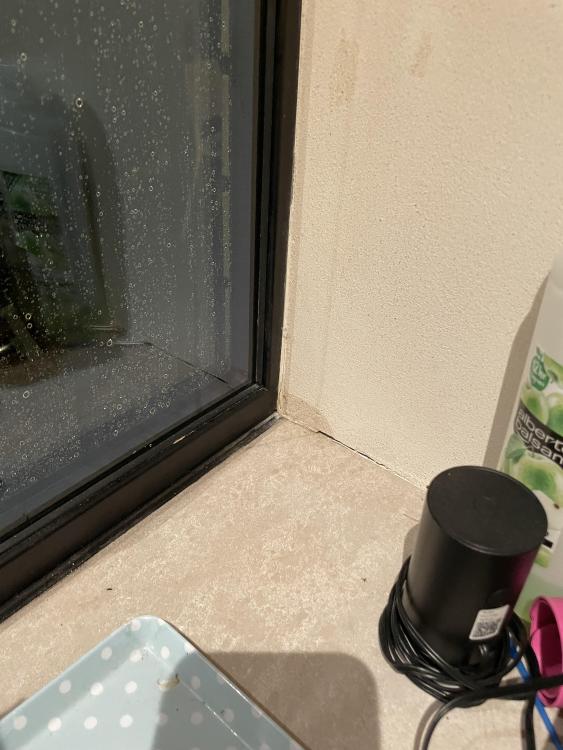
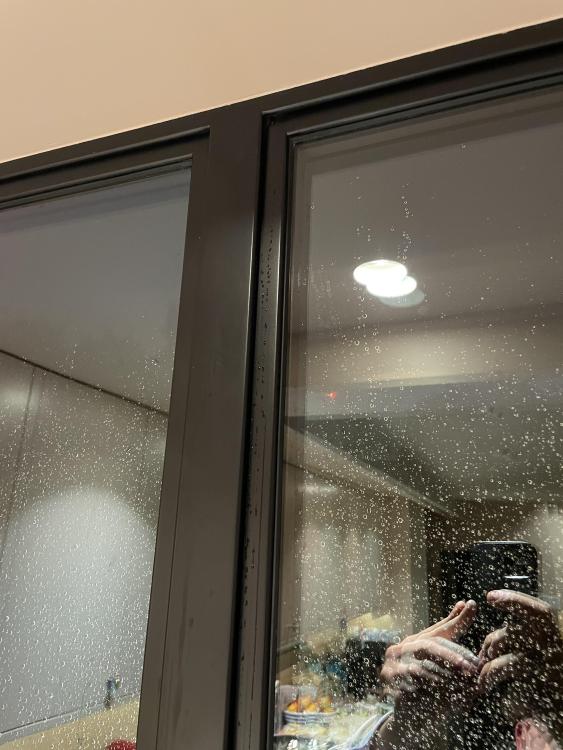
Got home this evening to discover water ingress at our kitchen window. This, as with all our other windows, is an Aluminium 2G MetTherm casement window which was installed almost 2 years ago. A couple of the windows had problems shortly after installation, but these were fixed by the installer, the problems having been identified a couple of days after installation. The installer also supplied them, so there wasn’t any room for them to dodge responsibility. We’ve not had any problems since then. There appear to be various drips that have come in from the top horizontal seals, and possibly also at the vertical edge - difficult to tell whether the water at the edge came in from that edge or dripped down from the top edge. They are top hung. This is part of the extension, so everything is new and I’m wondering how I prove this is a window issue, rather than some other construction issue? Some of our (rather expensive) clay plaster has been ruined by the leak. Not much really, but enough to notice if you know where to look. I suspect the window company will have purported to exclude such consequential loss, and I can choose to either argue with them about the lawfulness of such an exclusion clause, or make a claim against my buildings insurer, or just accept the marked plaster.

-
Yes, managed to keep the others from melting by drilling partly underwater (was drilling holes into ceramic pots). Not sure how I’ll keep it wet enough when I come to drill the tiles. They are also three times as thick as the ceramic pots!!!
-
I thought it was torque?
-
So finally got around to trying this out with a spearhead drill bit made by “Universal Fit” bought from screwfix. I took it fairly slow but clearly not slow enough as I managed to break the spearhead off at first attempt: I had my DeWalt drill on the greater torque setting of 2 (out of only two options, 1 or 2) and the other setting on 7. Created a lot of heat and only managed a 6mm depth hole before it broke!

-
Yes, there was a fake rock grain that looked very realistic, and would have been a shame to lose it. So I’m still glad I spent so long fixing that mud-labelling error.
-
I like my wine, and I like my wine fridge. But I’m not sure that makes me an expert!
-
You will be stung with a customs charge. Vote Brexit!
-
 @DIY-builder-Dad you could certainly remove those rafters, and then the roof would fall down. Only way to do it really is with lots of steel beams, and that’s probably a non starter, because the house wasn’t designed for that kind of weight up there. If you really need the extra space: get a design for a proper loft conversion. I think it will cost minimum £30k… and then some. Garden room far cheaper.
 -
What Boiler to prevent short cycling?
Adsibob replied to windsor-tg's topic in Central Heating (Radiators)
Not everybody is certified with Veissman to give you the guarantee. Search for an engineer that is. -
What Boiler to prevent short cycling?
Adsibob replied to windsor-tg's topic in Central Heating (Radiators)
A Veissman might. Depends how big those UFH loops are, but a Veissman can modulate down to 1/17th of its maximum output. I have a Veissman and we don’t have short cycling issues - we do however have a low loss header installed. -
It depends how you spec your UFH. I specified thicker pipes, because I wanted a higher output system, and the possibility of possibly switching to a heat pump in the future. We laid very expensive insulated boards made by Cellecta under the first floor. I can’t remember what they are called, Xflo something. This has resulted in a response time of only 80 minutes or so, so if you’re at the airport and unexpectedly need to bring a guest home, you switch the call for heat on remotely, and by the time you are home you only need to wait about 20 minutes or so for the room to start warming up. We are fairly well insulated, so even in winter it’s rare that a room is more than 2C or 3C colder than we want it to be, so 80 minutes is manageable.
-
See my previous post.
-
I would need to be able to control it remotely. Well, “need” is perhaps a strong word, but I use the remote control quite a lot in winter when our plans change, which they often do, and this saves energy. E.g. we will be spending the afternoon at my parents, my kids might unexpectedly sleep over at their grandparents such that it is helpful to quickly launch my tado app and change the timer on my two kids’ bedrooms and the family bathroom. Or at Christmas we took my uncle to the airport, only to be told on arrival that his flight was cancelled. So before getting in the car to drive home, I tell Tado he’s going to be sleeping in the guest bedroom and using the guest bathroom. In winter I tweak settings remotely about once a week. In summer I will sometimes tweak the hot water settings to heat extra water when I know I’m going to be using our rather massive bathtub. We have a large house, which although well insulated is not passive. So helpful to be able to control the heating in each room, and helpful to be able to do it remotely.
-
Can you control the flow balance for each room remotely, away from home?
-
Don’t install heating in the bedrooms, as @ProDavealluded to. Ventilate the rooms you want cooler. Time you heating use intelligently.
-
This is just not true. At least not in an airtight house. It also makes no sense to have sleeping quarters the same temp as say, your lounge and kitchen. Sleeping quarters are more comfortable at 18C (+/- 1C), whereas that would be far too cold for a living room, dining roo, bathroom or kitchen.
-
Thanks @patp. The product you’ve linked appears to be a consumable for some other product. Is that right, or have I misunderstood how these traps work?