Adsibob
-
Posts
3609 -
Joined
-
Last visited
-
Days Won
10
Everything posted by Adsibob
-
I have a kitchen unit door that is meant to open by lifting upwards. The hinges fitted is of the Blum Aventos HK-S Stay Lift series, but it's not working. The door just doesn't "stay" up. I'm pretty sure that it's because the "Power Factor" sometimes also described as "LF" (which maybe stands for Lift Force?) is too low and so I've found the next model up which has a greater Power Factor that should meet the requirements of my door. There is a helpful formula for working this out. But I spotted that on both the existing hinge and the replacement I am thinking of buying, the "opening angle" is stated as 107 degrees. I only have space for 88 degrees or so, as there is an obstruction once you reach 88 degrees of opening. Could another reason my existing hinge isn't working because I'm not opening it up to the max 107 it is designed for, or are these hinges variable such that you can configure them to different opening angles? The replacement I'm considering is this one: https://www.debonairjoineryproducts.co.uk/product/blum-aventos-hk-s-stay-lift-set-lift-mechanism-pair-20k2e00-02/
-

Council Tax Blow!
Adsibob replied to richo106's topic in Self Build VAT, Community Infrastructure Levy (CIL), S106 & Tax
Ditto here. -
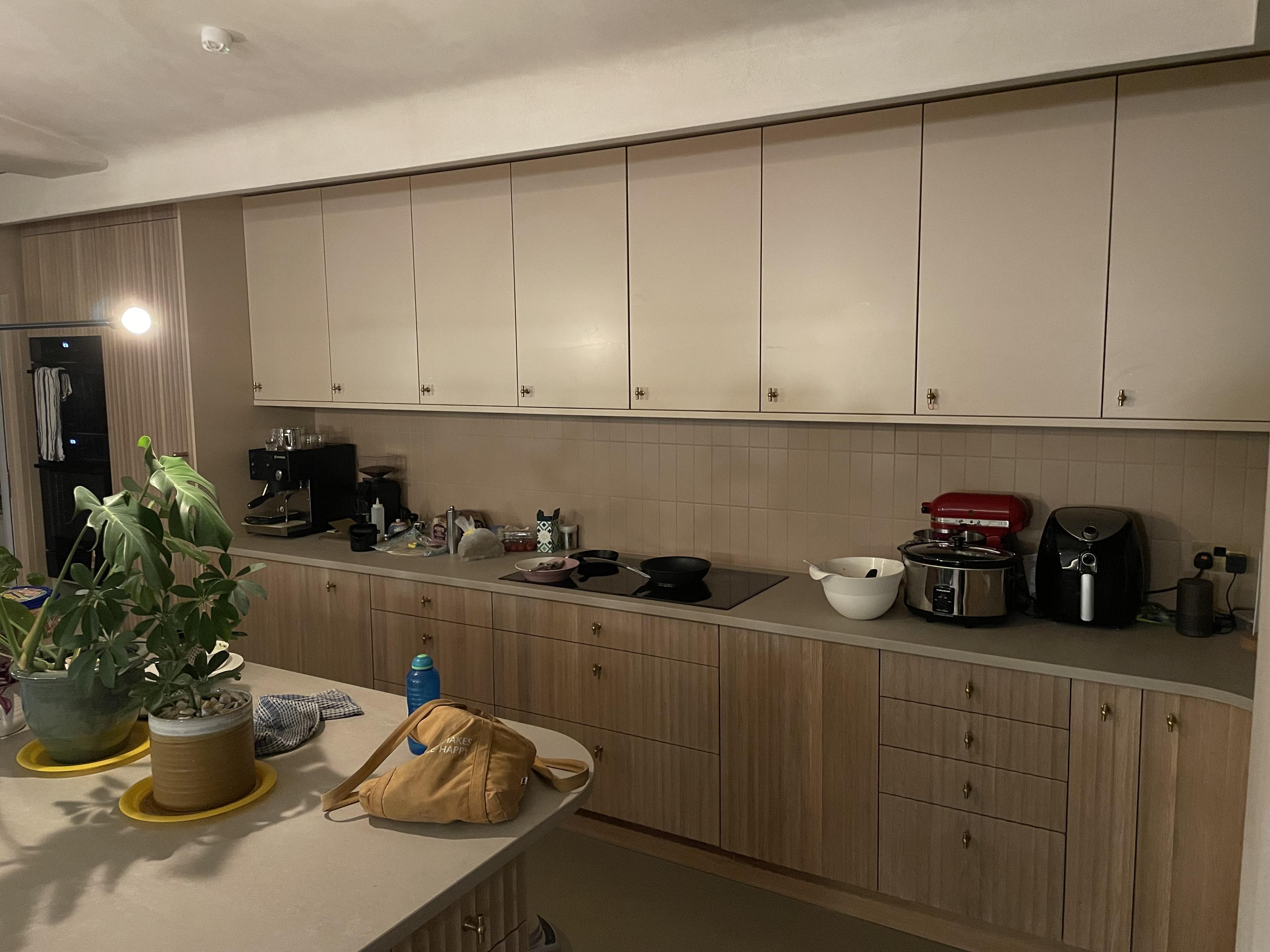
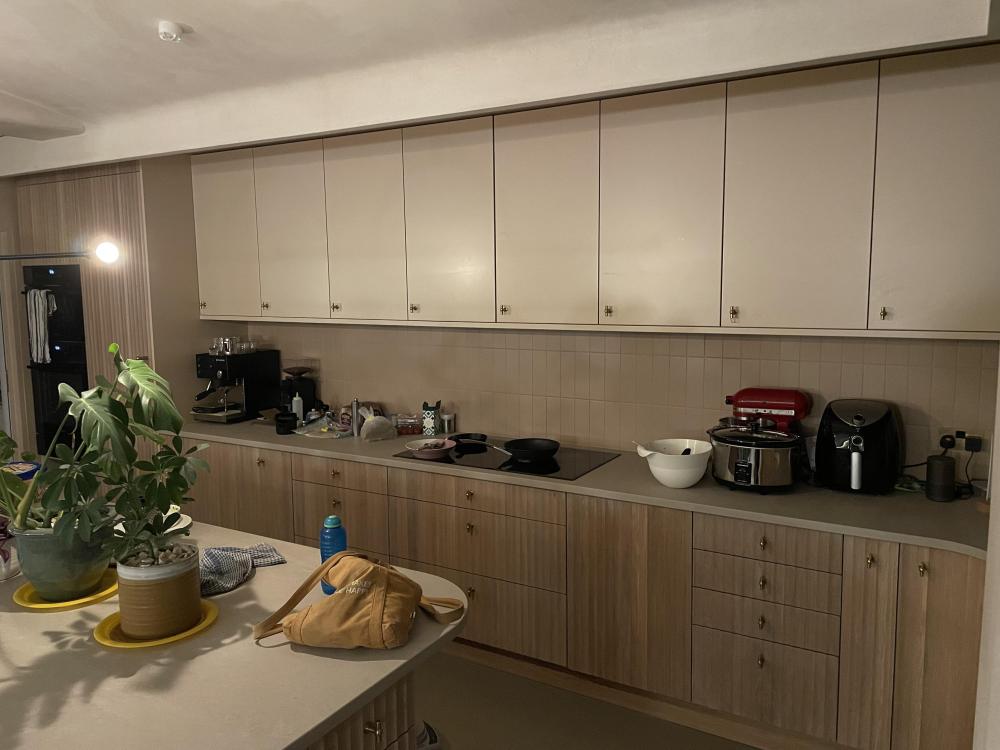
Yeah something like that, but because the wall units are only about 33cm deep and the tall units are full depth, they are on different planes, so you hardly notice. In our case, you never notice because they are two additional measures which conceal this: 1) although all the carcasses are from diY kitchens, the base units and tall units are finished in a different finish (oak) to the wall units (painted finish); 2) additionally, that top area is recessed behind a decorative bit of ceiling - difficult to explain but maybe this picture can explain: That ceiling slopes down from the apex of the roof to about 10cm in front of the tall units, above which the ceiling is flat. I really like this sort of our kitchen at it enables us to fit lots of almost concealed downlights as well as creating architectural ambience.
-
We installed it so that gap between bottom of pelmet and worktop is 58cm. The DIY kitchen standard pelmet is about an inch high, so cupboard must be 605mm above worktop. We are really happy with the height. could also work a bit lower. I think our hob, which is AEG requires a minimum of 560mm. Just pick a couple of hobs and see what their requirements are.
-
Just watch out for creating mould traps. Niches are notorious for this, unless It’sa noche in an internal wall (or a very well insulated external wall) and you have MVHR in which case you should be ok.
-
You are the type of LL to fit secret cameras in the bedrooms of your properties aren’t you?
-
Well I’ve ended up drilling about 70 holes into the thing, each hole has a diameter of 8mm so I’m hoping this will make somewhat of a difference. We are just storing bikes in there, no tools. Rust doesn’t really effect them as any bare metal is oiled. But mould did grow on some of the rubber bits. wish I’d known about the waterproofed floor, as we have laid a concrete floor, but there is no DPM. I guess I could paint a liquid DPM onto the floor, but probably won’t make a difference. If this doesn’t fix it, I will have to get a fan. There is actually some electrical lighting in the bike shed, so hopefully not too complex to run a feed off of that to power the fan, but I’m just a bit confused as to the practicality of such a solution. Would it need to be running 24hr a day or just come on a few times a day to clear the air?
-
Code for viewing area
-
@Pocster why does your kitchen window look out onto a brick wall. Is this the “kitchen” in the Fritzl dungeon?
-
+1,, though depends how fat you are.
-
I have an Asgard steel bike shed. It approximately 1.85m long, 95cm wide and 1.2m high, so just over 2 cubic metres in volume. It consists of 4 steel sides (one of which is a door) and a flat roof, which I’ve covered in Seedum. It has ventilation holes at either end, but the holes on one ends have been obstructed by us building a low 80cm high wall in front of the shed. The shed contents get mouldy as soon as the temperature drops to autumn/winter temps. There is still a 6cm gap between the shed and the wall, but I suppose it’s much more sheltered from the wind, such that the obstructed holes aren’t doing their job. I’m hoping to fix this issue by drilling 1cm diameter holes into the shed, at a higher point on its walls, ie above where the 80cm high wall reaches. Is this likely to fix the issue, and how many holes should I drill? The fewer the better, but I will space them out at regular intervals.
-
Take a photo of the building, print it and hang it up in a museum. Then knock it down (the building, not the museum).
- 39 replies
-
- 1
-

-
- demolition
- wall
- (and 1 more)
-
Why on Earth would the OP want to do that? Great way to piss off your neighbour, who you then have to live with until one of you dies or moves.
- 39 replies
-
- 5
-

-
- demolition
- wall
- (and 1 more)
-
How much technical detail should a construction drawing show?
Adsibob replied to Adsibob's topic in Damp & DPCs
You will find a few on google. Here’s an example: https://keyfix.com/product/non-combustible-cavity-tray-lintel/?ppc_keyword=cavity trays with lead&gad_source=1&gclid=Cj0KCQiAjMKqBhCgARIsAPDgWlx8CyNhgFmA730RIROMxpaQ2MGKnkndaf1HQZ5MjJug3wNxZHAFUg0aAgSrEALw_wcB -
How much technical detail should a construction drawing show?
Adsibob replied to Adsibob's topic in Damp & DPCs
My builder assures me it was installed. I went through my architect’s photos from the build, but unfortunately they don’t capture that level of detail on that particular aspect. I don’t have much choice but to trust the builder is not spinning me a yarn. -
Will the snubber/capacitor that was linked to earlier in the thread work, regardless of the voltage requirements of my LED?
-
I don’t, but I doubt anything has been done against regs, add the sparky was very good.
-
Maybe they aren’t demolishing it? Maybe they are converting it into something? Or extending it?
- 39 replies
-
- 1
-
-
- demolition
- wall
- (and 1 more)
-
How much technical detail should a construction drawing show?
Adsibob replied to Adsibob's topic in Damp & DPCs
Yes, well hopefully this is now fixed. Only time will tell. We need lots of rain to test it. But if it’s fixed this easily then it will be another example of me worrying excessively over sh!t not with worrying about. Sorry to hear about your roof. That’s terrible! -
How much technical detail should a construction drawing show?
Adsibob replied to Adsibob's topic in Damp & DPCs
Yes, it’s pretty maddening that this may have happened. I don’t know the exact design of the lintel and DPM but I understand it’s a lintel with an integrated cavity tray. Not sure exactly how deep into it the screw went, as presumably the cavity tray is at the top of the lintel, and the lintel must be pretty thick given it’s holding up lots of bricks. The window supplier was responsible for fitting, so it would have been their mistake. But it was compounded by lack of weep holes, which likely caused water to build up. The leak was not huge. Maybe 25ml of incoming water after heavy rain for many hours. So I’m hoping the weep vents will now allow the 25ml of moisture that built up to evaporate, but we shall see. Wondering if I should invest in that stormguard product someone linked, think it was @ProDave. -
Don’t you need to do some differential equation to model the fact that the heat leaks out continuously not incrementally.
-
This is a pretty long flexible LED tube, but not so flexible that I’m keen to remove it from the recess in our ceiling and experiment. It’s odd, because although it’sa long LED tube, I’m pretty sure it runs off normal voltage, without a transformer.
-
How much technical detail should a construction drawing show?
Adsibob replied to Adsibob's topic in Damp & DPCs
update: first two weep vents went in last week, final three went in yesterday. So we have 5 now, each one spaced about 42cm apart from the other, above a cavity that is about 165cm wide, so just within the NHBC requirements (not that my house was built to that standard 😂). Was a very quick job. Could have been done in half a day, but weather required a different timetable. Looks pretty tidy: They also removed the screws that the window company has drilled upwards, and filled the holes with silicone. So fingers crossed that is the end of my leak. Let’s see. Query what to do about the damp looking bricks. It is actually not the bricks themselves, but the off white mortar that has gone a bit brown around a few bricks above the lintel. Is there any harm in waiting till the wall properly dries out, I expect no sooner than April next year given we are this side of winter, and then addressing that?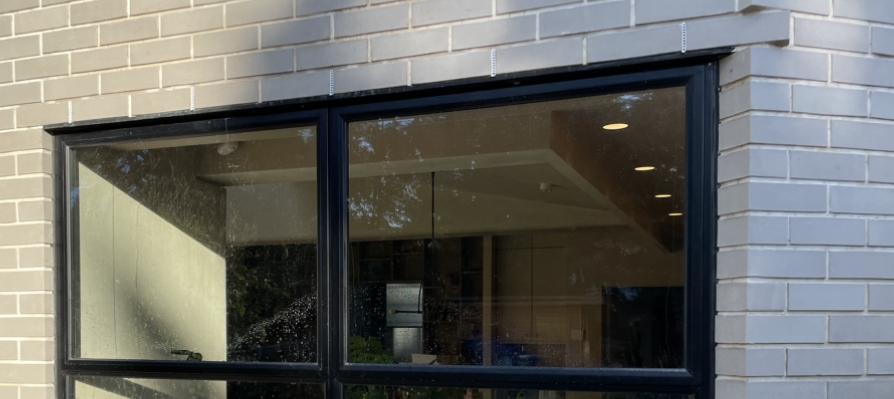
-
Where would the double pole switch go in my three way switching set up? Is it instead of one of the switches I have already or in addition?
-
I think I found what the issue is and the potential solution another forum: It's capacitive coupling between the wires between the two switches, this allows a small amount of electric current to make a side-run around the open switch contacts. This small current is enough to cause some CFLs to flash periodically and some LED fixtures to glow dimly. and to trigger non-contact voltage detectors. It can be cured by adding a lighting capacitor in parallel with the light fixture, providing a path to neutral sufficient to pass most of the ghost current rendering to voltage at the outlet too low to activate the lamp. Thoughts?