


Adsibob
-
Posts
3609 -
Joined
-
Last visited
-
Days Won
10
Everything posted by Adsibob
-
In my quest to hack a bog standard kitchen into something more fancy, instead of having the regular plinth to match the rest of the kitchen, we want it to be brass. The downsides of brass are that it might get scuffed easily when people knock into it with their shoes and I also imagine it's going to be quite expensive as we need about 12m by 10cm of it, although it would be pretty thin as it has to be flexible enough to bend into four right angled curves for the bit that goes around our island. It's structure would just be the plinth that is supplied by the kitchen company. Has anyone sourced such a piece of brass, if so where from? Would an alternative be to paint the plinth with some sort of gold paint. Has anybody done that before. Does it look good, or do I need to powder coat it?
-
Granite and marble are natural materials so although they look beautiful they do absorb liquids, which mean they do stain. Vendors will tell you that it has been sealed blah blah blah, but in my experience those seals rarely last, and even if it's possible to reseal, by the time you've noticed it's usually already stained. Wood is the only other natural material (apart from maybe slate) which is worth considering. That will also stain, but it is easier to care for if you have the discipline of regularly treating it with boiled linseed oil (a gentle sand and a coat of the oil once every 6 months should do it). I would still never lay a wooden worktop around a sink though. Worktops are really an example of you get what you pay for. If you are prepared to invest the £££ the man made composites like Dekton and Silestone are really incredible products that can almost look natural but have the benefits of man made products. Dekton in particularly is virtually bomb proof.
-
I tend to use www.soundstop.co.uk for all sound insulation queries and issues. They have products to suit all budgets. Slightly above mid price, is a sand filled board called an SBx board (https://www.soundstop.co.uk/soundproofing/soundproofing-floors/SBX-boards-solution4.php). This is really clever because the lattice that holds the sand is in a zig zag shape so it deflects the sound into the board where it hits more sand.
-
1. Pavers will be most expensive but give you a nice look. Concrete is cheaper. A halfway house is to get the companies that do concrete and then somehow mark it with a stencil or something to make it look like pavers. It is a pretty clever effect and gives you the best of both worlds, though if not done well it can look a bit tacky. Gravel is the cheapest. The low cost of gravel and the potential security benefits (it makes anoise when somebody steps on it) are its main advantages. It looks nice too. But gravel has a big disadvantage: even if you dig a trench for it and apply an edging strip to try and contain it, it gets all over the place eventually. So if you have gravel, be prepared for that and maybe consider whether you'll mind and if you will, whether you'll have time to sweep it, reposition the stray stones. 2.Pass. 3. I would definitely keep the garden. It's a nice feature, adds greenery and gives a calming and balancing affect to the view of the driveway. If you were to get rid of it you would just have a car park in front of your house. Don't worry about stray roots growing into neighbour's land. That's not your problem. 4.Probably not much you can do other than try and replace them with manhole covers that is coloured the same colour as your final driveway. 5. Pass. I'm due to do mine at the end of the summer and will let you know.
-
 I need some concealed cisterns and frames for wall hung toilets. I'm considering the Geberit Duofix with 8cm Sigma cistern shown below, as if I understand the product correctly, this will enable me to mount my wall hung toilet onto a thinner stud wall. Is there any disadvantage to this? Compared to the deeper 12cm version, the extra 4cm of space in the bathroom will come in handy, but at what cost? The waste pipe would go through the floor and then have to travel horizonally about 170cm to get to an external wall where it will connect with the main sewage pipe. I have posi joists so I'm hoping it won't be too tricky.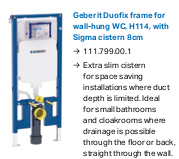
-
Cheapest 22mm Egger extra peel clean T&G supplier right now
Adsibob replied to Adsibob's topic in Floor Structures
Thanks. Where from? -
Assuming the consensus is still that 22mm Egger extra peel clean T&G chipboard flooring is better than 18mm plywood for achieving a solid sub floor, which supplier do people recommend! Best price I’ve found is £16.57 for a 2450x600 board, which i thought was cheaper than ply, but I’ve only just realised the ply I was comparing it to is 2450x1200 so this actually is much more than ply!
-
thanks @PeterW but how do I find the Grohe ones discounted to that sort of price?
-
I was going to call it an allergy, but that would really be silly. I just really don’t like chrome. Our bathrooms are all going to have a brushed brass, antique brass or matt black finish on the fittings and hardware. I would like to match the flush plates or push buttons on the wall hung toilets to these finishes, but I’m struggling to find something affordable. Seems madness to pay c. £100 plus for the flush plate when the frame and cistern and toilet only come to £400. geberit do some flush buttons which are white with a gold trim. I guess that might work, though it’s not ideal really. Grohe do a brushed gold which would more or less match, called “Grohe Arena Cosmopolitan S Flush Plate Brushed Cool Sunrise” but the price is £131 which is madness. I saw another Grohe option called the Grohe Skate Cosmopolitan which has some acceptable colours and comes in at £95, but again that seems a crazy price. i could get a Crosswater flush plate in brass for £80, but that would require getting a cross water cistern and frame - anybody have any experience of those? If anyone knows which manufacturer has reasonably priced non-standard colours for their flush plates, and still offers a 10 year warranty on the cistern and frame kit (like Grohe do ) please let me know.
-
You make a good point @ProDave. Particularly because I’m not sure my electrician has that much patience. I’m keen not to have too many switches on my splash back above all these appliances as I already have most of my sockets there. How many appliances is it worth having isolation switches for given a new consumer unit (which will be on the same floor as the kitchen, albeit at the other end of the house) should be capable of isolating the oven and the induction hob (separately). In addition to the oven and induction hob, I will have: Full size fridge freezer second fridge dishwasher recirculating fan If the isolation for the oven and hob are each done from the consumer unit, the recirculating fan is done separately and concealed within a cupboard above the fan, the dishwasher is done separately and placed near the dishwasher, that would just leave the two fridges and the freezer. Could those three be done on a 3 gang grid, or would that be tricky as well? The other alternative is to have some isolation switches in the adjacent utility room, but not a huge deal of space there either.
-
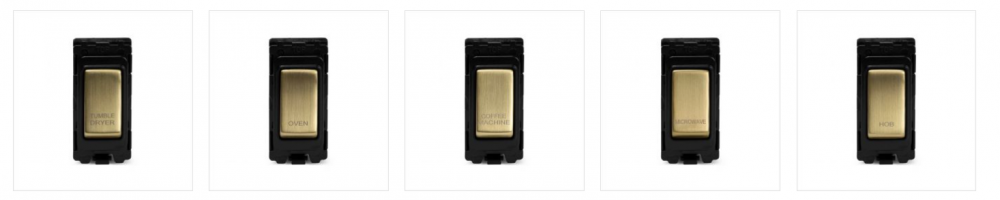
I'm going to order a "make your own switch" grid (like this) with a bunch of double pole switches like these: But my question is: how many appliances should I do this for. Have I understood correctly that the big stuff like the laundry machines, oven and induction hob needs a double pole isolation switch for safety, but the rest is more "optional". What are the advantages of having a double pole isolation switch for each appliance?
-
@Russdl thank you, this is very helpful and reassuring. If you change the settings, can you set it up so that instead of boosting from 200 to 300 it boosts to 240 or 250 it would be quieter whilst still giving you the boost in ventilation you need? How customisable are the settings and routines?
-
Thanks @Conor, just as @Russdl had persuaded me i should go with the Flair 400, you’ve now tempted me to get a quote from a sixth company. I didn’t realise Lindab sold MVHR units; for some reason I thought they just manufactured extract and supply valves.
-
Ventilation Boost switches
Adsibob replied to Stones's topic in Mechanical Ventilation with Heat Recovery (MVHR)
The Boost switches that CVC sell do exactly that. They are "bell press" switches. You press and forget about it as it automatically rocks back to the off position. It just boosts for a progammable amount of time. -
Good idea, but it just sounds like more complexity and more space required for the install. I'm a bit tight on space (both in my pump room and in my small skull). I think the reason is that Passivhaus have to test it to certify it. That probably costs money. So there is an extra cost. There is also extra demand from those who want PH certified homes and from those like me, who will never have a PH certified home but who recognise the value of their benchmarks.
-
Just thought I'd update this with some further things I learnt from CVC today about the Brink Flair 400: It's not the same as the Excellent 400. Apparently the Flair 400 is slightly quieter, not because the Excellent is noisy, but because - apparently - the Flair is the quietest machine Brink make. It can be used with an Activated Carbon filter. They cost £75 a pop though. CVC think that even in London an Activated Carbon filter would need replacing every six months, so this does increase running costs but given the quality of London I guess it's better to swallow the cost than the NO2 and SO2. It does not come with a humidity sensor as standard, but it is available as an extra for about £175. The Flair 400 Plus, is the same except that it can be controlled via the internet. This costs a bit more, but the majority of the increased cost is negated by not having to but a remote control pannel for it as your mobile phone becomes the remote control. The mobile phone app does not give you access to all of the controls the remote would, but it's enough to do most things. Full functionality can be accessed via a PC/laptop. Physical boost switches are available. The first costs about £45 and each subsequent one costs about £17. They look like white light switches with a rocker switch that automatically moves back to the off switch as soon as you press it. Can be replaced with your own light switch to match your other lights. After this conversation, I'm now really leaning towards the Brink Flair 400, but I'm going to let it percolate for a few days, so if @Visti or anyone else has any experiences of this machine or similar Brink model, good or bad, do shout.
-
Yep, according to this it is: https://database.passivehouse.com/en/components/details/ventilation_small/brink-climate-systems-bv-brink-flair-400-1362vs03
-
Very useful thanks @Trw144. The Hwam has some pretty cool features such as their autopilot feature that lets you set the temperature. Really very clever. I didn't understand this though: "All HWAM wood-burning stoves are convection stoves. This means that the wood-burning stove quickly emits heat after lighting. The heat is transferred by a natural air current, and not by heat radiation. This results in a pleasant indoor climate and a uniform temperature throughout the entire room. Another advantage is that the outer cap of the wood-burning stove does not become especially hot. This is to say that furniture can be placed quite close to the wood-burning stove." Does this mean it pumps hot air into the room? Wouldn't that mess with my MVHR? If i have misunderstood that and it is indeed compatible with MVHR, then both the HWAM 4520 and 4620 models look that they might work well for my room; I just need to figure out how mank KW i really need, as the 4520 is rated 3-7kW and the 4620 is rated 3-9kW.
-
Thanks @jack that’s good to know, though kind of a shame that such an expensive unit leaks, albeit not very often. I’m considering the Brink Flair 400 which i thought was slightly smaller than /different to the Excellent. if it's the same, then the company has some confusing labelling issues (as well as the rebadge branding issues). What filter do you use with it?
-
@Trw144 wow, you really are an expert then! Yes, apart from making sure it really is airtight, I need to work out if it is too big for my needs. It will be fitted to the side of an open plan area which is about 65m2 and almost 3m in height at some places. 7.5 metres in width and 9.5m in length at it’s longest point. The stove will go more or less at the mid point of the 9.5m wall. What alternatives with a large window, but not such a large output would you recommend? Maybe something in the 7kw or 8kw size. This is a once in a lifetime purchase, so happy to spend a bit more to get the right thing.
-
@Crofter this is helpful, thank you. I'm looking for an environmentally friendly stove (appreciate that is an oxymoron, but I mean a least bad option) and so efficiency is probably key. I was considering the Nestor Martin range of stoves, such as a Nestor Martin TQ33 which has a "nominal rating", whatever that means, of 9kW. This is quite big, but the stove is in an open plan area which is about 65m2 and almost 3m in height at some places, so it's quite a large area to heat. We won't rely on this necessarily as our heat source, but when it is on I don't want to have to have the UFH on as well. The house will be relatively well insulated, though not passive standards. Do you or @Trw144 have any experience of Nestor Martin. And, @Crofter is your comment about a high efficiency stove making the chimney struggle to draw a serious concern? The original chimney breast of our 1930s semi has been knocked down, but we plan on keeping the actual chimney bit above the roofline (I think it's called the stack?) and connecting a brand new insulated flue pipe from it to the stove, which will be about 10m below. I could also add a new higher pot to the top get me another 40cm or so. It's a direct air feed setup as I'm going to have MVHR, but I've yet to finalise the design as I'm still learning. The current plan is to route the direct air feed pipe upwards into the room above and then out through an external wall, as that's the shortest distance to an external wall, even taking into account the two right angle bends I will have to take (so about 3.5m of tubing plus the two bends, means effectively 5.5m of direct air feed pipe, relative to about 10m of flue). Do you think the Burley would cope with that setup?
-
This sounds very interesting @Cpd any chance you could post some photos of how they look once fairly mature?
-
Thanks @Dreadnaught that's helpful, I wasn't aware Ubiflux is essentially the same, but looking at the pictures it obviously is. How strange that they have two brand names. I think what it might come down to is which of these two units is best at filtering pollution as I live in London and I'm asthmatic - not a great combo! I think the finest filter either unit can take is an F7, which filters out some pollution, but not very much. However, the Zehnder is compatible with another Zehnder product called the Zehnder ComfoWell which appears to offer extra attenuation and filtration with F9 filters. Sounds expensive!
-
About a year ago I went for a kitchen design consultation with John Lewis. Complete waste of time. The context of my visit was that I had installed DIY Kitchens in the last two places we'd lived and members of my family and friends of ours had done the same so we were quite familiar with their product and fairly satisfied, but I was starting to tire of the DIY Kitchens aesthetic. It's probably one of only two criticisms I have of them. They have 9 or 10 different ranges, with the additional option of colour matching any RAL or Farrow and Ball colour on their painted range, but in terms of more interesting contemporary designs, they are quite limited. John Lewis on the other hand had a very attractive looking kitchen on their website which was a blend between an in frame and a more contemporary look which was exactly what I was looking for. But when I turned up at the consultation with my DIY Kitchens plan that I'd generated myself on the planner, and asked JL to recreate that in the look of the kitchen they had that I liked, many aspects of my layout was just not possible for JL. They are incredibly limited in terms of the unit offering versus DIY Kitchens. DIY Kitchens' other issue is that there is no official option to make simple adjustments to the units. For example, in all (or at least all the ranges I've looked at) their wall units come in a 300mm depth only. This might be a new development because they definitely used to sell a deeper wall unit. I don't particularly like deep wall units unless they are pull outs, but in certain situations a slightly deeper unit would be helpful. Unofficially, one can sometimes request bespoke fabrication. I'm not sure how they determine whether or not they want to make it, the website just says they decide on a case by case basis. I've actually just emailed to ask them if they will make a set of 6 wall units for me that are 330mm in depth. That's a non standard size, but I would have accepted 350mm or possibly even 360mm. But stay clear of John Lewis - they are even more limited than DIY!
-
Anyone have particularly good or particularly bad experiences of either of these two MVHR machines? Both are Passivhaus certified and similarly priced, but they are appear to offer slightly different features. Zehnder is about £150 less, but its filters are almost twice as expensive as the Brink's. Weirdly Ventilation Land does a grey import of the Brink for significantly less money which has a slightly greater fan capacity of 425, but CVC are trying to steer me away from that because it is unsupported in the UK.


