Adsibob
-
Posts
3609 -
Joined
-
Last visited
-
Days Won
10
Everything posted by Adsibob
-
The CO alarm point is a good one! Hadn’t thought Of that
-
I'm still on the fence. I've fallen in love with the Bora corner stove and had managed to get the manufacturer to sign off on the length and layout of our rather long air supply pipe, but it's not DibT certified, but maybe it doesn't need to be and this is just a lot of hot air from the HETAS engineer. He did try to scare me though, by saying "it's not just smoke that will leak, but carbon monoxide too". Now considering: Spartherm Cubo L Spartherm Seo S Rais 600 Max Rais Q-Be all of which are DibT rated (i think!), but still need to find out if they are all Defra approved for smoke control zones (as I live in one). Maybe I should just go with the Bora corner stove and set the MVHR with a bit of positive pressure and just find a non-HETAS approved installer.
-
Now that I understand there is a gold standard, that sort of makes sense. I emphasis the “sort of” because now I’m confused about whether I should just stick with the Bora and make sure I’m running a mild positive pressure, and for a pressure alarm if necessary, or ditch the Bora completely and try and find a Dibt compliant stove that meets my needs. Generally it’s very frustrating to have specifically requested Stovesonline to recommend an MVHR compatible stove, and for them not to have mentioned this gold standard until now. It would have been nice to get the steer on that. Really feel like they’ve lead me down the garden path. It is also confusing because this means that the majority of stoves marketed as direct air supply stoves suitable for use with MVHR are not.
-
So my saga to find an appropriate stove for a house with MVHR continues. I had settled on the Dik Guerts Bora Corner Stove. It is marketed as suitable for using with a direct air kit and after much persistence the importer was able to confirm that the air supply can be up to 11m long with up to 4 bends in it. That's plenty as we only 2 bends and 7.75m. So Stovesonline are pushing me to purchase it. I'm still prevaricating because it's so expensive and such a big decision; they reassure me that for extra peace of mind I can have a free survey with their recommended installers. So an engineer from a company called Bespoke Fire & Flue Services comes along to my house to survey it; it's all fine except he tells me that the DG Bora is not certified for use with MVHR! I was initially rather annoyed but then started to doubt him as he said that actually "no stove is fully air sealed as you'll always get leakage when you open the door to light or refill it". I went back to Stovesonline to query this. They have now come back to me to say there are three levels of air tightness when it comes to stoves: "DIP Test" ceritifed, which is a german standard adopted by passivehaus; "100% direct air sealed" which is what the DG Bora is. "direct air feed" which takes the majority of its air from the direct air supply, but not enough to be suitable for MVHR. I have googled DIP Test and passivehaus and couldn't find anything. It's possible I misheard what Stovesonline were telling me. Maybe the dip it in water and test for air bubbles??? Anyway, stovesonline are telling me that: the DG Bora meets the second category the reason Bespoke Fire & Flue Services didn't recognise the DG Bora as MVHR compliant is because they are HETAS certified and the DG Bora hasn't been tested to HETAS standards that doesn't mean the DG Bora wouldn't pass if tested, and they are still recommending it for me just that I should specify my MVHR system to run with some "positive pressure" in the room where I'm installing it. So part of me wants to trust what Stovesonline is telling me, but part of me remains confused. Curious to hear other's experiences of air sealed stoves and MVHR. Did you go for the "DIP Test" certified one, whatever that is, or did you just go for a stove with an air supply. Do you have any issues with MVHR sucking smoke out of your stove when you open to light it or to refill it?
-
13 zones on one floor! Wow, that must be a big floor. I’m planning 3: one zone for front room and hallway, which has easterly facing windows, one zone for bank of the house which is an open plan kitchen diner and has westerly elevation and one zone for middle of the house which has no windows but should be warmer anyway with less heat requirements due to wood burning stove that will be used occasionally.
-

Ventilation Boost switches
Adsibob replied to Stones's topic in Mechanical Ventilation with Heat Recovery (MVHR)
I’m just in the process of designing my extraction and supply ducts. Should extracts be as close as possible to a shower, or is there benefit of balancing its position beben the shower and the WC? -
Boiling Water taps. What and where to buy.
Adsibob replied to ProDave's topic in Kitchen & Household Appliances
Which one do you mean? they do a few. -
Boiling Water taps. What and where to buy.
Adsibob replied to ProDave's topic in Kitchen & Household Appliances
Can people really tell the difference in taste between tea made with 100 degree water and tea made with 98 degree water? The difference in price to get that extra 2 degrees is incredible. Remind me of cyclists paying extra hundreds of pounds to save grams on the weight of their bikes. -
Planning refused: entrance deemed too grand!
Adsibob replied to albion2021's topic in Planning Permission
I would only seek planning permission for things that actually require planning permission. So the barn conversion for example needs permission, but do you actually need permission to put up fences? I think as long as they are under a certain height you can do so under your PD rights. Same goes for the access road. If you need permission for the road itself, get it, and ask for something simple and modest that will get approval. You can then build it and modify it or add the grander touches to it afterwards. The more you ask for, the more likely they will refuse. So keep your application streamlined and you will find it much easier. Often, permission is needed for installing a thing from scratch, but not needed to modify that thing to look like something else. So that is a loop hole worth exploiting. -
Concealed toilet cisterns: Grohe vs Geberit vs Tece
Adsibob replied to Adsibob's topic in Bathrooms, Ensuites & Wetrooms
This is what a friend warned me about. He said the Geberit ones are easier to install incorrectly for some reason and steered me towards Grohe. Not sure if that is everyone's experience though. Odd why they make it push fit, which is surely more likely to be installed incorrectly, compared to regular screw fit. -
@Moira Niedzwiecka two and a bit years on, how is the Vitra toilet frame?
-
Concealed toilet cisterns: Grohe vs Geberit vs Tece
Adsibob replied to Adsibob's topic in Bathrooms, Ensuites & Wetrooms
I should clarify, in case I haven't already, that the nervous break down thing is because my eyes are allergic to chrome. They much prefer brushed brass, brushed gold or matt black. Whilst some of these options are available in the Grohe and Geberit flush plate ranges, they are astronomically expensive!!! Upwards of £200 for just the flush plate. Now I may be may be mad enough to have an allergy to chrome, but I'm not mad enough to pay £250 for a geberit flush plate in "fine brass". I'm now considering Vitra, as they do some very nice flush plates for £20 in matt black. The frame comes with a 7 year guarantee, so hoping it is fine, but if anyone has any experience, good or bad, of Vitra toilet frames and cisterns, grateful if you could share. And if someone like @pocster wants to make fun of my chrome allergy, that would be fine too. If I don't laugh about this soon, I will have to cry. -
Concealed toilet cisterns: Grohe vs Geberit vs Tece
Adsibob replied to Adsibob's topic in Bathrooms, Ensuites & Wetrooms
Thanks @Vijay that's such a good idea. I had a look at their website to try and find the answers but was none the wiser, do assumed they won't that "customer facing" but clearly I was wrong. What frame/cistern did you go for in the end? -
Concealed toilet cisterns: Grohe vs Geberit vs Tece
Adsibob replied to Adsibob's topic in Bathrooms, Ensuites & Wetrooms
Alas, having started this post more than a month ago I still haven't managed to order a toilet frame and cistern or a flush plate. I seem to verge on having a nervous breakdown every time I try. In the Grohe range for example, how does one work out if the different parts are compatible with eachother? For example, are the following three bits compatible: This frame and cistern: https://www.victorianplumbing.co.uk/grohe-rapid-slx-1-13m-support-frame-for-wall-hung-wc-39600000 This flush plate: https://www.xtwostore.co.uk/grohe-arena-cosmopolitan-s-flush-plate-cool-sunrise-brushed-37624gn0.html This inspection chamber, which presumably I need as the flush plate is a small one https://www.xtwostore.co.uk/grohe-small-maintenance-shaft-for-cover-plates.html Will the inspection chamber increase the thickness of the installed unit, or can I still conceal all of this within a 18cm studd wall? I just find the diagram from Grohe incredibly unclear. I've pasted it below. It clearly says the max wall thickness is 230mm, but what's the minimum achievable with this unit? And the 10-70mm figure, is that an additional thickness to your wall of 10mm if you don't have an inspection chamber or 70mm if you don't? Thanks for your help in advance and sorry for being so dense about this!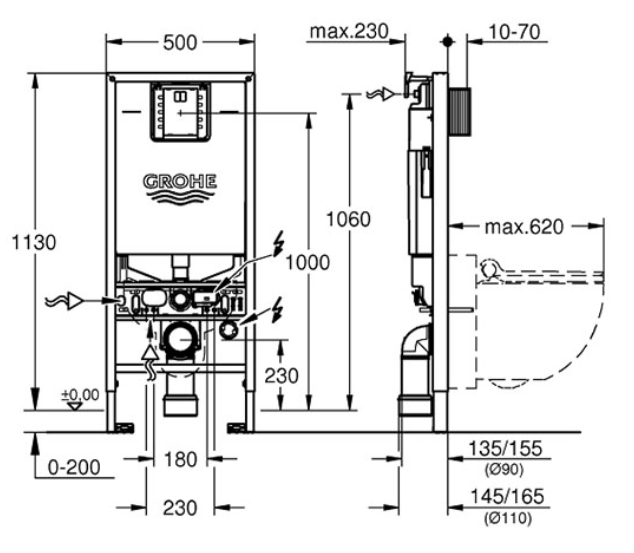
-
5mm acrylic lucite vs steel for baths
Adsibob replied to Adsibob's topic in Bathrooms, Ensuites & Wetrooms
Those who bought a Trojan, where did you get it from? I'm after the Trojancast Algarve 1700 x 750 and just received this from one of the few suppliers who purport to supply them: We are temporally unable to supply Trojancast baths due to extended lead-times from the manufacturer due to Covid. -
The current idea is to go with a 300 litre unvented indirect hot water tank. Maybe that's too small? We won't be using this giant bath everyday. More like twice a week.
-
It's a gas boiler, Vaillant ecoTEC plus 48kw, or possibly the Vaillant ecoTEC 637 which is 37kW. Not sure at the moment.
-
Forgive me, I'm a complete novice at this. I will have a large unvented tank in the loft (i.e. one floor above the bathroom in question). And the mains from the street was 18 litres a min previously, but I'm hoping it will increase slightly when we widen the size of the connection. Otherwise people wouldn't bother widening these pipes, surely.
-
Well f=ma, so I agree mass is important. But presumably for that equation to balance, since the greater the pressure, the greater the force, acceleration becomes a function of pressure.
-
There is no internal pipe work at the mo. We ripped it out and are starting from scratch. Soo can spec whatever gets a good recommendation here. The (very) old connection to the mains supply gave us about 18 per minute max, sometimes less. We are widening the connection, but haven’t done that yet, so can’t test. I thought pressure was more relevant than flow as it’s an unvented hot water tank. Pressure is 2.8 to 3.1.
-
It’s huge. It has a capacity of 350 and standard baths are anywhere between 130 and 175. It weighs 140kg... empty!
-
https://www.vado.com/product/6000/specifications-pdf
-
It’s a Large Picasso bath from Lusso Stone. @Bitpipe has one I think. It is described on the website as: “Water Capacity to Overflow: 350 Litre” but I reckon I would take up at least 95 litres of that, so I need a filler that can do 250 litres. At 17.6 litres per minute it will take about 14 minutes. Not terrible I suppose, but if I could achieve something a tad quicker.
-
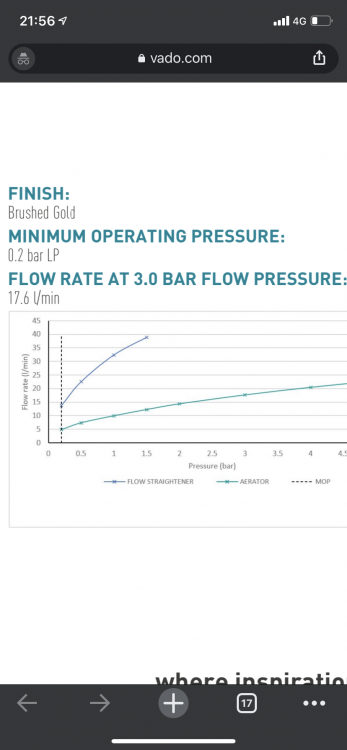
I’m considering a Vado bath filler. It’s flow performance graph is pictured below. Despite the tap’s official rating at 3 bar being 17.6 litres per min, the graph shows a much steeper second curve that would appear to reach almost 40 litres per min way before 3 bar. flow rate is important to me as the bath I’m filling is HUGE. Can someone explain what the “flow straightener” curve is please and how I can achieve the 40l/m rate? For background, I will have an UNvented cylinder and mains pressure is between 2.8 and 3.1 bar. Haven’t laid pipes yet, so could choose what diameter to optimise bath filler flow.
-
That would be great. Means I could pay my mortage off in the next 12 years rather than in the next 32.