Adsibob
-
Posts
3609 -
Joined
-
Last visited
-
Days Won
10
Everything posted by Adsibob
-

Economical way to combine soundproofing and UFH
Adsibob replied to Adsibob's topic in Underfloor Heating
So any comments on my walls and roof build up and the conundrum as to what heating system to have up there, if at all...? -
Thanks, but not sure I follow. Are you saying the noise comes from the pump rather than the manifold? If so, is this the pump you recommend: https://www.theunderfloorheatingstore.com/water-underfloor-heating/accessories/wilo-manifold-pump-pack-with-esbe-mixing-valve-unit and then my contractor can specify whichever manifold is compatible with that and meets our requirements?
-
How noisy are these manifolds? We may only have space on the first floor to put one above a wardrobe (which I would imagine is probably too high) or in a wardrobe. Both options involving having the manifold in a bedroom. Is that going to be audible enough to be a nuisance?
-
Economical way to combine soundproofing and UFH
Adsibob replied to Adsibob's topic in Underfloor Heating
Just to update everyone on where I am with this: we are installing 40mm Kooltherm K5 Phenolic Foam EWI on ALL the old external walls. Internally, we are not insulating the ground floor walls because we are advised that this would increase our risk of interstitial condensation for our specific situation. At first floor we are using insulated plasterboard though, which contains 35mm of PIR, on the walls. at second floor (loft) we are using wood fibre mainly, to bolster decrement delay. See attached build up which shows all second floor build ups: All windows are double glazed with no bridging between internal and external aluminium frames. They have an energy efficiency of A+, whatever that means. Still can’t decide whether I need heating in the loft and what type.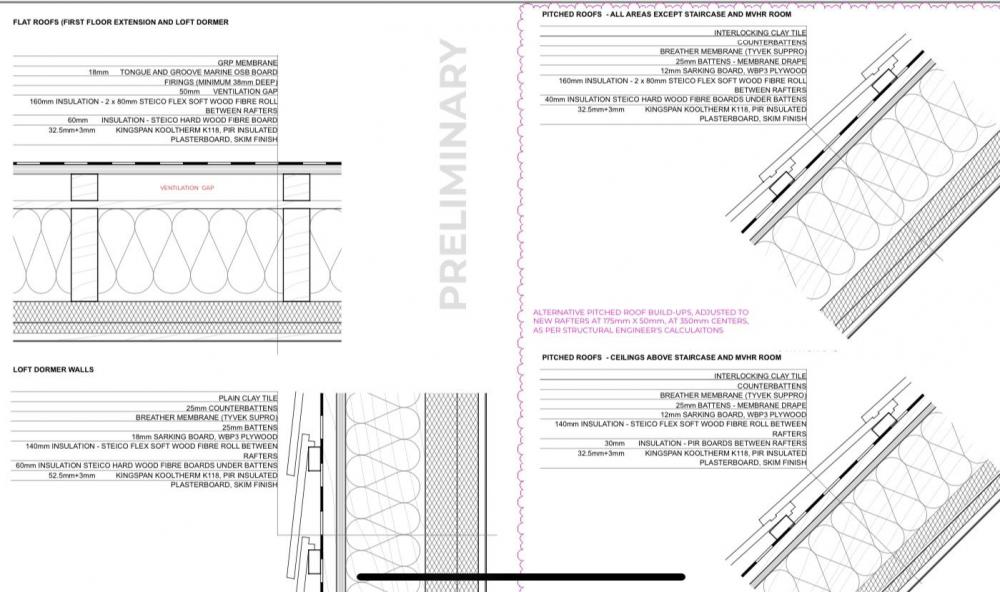
-
I need to get quite a lot of bespoke joinery done. We are having bespoke doors on our kitchen, as well as a few bespoke wardrobes, two pieces of bespoke cabinetry and quite a bit of cladding and concealed storage. My architect has designed it all in meticulous detail and we are now sending out his drawings to tender. Some of it will be CNC machined, but a lot of it will be hand made. Any recommendations for really good joiners that don't costs the earth gratefully received. Thanks.
-
Thought I'd post another update: I think we are on track to be fully water proof - even against horizontal rain, by mid september, although window company which still needs to fit 3 windows at loft level are messing me about. Octopus energy is the latest cause for delay and stress. We need to move a single phase connection and meter. UK Power Networks have been pretty good about the former, willing to do it on 12 working days' notice now that we've agreed a scope of works and EXTORTIONATE price - but they won't touch the meter. Apparently that is the property of the supplier. Such bollox. Anyway, earliest Octopus can do is 7 October and as it all has to happen on the same day, I need to delay UK Power Networks until then. Still so much to do. I won't list it but we are far far off. Builder gave me a new end date of 18 December. I asked him how confident he was of hitting it and he replied: "doubtful, very doubtful".
-
It does, but so far the two guys I contacted are possibly cowboys.
-
Thought as much. Would he do a job in London? if so, can you PM me his details please?
-
Do you know if the installer needs some sort of Veissman approved certification to get that, or could my builder's gas registered engineer install it and I still get the warranty by paying that?
-
I'm having a bit of a mare. Signed a contract last year with my contractor to basically do everything. I provided a fairly detailed draft spec for the UFH design and boiler and cylinder choice. I specified a multizone UFH system throughout the house, plus 3 towel rail heaters, a Veissman Vitodens 200-W system boiler, a 300L indirect unvented hot water cylinder made by brand recommended here and Tado controllers. Although Veissman has had mixed reviews here (e.g. here) it consistently gets well reviewed elsewhere and is the Vitodens 200-W is simply the most efficient gas boiler on the market. It modulates much better than any other boiler, with a modulation ratio of 1:17. My understanding is that this means you can fire it up to output 1/17th of its maximum output, which makes it quite good for heating water to the lower temps that UFH require efficiently. By comparison, the modulation on a Vaillant is only 1:5 or possibly 1:6 on some models. I specified Tado because I've used them before and my wife and I were really happy with them. We had some of the kit already so thought why not expand that system. Since we signed the contract I've been reminding the contractor that he needs to introduce me to his heating engineer so that we can go over my draft spec. Initially he admitted he thought I had had a professional design it because it was so detailed. He was surprised i did it myself and reluctantly agreed that we would have such a meeting. That was months ago. He then spoke to his engineer who explained he was not approved to install Veissman so I wouldn't get the 10 or 12 year warranty. He is registered with Vaillant and Keston and possibly one other. I had a look at Keston and wasn't impressed. Not sure why. I am familiar with Vaillant and never had particularly good experiences. They're okay, but their main appeal is that when they break down there are plenty of people who can fix them. I don't see that as a good USP. It's backwards thinking. One is better off buying a boiler that is more reliable. In addition to the great reviews for Veissman, I noted that their website actually promotes Tado products, which I thought was a bonus. As I've still not met my builder's engineer and as the UFH installation is scheduled to be start in the next couple of weeks, I started to worry. A friend put me in touch with a local plumber and heating engineer who she raved about. Looking at his website, he seems to have plenty of great reviews. I called him up and he said that whilst he can fix most boilers, he prefers to install Veissman or Atag. So big tick from me. I know Atag is not that well known here in the UK (at least according to this post here) but this engineer liked them. However, for my situation he recommended Veissman. Only issue is that he's not too keen to do the job as doesn't want to take work away from someone who is already on site. Fair enough I suppose. He was very helpful and offered to talk through my system with me. Surprisingly, he advised against having so many zones and said instead I should have only one zone per floor, and try and keep the temperature stable given the long response times. If installed this way, with the Veissman controlling most of the heating requirements, including its weather compensation feature, then it wouldn't short cycle and I wouldn't need buffer tank. If however I wanted so many zones, then he would recommend a 300L buffer tank. Not sure I have space for that and also I don't understand why it needs to be so big. So now I'm more confused than ever. I know Vaillants are popular here, but really concerned about their efficiency/sophistication. I think they are an okay mid range boiler, but prefer something more premium. If I were to go with my contractor's engineer and accept Vaillant, what's the best way to ensure they run efficiently? Low loss header or buffer tanks? If buffer tank, how big? My property will need the following floor spaces heated by UFH, 81m2 ground floor, 55 m2 at first floor and then about 30 m2 in the loft. It is fairly well insulated, but nowhere near passive standards. Does it matter where the buffer tank is?
-
Partitions: Timbers studs Vs Metal C studs
Adsibob replied to MortarThePoint's topic in General Construction Issues
How are people finding lead times for Metal studs (both C studs and I studs) at the moment. -
That's my point!
-
Gus, I’m sure you are speaking from professional experience as a diligent SE, but just to give some alternative context to this: I’ve done 3 projects all of which involved fairly substantial structural works, and never did the SE (which was a different person on each project) ask about muy or my builder’s insurance.
-
You aren't necessarily limited to self build mortgages. If you have equity in other properties you could release that. You might also be able to refinance loans you have on other properties from capital repayment to interest only to reduce your outgoings, which will boost your affordability meaning you can borrow more. You need to find a good broker. I will PM you the one I've used. He is very creative and knows how to play the different banks and get the most leverage out of your situation.
-
I'm not sure you "need" insurance unless you are employing someone to work on your property or your property is mortgaged. If mortaged, then it has to have buildings insurance and you need to make sure your insurer consents to the work to make sure it doesn't invalidate cover. Usually the insurance company use this as an opportunity to extract another premium from you. As to what insurance you might "want", public liability is a good idea. Make sure it covers situations where your works cause damage to neighbouring properties or to people working on site. There are brokers who sell this kind of thing. Alternatively, some insurers like Hiscox and Adrian Flux might offer this kind of thing.
-
Fear of heights, reasonable or not..
Adsibob replied to puntloos's topic in New House & Self Build Design
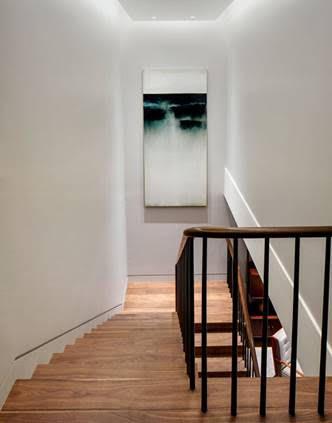
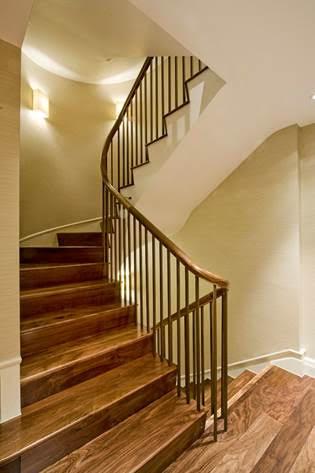
Here is a very contemporary version: Here is something similar where the spindles are lighter in colour, though I wouldn't have done the treads this shiny or this colour really: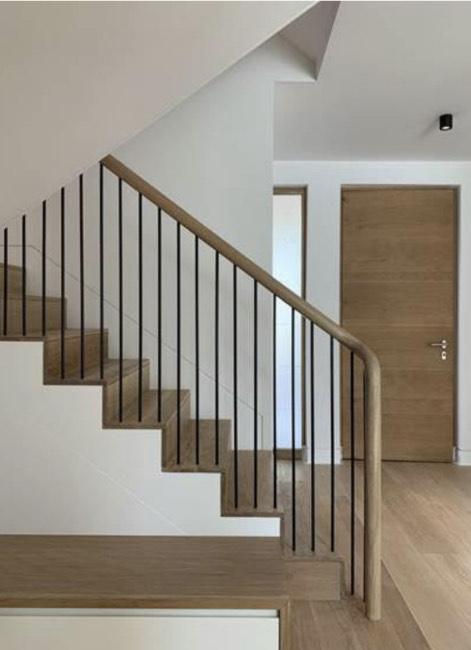
-
Fear of heights, reasonable or not..
Adsibob replied to puntloos's topic in New House & Self Build Design
I think a stairwell like that under a skylight is a lovely idea and will be a real feature. A friend of mine lived in a French 1800s block of apartments and they had a massive stairwell like that going up from the communal hallway to each flat. It was very dramatic. I would however lose the glass. You don't need it and it accentuates the feel of insecurity, without actually bringing in any additional light to the house, other than the small area immediately next to the glass where unless you are less than 90cm tall you won't notice. I would build the balustrade out of opaque materials such as timber or timber and metal. We are doing ours out of oak with oil blackened steel spindles. You could still have airiness by having gaps between the spindles. If you are concerned that 90cm is insufficient, make it 98cm tall. -
I have bought a large floor lamp that I want to control from a dimmer switch. Can I use an LED dimmer switch in combination with a 5A light socket? The bulb going in this floor lamp is an Led E27 bulb with 10W.
-
Thanks for the tips guys. So the ground floor area (all three sub-levels) comes to 81 square metres, with one zone covering about 15m2 of that, another coverign 35m2 and a third covering about 31m2. Would a standard manifold have enough ports to do that or am I better off fitting two?
-
So just three manifolds, one for each floor of the house and treat all three sub levels of the ground floor as one level?
-
Distance between kitchen units and under floor heating
Adsibob replied to Loz's topic in General Plumbing
Wouldn’t 100mm be more efficient for a gas boiler based system as well, on the basis that you could run it at a lower temp? -
My house is on three floors: ground, first and second, but the ground floor itself is actually divided in three different levels: Entrance hall and guest WC are at 0cm two steps down to living room/diner/kitchen/utility (this is probably 55% of the ground floor); and one step back up to a further room. so technically one could say i have five floors in total. Do I need five manifolds? Another factor which i think is relevant is that there is a different floor finish on each of the 3 ground floor areas, although the subfloor is screed and same level of insulation. Entrance hallway and guest WC floor finish will be 20mm terrazzo, the living room/etc... will be 3.5mm microcement and the the further room will be 14mm engineered parquet wood.
-
Not enough glue in 22mm Egger Chipboard installation?
Adsibob replied to Adsibob's topic in Floor Structures
Do you mean timber floor boards? -
Not enough glue in 22mm Egger Chipboard installation?
Adsibob replied to Adsibob's topic in Floor Structures
I guess what I want to know is whether anybody has laid chipboard without using the foaming glue, just using regular D4, and without gluing all the joins, just gluing half the joins, and gluing to the joists, and then screwing down plenty of floor tite screws. Has anybody done that and then years later developed squeaking? Because my builder points out that he has laid about 10 floor tite screws per board and that is way more than what Egger specify. I think they just require four nails per board, not even screws let alone floor tite screws. -
Not enough glue in 22mm Egger Chipboard installation?
Adsibob replied to Adsibob's topic in Floor Structures
Instructions I’m reading say: ”Adhesive Coverage - Bonding the board to the joist and within the tongue & groove joint will typically require 1 bottle of EGGER Joint & Joist Adhesive per 6 boards (2400 mm × 600 mm)"