


Adsibob
-
Posts
3609 -
Joined
-
Last visited
-
Days Won
10
Everything posted by Adsibob
-
Why not just rent it?
-

Wash hand space saver with self-closing waste valve 32 X 32MM
Adsibob replied to Adsibob's topic in General Plumbing
Thanks @Temp maybe I will fit an AAV. Does that create any air tightness issues for the MVHR system? I also wonder whether another solution might be to use a standard trap but locate it a bit further away from the sink's exit point so that I have more space for it. For example if directly under the exit point I have a right angled bend, that would take the waste water to the adjacent cupboard which is a cupboard rather than a set of drawers. Plenty more space there to locate a standard bottle trap. Or is that a no no because the trap must always go directly under the sink's exit point (as shown in the attached picture, which also features an AAV)?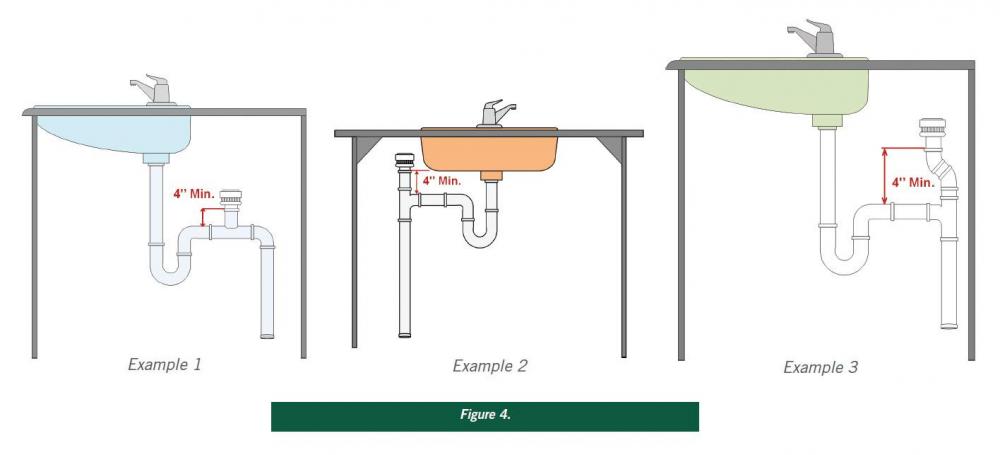
-
Wash hand space saver with self-closing waste valve 32 X 32MM
Adsibob replied to Adsibob's topic in General Plumbing
Yes, it is valve based. The downside of the Wirquin you've found (at least according to the reviews) is that it can be a little noisy. Also looks similar to the trap that came with @Bitpipe's floor mounted resin bath I believe, which he described as "worse than useless", although perhaps for a bathroom basin it's okay. Not sure I think I understand how a bottle trap works, in that it uses a bend in the pipework to create a small reservoir of water that acts as a block to prevent nasty smells coming up. But I don't get the difference between all the different types of traps and their pros and cons. For example, would something like this work: https://www.screwfix.com/p/floplast-shallow-bottle-trap-white-40mm/19145 -
I'm considering adapting an old piece of furniture into a vanity unit by mounting a countertop basin on top of the piece of furniture. Directly under where I want to mount the sink, there are some drawers. The top drawer is about 8cm deep. If I lose use of that drawer, presumably i still don't have space to fit a normal U-bend in it? If that's the case, could I use this: https://www.screwfix.com/p/mcalpine-wash-hand-basin-space-saver-with-self-closing-waste-valve-white-32-x-32mm/863HP?tc=ST2&ds_kid=92700055281954514&ds_rl=1249404&gclid=CjwKCAjw9aiIBhA1EiwAJ_GTSmDfMhXLaYlhNgx6txgim_zmzk2dsN1hq7GHyA-mPwdJVZLRrUSSixoC7pQQAvD_BwE&gclsrc=aw.ds Has anyone fitted (and lived with) one of these? Of the three reviews on screwfix's website, it looks okay, but just sounds too good to be true. If this works so well, why would anyone bother with a u bend?
-
Not enough glue in 22mm Egger Chipboard installation?
Adsibob replied to Adsibob's topic in Floor Structures
I think they only come in 45mm and 55mm length, so I guess it's the 55mm length I want...? -
Not enough glue in 22mm Egger Chipboard installation?
Adsibob replied to Adsibob's topic in Floor Structures
I'm looking into these floortite screws. Which length is best to fix 22 Egger to posis? 45mm or 55mm? -
Not enough glue in 22mm Egger Chipboard installation?
Adsibob replied to Adsibob's topic in Floor Structures
Thanks @Nickfromwales you and the others here have given me the confidence to do something about this. Do you think lifting the floor in one piece (the two rooms they have done are 3.6m by 4.7m and and 3.6m by 5m) is just not feasible because either the floor will break/bend, or the glue will cure quicker than they can lower it down again? -
Not enough glue in 22mm Egger Chipboard installation?
Adsibob replied to Adsibob's topic in Floor Structures
Yeah, you are right. They will have to sort it out. When he jumps on it and says "see, rock solid” how do I explain the importance of the glue in the long term life of the boards? -
Not enough glue in 22mm Egger Chipboard installation?
Adsibob replied to Adsibob's topic in Floor Structures
There is glue between the tongue and groove (they tell me - I can't see it), but I don't think there is any between the posi joist and the board. He was adamant about it being there between the T and G, and very clueless when I said it didn't look like they're was any between the board and the joist. So in pretty sure they have just glued the T+G. It's really pretty pathetic that they are so overconfident they do stuff without checking the instructions that I specifically bring to their attention. But I feel I'm in a no-win situation. I can get difficult and refuse to pay the next bill until this is redone or fixed, but that isn't really going to help the relationship, and there is a risk the builder then cuts corners elsewhere which I can't spot. I'm just a layman who reads a lot. So I'm trying to find the easiest way to fix this, because that is the only way in reality in likely to be able to improve the situation. Or I could sack the builder, but I don't think that is really such a great idea... better the devil you know and all that. -
Not enough glue in 22mm Egger Chipboard installation?
Adsibob replied to Adsibob's topic in Floor Structures
Thanks @James Newport, the cartridge gun is a good idea, but the "sets in 5 minutes" makes me think it's actually not possible to fix this. The idea the foreman had was to unscrew the floor from the joists and lift the hole thing up, then applly the glue and lower the floor back onto it. If they only have 5 minutes before it sets, I don't think they'll be able to do it in that time without pushing some of the floor down and not other parts. If they did that, they would surely break the floor into pieces or at least bend/damage it. Maybe we should just leave it and add a load of floortite screws? -
Not enough glue in 22mm Egger Chipboard installation?
Adsibob replied to Adsibob's topic in Floor Structures
Thanks. Not sure which they use, but it will have been one of these (and the foreman told me they are the same product just branding differences): D4 wood glue and https://www.everbuild.co.uk/product/502-all-purpose-weatherproof-wood-adhesive/ -
Not enough glue in 22mm Egger Chipboard installation?
Adsibob replied to Adsibob's topic in Floor Structures
Okay, I'm on site now. Definitely no glue in between the joists and the chipboard. Spoke to foreman and he was pretty relaxed about it, thought it wasn't necessary. The floor has actually been fitted in between the partition walls, so if all the floor screws were unscrewed it could be pushed up from underneath and glue could be squeezed in before it is lowered back down again (Foreman's suggestion not mine). I'm wondering however whether it's worth the hassle. Won't there be a risk of damaging the chipboard if we do this, which could end up worse or the same as how it is now? -
Not enough glue in 22mm Egger Chipboard installation?
Adsibob replied to Adsibob's topic in Floor Structures
Hmmm. I hate these sorts of conversations. Bloody annoying because i have an email from a couple of months ago where I sent the builder Egger's PDF instructions and the PDF is clear that there needs to be two beads of glue on every joist. The PDF (attached) also has a fifth step that says: Seal any exposed mechanical fixings, perimeter edges, cut edges and stairwells using EGGER Joint & Joist Adhesive. Once the building is watertight, excess adhesive can be removed with a scraper. Presumably painting Egger Joint and Joint Adhesive over the joins with the beams isn't going to do much at this stage? EGGER installation instructions.pdf -
Not enough glue in 22mm Egger Chipboard installation?
Adsibob replied to Adsibob's topic in Floor Structures
I wasn't looking for that specifically when I was on site this morning, but I don't recall seeing it. I will check again tomorrow. -
The chipboard flooring has started to go down onto the posi joists on the first floor. So far, about 2 out of the 5 rooms have been done on that floor. I gave the builder the instructions and pointed out to him that he needed to use two beads of glue on each tongue and groove joint. Following advice I'd read here, I also told his foreman: "this is the one job where I won't mind if it's messy and there's lots of glue coming out the joints - I want plenty of glue". The problem was that this was about a month ago when I thought they would be installing the floor, but due to various delays they only started yesterday. It is far too neat for them to have used the amount of glue I asked them to. No glue whatsover has leaked out the joins. Walking across the boards it feels solid with no creaking, so I'm possibly worrying about nothing (I'm good at that). Posi joists are at 400mm centres. I queried the insufficiency of the glue and was reassured that there is enough. I don't think taking up the floor and re-doing it is an option as it will no doubt damage the T&G joints and they have promised to use more on the rest of the floor. Is there anything I can do at this stage to strengthen the joins? Paste glue over the joins both on the upper side and the lower side? Tape the joins? If so, what glue or what tape? Tape is probably easier than painting on glue and is less likely to interfere with the rubber matting I am laying over the chipboard.
-
Has anybody had their build measured on completion?
Adsibob replied to DragsterDriver's topic in Planning Permission
Which is why I think such an order being made against a crowdfunding campaign is all the more unlikely. Go ahead and donate, I say! If somebody posts the crowdfunding page, I will put in £20. -
Yes.
-
Are you sure? My architect has specified the requirement on all of my electrical drawings.
-
Has anybody had their build measured on completion?
Adsibob replied to DragsterDriver's topic in Planning Permission
Definitely feasible. Litigation can be crowdfunded. A the third party costs order i mentioned in my previous post is pretty rare. Normally only used where a funder has funded a claim that has no prospects or allowed it to carry on when it was obvious it was bound to fail. For an example of when a litigation funder might be held liable to pay costs, see Money v Davey https://www.bailii.org/ew/cases/EWHC/Ch/2019/997.html In that case the funder tried to argue that its liability should be limited to no more than the amount it had funded (known as the Arkin cap). The judge clarified that the Arkin cap is just a guide and although courts should take it into account, they can depart from it. Here circumstances were so bad that it merited ordering the funder to pay a costs order in excess of the amount it had funded. Again, extremely rare. -
Has anybody had their build measured on completion?
Adsibob replied to DragsterDriver's topic in Planning Permission
That is correct. Section 51 of the Senior Courts Act 1981 and CPR 46.2 gives the Court the power to make third party costs orders against litigation funders. -
Has anybody had their build measured on completion?
Adsibob replied to DragsterDriver's topic in Planning Permission
As long as you are in time, you can always appeal. "Appeal" is a two stage process: First you need permission to appeal. Usually, the losing side makes an application for permission to appeal straight away, at the hearing where they lost, to the judge or tribunal which rendered the decision against them. Nine times out of ten, the judge will say "no" and one then needs to seek permission to appeal from the appellate court. Very occasionally, a Judge gives permission to appeal his or her own judgement. if that happens, it's almost always because the Judge thinks he/she has applied the law correctly but considers the law is in need of revision/updating. If you can't get permission to appeal from the judge/tribunal who gave the decision, then one has to go to the appellate court and ask that court for permission to appeal. That is basically a paper exercise that reviews the merits of the appeal on the papers and either gives you permission to go ahead and have an appeal hearing or basically stops the appeal there and then, effectively because it thinks it's hopeless. I would imagine this case raises sufficiently serious issues of fairness and important issues of law that mean getting permission to appeal should be possible. Whether it goes further than that and actually succeeds at appeal I could not say. In England we have two appellate courts : the Court of Appeal and the Supreme Court. In Scotland there are also two, but the first one isn't called the Court of Appeal, but the Inner House of the Court of Session (as opposed to the Outer House of the Court of Session). So usually, from a High Court decision one could appeal to the Court of Appeal, and if still not satisfied, appeal again to the Supreme Court. That is extremely rare though. Most appeals don't go all the way to the Supreme Court. Also, the worst thing about appeals is they take ages. Not enough appellate judges! Ministry of Justice has been cutting courts and budgets left, right and centre. -
All very helpful, thanks. My architect has amended his lighting schematic to show which switches work which lights, so this will hopefully make things easier. And glad I don't have to risk the finish on my switch plates by having them installed at first fix just to test. Although the drawings are now super clear, I don't envy the electrician. Complex job!
-
Spending a small fortune on light switches and sockets. Also designed quite a complicated lighting scheme with lots of two way switching and in some cases three way switching. All the two way switching have a dimmer switch at one point in each circuit. There is three floors of a 5 bed house to do, all from scratch. Presumably the light switches don’t get installed at first fix, they go in at the second fix together with the light fittings. But if that’s correct, how does the electrician make sure he has got all the wiring right? If a mistake isn’t discovered until 2nd fix, isn’t it too late by then to fix it?
-
Minimum thickness of stud wall with this toilet frame in it?
Adsibob replied to Adsibob's topic in Waste & Sewerage
Other side of the wall is the first floor landing. We were planning to put a shallow cupboard in that wall so that sheets/towels could be accessed from the hallway. I either have to lose that cupboard or go for a much slimmer frame. -
Has anybody had their build measured on completion?
Adsibob replied to DragsterDriver's topic in Planning Permission
The unfortunate consequences of the judgment in this case was an unintended CIL liability for over £118,000. Ouch! i hope he appeals.

