Adsibob
-
Posts
3604 -
Joined
-
Last visited
-
Days Won
10
Everything posted by Adsibob
-
I'm sure this has been covered before, but after various searches I couldn't find a post on it, other than the odd comment from @Nickfromwales about how horizontal cylinders are okay. I was about to order a horizontal UVC from Cylinders2Go. Spoke to Trevor who was very nice and he asked me why I wasn't getting a vertical one. I explained my space issues and he said if I can squeeze in a vertical one somehow I will have a more efficient system. Now that is a truism, I'm sure. But my question is how much more efficient will the system be? Say with a 400L tank, both the horizontal and vertical one made by Telford is the same dimension and so has the same heat loss of 2.58kW per 24. I get that hot water is lighter than cold and so rises, giving better stratification, but how much is this going to make a difference in practice? I'm sure it means the boiler needs to run more, but how much more? Other option I'm considering is a vertical 380L which is taller and slimmer than the 400L. It would be a real compromise to our house if we have it vertical, but I'm concerned about getting massive gas bills! (Changing to a different energy source isn't an option unfortunately.)
-
Okay, that definitely is a selling point of an accumulator. But what still confuses me is whether the DAB E.Sytank (details here), which is a 480L tank together with a clever pump is an accumulator plus a pump or is it not an accumulator at all? Because whilst an accumulator will give you really good mains static water pressure of about 3 to 4 bar all day (or at least until you use up the water in the accumulator) as far as I can tell, an accumulator will do absolutely zero for your dynamic water pressure if you are already dealing with a very low flow in the property. That's why I was looking at pumped systems. The DAB E.Sytank has a tank that appears to boost flow rates by 12 L/min, though I'm not entirely sure. It incorporates a pressure and flow sensor and an inverter. My understanding is that the pump inverter maintains a constant and stable pressure in the system by varying the speed of the pump motor to deliver the same pre-set pressure at the outlet regardless of how many outlets or appliances are in use, up to the maximum capability of the pump. So isn't something like the DAB E.Sytank going to be more effective than an accumulator of the same size tank?
-
When can I buy these?
-
But surely the accumulator can only accumulate the pressure one has coming in from the mains supply?
-

Mains Water Usage - What do you use?
Adsibob replied to Ferdinand's topic in General Self Build & DIY Discussion
Can any kitchen tap be adapted to do this, or do I need to buy a new tap? -
Upgrading the heating element in a HW cylinder to titanium?
Adsibob replied to Adsibob's topic in Boilers & Hot Water Tanks
Ah, I see. Thanks @PeterW. So presumably to do that one would need to drain the cylinder. How often would a cylinder's heating element need a service/inspecting? I am currently torn between two cylinders: Telford Tempest 400L like this: https://www.cylinders2go.co.uk/shop/stainless-steel-unvented-cylinders/unvented-horizontal-cylinders/telford-400-litre-horizontal-indirect-unvented-cylinder/ Telford Tempest 380L like this: https://www.cylinders2go.co.uk/shop/stainless-steel-unvented-cylinders/unvented-horizontal-cylinders/telford-380-litre-horizontal-indirect-unvented-cylinder/ The 380L is longer and less tall when mounted. It will probably fit more easily in my restricted head height area and might mean that rotating it isn't required when servicing the element. I really don't need the extra 20L afforded by the 400L tank, but I wonder whether the fact that's it's ratio of surface area to volume is greater than the 400L one will mean that it will have greater heat loss. Can't see the heat loss specs for either the 380L or the 400L tanks on Telford's website: https://www.telford-group.com/uploads/shop/Storage Tank Fiche 2021.pdf -
I need to fit an unvented indirect HW cylinder in a restricted height area. Even with a horizontal one, I'm not sure I will have enough clearance to be able to remove the electrical heating element which I assume is removable because it needs to be serviced/replaced every so often. I emailed Telford technical support (I'm looking at their Tempest range) and they said: "The immersion heater is 14” in length so you will need around 14” to remove it. The immersion heater can be moved to help this though". I don't understand the second sentence. Aren't these huge tanks (i'm looking at a 300L or 400L one) very heavy to move? Or do they mean once empty? I called Cylinders2go and asked if they could make a bespoke one which had the heating element at the end rather than on top. They said "not really" but suggested I pay an additional £80 or so to upgrade the heating element to titanium as apparently if I did that it would never need servicing, hence eliminating the problem. Has anybody got experience of servicing unvented indirect tanks? How often does the heating element need to be removed and is it possible to move the cylinder to assist with this, or is that just madness. Thoughts on the titanium upgrade? I should clarify that I will have a salt-based water softener system, so shouldn't really get any limescale.
-
I'm now having to research this as we finally did a dynamic pressure test and my pressure drops from 2.8 bar to about 1.2 bar as soon as second tap is turned on. Plumber brought a little cup with him to measure flow rate and reckons it's only 11L/min which I found odd because I did an old fashioned test (using a 6L bucket) before we did our building works and got around 17L/min. I'm also considering DAB systems, but my plumber has recommended one that comes with a 480 litre tank, called DAB E.Sytank. It's actually quite compact for a tank that size, because it's cuboidal rather than cylindrical and housed within some soundproofing casing, so the advertised dB is only 45dB. Expensive, but almost £2k less than boost a main. My builder is concerned that we don't have the structural strength in the floor to support something so heavy given that the unvented HW cylinder is going nearby and it is about 400kg. I need to double check, but I think the posis which support the HW cylinder are not the same posis that would support this E.Sytank. If I'm right about that, then he must be worried about the wooden beam that is attached to the wall from which the posis are hung, but that just seems odd. Now need to speak to structural engineer to see if he can find a solution, as not sure I have space for it elsewhere.
-
Fair enough. It does make your house more appealing to a wider market, I agree.
-
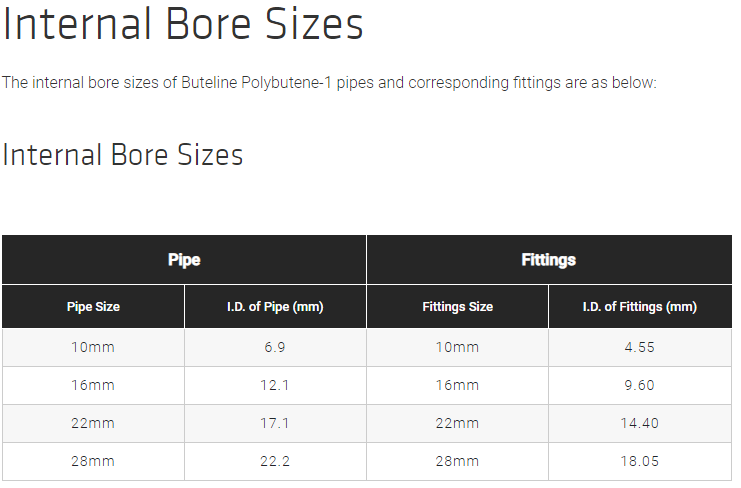
My plumber wants to use a combination of copper and plastic pipes. He says he prefers copper for the ends of runs where he connects to a cylinder, taps, shower etc., but that he prefers to use plastic for the long runs. I asked if he would be using hep20 (because I had heard good reviews of it on this forum) and he said he prefers to use Buteline. He says it's much stronger and has no rubber parts. Googling around I found this https://community.screwfix.com/threads/well-done-wavin.186552/ which reviews the Buteline system highly (see second post and video contained therein). The test in the video is a bit irrelevant as we are struggling to get above 3 bar let alone 30! Any experience on this forum of using buteline? If I go with buteline, which pipe diameters do I want to use for HW secondary loop? (22mm?) HW run from secondary loop to showers? (16mm?) HW run from secondary loop to basins (10mm?) Cold water run to basins (10mm?) cold water run to shiowers (16mm?) I was surprised that the plumber recommended "15mm" for basins, because I thought the advice here was always to use 10mm to reduce build up of cold water in dead legs. From the info below (taken from Buteline's website), the 10mm seems to have a tiny ID and even smaller ID of fittings, so maybe that's why he prefers 16mm (not "15mm" which doesn't seem to exist). But he also said that all taps these days have narrower hoses so it doesn't matter if we use 10mm or 15mm, but I think he's not thinking about dead legs.
-
I always find this kind of assumption very defeatist, pessimistic and generally avoidable. Unless you are already severely challenged in mobility terms, there is no reason why one cannot take care of one's physical health so that one doesn't grow frail. Old yes, but not necessarily frail. There are things one can do to stay mobile. Walking up and down stairs is one of the most important. Use it or lose it. A simple series of exercises to keep the leg joints working doesn't take longer than 10 minutes a day. If you have a joint issue, invest money on a good physiotherapist who can rehab you and then get you onto a good gym programme that will get you fit. I have several back and joint issues and a nervous system issue that requires some pretty strong anti convulsive medication. If i don't do my exercises I spasm in pain, but if I do i get by okay and have no reason to believe I won't be able to climb up and down stairs until the day I die. See this for info, particularly the bit about exercise: https://www.england.nhs.uk/ourwork/clinical-policy/older-people/frailty/preventing-frailty/
-
I've never seen a concrete lintel that big. Is it going to be reinforced with metal bars? How does it compare to your structural engineer's design? You have got a structural engineer right?
-
Economical way to combine soundproofing and UFH
Adsibob replied to Adsibob's topic in Underfloor Heating
They're very nice. Really happy with the frames. Some of the glazing units had to be replaced though due to some issues. Mostly boarded up now, but once we unboard I'll post some pics. -
Economical way to combine soundproofing and UFH
Adsibob replied to Adsibob's topic in Underfloor Heating
We have posi joists under the first and second floor, so this will help. The internal walls are all studs, so that too will provide a void for services. As for the channels within the external wall, I'm not sure! I need to double check, but I'm hoping the builder and/or architect has thought about this! -
Economical way to combine soundproofing and UFH
Adsibob replied to Adsibob's topic in Underfloor Heating
Thank for reminding me about this. It is a spec that the surveyor recommended, just the architect forgot to include it on his drawings. -
Economical way to combine soundproofing and UFH
Adsibob replied to Adsibob's topic in Underfloor Heating
https://www.dupont.co.uk/products/tyvek-supro.html it is vapour permeable, breathable and water resistant No idea I'm afraid. My architect designed it, I then asked him to run it by a RICS surveyor who designs these sorts of things and he made some tweaks and this is the end product. Couldn't tell you which way is the right or the wrong way to do these things. Why do you think having the membrane floating between the batten and counter batten is wrong? Yeah, that's a good idea. The only downside is that if I don't end up needing to install radiators, we'll end up with pipes sticking out the floor. Because of aesthetic and cost reasons. We are having crittall style windows made by MetTherm. We really liked their slim frames, look very much like the original steel frames, but made from aluminium and much better insulated than the steel ones because they are thermally broken whereas steel are not. They don't do 3D so if we had insisted on that, we would have had to go with something very bespoke to achieve the same look. We have fairly large windows on the rear elevation, so we will get some heat loss vs 3D, but that will be partially mitigated by the solar gain, as most of the windows get good amount of sunshine. It's not a passive house, just a refurb of a very poorly maintained 1930s house. -
Didn't realise there was a difference. Good to know. So can you recommend a quiet sump pump?
-
Will widening my connection to Thames Water make a difference?
Adsibob replied to hendriQ's topic in General Plumbing
Hi @Oldsteel after the survey, how long did it take to get the work done to actually connect it? -
Rainwater.
-
So would you recommend Wilo for other pumps which should be quiet as well? I need one to pump water from a soakaway to a sewer on an ad hoc basis, and I need another one to pump my secondary loop for a minute or so every 20 minutes
-
Economical way to combine soundproofing and UFH
Adsibob replied to Adsibob's topic in Underfloor Heating
So any comments on my walls and roof build up and the conundrum as to what heating system to have up there, if at all...? -
Thanks, but not sure I follow. Are you saying the noise comes from the pump rather than the manifold? If so, is this the pump you recommend: https://www.theunderfloorheatingstore.com/water-underfloor-heating/accessories/wilo-manifold-pump-pack-with-esbe-mixing-valve-unit and then my contractor can specify whichever manifold is compatible with that and meets our requirements?
-
How noisy are these manifolds? We may only have space on the first floor to put one above a wardrobe (which I would imagine is probably too high) or in a wardrobe. Both options involving having the manifold in a bedroom. Is that going to be audible enough to be a nuisance?
-
Economical way to combine soundproofing and UFH
Adsibob replied to Adsibob's topic in Underfloor Heating
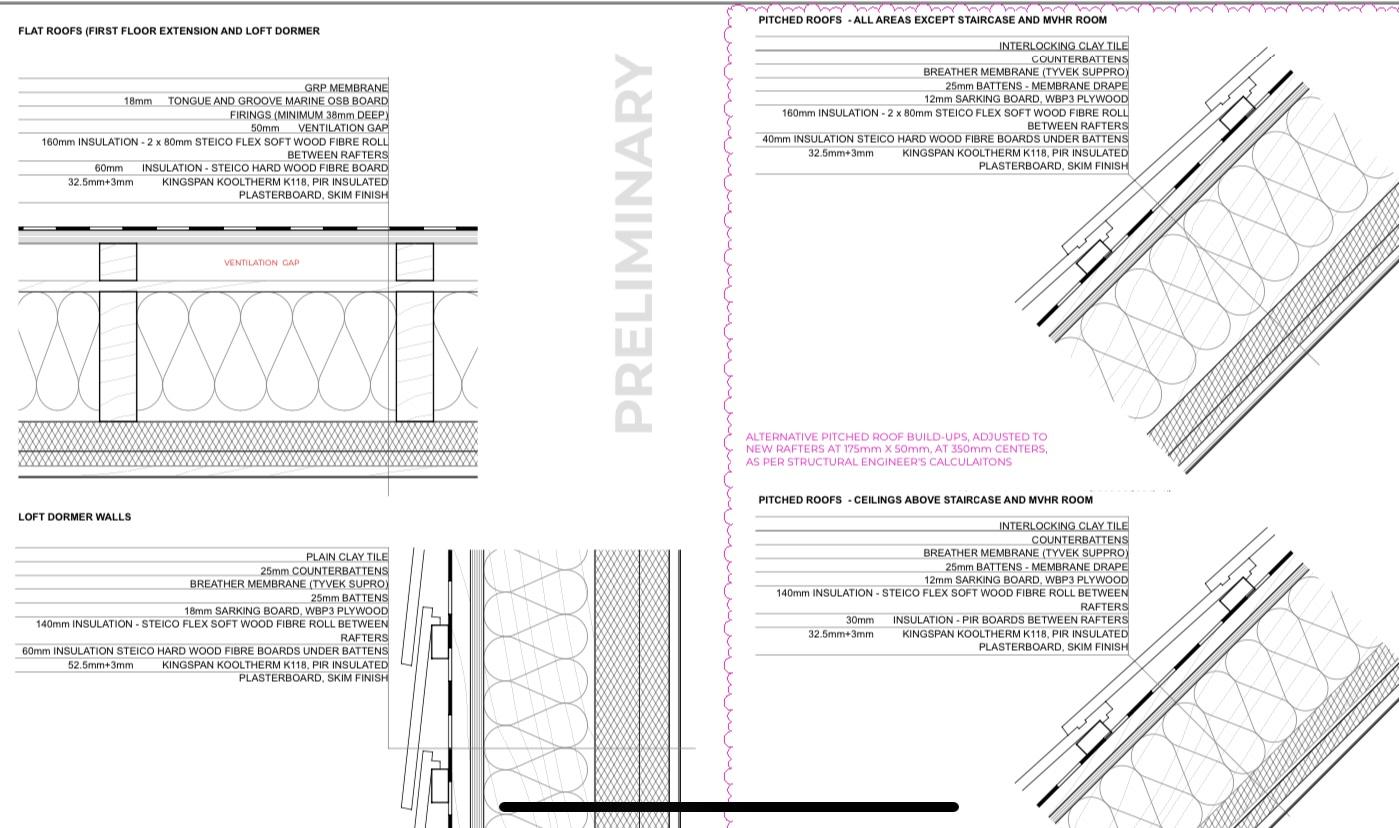
Just to update everyone on where I am with this: we are installing 40mm Kooltherm K5 Phenolic Foam EWI on ALL the old external walls. Internally, we are not insulating the ground floor walls because we are advised that this would increase our risk of interstitial condensation for our specific situation. At first floor we are using insulated plasterboard though, which contains 35mm of PIR, on the walls. at second floor (loft) we are using wood fibre mainly, to bolster decrement delay. See attached build up which shows all second floor build ups: All windows are double glazed with no bridging between internal and external aluminium frames. They have an energy efficiency of A+, whatever that means. Still can’t decide whether I need heating in the loft and what type.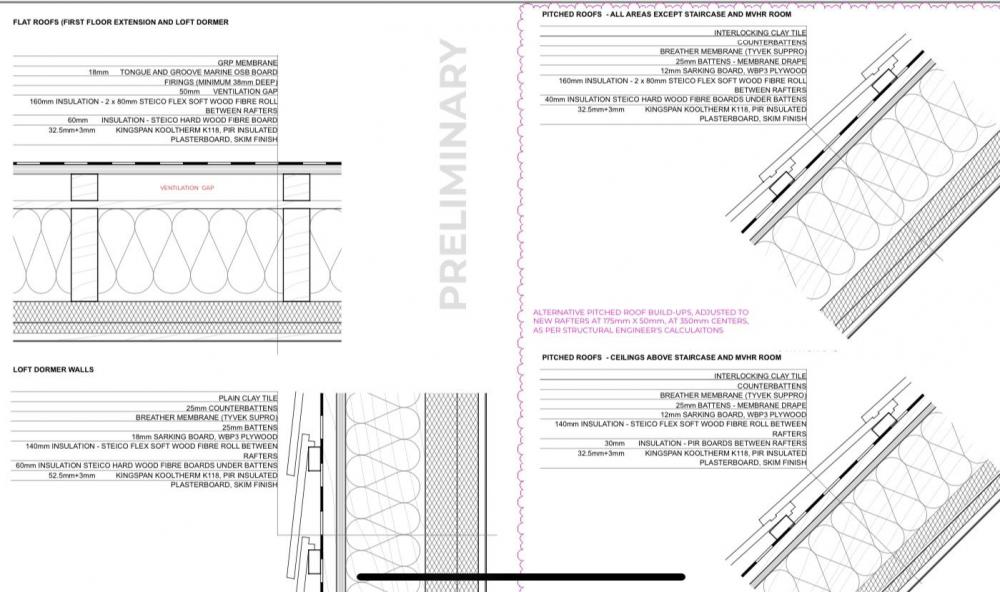
-
I need to get quite a lot of bespoke joinery done. We are having bespoke doors on our kitchen, as well as a few bespoke wardrobes, two pieces of bespoke cabinetry and quite a bit of cladding and concealed storage. My architect has designed it all in meticulous detail and we are now sending out his drawings to tender. Some of it will be CNC machined, but a lot of it will be hand made. Any recommendations for really good joiners that don't costs the earth gratefully received. Thanks.