


Adsibob
-
Posts
3604 -
Joined
-
Last visited
-
Days Won
10
Everything posted by Adsibob
-
Plenty of examples i can think of:: you're out with the family for the day, but for whatever reasons we need to come home early unexpectedly. Rather than get home to a cold house, you can remotely switch on theheating or modify the schedule so that it reaches the required temperature just as you get home. Teenager at home alone. Teenager told to turn the heating off when she leaves. Teenager forgets. Tado's geolocation will turn it off as soon as the Teenager leaves. You leave the house in a rush and can't remember if you turned the heating off. No worries, you can check the Tado app and control it from there. Bad luck about being burgled.
-
That's an interesting view, but not one that I share as far as heating and lighting go. I think that being able to control lighting and heating remotely is very useful, whereas being able to control your oven or washing machine remotely sounds silly to me. Heating I know Tado doesn't get a very good rep on this forum, but I have been very happy with my Tado system - let's us control our heating with a lot of accuracy, whether we are at home or away. Also has geofencing so will act intelligently depending on whether we are there or not. All the Tado hardware also has temperature sensors and logs which means you can log the temperature for each zone where you have a Tado thermostat or thermostatic valve. I know a lot of people here like logging temperature, so that gives you some benefits. Lighting You'd be surprised how much of a burglary deterrent having lighting routines come on whilst you are away are. There are lots of ways to do this and you don't need every bulb in your house to be remotely controlled, 5 or 6 bulbs should be enough. This is better than a timer device in my opinion, as you have far more control and can have more varied routines just in case some clever burglar was watching out for the repetitiveness.
-
55mm to 60mm of sand and cement screed is being poured over my UFH pipes/insulation on Friday. The floor finish will be microcement poured onto the screed - that is only 3.5mm thick. I need to lay a power cable under the floor finish so that the kitchen island has power. What's the best way of doing this given all the 16mm UFH pipes that will be in the way. Should I lay a duct in case the cable ever needs to be replaced? - though can't see why that would be the case
-
This is very reassuring thank you. We will have three towel rails. I have only bought one of the towel rails so far, it is rated at 1607 btu (471W). Would you say that is about the right size to act as my pseudo buffer? I ask because the remaining two towel rails could be off a similar size, or slightly bigger, and I could run any one of the three as the pseudo buffer.
-
Would these be good for terrazo as well?
-
Unfortunately I have done zero thermal modelling (other than some calculations to make sure our loft conversion gave us a decent decrement delay). Does anybody have a template excel spreadsheet I can use for this, or recommend an online calculator. I appreciate it's quite involved and usually done by professionals, but I don't have money for that and rather try and cobble together a basic version myself.
-
I get what you mean, but is that likely to arise in practice? I will have about 500m length of 16mm pipe for my in-screed system at ground floor. At least 3/4 of that will be on for most days 4 months a year, probably for at least 9 hours a day if not longer. The house is fairly well insulated, but not to passive standards (it's a 1930s house which we've gutted and upgraded) so during winter's shoulder months I imagine we will still have the system on throughout most of the ground floor for at least 4 hours a day. I'm not yet sure how much we will have the UFH on in the first and second floors, but imagine it will come on on the first floor for a few hours in the evening and a few hours in the morning during winter, whereas on the second floor it will hardly ever be used. Although it's a multizone system, it's unlikely that we will ever have one small zone on only. So I'm just trying to understand how often it will be the case that the UFH will need less than 1.84kW?
-
I know your standard advice is always to install a buffer tank for the UFH to avoid short cycling, but I'm just trying to understand if that is always the case. For example, if I have a gas boiler that has very high modulation range of up to 1:19 (such as the latest Veissman Vitodens 35kw), wouldn't the boiler simply be able to modulate right down to the low temp requirements of the UFH? 1:19 is pretty unique on the residential boiler market and enables the 35kw version of the boiler to run as low as 1.8421kW. By comparison Vaillant and Baxi have modulation ranges of about 1:6 or maybe 1:10.
-

Steico Flex wood fibre in short supply - what's the alternative
Adsibob replied to Adsibob's topic in Heat Insulation
I was told by the MVHR that the pipes should be within the thermal envelope. If i do that, why would I need to insulate them? Sorry, I'm sure I'm being quite thick about this. Also, what do you use to insulate them? Mine are 90mm radial ducting a bit like this: https://www.cef.co.uk/catalogue/products/4875483-fast-track-90mm-semi-rigid-ducting-50m-length?gclid=CjwKCAjw7--KBhAMEiwAxfpkWAMjqFn5zXL5HXettKD9Wlz_yypRWtKaaIs52jhED_tHs1zt_mUszRoCDnAQAvD_BwE&gclsrc=aw.ds -
Steico Flex wood fibre in short supply - what's the alternative
Adsibob replied to Adsibob's topic in Heat Insulation
I think you are probably right. I guess I was worried about the heat from the outside transferring to the MVHR room and then heat from there transferring to the adjacent living space. We have fairly thin metal stud partitions between the MVHR room and the adjacent rooms. Also, on a hot summer's day, won't the excess heat in the MVHR room affect the temp of the air supply to the rest of the house, or is that not relevant because the air supply pipes are pretty short in that room - about 3m to 4m before the exit into adjacent rooms. -
Steico Flex wood fibre in short supply - what's the alternative
Adsibob replied to Adsibob's topic in Heat Insulation
Thanks @PeterW, I had a look at Frametherm in a 140mm thickness and it has a thermal conductivity of 0.035 W/mK and an R-value (thermal resistance) of 4.00 m2K. Steico flex has a similar conductivity at 0.036, and similar R value at 3.85. There is no data in Knauf's datasheet on Frametherm 35's specific heat capacity or density, which I think are the remaining inputs I would need to calculate decrement delay, but I remember that you used Frametherm in your build. But didn't you have a much thicker size that the 140mm I have space for? At least comparing to the specs of generic glass wool on this website wood fibre would appear to have twice the specific heat capacity of glass wool and several times the density, suggesting it would give a much better decrement delay. -
The build up of the loft space where my MVHR and hot water cylinder are going was going to be like this: Steico Flex has been in short supply for months. We placed the order at the beginning of August and were told it was a 10-12 week lead time but we would have it in October. Today my builder got a call from the supplier who cancelled the order. Calling round today we are getting even longer lead times of 12-14 weeks (From now). My builder is in a rush and wants to use PIR instead of the 140mm Steico Flex. I'm not keen on this at all because this build up was designed (together with the external layers of the roof such as the sarking board) to give us a decrement delay of about 8.5 to 9.5 hours. Not as good as the ideal 11h, but still much much better for keeping the house cool than PIR. My builder says it's just the MVHR and hot water cylinder room so it doesn't need to be kept cool. There is not much linear metres of MVHR pipe in that room, as although all the pipes start and end there, they leave the MVHR room within 3m or 4m at most. We have enough Steico flex for the the actual living spaces in the roof (where the build up is 160mm of steico instead of 140mm and we also have additional 40mm of hard wood fibre, so 200mm in total). What should I do: just make the builder's life easy and go with PIR for the section of the roof that encloses the MVHR and cylinder room, or try and find an alternative supplier or alternative product? (I've already called 4 suppliers any nobody has Steico flex in supply.)

-
Thanks @tanneja I have sent them an email. Please let me know how your install goes and whether you are happy with the end product.
-
Yeah, it’s weird… my wife didn’t like an overhead rain shower either.
-
Looking for a good Caesarstone worktop supplier and installer for the London/South East area. I have one quote but need a couple of others to compare.
-
I remember when we ordered DIY Kitchens in 2014 they did something similar, asking us if we wanted to delay delivery in return for a small percentage back. I also got the email on Friday as we placed an order in August which at that time was for delivery in late October. Unfortunately, I can't really use the offer this time either, though knowing my luck my builder won't be ready for when he says he needs it.
-
Are all UFH pipes able to be laid at 150mm spacing, or will some have too high a turning radius to achieve this without kinking?
-
All helpful stuff, thanks @joth. I think the only areas we are unsure about is: whether to put it under the kitchen island and how far, if at all, to go under the kitchen units which are along the external walls. As for the kitchen island, I know there's one school of thought which is to not heat under this on the basis that you won't really feel the benefit and it might not do the kitchen units all that good. But I've also read on this site that some people say that with a screed based UFH system, if one doesn't heat under the kitchen units, the screed alongside that area will loss heat to the cold bit of screed under the island. Is that right? Surely if heat moves mostly upwards, and with 100mm of foil backed PIR underneath the screed, this won't be a massive issue? I know 150mm or even 200mm of PIR would have been better, but there was no way of fitting this as this is a renovation not a new build. Our Island base is 2600mm long by 700mm wide, although 600 by 600 of that is a wine fridge where obviously I won't run the loops. As for the space under the units that run along the walls, 90% of those external walls are brand new built to comply with current building regs for extensions, so we have breeze blocks, then cavity insulation, then facing bricks. Not sure what exact U value is, but you get the idea. I'm tempted to let the heating loop run under these but only to a depth of 15cm, which is about a quarter of the total depth available. Does this sound sensible, or would you run it a bit more depth than that?
-
Like one of the three options described in the attached. Reading the NHBC guidance I see that there does not appear to be a right and a wrong way of doing this. It simply says: "Underfloor heating pipework loops can be laid out in several patterns, depending on the fixing methods and shape of the room. The most appropriate layout for a particular application should be confirmed by the system manufacturer." layouts.pdf
-
I guess because another plumber (not the one we are using) told me that UFH works best if you leave it on all the time at a low temp, rather than have it multi zoned. Something to do with response times being much slower than radiators and so if you are too hot, switching the UFH off will take at least an hour, possibly longer before you cool down.
-
ditto, hence i thought i would leave it to the builder/plumber to sort.
-
The builder/plumber are taking care of the loops layout. I hadn't really considered designing that. Not sure I understand how differently designed loops would affect performance. What are the pitfalls we should be avoiding?
-
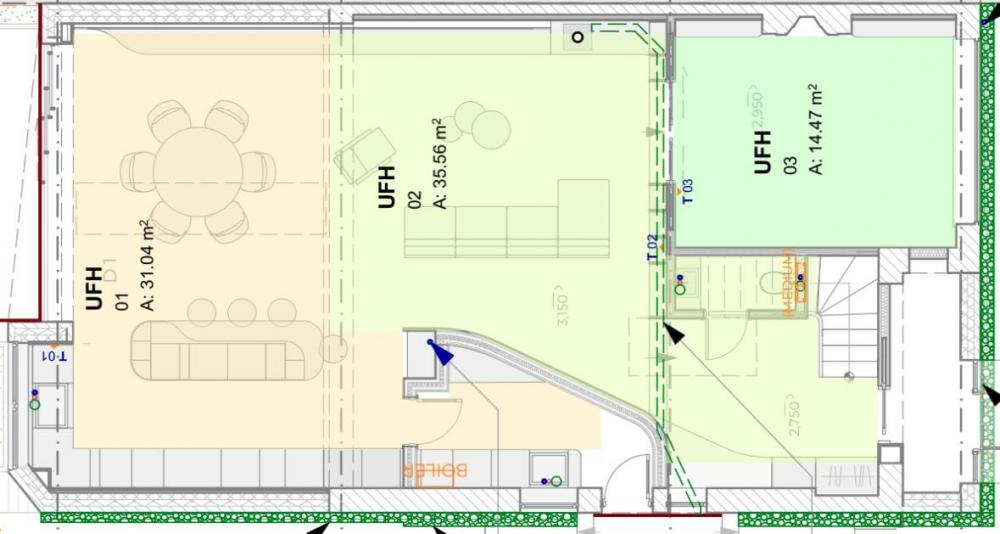
Screed is being poured in 4 days' time and I need to finalise my UFH heating zones and manifold position for my ground floor. Originally we were going to have three zones, as shown in the three different colours on this drawing, with: Zone 1 being the kitchen area/dining area/utility room Zone 2 being the lounge area where we have our wood burning stove and also the hallway and guest WC area Zone 3 being the front room (which apart from the WC and the utility room is the only area of the ground floor which is not open plan). But because there are two steps in between the hallway and the lounge area, my builder's plumber prefer to have two manifolds, one for the hallway/WC area and the front room and one for the lounge and the kitchen/dining/utility. I know a couple of people here have said that one manifold would be enough for the whole of the ground floor, even though it is split level, but there are other advantages of having a separate manifold for the front room and hallway/WC, in that those areas have a much thicker floor finish (14mm engineered wood in front room and 20mm terrazzo in hallway and WC) whereas the rest of the floor is just 3.5mm of microcement. So my question is do i have a fourth underfloor heating zone just for the WC and hallway, or do I keep it on the same zone as the front room? If I had it separate it would create four zones, which for just one floor seems excessive, but I also don't want to combine the kitchen dining area (where there is a lot of solar gain) with the lounge area where there is going to be a wood burning stove. When we don't have the stove on we'll want UFH on, but when we do have the stove on we might to turn the UFH off there, but not in the kitchen/dining area. Other question is where to put the second manifold for what is currently shown as Zone 01 and Zone 02. I was going to put it in the utility room, but not actually a huge deal of space for it. Didn't realise they were 750mm wide.
-
Luckily the company I ordered from originally somehow had some in stock. I couldn’t believe it, as last time lead time was 18 weeks and this time the first couple of suppliers said the same. I will believe it when they actually arrive, but touch wood, crisis averted! of course they company doesn’t have fuel to make a delivery, but if I find some fuel I could pick them up, only a 15 mile round trip.
-
Even though I ordered 15% wastage we are short by 110 tiles. Don't ask why! They are 330 x 226mm in size, Sandtoft 20/20 interlocking clay tiles in Antique Slate 68. If anybody has any spare, I will gladly buy them off you. Otherwise I'm looking at a 16 week wait to finish my roof. ☔

